Airport Microgrid Market Size, Share & Industry Analysis, By Airport Type (Commercial Service, International Hub, Regional, and Cargo Airports), By Component (Power Generation Systems, Energy Storage Systems, Microgrid Controllers, and Power Conversion Systems), By Power Source (Solar PV, Natural Gas Generators, and Diesel Generators), By Grid Connectivity (Grid-Connected and Islanded Microgrid), By Application (Terminal Power Supply and Airfield Lighting & Navigation Systems), By End User (Airport Authorities, Airport Operators, and Utility Companies), and Regional Forecast, 2026-2034
 Download Free Sample
Airport Microgrid Market Size and Future Outlook
 Listen to Audio Version
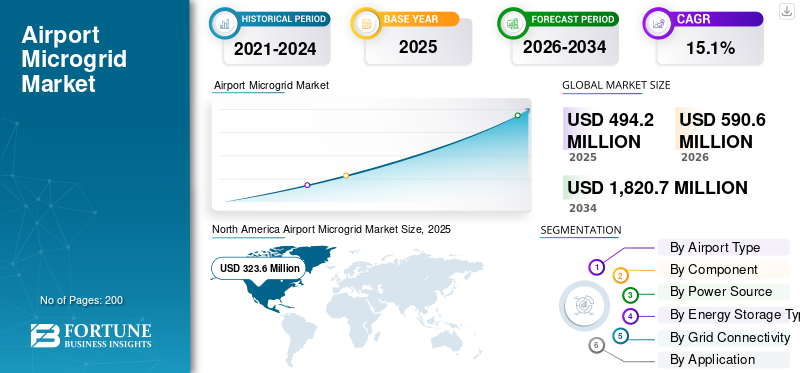
The airport microgrid market size was valued at USD 494.2 million in 2025. The market is projected to grow from USD 590.6 million in 2026 to USD 1,820.7 million by 2034, exhibiting a CAGR of 15.1% during the forecast period. North America dominated the airport microgrid market with a market share of 65.48% in 2025.
An airport microgrid is a localized energy system that combines solar energy, backup power, a battery energy storage system, and a microgrid control system to support critical airport operations during normal supply and a grid outage. The market is growing as airports expand renewable energy, add electric vehicle charging, and require real time power management for terminals, airfield lighting, cargo areas, and security systems.
Key players such as Schneider Electric, Siemens, Eaton, ABB Ltd, Honeywell, S&C Electric Company, Tesla Inc., Bloom Energy, ENGIE, and Ameresco are driving adoption through control platforms, storage integration, and lifecycle microgrid operating services.
Download Free sample to learn more about this report.
AIRPORT MICROGRID MARKET KEY TAKEAWAYS
 Global Market Size & Forecast
- 2025 Market Size: USD 494.2 million
- 2026 Market Size: USD 590.6 million
- 2034 Forecast Market Size: USD 1,820.7 million
- CAGR: 15.1% from 2026–2034
 Market Share
- North America dominated the market with a 65.48% share in 2025.
- The Commercial Service Airports segment held the largest market share in 2025.
- The Power Generation Systems segment held the largest market share in 2025.
 Key Regional Highlights
North America
North America dominated the market with a 65.48% share in 2025 and is projected to grow at a 14.0% CAGR, supported by early microgrid adoption, grid resilience initiatives, and airport sustainability investments.
Europe
Europe projected to grow at a 14.5% CAGR, driven by airport decarbonization targets, renewable energy procurement, and investments in airport-scale solar and electrical infrastructure.
Asia Pacific
Asia Pacific expected to grow at the fastest 17.7% CAGR, supported by rapid airport development, rising passenger traffic, and increasing investment in renewable energy and airport electrification.
U.S.
The market reached USD 166.1 million in 2025, growing at a 14.2% CAGR, supported by early adoption of renewable power, natural gas generation, controls, and backup systems.
Japan
Japan growth is supported by increasing airport electrification, renewable energy integration, battery storage deployment, and smart energy management initiatives aimed at improving resilience and reducing airport emissions.
Read More

AIRPORT MICROGRID MARKET TRENDS
Shift Toward Renewable-Integrated Airport Microgrids Shapes Market Trend
Airports are transitioning from diesel-only backup power systems to integrated microgrid architectures that combine solar, natural gas generation, a battery energy storage system and a microgrid control system. This trend is becoming more important as airport operators seek real-time power visibility, less dependence on the grid and more control of critical loads during a grid outage. The model also supports future electric vehicle charging demand and allows airports to use renewable power without sacrificing operational reliability.
MARKET DYNAMICS
MARKET DRIVERS
Download Free sample to learn more about this report.
Rising Need for Energy Resilience Drives Market Growth
Airport operations depend on continuous electricity for terminals, baggage handling, airfield systems, and other operations. Recent power disturbances have shown that conventional grid dependency can affect passenger movement and airline operations. As a result, demand is rising for microgrids that enhance energy resilience, provide reliable backup power, and keep important airport systems operating during grid instability.
In March 2025, a power outage at Baltimore/Washington International Airport caused more than 100 flight delays, while in June 2024, a major power cut at Manchester Airport led to widespread flight cancellations and disruption across terminals.
MARKET RESTRAINTS
High Capital Intensity and Site-Specific Integration Restrains Market Growth
The deployment of the microgrid at the airport involves custom electrical design, airside safety compliance, utility coordination, switchgear upgrades, control integration, and longterm O&M planning. Third-party financing, public-private partnership structures or utility-led models are often prerequisites for airports before approving large-scale microgrid investments, slowing adoption among regional and small airports.
MARKET OPPORTUNITIES
Airport Electrification and Front-of-the-Meter Models Create Strong Growth Opportunity
Growth of electric ground support equipment, airport EV fleets, terminal electrification and future aircraft charging create opportunities for airport microgrid market growth. A properly designed front-of-the-meter or hybrid energy model provides great value. It acts as a multi-use tool to stabilize the power grid, balance renewable power, reduce peak electricity costs, and optimize large-scale campus operations like airports.
MARKET CHALLENGES
Cybersecurity and Real-Time Control Complexity Challenges Market Expansion
As airports’ microgrids become more digital, the microgrid control system has to coordinate in real time generation, storage, grid imports, load shedding, protection systems and microgrid operating modes. This results in a growing demand for cybersecurity, reliability of communication and fail-safe automation.
Impact of Tariffs
Higher Clean-Energy Equipment Costs Pressurize Airport Microgrid Deployment
The tariff war is expected to create a mixed impact on the market. In the near term, it may restrain project execution by increasing the landed cost of solar energy modules, battery cells, inverters, switchgear, transformers, steel structures, aluminum cabling, and other electrical balance-of-system components. Since airport microgrids require a battery energy storage system, backup power, a microgrid control system, and utility-grade interconnection equipment, higher import duties can increase EPC bids and delay approvals for cost-sensitive regional airport projects. However, large hub airports are likely to continue investments as airport microgrid enables uninterrupted operations during a grid outage, supports electric vehicle charging, and enhances energy resilience for mission-critical airport infrastructure.
In May 2024, the U.S. announced higher tariffs on Chinese clean-energy and industrial goods, including solar cells, batteries, steel, aluminum, and related strategic products, while in August 2025, U.S. steel and aluminum tariff coverage was expanded to several finished imported goods, including electrical transformers and machinery.
Segmentation Analysis
By Airport Type
Due to High Passenger-Facing Power Loads, Commercial Service Airports Segment Dominate Market
By airport type, the market is categorized into commercial service airports, international hub airports, regional airports, cargo airports, general aviation airports, military airbases, and joint civil-military airports.
Commercial service airports segment dominate the market as they have the largest operational power requirement across terminals, airfield lighting, baggage systems, security infrastructure, cargo areas, and passenger-facing facilities. Additionally, these airports also face higher pressure to maintain uninterrupted operations during a grid outage, due to which microgrid investment in commercially service airports is high than smaller general aviation or purely military sites.
Cargo airports segment is expected to grow at a highest CAGR of 17.3% over the forecast period.
To know how our report can help streamline your business, Speak to Analyst
By Component
Power Generation Systems Segment Dominated Market Due to High Capital Allocation Toward On-Site Generation Assets
On the basis of component, the market is classified into power generation systems, energy storage systems, microgrid controllers, power conversion systems, switchgear & protection equipment, distribution & electrical infrastructure, energy management software, monitoring, analytics & SCADA systems, EV/GSE charging infrastructure, communication & cybersecurity systems, and others.
Power generation systems segment held the largest global airport microgrid market share in 2025 as power generation resources represent the largest physical and capital-intensive part of an airport microgrid. Airports typically prioritize solar PV, natural gas generators, and hybrid renewable power capacity before expanding into controls, monitoring, and optimization layers. This makes generation equipment the primary spending category in early-stage and large-scale airport microgrid projects.
EV/GSE charging infrastructure segment is expected to show the fastest growth, registering a CAGR of 19.5% over the forecast period.
By Power Source
Due to Large Airport Land Availability and Decarbonization Benefits, Solar PV Segment Dominated Market
By power source, the market is classified into solar PV, natural gas generators, diesel generators, wind energy, fuel cells, combined heat & power, grid power integration, hybrid renewable systems, hydrogen-based power systems, and others.
Solar PV segment held the largest global market size in 2025, since airports have suitable land parcels, rooftops, parking areas, and non-operational zones that can support solar energy deployment without disturbing core aviation activity. Solar PV also aligns well with airport carbon-reduction targets and can be integrated with a battery energy storage system and microgrid control system for real time load management.
Hydrogen-based power systems segment is expected to show the fastest growth, registering a CAGR of 24.2% over the forecast period.
By Energy Storage Type
Lithium-Ion Battery Storage Segment Dominated Market Due to Faster Response and Strong Commercial Maturity
On the basis of energy storage type, the market is classified into lithium-ion battery storage, flow battery storage, lead-acid battery storage, thermal energy storage, hydrogen storage, flywheel storage, supercapacitor storage, and others.
Lithium-ion battery storage segment held the largest global market share in 2025, due to its modular installation, mature supplier ecosystem, and suitability for short-duration backup power and peak-load management. For airports, lithium-ion systems are attractive since they support grid stabilization, renewable energy smoothing, and emergency operations without requiring large additional land compared with some alternative storage technologies.
Hydrogen storage segment is expected to show the fastest growth, registering a CAGR of 24.3% over the forecast period.
By Grid Connectivity
Due to Airport Preference for Utility-Linked Resilience, Grid-Connected Microgrid Segment Dominated Market
On the basis of grid connectivity, the market is classified into grid-connected microgrid, islanded/standalone microgrid, and hybrid grid-connected & islandable microgrid.
Grid-connected microgrid segment held the largest global market share in 2025 as most commercial airports already operate as grid-connected campuses and prefer systems that can import power, export surplus renewable energy, and shift into island mode during disruptions. This method delivers a practical balance of reliability, affordability, and compliance compared to standalone microgrids.
Islanded/standalone microgrid segment is expected to show the fastest growth, registering a CAGR of 17.8% over the forecast period.
By Application
Due to Continuous Electricity Demand from Passenger Infrastructure, Terminal Power Supply Segment Dominates Market
By application, the market is further divided into terminal power supply, airfield lighting & navigation systems, air traffic control & communication facilities, baggage handling systems, security & surveillance systems, cargo and cold chain facilities, ground support equipment charging, EV charging infrastructure, MRO and hangar operations, fuel farm and SAF infrastructure support, emergency backup and resilience, electric aircraft charging, hydrogen and future aviation fuel infrastructure, airport commercial real estate loads, and others.
Terminal power supply segment held the largest global market share in 2025. The growth is driven by airport terminals consuming electricity continuously for HVAC, lighting, security screening, baggage handling, passenger processing, retail areas, IT systems, and other services. Since terminal disruption directly affects passenger movement and airline schedules, airports prioritizes terminal loads while designing backup power, renewable power, and microgrid operating strategies, resulting in segment dominance.
Electric aircraft charging segment is expected to show the fastest market growth, registering a CAGR of 25.9% over the forecast period.
By End User
Due to Direct Control Over Airport Energy Infrastructure, Airport Operators Segment Dominate Market
Based on end user, the market is segmented into airport authorities, airport operators, defense & military airbases, cargo terminal operators, MRO facility operators, utility companies, energy service companies, ground handling companies, and others.
Airport operators dominate the end user segment as they control airport energy planning, tenant power allocation, sustainability targets, and procurement decisions for critical infrastructure. They are the most preferred to set up long-term energy deals, work with utility companies, and manage daily service needs. This includes keeping microgrids running, providing backup power, and using wind or solar energy.
Energy service companies segment is expected to show the fastest market growth, registering a CAGR of 17.7% over the forecast period.
Airport Microgrid Market Regional Outlook
By geography, the market is categorized into North America, Europe, Asia Pacific, Latin America, and the Middle East & Africa.
North America
North America Airport Microgrid Market Size, 2025 (USD Million)
To get more information on the regional analysis of this market, Download Free sample
North America holds the largest market share and is anticipated to grow at a CAGR of 14.0% during the forecast period, due to early airport microgrid adoption, higher focus on grid resilience, mature utility participation, and strong investment in airport sustainability infrastructure. The U.S. has been an early proving ground for airport microgrid models where renewable power, natural gas generation, controls, and backup power are combined to protect critical airport operations. The Redwood Coast Airport Microgrid at Humboldt County Airport is an important example of how airport microgrids are moving beyond single-customer backup systems toward grid-interactive models.
U.S. Airport Microgrid Market
Based on the strong contribution of North America to the market and the dominance of U.S. within the region, the U.S. market stood at around USD 166.1 million in 2025, growing at a CAGR of 14.2% during the forecast period.
Europe
The market in Europe is anticipated to grow at a CAGR of 14.5% during the forecast period. Europe focus on strong airport decarbonization targets, mature renewable energy procurement and increasing investment in airport-scale solar and electrical infrastructure. Moreover, large airport groups in Spain, France, Germany, the U.K., Italy and the Nordics are increasing deployment of renewable power, energy-efficiency upgrades, and grid-connected systems to reduce operating emissions while improving energy resilience.
France Airport Microgrid Market
The market in France reached USD 14.4 million in 2025, equivalent to around 12.22% of Europe revenues.
Asia Pacific
Asia Pacific is anticipated to grow at a highest CAGR of 17.7% over the forecast period, supported by rapid airport development, strong passenger growth, and rising investment in airport electrification. India, China, Japan, South Korea, Australia, and Southeast Asian countries are increasing renewable energy use at airports, while new greenfield airports are being designed with solar energy, electric vehicle charging, and smart energy management from the planning stage.
China Airport Microgrid Market
The Chinese market revenues stood at USD 37.1 million in 2025, representing roughly 32.29% of sales.
India Airport Microgrid Market
The Indian market stood at USD 13.6 million in 2025, growing at a CAGR of 20.2% during the forecast period.
Middle East & Africa
Middle East & Africa is anticipated to grow at a 15.2% CAGR during the forecast period, driven by airport modernization, and tourism-led aviation infrastructure. The UAE, Saudi Arabia, Qatar, South Africa, and Egypt are key markets where renewable power, battery storage, and airport electrification can support both sustainability targets and reliable airport operations.
UAE Airport Microgrid Market
The market in UAE reached USD 8.3 million in 2025, growing at a CAGR of 16.1% during the forecast period.
Latin America
Latin America holds a comparatively smaller market share but is expected to grow at a 12.4% CAGR during the forecast period, driven by community microgrid enablement programs, carbon accreditation efforts, and renewable energy adoption across Brazil, Mexico, Colombia, Ecuador, Chile, and Argentina.
Brazil Airport Microgrid Market
The market in Brazil reached USD 10.8 million in 2025, growing at a CAGR of 12.0% during the forecast period.
COMPETITIVE LANDSCAPE
Key Industry Players
Key Players Focus on Integrated Energy Resilience and Airport Electrification to Strengthen Competitive Position
The global airport microgrid market is moderately fragmented, with Schneider Electric, Siemens, Eaton, ABB, Hitachi Energy, Honeywell, GE Vernova, S&C Electric Company, Ameresco, ENGIE, Tesla Inc., Bloom Energy, Caterpillar, Cummins, and PowerSecure competing through integrated microgrid solutions. Their offerings combine microgrid control system, battery energy storage system, backup power, switchgear, solar integration, and real time monitoring to support airport energy resilience and electrification.
Market competition is increasingly shaped by long-term airport-utility partnerships and lifecycle service models. Pittsburgh International Airport’s 20-year microgrid agreement with Peoples Natural Gas and Noida International Airport’s renewable energy and smart utility partnership with Tata Power show how airports are moving toward cleaner, resilient, and professionally managed energy infrastructure.
LIST OF KEY AIRPORT MICROGRID COMPANIES PROFILED IN REPORT
- Schneider Electric SE (France)
- Siemens AG (Germany)
- Eaton Corporation plc. (Ireland)
- ABB Ltd. (Switzerland)
- Hitachi Energy Ltd. (Switzerland)
- Honeywell International Inc. (U.S.)
- GE Vernova Inc. (U.S.)
- S&C Electric Company (U.S.)
- Ameresco, Inc. (U.S.)
- ENGIE SA (France)
- Enel X / Enel S.p.A. (Italy)
- Tesla, Inc. (U.S.)
- Bloom Energy Corporation (U.S.)
- Caterpillar Inc. (U.S.)
- Cummins Inc. (U.S.)
- PowerSecure, Inc. (U.S.)
- Scale Microgrids, LLC (U.S.)
- Rolls-Royce Holdings plc / mtu Solutions (U.K.)
- Johnson Controls International plc (Ireland)
- Aggreko Ltd. (U.K.)
KEY INDUSTRY DEVELOPMENTS
- February 2025: Noida International Airport partnered with Indraprastha Gas Limited to develop CNG stations, city gas distribution, and PNG pipeline infrastructure for terminal and ancillary services, strengthening cleaner airport energy and mobility infrastructure.
- November 2024: Tata Power and Noida International Airport signed contract worth USD 66 million for renewable energy and smart utility agreements covering 10.8 MW of wind power, 13 MW of on-site solar power, critical dry utilities, and 25-year O&M services.
- September 2024: Noida International Airport partnered with Statiq to establish airside EV charging infrastructure, including AC chargers and high-power 120 kW and 240 kW chargers for electric GSE and airport vehicles.
- April 2024: Noida International Airport signed a concession agreement with Bird Group for ground-handling services, with the agreement requiring all ground service equipment to be electric-powered to support the airport’s net-zero operating approach.
- May 2022: CNX Resources and Pittsburgh International Airport formed a partnership to expand on-site natural gas utilization for alternative fuels and electricity, building on the airport’s existing microgrid and energy-resilience platform.
- April 2022: Yotta Energy received a USD 1.97 million U.S. Department of Defense award under the Environmental Security Technology Certification Program for a battery storage and microgrid project at Nellis Air Force Base, supporting solar-linked energy resilience at the military airbase.
- December 2021: An ACWA Power-led consortium secured USD 1.33 billion in senior debt for the Red Sea Project utilities system, which includes large-scale renewable power and battery storage infrastructure supporting the Red Sea destination and airport ecosystem.
- July 2021: Pittsburgh International Airport completed its on-site microgrid with natural gas generation and solar power, making it one of the first major airports globally to power its full campus through a dedicated airport microgrid.
REPORT COVERAGE
The global airport microgrid market analysis provides an in-depth study of market size, market segmentation, company profiling & forecast by all the market segments included in the report. It includes details on the market dynamics and trends that are expected to drive the market during the forecast period. It offers information on the technological advancements, new product launches, key industry expert’s developments, and details on strategic partnerships, mergers & acquisitions. The market research report also encompasses detailed competitive landscape with information on the market share and profiles of key players.
Request for Customization to gain extensive market insights.
Report Scope & Segmentation
| ATTRIBUTE | DETAILS |
| Study Period | 2021-2034 |
| Base Year | 2025 |
| Estimated Year | 2026 |
| Forecast Period | 2026-2034 |
| Historical Period | 2021-2024 |
| Growth Rate | CAGR of 15.1% from 2026 to 2034 |
| Unit | Value (USD Million) |
|
Segmentation |
By Airport Type
|
|
By Component
|
|
|
By Power Source
|
|
|
By Energy Storage Type
|
|
|
By Grid Connectivity
|
|
|
By Application
|
|
|
By End User
|
|
|
By Region
|
Frequently Asked Questions
Fortune Business Insights says that the global market value stands at USD 590.6 million in 2026 and is projected to reach USD 1,820.7 million by 2034.
In 2025, the North America’s market value stood at USD 323.6 million.
The market is expected to exhibit a CAGR of 15.1% during the forecast period.
Commercial service airports segment led the market by airport type.
Rising need for energy resilience drives the market growth.
Key players in the market include Schneider Electric SE, Siemens AG, Eaton Corporation plc, ABB Ltd., Honeywell International Inc., and GE Vernova Inc.
North America held the largest market share.



- 2021-2034
- 2025
- 2021-2024
- 200
Get 30-60 hrs Free Customization
Expand Regional and Country Coverage, Segments Analysis, Company Profiles, Competitive Benchmarking, and End-user Insights.




















Related Reports
-
US +1 833 909 2966 ( Toll Free )
-
Get In Touch With Us