Airport Runway FOD Detection Systems Market Size, Share & Industry Analysis, By System Type (Fixed/Stationary, Mobile/Vehicle-Mounted, Hybrid Radar & Optical, and AI-Enabled), By Technology (Millimeter-Wave Radar, Electro-Optical Cameras, and Infrared/Thermal Imaging), By Component (Radar & Sensor, Cameras & Imaging Systems, Detection Software & Analytics, and Control Room Display/Alerting Interface), By Deployment Area (Runways, Taxiways, and Aprons/Ramp Areas), By Project Type (Brownfield Modernization, Greenfield Development, and Runway Expansion), and Regional Forecast, 2026-2034
 Download Free Sample
Airport Runway FOD Detection Systems Market Size and Future Outlook
 Listen to Audio Version
The global airport runway FOD detection systems market size was valued at USD 177.2 million in 2025. The market is projected to grow from USD 190.0 million in 2026 to USD 345.7 million by 2034, exhibiting a CAGR of 7.77% during the forecast period. North America dominated the airport runway FOD detection systems market with a market share of 38.94% in 2025.
Airport runway (foreign object debris detection) FOD systems are automated safety solutions used to identify foreign object debris on runways, taxiways, aprons, shoulders, and other airside pavement areas before it damages aircraft tires, engines, landing gear, or ground equipment. FAA defines FOD as any object in an inappropriate airport location that can injure personnel or damage aircraft. The market includes fixed radar, mobile radar, electro-optical cameras, infrared imaging, LiDAR, AI analytics, control-room alerts, communication systems, installation, calibration, and predictive maintenance. Key players include Moog, Xsight Systems, Trex Aviation, NCS, Changi, and Pavemetrics.
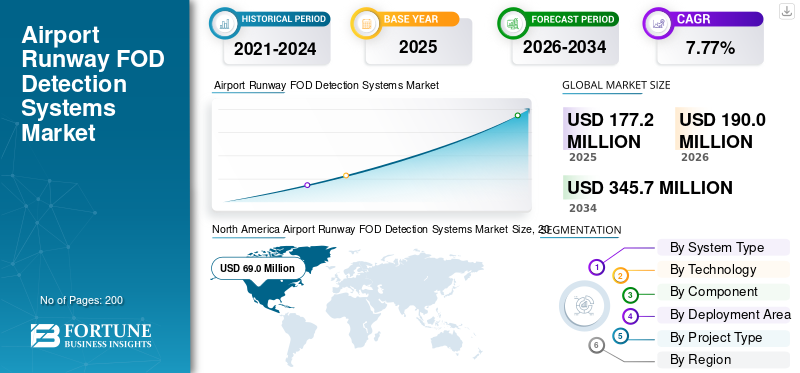
Download Free sample to learn more about this report.
AIRPORT RUNWAY FOD DETECTION SYSTEMS MARKET KEY TAKEAWAYS
 Global Market Size & Forecast
- 2025 Market Size: USD 177.2 million
- 2026 Market Size: USD 190.0 million
- 2034 Forecast Market Size: USD 345.7 million
- CAGR: 7.77% from 2026–2034
 Market Share
- North America dominated the market with a 38.94% share in 2025.
- The Runways segment held the largest market share in 2025.
- The Brownfield Airport Modernization segment held the largest market share in 2025.
 Key Regional Highlights
North America
North America reached USD 69.0 million in 2025, supported by strong runway safety regulations, mature airport infrastructure, and ongoing airside modernization.
Europe
Europe projected to reach USD 45.7 million by 2026, growing at a 7.81% CAGR, driven by digital-airfield modernization and surface safety initiatives.
Asia Pacific
Asia Pacific projected to reach USD 41.9 million by 2026, emerging as the fastest-growing region due to airport expansion, rising air traffic, and increasing focus on runway safety.
U.S.
The market is projected to reach USD 46.2 million by 2026, growing at an 8.02% CAGR, supported by FAA FOD management policies and airport infrastructure investments.
Japan
Japan growth is supported by increasing investments in airport modernization, runway safety systems, airfield digitalization, and advanced FOD detection technologies.
Read More

AIRPORT RUNWAY FOD DETECTION SYSTEMS MARKET TRENDS
Sensor Fusion in Runway Foreign Object Debris Detection System is a Key Market Trend
The market is gradually moving from single-sensor debris detection toward integrated runway monitoring systems, where radar, cameras, infrared imaging, and analytics work together. Airports no longer want only a basic alarm; they need precise object location, visual confirmation, event history, and faster support for runway clearance teams. This is encouraging vendors to improve sensor fusion, reduce false alarms, and add AI-based classification. The trend is strongest at busy airports where manual runway checks can interrupt airport operations. Over the forecast period, FOD detection is expected to become part of wider smart-airfield safety systems rather than a standalone runway device.
MARKET DYNAMICS
MARKET DRIVERS
Download Free sample to learn more about this report.
Aircraft Damage Prevention Drives Market Growth
Aircraft damage prevention remains the main driver for the runway FOD detection systems market growth. FOD incidents may begin with a small object, but the cost impact can be serious when debris affects engines, tires, landing gear, or aircraft structures. Airports are under pressure to keep runways available while maintaining high safety standards, and manual inspections alone cannot provide continuous coverage. As global aircraft movements recover and major airports become busier, the gap between inspection rounds becomes a larger operational concern. Automated FOD detection helps airports identify debris faster, reduce response time, and support safer runway reopening decisions.
MARKET RESTRAINTS
High Installation Cost Restrains Wider Adoption Across Smaller Airports
High system cost remains the biggest restraint for wider adoption. A full fixed FOD detection system can require radar or optical sensors, mounting structures, power supply, communication links, software integration, civil works, calibration, and operator training. This level of investment is easier to justify at large hubs, cargo airports, and military airbases, but it is harder for smaller regional airports with limited aircraft movements. Maintenance and periodic calibration also add to ownership cost. As a result, adoption is likely to remain concentrated at high-risk airports rather than becoming universal across all commercial and general aviation airports in the near term.
MARKET OPPORTUNITIES
Brownfield Runway Modernization Creates a Strong Market Growth Opportunity
The strongest opportunity lies in brownfield airport modernization since most near-term demand will come from existing airports rather than newly built facilities. Large airports already face high aircraft movements, tight runway slots, and greater exposure to FOD-related damage. For these airports, even a short runway closure can affect schedules, aircraft utilization, passenger handling, and cargo movement. Installing FOD detection during runway resurfacing, pavement works, lighting upgrades, or airfield digitalization is more practical than treating it as a separate project. This creates steady demand for fixed, mobile, and hybrid systems that can connect with current operations centers and inspection workflows.
MARKET CHALLENGES
Operational Reliability, Battery Duty Cycle, and Mixed Fleets to Challenge Market Growth
The main challenge is reliable detection in real airport conditions. A runway is not a controlled environment; systems must work around rain, fog, heat shimmer, low light, runway markings, rubber deposits, aircraft movement, lighting glare, and changing pavement surfaces. False alarms can slow operations, but missed detections create safety exposure. Airports also need systems that can be installed safely without interfering with aircraft movement, pavement operations, or other airfield equipment. AI and sensor fusion can improve performance, but airport operators will still demand proof of reliability, low false-alarm rates, maintainability, and safe integration before scaling deployment.
Segmentation Analysis
By System Type
Operational Flexibility and Lower Deployment Complexity Drive Growth of Mobile / Vehicle-Mounted FOD Detection Systems Segment
Based on system type, the market is segmented into fixed / stationary FOD detection systems, mobile / vehicle-mounted FOD detection systems, hybrid radar & optical FOD detection systems, portable / temporary FOD detection systems, AI-enabled FOD detection systems, and others.
The mobile / vehicle-mounted segment is anticipated to account for the largest market share as airports look for a flexible and lower-cost way to strengthen runway inspections without installing full fixed infrastructure. These systems are useful for regional airports, military bases, temporary runway works, and sites where permanent sensor deployment is difficult to justify.
The AI-enabled FOD detection systems segment is anticipated to rise with a high CAGR of 8.52% over the forecast period.
By Technology
All-Weather Performance and High Detection Reliability Boosted Leadership of Millimeter-Wave Radar Segment
Based on technology, the market is segmented into millimeter-wave radar, electro-optical camera systems, infrared / thermal imaging, LiDAR / laser-based detection, AI / computer vision analytics, and others.
In 2025, the millimeter-wave radar segment dominated the global market as it supports detection during low visibility, night operations, rain, haze, and visually complex runway conditions. Its ability to provide reliable object detection and location data makes it a preferred technology for fixed and hybrid FOD detection systems.
The AI / computer vision analytics segment is projected to grow at a high CAGR of 8.47% over the forecast period.
By Component
Sensor Coverage and System Hardware Requirements Drive Leadership of Radar & Sensor Units Segment
Based on component, the market is segmented into radar & sensor units, cameras & imaging systems, detection software & analytics, control room display / alerting interface, communication & networking systems, and others.
The radar & sensor units segment is anticipated to witness a dominating market share over the forecast period as they form the core detection layer of any FOD detection system. Airports need reliable field equipment, sensor coverage, and redundancy before software analytics and control-room interfaces can deliver operational value.
The detection software & analytics segment is projected to grow at a high CAGR of 8.52% over the forecast period.
By Deployment Area
High-Speed Aircraft Movement and Direct Damage Risk Led to Dominance of Runways Segment
Based on deployment area, the market is segmented into runways, taxiways, aprons / ramp areas, runway shoulders & safety areas, high-speed exit taxiways, and others.
The runways segment dominated the market as FOD creates the highest aircraft safety risk during take-off and landing. Airports usually prioritize runway coverage first due to the direct risk of engine ingestion, tire damage, landing gear impact, and operational disruption.
In addition, aprons / ramp areas segment is projected to grow at a high CAGR of 8.60% during the study period.
By Project Type
To know how our report can help streamline your business, Speak to Analyst
Retrofit Demand and Active Runway Safety Upgrades Drive Leadership of Brownfield Airport Modernization
Based on project type, the market is segmented into brownfield airport modernization, greenfield airport development, runway expansion projects, military airbase modernization, and others.
The brownfield airport modernization segment dominated the segmental market share in 2025 as most demand comes from existing high air traffic airports upgrading runway safety systems while continuing daily operations. FOD detection fits naturally into runway resurfacing, lighting upgrades, pavement works, and broader airfield modernization programs.
In addition, greenfield airport development segment is projected to grow at a CAGR of 8.51% during the study period.
Airport Runway FOD Detection Systems Market Regional Outlook
By geography, the market is categorized into Europe, North America, Asia Pacific, and rest of the world.
North America
North America Airport Runway FOD Detection Systems Market Size, 2025 (USD Million)
To get more information on the regional analysis of this market, Download Free sample
North America held the dominant share in 2024, valuing at USD 62.0 million, and also maintained the leading share in 2025, with USD 69.0 million. North America is expected to remain a leading region due to strong runway safety regulation, mature airport infrastructure, and continued modernization of airside operations. FAA guidance specifically supports airport FOD management programs and provides procurement specifications for FOD detection equipment, giving airports a clearer basis for adoption.
U.S. Airport Runway FOD Detection Systems Market
Based on North America’s strong contribution and the U.S. dominance within the region, the U.S. market can be analytically approximated at around USD 46.2 million in 2026, accounting for roughly 8.02% CAGR over the forecast period. FAA policy in the U.S. directly links airport safety programs with FOD management and equipment standards. Demand is supported by runway, taxiway, and safety-focused airport infrastructure funding, along with the need to reduce manual inspection gaps at busy commercial and military airfields.
Europe
Europe is projected to record a steady growth rate of 7.81% during the forecast period, which is the second highest among all regions, and reach a valuation of USD 45.7 million by 2026. Europe is expected to grow steadily as airport safety upgrades become part of wider digital-airfield and surface-movement modernization programs. SESAR highlights airport surface management, runway monitoring, conflict alerting, and vehicle-driver alerts as safety tools for reducing runway and taxiway risks.
U.K. Airport Runway FOD Detection Systems Market
The U.K. market is estimated at around USD 14.5 million in 2026, representing roughly 8.19% of CAGR during the study period. The U.K. market is supported by strict airside safety practices and defense aviation safety requirements, where FOD prevention remains part of flight safety management. The U.K. CAA’s airside safety guidance focuses on reducing ground damage to aircraft, while the U.K. Military Aviation Authority includes FOD prevention measures under flight safety procedures.
Germany Airport Runway FOD Detection Systems Market
Germany’s market is projected to reach approximately USD 12.7 million in 2026. Germany is expected to benefit from airfield digitalization and surface safety modernization at major airports. SESAR deployment activity in Germany includes A-SMGCS runway monitoring and incursion monitoring at Düsseldorf Airport, showing the country’s focus on safer ground movement operations.
Asia Pacific
Asia Pacific region is estimated to reach USD 41.9 million in 2026 and secure the position of the third-largest region in the market and fastest growing during the study period. The growth is supported by airport expansion, high traffic growth, and increasing regulatory attention toward runway pavement safety. ICAO Asia Pacific papers have encouraged adoption of FOD detection systems at major airports, while regional technology discussions are moving toward radar, optical systems, and AI-based detection.
China Airport Runway FOD Detection Systems Market
China’s market is projected to be one of the largest in Asia Pacific, with 2026 revenues estimated at around USD 13.3 million. China is moving faster than most markets since it has formalized technical requirements for airport pavement FOD detection equipment. CAAC issued technical requirements covering design, manufacturing, use, testing, installation, acceptance, and safety evaluation of airport pavement FOD detection devices.
India Airport Runway FOD Detection Systems Market
The Indian market is estimated at around USD 11.6 million in 2026. India offers strong long-term potential due to ongoing greenfield and brownfield airport development, rising aircraft movements, and growing focus on operational safety. The Ministry of Civil Aviation lists greenfield and brownfield airport projects as part of national airport development, while AAI emphasizes safety audits, operational hazard identification, and mitigation procedures across its airport network.
Rest of the World
The rest of the world include Middle East & Africa and Latin America. The market is expected to grow selectively, led by major international airports, cargo hubs, defense airbases, and runway modernization projects. Latin America will benefit from concession-led airport upgrades, while the Middle East will see stronger demand from mega-airport and smart-airfield investments such as Al Maktoum International Airport. Africa’s adoption will remain gradual, focused mainly on strategic hubs and high-priority airfields. The Middle East & Africa and Latin America market is set to reach a valuation of USD 17.2 million and USD 11.2 million in 2026.
COMPETITIVE LANDSCAPE
Key Industry Players
Technological Advancements and Proven Airport Deployments to Shape Market Expansion
The airport runway FOD detection systems market is moderately consolidated, with a limited group of specialized technology providers serving airports and defense airfields. Key players include Moog, Xsight Systems, Trex Aviation, NCS, Changi, and Pavemetrics.
Technological advancement is shaping competition as suppliers focus on sensor fusion, millimeter-wave radar, electro-optical imaging, laser profiling, AI analytics, and mobile inspection platforms. Proven airport deployments matter as buyers prioritize detection reliability, low false alarms, all-weather performance, and smooth integration with runway safety workflows. Suppliers with tested systems, strong maintenance support, and upgrade-ready platforms are better positioned to win modernization projects.
LIST OF KEY AIRPORT RUNWAY FOD DETECTION SYSTEMS COMPANIES PROFILED IN REPORT
- Moog Inc. (U.S.)
- Xsight Systems Ltd. (Israel)
- Trex Aviation Systems (U.S.)
- NCS Pte Ltd (Singapore)
- Changi Airport Group (Singapore)
- Pavemetrics Systems Inc. (Canada)
- QinetiQ Ltd. (U.K.)
- Navtech Radar Ltd. (U.K.)
- Dallmeier electronic GmbH & Co. KG (Germany)
- Skylark Labs, Inc. (U.S.)
KEY INDUSTRY DEVELOPMENTS
- March 2026: Dallas Fort Worth International Airport issued a procurement request for a fully autonomous FOD detection and removal robot. The scope covered detecting, reporting, and removing FOD from active airside areas, along with runway surface inspection. The reported value range was USD 0.50 million to USD 2.00 million, making it one of the more visible autonomous FOD-related airport pilots in the U.S.
- March 2026: Skylark Labs announced deployment of its fixed AI-powered FOD detection system at major commercial airports. The system is positioned for continuous autonomous runway monitoring, reducing dependence on mobile vehicle patrols and manual inspections
- March 2026: Skylark Labs announced expansion of its Tracer AI Vehicle after two years of deployment with the Indian Navy across two active airfield sites. The company also cited deployment at one Indian Air Force site and plans to expand across defense and commercial aviation operators.
- November 2025: Moog showcased its ROMDAS airfield laser FOD detection system at Dubai Airshow 2025. The system is positioned for rapid runway and airfield pavement condition assessment using laser-based detection and modular surveying capability.
- December 2024: NCS and Changi Airport Group highlighted iFerret 2.0, an AI-powered FOD detection system developed for runway safety. The system uses high-definition electro-optical sensors, real-time analytics, and machine learning to detect and verify FOD.
REPORT COVERAGE
The global airport runway FOD detection systems market analysis includes a comprehensive study of the market size & forecast by all the market segments included in the report. It includes details on the market dynamics and market trends driving the market over the forecast period. It provides information on key aspects, including an overview of advancements in technology, the regulatory environment, porter’s five forces analysis, company profiles, and retrofitting program. Additionally, it details partnerships, mergers & acquisitions, as well as key aviation industry developments and prevalence by key regions. The global market report also provides a depth competitive landscape with information on the market share and profiles of key operating players.
Request for Customization to gain extensive market insights.
Report Scope & Segmentation
| ATTRIBUTE | DETAILS |
| Study Period | 2021-2034 |
| Base Year | 2025 |
| Estimated Year | 2026 |
| Forecast Period | 2026-2034 |
| Historical Period | 2021-2024 |
| Growth Rate | CAGR of 7.77% from 2026-2034 |
| Unit | Value (USD Million) |
| Segmentation | By System Type, Technology, Component, Deployment Area, Project Type, and Region |
| By System Type |
|
| By Technology |
|
| By Component |
|
| By Deployment Area |
|
| By Project Type |
|
| By Region |
|
Frequently Asked Questions
According to Fortune Business Insights, the global market value stood at USD 177.2 million in 2025 and is projected to reach USD 345.7 million by 2034.
In 2025, the North America’s market value stood at USD 69.0 million.
The market is expected to exhibit a CAGR of 7.77% during the forecast period of 2026-2034.
By system type, the mobile / vehicle-mounted FOD detection systems segment is expected to dominate the market.
Aircraft damage prevention drives market growth.
Key players include Moog, Xsight Systems, Trex Aviation, NCS, Changi, and Pavemetrics are key market players.
North America held the largest market share in 2025.



- 2021-2034
- 2025
- 2021-2024
- 200
Get 30-60 hrs Free Customization
Expand Regional and Country Coverage, Segments Analysis, Company Profiles, Competitive Benchmarking, and End-user Insights.




















Related Reports
-
US +1 833 909 2966 ( Toll Free )
-
Get In Touch With Us