Airside Services Market Size, Share & Industry Analysis, By Core Service Line (Aircraft Ground Handling, Baggage Handling, Cargo & Mail Handling, Into-Plane Refueling, and De-icing Services), By Equipment (GSE) Category (Powered/Motorized, Non-Powered, and Fixed/Terminal-Integrated GSE), By Propulsion/Energy Source (Combustion, Electric, and Hydrogen Fuel Cell), By Airport/Airfield Type (International Hub, Regional/Secondary, and Domestic Airports), By End User (Full-Service Airlines, Low-Cost Carriers, Cargo/Freight Operators, and Airport Operators), and Regional Forecast, 2026-2034
 Download Free Sample
Airside Services Market Size and Future Outlook
 Listen to Audio Version
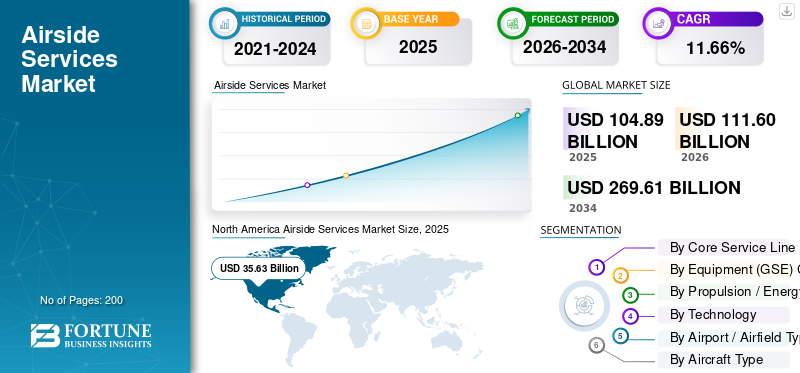
The airside services market size was valued at USD 104.89 billion in 2025. The market is projected to grow from USD 111.60 billion in 2026 to USD 269.61 billion by 2034, exhibiting a CAGR of 11.66% during the forecast period. North America dominated the airside services market with a market share of 33.97% in 2025.
The market comprises operational services performed within restricted airport areas to support aircraft arrivals, departures, and turnaround. Its scope includes ramp handling, baggage and cargo transfer, aircraft loading and unloading, pushback and towing, ground-power services, cleaning, de-icing, passenger transport, and turnaround coordination. These airport services are critical for maintaining aircraft safety, punctuality, and airport capacity utilization.
The market growth is driven by increasing passenger traffic, aircraft movements, air-cargo volumes, airline outsourcing, and pressure to shorten turnaround times. ACI projected global air travelers at approximately 9.8 billion passengers in 2025, directly increasing demand for ground-handling personnel, equipment, and infrastructure. Growing emphasis on standardized safety procedures, baggage reliability, workforce productivity, and lower-emission airport operations is also supporting ongoing investment.
Major market participants include Menzies Aviation, Swissport International AG, dnata (Emirates Group), SATS Ltd., and Fraport AG. Across the industry, leading providers are expanding through acquisitions, airport-license wins, long-term airline contracts, and entry into high-growth aviation hubs. Their strategies also include integrated service portfolios, electric ground-support equipment, automated baggage vehicles, digital turnaround-management systems, workforce training, and global safety certification.
Download Free sample to learn more about this report.
Airside Services Market Key Takeaways
 Global Market Size & Forecast
- 2025 Market Size: USD 104.89 Billion
- 2026 Market Size: USD 111.60 Billion
- 2034 Forecast Market Size: USD 269.61 Billion
- CAGR: 11.66% from 2026-2034
 Market Share
- North America dominated the global market with a strong revenue share of 33.97% in 2025.
- Germany accounted for approximately 3.6% of the global market, driven by strong hub-airport operations.
- China held a notable 8.1% share of the global market, driven by rapid airport and cargo hub expansion.
 Key Regional Highlights
North America
North America held the largest regional share at 33.97% in 2025, supported by strong airport modernization and electrification funding.
Europe
Europe accounted for a valuation of USD 29.73 billion in 2025, driven by strict emission rules pushing electric GSE adoption.
Asia-Pacific
Asia-Pacific is set to be the fastest-growing region, fueled by extensive new airport and terminal development.
U.S.
The U.S. reached USD 32.92 billion in 2025, driven by large-scale airport modernization and turnaround demand.
Japan
Japan reached USD 3.28 billion in 2025, supported by steady flight-handling volumes at major hub airports.
Read More

Airside Services Market Trends
Shift Toward Electric, Autonomous, Connected, and AI-Orchestrated Systems is Emerging Market Trend
Electrification is becoming a central market trend as service providers replace diesel-powered baggage tractors, pushback units, belt loaders, ground-power units, buses, and utility vehicles. International Air Transport Association (IATA) estimates that electric GSE can lower aircraft-turnaround emissions by approximately 35% to 52%, depending on the equipment mix and source of electricity. Swissport has committed around USD 1.98 billion to environmentally efficient technology and has deployed more than 1,000 hybrids and electric GSE units across 28 countries. Dnata also announced a USD 110 million program to deploy 800 new GSE units, including electric, hybrid, and lower-emission equipment.
For instance, in May 2026, Menzies Aviation, easyJet, and Amsterdam Airport Schiphol expanded the use of the semi-robotic electric TaxiBot system, which can save an estimated 95 kilograms of fuel and 299 kilograms of CO₂ per flight by reducing main-engine use during taxiing.
Market Dynamics
MARKET DRIVERS
Download Free sample to learn more about this report.
Rising Aircraft Movements and Time-Critical Turnaround Requirements Are Augmenting Market Growth
The continued increase in passenger traffic, aircraft movements, and air-cargo activity is the primary factor driving the airside services market growth. Airports Council International (ACI) World forecasts global passenger traffic to reach approximately 10.2 billion in 2026, representing 3.9% year-on-year growth, and to increase to around 18.8 billion passengers by 2045. Every additional aircraft movement creates demand for ramp handling, baggage transfer, pushback, towing, refueling, catering uplift, cleaning, de-icing, cargo handling, and line-maintenance support. Airlines are therefore increasingly dependent on specialized service providers that can handle multiple activities within short aircraft turnaround windows.
For instance, in February 2025, Air India awarded Menzies Aviation a three-year ground and cargo-handling contract across eight airports in Europe, North America, the Middle East, and Asia Pacific, covering at least 4,100 aircraft turns and approximately 9,000 tonnes of cargo during the first year.
MARKET RESTRAINTS
High Equipment, Infrastructure, Compliance, and Workforce Costs Restrict Rapid Service Modernization
Airside service providers operate under significant cost pressure as they must maintain large fleets of pushback tractors, baggage tractors, loaders, passenger stairs, ground-power units, de-icing vehicles, buses, and specialized cargo equipment. Transitioning from diesel equipment to electric GSE further requires charging stations, upgraded airport electricity networks, battery-management systems, maintenance facilities, and trained technicians. The European Union has provided more than USD 164.3 million in grant support for projects across 63 airports covering electricity supply, charging infrastructure, grid connections, and related airport decarbonization measures, demonstrating the scale of investment required.
MARKET OPPORTUNITIES
Smart Airport Expansion, Electrification, Specialized Cargo, and Market Consolidation Are Creating New Revenue Pools
Strong opportunities are emerging from new airports, terminal expansions, outsourced airline operations, cross-border e-commerce, pharmaceutical logistics, and temperature-controlled cargo handling. Service providers can expand revenue by combining ramp handling with cargo, fueling, passenger services, executive aviation, lounges, and airport logistics under integrated contracts. Smart cargo terminals equipped with automated sorting, AI-based flow management, real-time tracking, and cold-chain monitoring are becoming important in Asia Pacific and Middle East & Africa. Swissport’s Shanghai facility, for example, includes a 144,000-square-metre cargo operation, automated sorting, AI-enabled decision systems, digital visibility, and fully electrified handling infrastructure.
For instance, in June 2026, Menzies Aviation completed the acquisition of remaining 49.9% stake in SPdH from TAP Air Portugal, gaining full ownership of a business handling more than 100,000 aircraft turn annually across five Portuguese airports.
MARKET CHALLENGES
Workforce Shortages, Ground-Damage Risk, Operational Fragmentation, and Technology Integration Threatens Reliability
Airside services remain highly dependent on trained employees who work in confined ramp environments, around moving aircraft and equipment, under strict time pressure and changing weather conditions. Recruiting and retaining ramp agents, equipment operators, baggage handlers, de-icing staff, cargo specialists, and maintenance technicians is difficult as operations involve irregular shifts, physical work, extensive security clearance, and continuous safety training. Workforce shortages can lead to flight delays, baggage disruption, higher overtime costs, inconsistent service quality, and lower equipment utilization. The challenge becomes more serious during seasonal traffic peaks, severe weather events, and sudden airline schedule changes.
SEGMENTATION ANALYSIS
By Core Service Line
Rising E-Commerce and Specialized Cargo Demand Leads to the Fastest Growth of Cargo & Mail Handling Segment
The global market by core service line is classified into aircraft ground handling (ramp/airside), baggage handling (airside), cargo & mail handling (airside), into-plane refueling & fuel services, de-icing / anti-icing services, catering logistics (airside transport & uplift), line maintenance (airside MRO), passenger transfer (airside), and others.
The cargo & mail handling (airside) segment is estimated to grow at a fastest rate of 14.60% during the forecast period. Growth is being supported by increasing express deliveries, cross-border e-commerce, pharmaceutical shipments, perishables, and time-sensitive industrial cargo transported by air. Airports are expanding cargo terminals and introducing automated sorting, digital shipment tracking, cold-chain facilities, and faster aircraft-loading systems to handle higher volumes.
The aircraft ground handling (ramp/airside) segment accounted for the largest market share of 24.49% in 2025. It is projected to grow at a CAGR of 11.17% during the forecast period.
By Equipment (GSE) Category
Airport Automation and Capacity Expansion Are Rapidly Driving Fixed and Terminal-Integrated Systems Segment Growth
The global market, by equipment (GSE) category, is classified into powered / motorized GSE, non-powered GSE, and fixed / terminal-integrated systems.
The fixed / terminal-integrated systems segment is projected to grow at a fastest rate of 12.16% over the forecast period. Airports are investing in fixed ground-power units, pre-conditioned air systems, automated baggage networks, passenger boarding bridges, visual docking guidance systems, and centralized aircraft-servicing infrastructure. These systems reduce the movement of mobile equipment around aircraft and help airports improve ramp safety, turnaround consistency, and energy efficiency.
The powered / motorized GSE segment registered for the largest market share of 58.73% in 2025. It is also predicted to grow at a CAGR of 11.74% during the forecast period.
By Propulsion / Energy Source
Decarbonization Requirements Are Swiftly Accelerating Hydrogen Fuel Cell Adoption in Airside Operations
The global market, by propulsion / energy source, is segmented into internal combustion, electric (battery eGSE), hybrid, hydrogen fuel cell, compressed natural Gas / LPG, and charging & energy-management infrastructure.
The hydrogen fuel cell segment is estimated to grow at a fastest rate of 16.36% during the forecast period. Fuel-cell-powered ground equipment offers longer operating periods and faster refueling compared to some battery-electric systems, making it suitable for baggage tractors, buses, cargo vehicles, and other high-utilization equipment. Airports seeking to reduce emissions are evaluating hydrogen alongside battery-electric technologies for operations where long shifts and limited charging time remain major concerns.
The internal combustion segment held largest market share of 57.79% in 2025. In addition, the segment is projected to grow at a CAGR of 10.65% during the forecast period.
By Technology
Hydrogen-Ready Airport Development is Boosting Rapid Growth of Hydrogen Refueling Infrastructure Segment
The global market, by technology, is classified into autonomous & automated GSE, robotic de-icing & robotic cleaning, robotic / AI-assisted aircraft marshalling, advanced VDGS & automated docking, predictive & condition-based maintenance, digital twins, hydrogen refueling infrastructure, and others.
The hydrogen refueling infrastructure segment is predicted to grow at a fastest rate and with a highest CAGR of 15.20% during the forecast period. Airports preparing for hydrogen-powered GSE and future hydrogen aircraft will require storage tanks, compression systems, mobile refuelers, pipelines, safety-monitoring equipment, and controlled fuel-distribution areas. Investment in this infrastructure is increasing as hydrogen adoption cannot progress without reliable production, delivery, and refueling capacity inside the airport environment.
The predictive & condition-based maintenance segment accounted for largest market share of 27.50% in 2025. In addition, this is projected to grow at a CAGR of 10.92% during the forecast period.
By Airport / Airfield Type
Advanced Air Mobility Expansion Leads to Heliports and Vertiports as the Fastest-Growing
The market, by airport/airfield type, is divided into international hub airports, regional/secondary airports, domestic airports, dedicated cargo/freight airports, military/defense airfields, and heliports/vertiports.
The heliports / vertiports segment is estimated to grow at a fastest rate with highest CAGR of 15.99% over the forecast period. The development of electric vertical take-off and landing aircraft is generating demand for new urban and regional facilities that require charging, passenger handling, landing-area management, baggage support, and aircraft turnaround services. Vertiports will require compact and highly coordinated airside operations as they are expected to handle frequent movements within limited physical space.
The international hub airports segment accounted for largest market share of 46.59% in 2025. It is projected to grow at a CAGR of 11.25% over the forecast period.
By Aircraft Type
Electric Aviation Commercialization is Leading to Fastest Growth of Electric Aircraft Segment
The market, by aircraft type, is classified into fixed-wing passenger aircraft, cargo aircraft, rotary-wing aircraft, government and defense aircraft, and electric aircraft.
The electric aircraft segment is projected to grow at a highest CAGR of 14.97% during the forecast period. The expected deployment of electric training aircraft, regional aircraft, and eVTOL platforms will create demand for charging systems, battery monitoring, thermal-management support, specialized towing, and new ground-safety procedures. Electric aircraft will require different airside service models as energy replenishment, battery condition, and turnaround scheduling will be closely connected.
The fixed-wing passenger aircraft segment accounted for largest market share of 75.50% in 2025. It is projected to grow at a CAGR of 11.48% during the forecast period.
By End User
To know how our report can help streamline your business, Speak to Analyst
Growth in Premium and On-Demand Aviation is Rapidly Driving Charter and VIP Operator Segment
The global market, by end user, is classified into full-service airlines, low-cost carriers, cargo / freight operators, airport operators / authorities, government / military / defense, FBO operators, and charter / VIP operators.
The charter / VIP operators segment is estimated to grow at a fastest rate of 14.82% during the forecast period. This demand is being supported by corporate travel, private aviation, high-net-worth passenger movement, medical flights, government travel, and flexible point-to-point transportation. These operators require fast and customized airside services, including aircraft positioning, fueling, catering, cabin cleaning, baggage handling, security coordination, and passenger transfers.
The full-service airlines segment accounted for largest market share of 42.05% in 2025. In addition, it is projected to grow at a CAGR of 10.20% during the forecast period.
Airside Services Market Regional Outlook
By region, the market is categorized into Europe, North America, Asia Pacific, and Rest of the World.
North America
North America Airside Services Market Size, 2025 (USD Billion)
To get more information on the regional analysis of this market, Download Free sample
North America accounted for the largest airside services market share in 2025, valued at USD 35.63 billion. The region will also maintain a leading share in 2026, with USD 37.57 billion. Large-scale airport modernization and electrification funding is accelerating the adoption of electric ground-support equipment, charging systems, automated baggage handling, and digital ramp-management solutions.
U.S. Airside Services Market
Based on North America's strong contribution, the U.S. market reached USD 32.92 billion in 2025 and is estimated to have a CAGR of 10.39% during the forecast period.
Europe
Europe is projected to grow at second fastest rate with a CAGR of 12.05% during the forecast period. In 2025, the market value stood at USD 29.73 billion. Strict emission-reduction objectives and new European Union Aviation Safety Agency (EASA) ground-handling regulations are pushing European airports and service providers to replace older diesel equipment with electric GSE and introduce stronger safety-management, information-security, and operational-control systems.
U.K. Airside Services Market
The U.K. market in 2025 was valued at USD 4.71 billion and is estimated to grow at a rate of 9.20% during the forecast period.
Germany Airside Services Market
The Germany market in 2025 was at USD 3.75 billion and is predicted to grow at a CAGR of 11.12% during the forecast period.
Rest of Europe Airside Services Market
The Rest of Europe market in 2025 reached USD 10.04 billion and is estimated to grow at a rate of 13.03% over the forecast period.
Asia Pacific
The Asia Pacific market was at USD 26.74 billion in 2025 and is predicted to be fastest growing region with a CAGR of 13.49% during the forecast period. The development of new airports, runways, terminals, and aviation hubs is creating additional aircraft stands and higher flight-handling volumes, which requires expanded baggage, ramp, cargo, passenger-transfer, and aircraft-support capacity.
China Airside Services Market
The China market in 2025 reached USD 8.53 billion and is estimated to grow at a rate of 14.18% during the forecast period.
India Airside Services Market
The India market in 2025, was valued at USD 4.39 billion and is estimated to grow at a CAGR of 16.26% during the forecast period.
Japan Airside Services Market
The Japan market in 2025 was at USD 3.28 billion and is predicted to grow at a rate of 11.49% during the forecast period.
Rest of World
Rest of World consist of a Latin America and Middle East & Africa regions. They are expected to witness moderate growth in the market space during the forecast period.
The Latin America market was valued at USD 5.05 billion in 2025. Airport concessions and public-private partnerships are bringing private capital and international operating standards into regional airports, which is accelerating terminal expansion, equipment replacement, and service-quality improvements.
The Middle East & Africa market was at USD 7.75 billion in 2025. Saudi Arabia, the UAE, and other Gulf economies are expanding airports, tourism destinations, cargo hubs, and general aviation facilities, which is creating new licenses and contracts for ground handling, executive aviation support, refueling, and passenger services.
COMPETITIVE LANDSCAPE
Key Industry Players
Consolidation, Integrated Service Expansion, and Smart Airside Technologies are Reshaping Market Competition
The airside services industry is moderately consolidated and competing through airport licenses, airline contracts, acquisitions, and integrated service portfolios. Competition is moving beyond traditional ramp handling, as major providers increasingly combine ground handling services, cargo, fueling, passenger services, executive aviation, and technical support under multi-airport agreements. Providers are also entering high-growth cargo hubs and regional airports to reduce dependence on mature markets and secure long-term airline relationships.
Technology and sustainability are becoming major competitive differentiators as airlines and airports increasingly select handlers that can improve turnaround time, safety, emissions, and operational visibility. Consequently, the industry is progressing toward electric fleets, autonomous tractors, digital simulation, AI-based resource planning, predictive maintenance, anti-collision systems, and real-time cargo and baggage tracking, while scale, technology integration, safety performance, and global service consistency are becoming the main foundations of competitive advantage.
LIST OF KEY AIRSIDE SERVICES COMPANIES PROFILED
- Swissport International AG (Switzerland)
- dnata (Emirates Group) (UAE)
- Menzies Aviation (U.K.)
- SATS Ltd. (Singapore)
- Çelebi Havacılık Holding A.Ş. (Turkey)
- Unifi Aviation, LLC (U.S.)
- Fraport AG (Germany)
- Oshkosh Corporation (U.S.)
- ALVEST Group (France)
- Cavotec SA (Switzerland)
- ADB SAFEGATE (Belgium)
- Vestergaard Company A/S (Denmark)
- Mallaghan Engineering Ltd. (U.K.)
- ADELTE Group, S.L. (Spain)
- Weihai Guangtai Airport Equipment Co., Ltd. (China)
KEY INDUSTRY DEVELOPMENTS
- June 2026: Amsterdam Airport Schiphol awarded dnata a seven-year ground-handling licence to continue providing passenger, baggage, ramp, and cargo services for more than 20 airlines and approximately 16,000 flights annually.
- June 2026: Silk Way Group awarded dnata a multi-year cargo and freighter aircraft handling contract at Singapore Changi Airport covering more than 100 freighter flights and over 15,000 tonnes of cargo annually.
- April 2026: Wizz Air awarded and renewed several ground-handling contracts with Menzies Aviation across 16 European airports, including a new five-year contract at Bucharest Henri Coandă International Airport covering more than 18,000 flights annually.
- February 2026: Bangalore International Airport Limited awarded Menzies Aviation a 15-year ground-handling licence at Kempegowda International Airport Bengaluru for passenger, ramp, and baggage operations across Terminals 1.
- November 2025: China Cargo Airlines awarded Worldwide Flight Services, a SATS company, a freighter, ramp, cargo-warehouse, and road-feeder-services contract at Paris Charles de Gaulle Airport for three weekly Boeing 777F flights.
REPORT COVERAGE
The airside services market analysis includes a comprehensive study of the market size & forecast by all the market segments included in the report. It contains details on the market dynamics and global market trends expected to drive the market over the forecast period. It provides information on key aspects, including an overview of technological advancements, pipeline candidates, the regulatory environment, and product launches. Additionally, it details partnerships, mergers & acquisitions, as well as key aviation industry developments and prevalence by key regions. The global market research report also provides a detailed competitive landscape with information on the market share and profiles of key operating players.
Request for Customization to gain extensive market insights.
Report Scope & Segmentation
| ATTRIBUTE | DETAILS |
| Study Period | 2021-2034 |
| Base Year | 2025 |
| Estimated Year | 2026 |
| Forecast Period | 2026-2034 |
| Historical Period | 2021-2024 |
| Growth Rate | CAGR of 11.66% from 2026-2034 |
| Unit | Value (USD Billion) |
|
Segmentation |
By Core Service Line
By Equipment (GSE) Category
By Propulsion / Energy Source
By Technology
By Airport / Airfield Type
By Aircraft Type
By End User
By Region
|
Frequently Asked Questions
Fortune Business Insights says that the global market value stood at USD 104.89 billion in 2025 and is projected to reach USD 269.61 billion by 2034.
In 2025, the European market value stood at USD 29.73 billion.
The market is expected to exhibit a CAGR of 11.66% during the forecast period.
The charter / VIP operators segment is expected to grow at a fastest CAGR over the forecast period.
Rising aircraft movements and time-critical turnaround requirements are expanding demand for airside services.
Menzies Aviation, Swissport International AG, dnata (Emirates Group), SATS Ltd., and Fraport AG are the top players in the market.
North America dominated the market in 2025.



- 2021-2034
- 2025
- 2021-2024
- 200
Get 30-60 hrs Free Customization
Expand Regional and Country Coverage, Segments Analysis, Company Profiles, Competitive Benchmarking, and End-user Insights.




















Related Reports
-
US +1 833 909 2966 ( Toll Free )
-
Get In Touch With Us