Aircraft Towbar Market Size, Share & Industry Analysis, By Product Type (Dedicated/Aircraft-Specific Towbars, Multi-head/Interchangeable Towbars, Universal Towbars, Portable/Fly-away Towbars, & Others), By Material (Aluminum Towbars, Steel Towbars, High-strength Lightweight Steel Towbars, & Mixed-material/Corrosion-Resistant Component Designs), By Capacity (Up to 14,000 lb, 14,001–60,000 lb, 60,001–125,000 lb, & Above 125,000 lb), By Application (Commercial Narrow-Body Aircraft, Commercial Wide-Body Aircraft, Regional Aircraft, & Others), By End User, & Regional Forecast, 2026-2034
 Download Free Sample
Aircraft Towbar Market Size and Future Outlook
 Listen to Audio Version
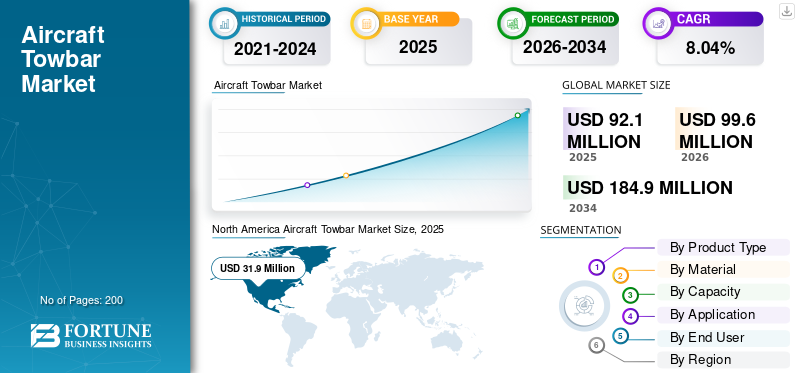
The global aircraft towbar market size was valued at USD 92.1 million in 2025. The market is projected to grow from USD 99.6 million in 2026 to USD 184.9 million by 2034, exhibiting a CAGR of 8.04% during the forecast period. North America dominated the aircraft towbar market with a market share of 34.64% in 2025.
Aircraft towbars are sturdy bars, often made of steel or aluminum, that connect ground tugs to an aircraft's nose landing gear for safe towing and maneuvering. They include universal or model-specific heads with locking jaws, shear pins for protection, shock absorbers, pneumatic wheels, and towing eyes. Used at airports for repositioning planes during turnaround, maintenance hangar moves, and tight-space navigation, they serve commercial, regional, military, and general aviation fleets. Growth stems from rising air traffic, low-cost carrier expansions, airport infrastructure investments, and the need for efficient ground handling.
Key players include Tronair (offers multi-head universal towbars for 60+ aircraft types), AERO Specialties (produces heavy-duty models up to 125,000 lbs with shock absorption), Brackett Aircraft (supplies lightweight universal bars for small planes), and Textron GSE (provides robust towing gear for pushback).
Download Free sample to learn more about this report.
Aircraft Towbar Market Key Takeaways
 Global Market Size & Forecast
- 2025 Market Size: USD 92.1 million
- 2026 Market Size: USD 99.6 million
- 2034 Forecast Market Size: USD 184.9 million
- CAGR: 8.04% from 2026–2034
 Market Share
- North America dominated the aircraft towbar market with a 34.64% share in 2025.
- Multi-head/interchangeable towbars held a leading market position due to fleet versatility and cost efficiency.
- Aluminum towbars dominated the market in 2025 due to lightweight design advantages.
 Key Regional Highlights
North America
North America led with USD 31.9 million market size in 2025.
Asia Pacific
Asia Pacific is projected to reach USD 30.2 million by 2026.
Europe
Europe is expected to reach USD 21.0 million by 2026.
U.S.
The U.S. market is estimated at USD 19.8 million in 2026, driven by fleet expansion.
Japan
The Japan market is estimated at USD 5.4 million by 2026, supported by airport modernization.
Read More

AIRCRAFT TOWBAR MARKET TRENDS
Usage of Lightweight Aluminum and Composites is a Market Trend
Lightweight aluminum and composites mark a key trend in aircraft towbars, replacing heavier steel to cut weight, boost towing efficiency, and lower fuel use in ground ops. Aluminum alloys offer corrosion resistance, ideal for harsh airport environments, while enhancing sustainability through reduced emissions and easier handling. Composites like carbon fiber-epoxy deliver high strength-to-weight ratios up to 50% lighter than metals with superior fatigue and impact resistance, as shown in filament-wound prototypes.
MARKET DYNAMICS
MARKET DRIVERS
Download Free sample to learn more about this report.
Surging Global Air Passenger Traffic to Drive Market Growth
Rising global air passenger traffic drives the aircraft towbar market by increasing aircraft movements on crowded aprons, demanding faster repositioning between gates, runways, and hangars to minimize turnaround times. Increased flight volumes compel ground handling operations teams to manage higher daily throughput, accelerating equipment wear and necessitating durable replacements to ensure uninterrupted operations. Airport congestion worsens without efficient aircraft towing, risking delays that cascade through schedules, so airlines and handlers invest in towbars to boost ramp throughput amid nonstop demand growth.
MARKET RESTRAINTS
Stringent Regulatory and Compliance Standards to Hinder Market Expansion
Stringent regulatory compliance restrains the aircraft towbar market growth by imposing rigorous FAA and EASA certification processes, including load testing, shear pin validation, and interoperability checks per AC 00-65A standards. Operators must submit detailed protocols covering training, inspections, day/night procedures, and radio communications to Flight Standards District Offices, delaying deployments amid recent safety incident scrutiny. Adherence to ISO 9667 and ARP 1915 demands precise manufacturing tolerances for diverse fleets, hiking development costs and timelines.
MARKET OPPORTUNITIES
Rise in aftermarket Upgrades Creates New Market Opportunities
Rise in aftermarket upgrades creates new market opportunities for aircraft towbars by retrofitting aging equipment with IoT sensors for real-time monitoring and predictive maintenance, minimizing unplanned downtime at high traffic hubs. Ground handlers upgrade shear pins, shock absorbers, and heads for fleet compatibility amid diverse narrowbody/widebody mixes, extending service life cost-effectively versus full replacements. FAA safety advisories mandate demand for compliant enhancements such as improved locking mechanisms and post-incident reviews, while electrification kits enable hybrid operations, aligning with sustainability mandates.
MARKET CHALLENGES
High Costs of Advanced Materials Present a Major Market Challenge
High costs of advanced materials present a major market challenge for aircraft towbars, as aerospace-grade aluminum alloys and carbon fiber composites command premium prices that exceed budgets for regional airports and budget airlines. Volatility in raw material supplies, aggravated by 2025 U.S. tariffs on titanium and composites, forced manufacturers to absorb hikes or pass them to buyers, which delayed orders. Furthermore, processing these materials requires specialized tooling and quality controls to meet FAA shear strength and fatigue specs, inflating production expenses by up to 30% over steel.
Segmentation Analysis
By Product Type
Versatility and Cost-Efficiency to Boost the Multi-head/Interchangeable Towbars Segment Growth
Based on product type, the market is segmented into dedicated/aircraft-specific towbars, multi-head/interchangeable towbars, universal towbars, portable/fly-away towbars, towbar heads/adapters, and others.
The multi-head/interchangeable towbars segment is anticipated to account for the largest aircraft towbar market share. This is owing to their versatility across diverse aircraft fleets and cost-efficiency in reducing inventory and downtime through quick head swaps.
The towbar heads/adapters segment is anticipated to rise with a CAGR of 8.38% over the forecast period.
By Material
Lightweight Design Boosted Aluminum Towbar Segment Growth
Based on material, the market is segmented into aluminum towbars, steel towbars, high-strength lightweight steel towbars, and mixed-material/corrosion-resistant component designs.
In 2025, the aluminum towbar segment dominated the global market. Compared to steel towbars, aluminum variants are substantially lighter, which reduces physical strain and fatigue during manual handling. This allows ground handling staff to move, attach, and operate towbars more effectively, supporting the segment’s dominance.
The mixed-material/corrosion-resistant component designs segment is projected to grow at a CAGR of 9.39% over the forecast period.
To know how our report can help streamline your business, Speak to Analyst
By Capacity
14,001–60,000 lb Segment to Lead due to its Suitability for High-Frequency Short-Haul Operations
Based on capacity, the market is segmented into Up to 14,000 lb, 14,001–60,000 lb, 60,001–125,000 lb, and above 125,000 lb.
The 14,001-60,000 lb segment is anticipated to witness a dominant market share over the forecast period. The segment’s dominance is owing to its suitability for high-frequency short-haul operations at busy airports, where efficient towing of mid-size aircraft minimizes turnaround delays amid surging passenger traffic.
The 60,001-125,000 lb segment is projected to grow at a CAGR of 8.26% over the forecast period.
By Application
Increasing Private Aviation Boosted the Business Jets Segment Growth
Based on application, the market is segmented into commercial narrow-body aircraft, commercial wide-body aircraft, regional aircraft, business jets, general aviation aircraft, helicopters/rotorcraft, military fixed-wing aircraft, and military rotorcraft/special mission aircraft.
The business jets segment dominated the market share. The segmental dominance is due to booming private aviation sectors and rising demand from high-net-worth individuals and corporate fleets, requiring compact, lightweight towbars for precise maneuvering.
Helicopters/rotorcraft are projected to grow at the highest CAGR of 8.36% during the study period.
By End User
Increasing Commercial Fleet Boosted the Airlines Segment Growth
Based on end user, the market is segmented into airlines, airport operators, ground handling companies, military/defense operators, and others.
The airlines segment dominated the market. The segmental dominance is due to airlines' large commercial fleets, particularly high-traffic narrowbody aircraft, necessitating robust towbars for rapid gate turnarounds at major hubs amid surging global passenger volumes.
Ground handling companies are projected to grow at the highest CAGR of 8.66% during the study period.
Aircraft Towbar Market Regional Outlook
By geography, the market is categorized into Europe, North America, Asia Pacific, and the Rest of the World.
North America
North America Aircraft Towbar Market Size, 2025 (USD Million)
To get more information on the regional analysis of this market, Download Free sample
North America held the dominant share in 2024, valuing at USD 29.5 million, and also maintained its leading share in 2025, with USD 31.9 million. The region leads aircraft towbar demand due to its vast airport infrastructure and intense air traffic at key hubs such as Atlanta and LAX, which require constant equipment upgrades for smooth operations. Tronair maintains a strong manufacturing presence with universal towbar designs tailored for commercial aviation fleets.
U.S. Aircraft Towbar Market
Based on North America’s strong contribution and the U.S. dominance within the region, the U.S. market can be analytically approximated at around USD 19.8 million in 2026, accounting for roughly 7.90% CAGR. The U.S. drives regional dominance through major airlines' narrowbody expansions and busy FBO networks serving business aviation. Tronair leads production of multi-purpose towbars, while Airtug develops compact electric variants for smaller ramps.
Europe
Europe is projected to record a steady growth rate during the forecast period of 8.47%, which is the second-highest among all regions, and reach a valuation of USD 21.0 million by 2026. The region advances sustainable ground handling under EU environmental directives, accelerating lightweight towbar deployments at major airports.
U.K. Aircraft Towbar Market
The U.K. market in 2026 is estimated at around USD 7.1 million, representing roughly 9.01% CAGR during the study period. The U.K. witnesses growth from Heathrow's capacity increases and regional airport recoveries, boosting demand for reliable towing solutions. TLD provides robust aftermarket support for diverse aircraft types.
Germany Aircraft Towbar Market
Germany’s market is projected to reach approximately USD 5.8 million by 2026. The country benefits from Lufthansa's fleet renewals and infrastructure investments at Frankfurt Airport, favoring demand for heavy-duty towbar configurations.
Asia Pacific
The Asia Pacific region is estimated to reach USD 30.2 million by 2026 and secure the position of the third-largest region in the market and fastest-growing during the study period. The region experiences strong growth driven by new terminal developments in Singapore and Tokyo, supporting low-cost carrier operations.
Japan Aircraft Towbar Market
The Japanese market is estimated at around USD 5.4 million by 2026, accounting for roughly 8.50% of the compound annual growth rate (CAGR) during the forecast period. Japan focuses on high-precision towbars suited for congested ramp operations at Narita International Airport and Haneda Airport, amid steady growth in business jet movements.
China Aircraft Towbar Market
China’s market is projected to be one of the largest in Asia Pacific, with 2026 revenues estimated at around USD 10.6 million. China expands alongside COMAC C919 deliveries and projects such as Beijing Daxing airport, creating massive towing requirements.
India Aircraft Towbar Market
The Indian market is estimated at around USD 8.1 million by 2026. Growth is supported by expansion projects through Delhi and Mumbai airports, particularly IndiGo's A320 fleet, driving demand for adaptable towbars.
Rest of the World
The rest of the world includes the Middle East & Africa, and Latin America. Latin America is advancing through aircraft production activities led by Embraer production and airport expansion initiatives in Mexico, while major Middle East and Africa hubs such as Dubai are driving demand for the product. Companies such as TLD and Goldhofer are expanding their services outposts to support emerging markets. The Middle East & Africa and Latin America markets are set to reach a valuation of USD 8.6 million and USD 5.4 million, respectively, in 2026.
COMPETITIVE LANDSCAPE
Key Industry Players
Key Players Focus on Strategic Partnerships to Strengthen their Operational Resilience
The aircraft towbar market remains moderately consolidated, with specialized players such as Tronair, AERO Specialties, TLD Group, and Goldhofer commanding shares through OEM integrations and FAA/EASA-compliant supply chains.
Strategic partnerships are driving market expansion, as Tronair teams up with Boeing on 737 MAX ground handling systems, TLD Group supplies Airbus for A320neo ramp operations alongside major hubs, and AERO Specialties supports Textron Aviation in towbarless transitions programs for Citation jets. These collaborations strengthen operational resilience amid narrowbody demand, business jet growth, and next-gen airport programs demanding lightweight, universal components.
LIST OF KEY AIRCRAFT TOWBAR COMPANIES PROFILED
- Tronair Inc. (U.S.)
- AERO Specialties, Inc. (U.S.)
- Brackett Aircraft Company Inc. (U.S.)
- Textron GSE (U.S.)
- TLD Group (France)
- Goldhofer AG (Germany)
- AGSE Corporation (U.S.)
- DEDIENNE Aerospace (France)
- Techman-Head Group (Taiwan)
- LANGA Industrial S.A. (Spain)
KEY INDUSTRY DEVELOPMENTS
- April 2025: Air Canada's ground operations in Québec City will be the first in Canada to achieve 100% electrification of its GSE fleet across all major categories.
- January 2025: TCR, a world leader in ground support equipment (GSE) solutions, was chosen by the New Terminal One at John F. Kennedy International Airport (JFK) to supply an all-electric GSE fleet for the airport's new, world-class international gateway, which is set to open in 2026.
- January 2025: Swissport International began offering comprehensive ground handling equipment and services to Lufthansa Group airlines and their guests at London Heathrow Airport in April 2025. The five-year agreement highlights Swissport's global expertise in managing large-scale base operations.
- July 2024: Aurrigo effectively showcased its Auto-DollyTug driverless technology at Stuttgart Airport as part of the Digital Testbed Air Cargo (DTAC) Demonstration initiative.
- May 2024: At the Dubai Airport Show, Dnata, an Emirates Group subsidiary and air services operator based in Dubai, signed five-year worldwide framework contracts worth USD 210 million for new ground support equipment (GSE).
REPORT COVERAGE
The global aircraft towbar industry analysis includes a comprehensive study of the market size & forecast by all the market segments included in the report. It includes details on the market dynamics and trends expected to drive the market over the forecast period. It provides information on key aspects, including an overview of technological advancements, the regulatory environment, Porter’s five forces analysis, company profiles, and the retrofitting program. Additionally, it details partnerships, mergers & acquisitions, and key aviation industry developments and prevalence by key regions. The global market research report also provides a detailed competitive landscape with information on the market share and profiles of key operating players.
Request for Customization to gain extensive market insights.
Report Scope & Segmentation
| ATTRIBUTE | DETAILS |
| Study Period | 2021-2034 |
| Base Year | 2025 |
| Estimated Year | 2026 |
| Forecast Period | 2026-2034 |
| Historical Period | 2021-2024 |
| Growth Rate | CAGR of 8.04% from 2026 to 2034 |
| Unit | Value (USD Million) |
| Segmentation | By Product Type, Material, Capacity, Application, End User, and Region |
| By Product Type |
|
| By Material |
|
| By Capacity |
|
| By Application |
|
| By End User |
|
| By Region |
|
Frequently Asked Questions
According to Fortune Business Insights, the global market value stood at USD 92.1 million in 2025 and is projected to reach USD 184.9 million by 2034.
In 2025, the market value stood at USD 31.9 million.
The market is expected to exhibit a CAGR of 8.04% during the forecast period.
By product type, the multi-head/interchangeable towbars segment is expected to dominate the market.
Surging global air passenger traffic is the key factor driving market growth.
Tronair Inc., AERO Specialties, Inc., Brackett Aircraft Company Inc., Textron GSE, and TLD Group are a few key players in the global market.
North America dominated the market.



- 2021-2034
- 2025
- 2021-2024
- 200
Get 30-60 hrs Free Customization
Expand Regional and Country Coverage, Segments Analysis, Company Profiles, Competitive Benchmarking, and End-user Insights.



















Related Reports
-
US +1 833 909 2966 ( Toll Free )
-
Get In Touch With Us