Analog Integrated Circuit Market Size, Share & Industry Analysis, By Product Type (CMOS Analog ICs, Bipolar Analog ICs, RF Analog ICs, Power Analog ICs, and Mixed-Signal Analog ICs), By Application (Communication Systems, Audio Processing, Power Management, Sensor Interfaces, and Others), By Technology (CMOS Technology, Bipolar Technology, and GaAs Technology), By End-Use Industry (Communication, Consumer Electronics, Automotive, Healthcare, Industrial, and Others), and Regional Forecast, 2026-2034
 Download Free Sample
KEY MARKET INSIGHTS
 Listen to Audio Version
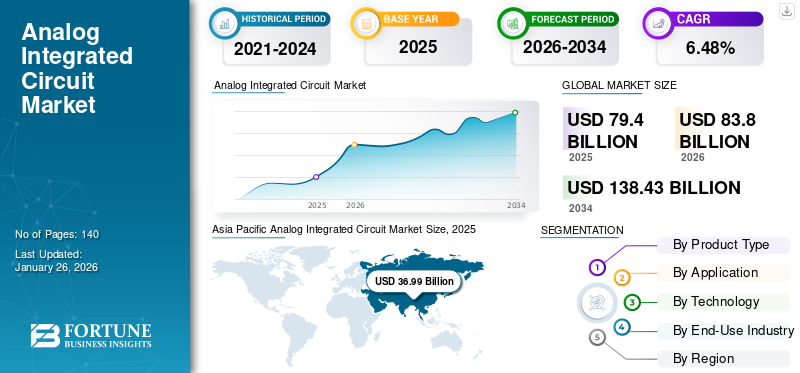
The global analog integrated circuit market size was valued at USD 79.4 billion in 2025 and is projected to grow from USD 83.8 billion in 2026 to USD 138.43 billion by 2034, exhibiting a CAGR of 6.48% during the forecast period. Asia Pacific dominated the market with a share of 46.59% in 2025.
Analog integrated circuits (ICs) comprise electronic circuits designed to process analog signals. These circuits are built to accept, process, and output continuous signal levels in real time while the equipment is running. The major players included in this market are Texas Instruments, Analog Devices, Inc., STMicroelectronics, Infineon Technologies, NXP Semiconductors, Renesas Electronics Corporation, ON Semiconductor, Microchip Technology, Skyworks Solutions, and Qualcomm.
The market is experiencing significant growth mainly due to rising demand for consumer electronic devices, such as smartphones, tablets, and smart-home devices. Technological advancements such as the rollout of 5G are accelerating market growth. As wireless technologies continue to evolve, the market will grow alongside them. An estimate from Ericsson lists that by the year 2028, 5G networks will potentially reach 85% of the global population and account for 70% of mobile data traffic. This widespread adoption of cutting-edge connectivity solutions is driving the demand for analog signal processor capabilities across a wide range of applications, hence expanding the market share.
The COVID-19 pandemic impacted the demand for analog ICs by delaying hardware upgrades and long-term migration projects. It also contributes to increased costs and supply chain challenges.
Download Free sample to learn more about this report.
Analog Integrated Circuit Market Key Takeaways
 Global Market Size & Forecast
- 2025 Market Size: USD 79.4 billion
- 2026 Market Size: USD 83.8 billion
- 2034 Forecast Market Size: USD 138.43 billion
- CAGR: 6.48% from 2026–2034
 Market Share
- Asia Pacific dominated the analog integrated circuit market with a 46.59% share in 2025.
- CMOS analog ICs are projected to lead the market with a 32.97% share in 2026.
- Communication systems are expected to account for a 30.07% market share in 2026.
 Key Regional Highlights
Asia Pacific
Asia Pacific generated USD 36.99 billion in 2025 and is projected to reach USD 39.65 billion in 2026.
North America
North America held USD 20.71 billion in 2025 and is expected to reach USD 21.59 billion in 2026.
Europe
Europe reached USD 13.17 billion in 2025 and is projected to grow to USD 13.8 billion in 2026.
U.S
The market is projected to reach USD 16.17 billion by 2026.
Japan
The market is projected to reach USD 8.8 billion by 2026.
Read More

IMPACT OF GENERATIVE AI
AI-driven Design Efficiency to Fuel Market Growth
Generative AI is already having a transformative impact on the analog integrated circuits market by accelerating the design process, improving performance, and enhancing the need for differentiated parts. AI algorithms also improve the modeling of analog components, allow designers to iterate rapidly, and reduce time-to-market. For instance, AI can predict performance trade-offs in mixed-signal ICs, replacing the need for costly physical prototyping.
IMPACT OF RECIPROCAL TARIFFS
The impact of reciprocal tariffs has introduced considerable difficulties and prompted strategic changes within the analog IC industry, especially for manufacturers and integrators dependent on global supply chains. In response, chip designers are increasingly focused on reducing risks by optimizing inventory management and diversifying their supplier base.
ANALOG INTEGRATED CIRCUIT MARKET TRENDS
Increased Need for Industrial Automation Emerges as a Key Market Trend
The rising need for industrial automation is increasing the demand for analog ICs. Analog ICs find applications across a variety of industrial sectors, including factory automation, process control, and robotics. The escalating need for enhanced productivity and efficiency in manufacturing is prompting the implementation of industrial automation solutions. Analog ICs play a vital role in these systems as they provide crucial signal conditioning, power management, and interfacing capabilities.
MARKET DYNAMICS
Market Drivers
Rise in IoT Applications to Aid Market Growth
The proliferation of IoT applications is considerably boosting the need for ICs, due to their essential role in enhancing the functionality, performance, and connectivity of various devices and systems. From smart home applications to wearables or industrial automation systems, analog ICs are vital for ensuring efficient and reliable operations. As IoT adoption continues to expand across sectors, the demand for high-quality analog ICs continues to increase. With the market forecasted to grow considerably in the coming years, analog IC manufacturers are well-positioned to benefit from this rising demand.
Market Restraints
Design Complexities to Hinder Market Expansion
Essentially, the design of analog ICs is a significant challenge for manufacturers since demand for different analog ICs is inconsistent due to technology advancements and evolving device requirements. Larger manufacturers, which specialize in analog ICs, are constantly competing and trying to deliver new and differentiated products to stay ahead of the market. Balancing the need to maintain high quality while achieving economic production remains a persistent difficulty. These ongoing challenges are expected to limit the analog integrated circuit market growth over the next five years.
Market Opportunities
Increasing Demand for Cost-effective Semiconductors that Compose Enhanced Features to Create Lucrative Market Opportunities
Key players in the market may increase their revenue and market share by providing semiconductors at reasonable or reduced prices. While counterfeit semiconductors may be offered at discounted prices, they may operate under the rating and fail in a substantially shorter time. By offering high-quality semiconductors at reduced prices, large players with counterfeiting threats may make it financially impossible for those competitors to operate while also preserving their market presence, along with customer trust and reliability.
Segmentation Analysis
By Product Type
Rising Need for Enhanced Features Provided by CMOS Analog ICs Boosted Segment Expansion
Based on product type, the market is segmented into CMOS analog ICs, Bipolar analog ICs, RF analog ICs, Power analog ICs, and Mixed-Signal analog ICs.
In terms of share, the CMOS analog ICs segment is projected to dominate the market with a share of 32.97% in 2026 due to its enhanced integration capability, minimal power usage, and affordability, key attributes for applications in consumer electronics, automotive, industrial, and communication industries.
The power analog ICs segment is anticipated to experience the highest compound annual growth rate (CAGR) during the forecast period. The growth of this segment is due to the rise of battery-powered and energy-efficient devices, and the increasing adoption of electric vehicles and advanced driver assistance systems (ADAS).
By Application
Sensor Interfaces Segment to Display Highest CAGR Due to Innovations in ADCs
Based on application, the market is segmented into communication systems, audio processing, power management, sensor interfaces, and others.
The sensor interfaces segment is anticipated to register the highest CAGR during the forecast period. Innovations in Analog-to-Digital Converters (ADCs), programmable interfaces, and miniaturization are accelerating this growth, making sensor interface ICs increasingly vital across a range of modern electronic applications.
The communication systems segment is projected to dominate the market with a share of 30.07% in 2026. This category encompasses a wide range of technologies, such as mobile devices, wireless networks, and data communication systems. The reduced latency enabled by 5G networks is accelerating the growth of the Internet of Things (IoT), which in turn drives demand for advanced analog integrated circuits to ensure reliable connectivity.
By Technology
CMOS Technology Segment Dominated Market Due to Its Low Power Consumption
Based on technology, the market is categorized into CMOS technology, bipolar technology, and GaAs technology.
In terms of market share, the CMOS technology segment dominated the market in 2024, largely due to its low power consumption, scalability, and suitability for integrating analog functions on a single chip. Over the past decade, CMOS technology has increasingly replaced older technologies in analog IC design, driven by growing demand for higher integration and lower voltage operation.
The GaAs technology segment is expected to record the highest CAGR during the forecast period, particularly in sectors prioritizing speed, efficiency, and high-frequency performance. However, it continues to face competition from silicon-based alternatives in mainstream applications.
By End-Use Industry
To know how our report can help streamline your business, Speak to Analyst
Communication Segment Dominated Market Due to Surging Adoption of Smartphones
Based on the end-use industry, the market is categorized into communication, consumer electronics, automotive, healthcare, industrial, and others.
The communication segment is projected to dominate the market with a share of 27.79% in 2026 due to innovations in analog ICs, such as improved power efficiency and integration with digital signal processing (DSP). These advancements are expanding the use of ICs in next-generation communication systems. Additionally, the increasing adoption of smartphones, tablets, and other mobile devices is a major driver, as these products rely on analog ICs for signal amplification, modulation, and conversion.
The healthcare segment is expected to achieve the highest CAGR during the forecast period due to the proliferation of connected medical devices (wearables, remote monitoring, and diagnostic equipment). Moreover, integrating IoT and AI in healthcare, which requires advanced analog signal processing and power management, also contributes to market growth.
ANALOG INTEGRATED CIRCUIT MARKET REGIONAL OUTLOOK
By region, the market is divided into Asia Pacific, Europe, North America, South America, and the Middle East & Africa.
Asia Pacific
Asia Pacific Analog Integrated Circuit Market Size, 2025 (USD Billion)
To get more information on the regional analysis of this market, Download Free sample
In 2025, Asia Pacific generated USD 36.99 billion, contributing 46.59% to global market revenue, and is projected to grow to USD 39.65 billion in 2026, mainly due to the rapid growth in the usage of electronics in modern societies such as China, Japan, and South Korea. Top-ranked electronics manufacturers in these countries rely on highly capable analog integrated circuits to enhance product functionality and performance. The Japan market is projected to reach USD 8.8 billion by 2026,the India market is projected to reach USD 5.44 billion by 2026.
Download Free sample to learn more about this report.
China remains the leader in the Asia Pacific market, driven by its vast electronics manufacturing sector and rapidly increasing domestic demand. The nation's strategic emphasis on achieving semiconductor self-sufficiency has heightened investments in the analog devices market and design and electronic manufacturing capabilities. The China market is projected to reach USD 14.41 billion by 2026
To know how our report can help streamline your business, Speak to Analyst
South America
The market for analog ICs in South America is experiencing steady growth due to recent shifts in the local economy and enhanced government funding for research initiatives.
Europe
Europe maintained a strong presence in the global market, reaching USD 13.17 billion in 2025, accounting for 16.59% share, and is expected to reach USD 13.8 billion in 2026. Europe is estimated to grow at the highest rate during the forecast period due to robust demand from the electronics and automotive industry, especially in Germany, which drives technological advancements in the global IC sector. The European Union's commitment to achieving carbon neutrality by 2050 has opened up considerable prospects for analog industry producers, particularly in applications related to energy efficiency. The UK market is projected to reach USD 2.92 billion by 2026, while the Germany market is projected to reach USD 2.7 billion by 2026.
Latin America
The Latin America market generated USD 2.96 billion in 2025, representing 3.73% of the global market landscape, and is expected to reach USD 3.03 billion in 2026.
Middle East & Africa
Middle East & Africa recorded a market size of USD 5.56 billion in 2025, capturing 7.00% of the global market share, and is projected to reach USD 5.73 billion in 2026. The Middle East & Africa region has a smaller presence in the analog IC market. However, expanding smart infrastructure projects are positively impacting the market, while economic diversification challenges remain.
North America
The North America region captured 26.08% of the global market in 2025, generating USD 20.71 billion in revenue, and is projected to reach USD 21.59 billion in 2026. The North American market is witnessing substantial growth opportunities, driven by the growing use of smart home devices and IoT applications. Escalating energy expenses have resulted in a heightened adoption of energy-efficient and economical solutions, especially in thermostats, lighting, and smart plugs. Furthermore, strong demand for the consumer electronics industry in the U.S., along with growing investments in 5G infrastructure, is generating significant demand for analog integrated circuits across a wide range of applications. The U.S. market is projected to reach USD 16.17 billion by 2026.
Competitive Landscape
KEY INDUSTRY PLAYERS
Market Players Use Merger & Acquisition, Partnership, and Product Development Strategies to Expand Business Reach
Key players operating in this market are providing analog ICs to provide users with benefits such as low power consumption and the ability to process continuous signals. They are focusing on signing acquisition agreements with small and local firms to increase their business operations. Moreover, partnerships, mergers & acquisitions, and key investments will also boost the demand for this technology.
List of Key Analog Integrated Circuit Companies Studied
- Texas Instruments (U.S.)
- Analog Devices, Inc. (U.S.)
- STMicroelectronics (Switzerland)
- Infineon Technologies (Germany)
- NXP Semiconductors (Netherlands)
- Renesas Electronics Corporation (Japan)
- ON Semiconductor (U.S.)
- Microchip Technology (U.S.)
- Skyworks Solutions (U.S.)
- Qualcomm (U.S.)
- Toshiba (Japan)
- MediaTek (Taiwan)
- Semtech (U.S.)
- Silicon Labs (U.S.)
- Cirrus Logic (U.S.)
- ROHM Semiconductor (Japan)
- Nexperia (Netherlands)
- Aura Semiconductor Co., Ltd. (U.S.)
- Synopsys (U.S.)
- Murata Manufacturing Co., Ltd. (Japan)
KEY INDUSTRY DEVELOPMENTS
- January 2025: OKI and Nisshinbo Micro Devices Inc. successfully achieved three-dimensional (3D) integration of thin-film analog ICs using Crystal Film Bonding (CFB) technology. This advancement supports mixed integration, allowing the combination of different types of semiconductor devices, including analog ICs, on a single platform.
- November 2024: STMicroelectronics launched its new design and industrialization center in Italy, featuring a dedicated testing laboratory. Developed in partnership with the University of Pisa’s Department of Information Engineering, the center focuses on the design and industrialization of ICs.
- September 2024: Cadence Design Systems, Inc. revealed its partnership with TSMC to boost productivity and performance for AI-focused advanced-node designs and 3D-ICs. The Cadence Integrity 3D-IC Platform, which integrates analog, packaging, and digital design, accommodates the newest 3Dblox features.
- April 2024: Siemens Digital Industries Software expanded its longstanding partnership with long-time ally TSMC, which has led to the successful attainment of various new product certifications and project milestones for TSMC's latest and most sophisticated processes for ICs.
- October 2022: TSMC and Siemens validated the mPower analog software solution for EM/IR sign-off at the transistor level for TSMC’s N3E process. This milestone enables TSMC clients to leverage mPower’s capabilities in their analog IC designs.
INVESTMENT ANALYSIS AND OPPORTUNITIES
Investment opportunities in the analog integrated circuit business give both growth and value, particularly in the niches of power management for electric vehicles and high-end precision analog components. Significant players such as Analog Devices and Texas Instruments capture the market with favorable financial performance and aggressive M&A activity. For those investing, this sector is considered relatively secure within the technology field, featuring moderate growth potential linked to new technologies and industrial uses.
REPORT COVERAGE
The report provides a detailed analysis of the market and focuses on key aspects, such as leading companies, product types, and the leading end-use industry of the product. Besides, it offers insights into the market trends and highlights key industry developments. In addition to the factors mentioned above, the report encompasses several factors that have contributed to the growth of the market in recent years.
Request for Customization to gain extensive market insights.
REPORT SCOPE & SEGMENTATION
|
ATTRIBUTE |
DETAILS |
|
Study Period |
2021-2034 |
|
Base Year |
2025 |
|
Estimated Year |
2026 |
|
Forecast Period |
2026-2034 |
|
Historical Period |
2021-2024 |
|
Growth Rate |
CAGR of 6.48% from 2026 to 2034 |
|
Unit |
Value (USD Billion) |
|
Segmentation |
By Product Type
By Application
By Technology
By End-Use Industry
By Region
|
|
Companies Profiled in the Report |
Texas Instruments (U.S.) Analog Devices, Inc. (U.S.) STMicroelectronics (Switzerland) Infineon Technologies (Germany) NXP Semiconductors (Netherlands) Renesas Electronics Corporation (Japan) ON Semiconductor (U.S.) Microchip Technology (U.S.) Skyworks Solutions (U.S.) Qualcomm (U.S.) |
Frequently Asked Questions
The market is projected to reach a valuation of USD 138.43 billion by 2034.
In 2025, the market was valued at USD 79.4 billion.
The market is projected to record a CAGR of 6.48% during the forecast period.
By product type, the CMOS analog ICs segment led the market in 2025.
The rise in IoT applications aids market growth.
Texas Instruments, Analog Devices, Inc., STMicroelectronics, Infineon Technologies, NXP Semiconductors, Renesas Electronics Corporation, ON Semiconductor, Microchip Technology, Skyworks Solutions, and Qualcomm are the top players in the market.
Asia Pacific held the highest market share in 2024.
By end-use industry, the healthcare segment is expected to record the highest CAGR during the forecast period.



- 2021-2034
- 2025
- 2021-2024
- 140
Get 30-60 hrs Free Customization
Expand Regional and Country Coverage, Segments Analysis, Company Profiles, Competitive Benchmarking, and End-user Insights.




















Related Reports
-
US +1 833 909 2966 ( Toll Free )
-
Get In Touch With Us