Antibody Fragments Market Size, Share & Industry Analysis, By Source (Humanized, Animal-derived/Polyclonal, and Synthetic/Library-derived/Engineered Fragments), By Type (Fab / Fab’ Fragments, F(ab’)₂ Fragments, Single-chain Variable Fragments (scFv), Bispecific scFv / Fragment-based Bispecific Constructs, Single-domain Antibodies / Nanobodies / VHH), By Application (Therapeutics, Diagnostics & Imaging, Research Reagents, Drug Delivery & Conjugates, Biosensors, and Others), By End User (Pharmaceuticals & Biotechnology Companies, Diagnostic Laboratories), and Regional Forecast, 2026-2034
 Download Free Sample
 Antibody Fragments Market Size and Future Outlook
 Listen to Audio Version
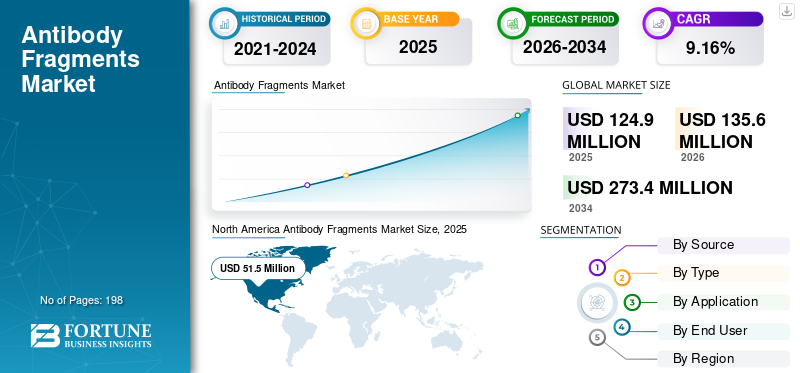
The global antibody fragments market size was valued at USD 124.9 million in 2025. The market is projected to grow from USD 135.6 million in 2026 to USD 273.4 million by 2034, exhibiting a CAGR of 9.16% during the forecast period. North America dominated the antibody fragments market with a market share of 41.23% in 2025.
The global market encompasses raw materials and research-use antibody fragment products utilized in diverse applications. The market is expanding as the demand for smaller and more engineerable antibody formats increases in biologics discovery, assay development, targeted delivery research, and sophisticated diagnostic platforms. The product demand is rising as pharmaceutical and biotechnology firms, CROs/CDMOs, diagnostic labs, and academic institutions seek recombinant, humanized, and library-derived fragments for screening, validation, conjugation, and protein engineering research. The transition from traditional polyclonal fragments to recombinant and engineered formats is enhancing reproducibility, scalability, and personalization. The market growth is additionally bolstered by the increasing application of scFv and VHH/nanobody formats in CAR-related studies, bispecific construct creation, immunoassays, imaging tools, and biosensor systems.
Key players operating in the global market include Thermo Fisher Scientific Inc., Merck KGaA, and Danaher Corporation. These companies are focusing on portfolio expansion, custom fragment engineering, and conjugation services to support research, diagnostic, and therapeutic development applications.
Download Free sample to learn more about this report.
Antibody Fragments Market KEY TAKEAWAYS
 Global Market Size & Forecast
- 2025 Market Size: USD 124.9 million
- 2026 Market Size: USD 135.6 million
- 2034 Forecast Market Size: USD 273.4 million
- CAGR: 9.16% during 2026–2034
 Market Share
- North America dominated the global market with a 41.23% share in 2025.
- Humanized/Recombinant led the product type segment in 2025.
- Fab/Fab’ dominated the fragment type segment in 2025 and is projected to hold a 26.2% share in 2026.
 Key Regional Highlights
North America
Dominated the market with a valuation of USD 51.5 million in 2025.
Europe
Projected to grow at a 7.99% CAGR, supported by its established biotechnology clusters.
Asia Pacific
The projected to reach USD 30.7 million in 2026 and is expected to be the fastest-growing region.
U.S.
The market is projected to reach approximately USD 48.9 million in 2026.
Japan
The market is estimated to reach approximately USD 7.0 million in 2026.
Read More

ANTIBODY FRAGMENTS MARKET TRENDS
Increasing Adoption in Targeted Drug Delivery Applications is a Major Trend
The growing uptake in specific drug delivery applications is becoming a significant trend in the market. Antibody fragments such as Fab, scFv, and VHH/nanobodies are being investigated more frequently as targeting ligands due to their smaller size, which facilitates improved tissue infiltration, quicker tumor reach, and more versatile conjugation than full-length antibodies. This is boosting their application in fragment-drug conjugates, radionuclide transport, nanoparticle targeting, toxin transport, and payload-linker creation. The trend is further driven by the increasing need for site-specific conjugation technologies as developers strive to achieve more consistent and regulated drug-to-antibody ratios. These benefits are motivating pharmaceutical and biotechnology firms, CROs/CDMOs, and academic research teams to incorporate antibody fragments in initial drug delivery studies. Consequently, this segment is anticipated to expand more rapidly than traditional research reagent uses, particularly in oncology and precision medicine processes. These factors are supporting the global market growth.
- For instance, in February 2024, researchers from France published a study in Cell Death Discovery demonstrating site-specific conjugation of antibody fragments, including Fab, scFv, and VHH formats, using a bacterial transglutaminase-based Q-tag approach. The study engineered anti-HER2 antibody fragments and conjugated them with payloads, showing that Fab, scFv, and VHH conjugates could be generated with controlled drug ratios and maintained target-binding functionality, supporting their potential use in targeted drug delivery
MARKET DYNAMICS
MARKET DRIVERS
Download Free sample to learn more about this report.
Rising Demand for Targeted Biologics for Cancer and Autoimmune Diseases to Boost Market Growth
The increasing need for specific biologics for cancer and autoimmune diseases is a major factor influencing the antibody fragments market growth, as pharmaceutical developers require smaller, modifiable binding formats for focused therapeutic research. Fragments such as scFv, Fab, and VHH/nanobodies are commonly utilized in CAR-T design, bispecific construct creation, immune-cell redirection, and target-validation research. Their reduced size, binding affinity, and suitability for recombinant engineering render them valuable for initial biologics discovery. With cancer and autoimmune pipelines evolving toward more targeted mechanisms, there is a growing demand for tailored antibody fragments, fragment libraries, recombinant expression services, and engineered binder platforms. This fosters expansion within pharmaceutical/biotech firms, CROs/CDMOs, and research organizations engaged in the development of targeted biologics. The trend is particularly robust in oncology as targeted cell therapies and bispecific formats keep growing.
- For instance, in November 2024, Autolus Therapeutics announced the FDA approval of Aucatzyl for adults with relapsed or refractory B-cell acute lymphoblastic leukemia. The product is a CD19-directed CAR-T therapy and CAR-T products commonly use antibody-derived antigen recognition domains such as scFv formats. This helps support the continued demand for antibody-fragment discovery and engineering tools in targeted cancer biologics development.
MARKET RESTRAINTS
Stability and Short Half-Life Issues Associated with Certain Fragments to Limit Market Growth
Challenges related to stability and the short half-life of certain antibody fragments limit the global market, as smaller formats such as scFv, Fab, and VHH/nanobodies may be eliminated from the body more quickly and may need extra engineering for enhancing stability, solubility, and functional longevity. In contrast to full-length antibodies, numerous fragments are missing the Fc region, which typically aids in prolonged serum retention via FcRn recycling. This may restrict their direct therapeutic effectiveness and heighten the demand for PEGylation, albumin-binding domains, multimerization, Fc-fusion, or alternative half-life extension methods. These changes introduce development challenges, extend optimization schedules, and elevate production and validation expenses for pharma/biotech firms and CROs/CDMOs. In research and diagnostic settings, stability issues may impact storage, assay reliability, conjugation effectiveness, and consistency between batches. Consequently, certain end users might still favor full-length antibodies or recognized recombinant formats unless the fragment provides distinct benefits in terms of penetration, targeting, or adaptability in engineering.
- For instance, EMA’s Cablivi product information states that caplacizumab is a humanized bivalent nanobody produced by recombinant DNA technology and requires daily subcutaneous administration after plasma exchange and for 30 days after stopping daily plasma exchange treatment. This dosing pattern highlights how certain antibody-fragment formats may require frequent administration due to pharmacokinetic and target-coverage limitations, supporting the concern around short functional duration for some fragment-based formats.
MARKET OPPORTUNITIES
Soaring Advancements in Antibody Engineering Technologies to Offer Lucrative Opportunities
Advancements in antibody engineering technologies are significantly enhancing opportunities for market players, as these tools facilitate the design, optimization, and production of smaller binding formats such as Fab, scFv, VHH/nanobodies, and bispecific fragment constructs. Novel engineering platforms are aiding researchers in enhancing affinity, stability, specificity, solubility, and developability during the early phases of discovery. This minimizes trial-and-error in fragment screening and facilitates quicker progression from target identification to validated research-grade or development-grade fragments. This opportunity is particularly significant for CROs/CDMOs, custom antibody service providers, and pharmaceutical/biotech firms that need customized fragments for therapeutic development, diagnostics, imaging, biosensors, and drug-delivery research. With advancements in AI, phage display, yeast display, synthetic libraries, and recombinant expression platforms, the need for custom engineered fragments is anticipated to increase. This will enhance high-end services and broader utilization of synthetic/library-derived antibody fragments. All these factors would drive the market growth in the coming years.
- For instance, in March 2024, AION Labs launched CombinAble.AI, a startup focused on using AI to optimize multiple antibody properties simultaneously during design. The platform aims to reduce trial-and-error in antibody development by identifying candidates with balanced profiles across several characteristics, supporting the broader shift toward computational and engineered antibody discovery workflows.
MARKET CHALLENGES
High Development and Production Costs to Create Challenges for Market Growth
The high development and production costs remain a major challenge for the global market, especially for custom Fab, scFv, VHH/nanobody, and bispecific fragment formats. Although these fragments are smaller than full antibodies, their development often requires multiple rounds of library screening, affinity maturation, expression optimization, purification, conjugation, and analytical validation. Many formats also face yield, solubility, aggregation, and stability issues, which can increase the number of failed batches and raise project costs for pharma/biotech companies and CROs/CDMOs. For raw material suppliers, the need for specialized recombinant expression systems, protein engineering expertise, QC testing, and small-batch customization limits pricing flexibility. This challenge is stronger for engineered and library-derived fragments, where each project may require target-specific design rather than simple catalog supply. As a result, the high cost can slow adoption among academic institutes, smaller biotech companies, diagnostic developers, and emerging-market laboratories. All the factors cumulatively affect the market growth.
- For instance, in July 2025, researchers introduced HelixDesign-Antibody, noting that traditional antibody discovery depends on time-consuming and resource-intensive experimental screening. Further, large-scale antibody design also faces fragmented toolchains and high computational demand.
Segmentation Analysis
By Source
Humanized / Recombinant Segment Dominated the Market Due to Higher Specificity and Engineering Flexibility
In terms of source, the market is divided into humanized/recombinant, animal-derived/polyclonal, and synthetic/library-derived/engineered fragments.
The humanized/recombinant segment led the global antibody fragments market share in 2025. These fragments offer better batch-to-batch consistency, higher specificity, and easier customization compared to conventional animal-derived fragments, which is a key factor driving the segment dominance. The segment is also supported by the growing demand from pharmaceutical and biotechnology companies and CROs/CDMOs for scalable fragment expression, affinity optimization, and conjugation-ready formats. Compared with polyclonal fragments, recombinant fragments reduce variability and support more reproducible assay and discovery workflows.
- For instance, Sino Biological offers recombinant Fab, scFv, tandem-scFv, and VHH antibody-fragment expression services using mammalian and E. coli systems. These solutions support applications in antibody drug development, bispecific antibody construction, and recombinant fragment production.
The synthetic/library-derived/engineered fragments segment is anticipated to rise at a CAGR of 11.26% over the forecast period.
To know how our report can help streamline your business, Speak to Analyst
By Type
Established Use in Diagnostic Assay Development and Staining Workflows Propelled Fab / Fab’ Fragments Segment Dominance
Based on type, the market is classified into Fab/Fab’ fragments, F(ab’) ₂ fragments, single-chain variable fragments, bispecific scFv/fragment-based bispecific constructs, single-domain antibodies/nanobodies/VHH, and others.
The Fab/Fab’ fragments segment accounted for the dominant market share in 2025. The segment's leadership is due to the fact that these are the most established and widely used formats in research, diagnostic assay development, immunohistochemistry, flow cytometry, western blotting, and multiplex staining workflows. Their smaller size and absence of the Fc region help reduce nonspecific Fc receptor binding, improve tissue penetration, and lower background staining compared with full-length IgG antibodies. The segment is also supported by the broad availability of catalog Fab fragment secondary antibodies and antibody fragmentation kits from leading reagent suppliers. Furthermore, the segment is set to hold a share of 26.2% in 2026.
- For instance, Thermo Fisher Scientific offers F(ab) and F(ab’) ₂ fragment secondary antibodies for applications such as immunohistochemistry, immunocytochemistry, western blotting, and flow cytometry.
The single-domain antibodies/nanobodies/VHH segment is anticipated to rise at a CAGR of 14.18% over the forecast period.
By Application
Strong Use in Targeted Biologics Development Supported the Dominance of the Therapeutics Segment
On the basis of application, the market is divided into therapeutics, diagnostics & imaging, research reagents, drug delivery & conjugates, biosensors, and others.
In 2025, the therapeutics segment led the antibody fragments market share. Pharmaceutical and biotechnology companies increasingly use Fab, scFv, VHH/nanobody, and bispecific fragment formats in early-stage targeted biologics development, propelling the dominance of the segment. The segment is also supported by rising investment in oncology, autoimmune, and precision biologics pipelines, where smaller engineered binding formats help improve target specificity and design flexibility. Furthermore, the segment is set to hold a share of 33.2% in 2026.
- For instance, in January 2024, the U.S. FDA issued final guidance on the development of CAR-T cell products, reflecting the continued regulatory and industry focus on targeted cell therapies. Since CAR-T and related engineered cell therapies commonly use antibody-derived antigen-binding domains such as scFv formats for target recognition, continued development activity in this field supports the demand for antibody-fragment discovery, engineering, and validation tools used in therapeutic development.
The biosensors segment is anticipated to rise at a CAGR of 14.02% over the forecast period.
By End User
Pharmaceuticals & Biotechnology Companies Segment Led the Market due to Higher Use in Biologics Discovery and Targeted Drug Development
Based on end user, the market is segmented into pharmaceuticals & biotechnology companies, diagnostic laboratories, academic & research institutes, CROs/CDMOs, and others.
The pharmaceuticals & biotechnology companies segment dominated the market in 2025. The dominance of the segment is attributed to the fact that these companies are the primary users of Fab, scFv, VHH/nanobody, and bispecific fragment formats for targeted biologics discovery and development. The segment is also supported by the rising number of oncology, immunology, and rare disease biologics programs where smaller antibody formats help improve specificity and design flexibility. Furthermore, the segment is set to hold a share of 37.8% in 2026.
- For instance, in February 2024, AbbVie and Tentarix Biotherapeutics announced a collaboration to develop conditionally active, multi-specific biologics for oncology and immunology. AbbVie agreed to provide expertise and option advances totaling USD 64 million for two programs, while Tentarix contributed its proprietary Tentacles platform.
In addition, CROs/CDMOs segment is projected to witness a CAGR of 15.33% during the forecast period.
Antibody Fragments Market Regional Outlook
Based on region, the global market is divided into Latin America, Asia Pacific, Europe, North America, and the Middle East & Africa.
North America
North America Antibody Fragments Market Size, 2025 (USD Million)
To get more information on the regional analysis of this market, Download Free sample
The North America market was valued at USD 47.3 million in 2024 and dominated the global market. In 2025, the region maintained its dominance with a valuation of USD 51.5 million. The regional growth is driven by strong R&D spending, availability of advanced recombinant antibody engineering platforms, and the early adoption of custom fragment services.
U.S. Antibody Fragments Market
The U.S. market leads the North America market and is projected to be approximately USD 48.9 million in 2026, representing about 36.1% of the global market.
Europe
The Europe market is poised to expand at a CAGR of 7.99% during the forecast period. The regional market is growing due to its strong academic research base, established biotechnology clusters, diagnostic development activity, and high product use in protein engineering and translational research.
U.K. Antibody Fragments Market
The U.K. market is estimated to reach around USD 6.5 million in 2026, representing roughly 4.8% of global revenues.
Germany Antibody Fragments Market
The Germany market size is projected to reach approximately USD 7.5 million in 2026, equivalent to around 5.5% of global sales.
Asia Pacific
The Asia Pacific market size is expected to reach a valuation of USD 30.7 million by 2026. Asia Pacific is expected to be the fastest-growing region due to the rapid expansion of biotech companies, CRO/CDMO capacity, recombinant antibody service providers, and diagnostic development in Asian countries.
Japan Antibody Fragments Market
The Japan market is estimated to touch a value of around USD 7.0 million in 2026, accounting for roughly 5.2% of global revenues.
China Antibody Fragments Market
The China market is projected to reach revenues of around USD 10.2 million in 2026, representing roughly 7.5% of global sales.
India Antibody Fragments Market
The India market is estimated to reach around USD 3.5 million in 2026, accounting for roughly 2.6% of global revenues.
Latin America and Middle East & Africa
Latin America and the Middle East & Africa regional markets are anticipated to depict moderate growth in the coming years. Prominent factors such as the gradual expansion of diagnostic laboratories, academic research activity, and biotechnology development are anticipated to boost the market growth in these regions. The Latin America market is estimated to touch around USD 7.5 million in 2026.
In the Middle East Africa region, the GCC market is projected to reach approximately USD 2.6 million by 2026, representing about 1.9% of global revenues.
COMPETITIVE LANDSCAPE
Key Industry Players
Strong Focus on Recombinant and Engineered Antibody Fragment Offerings by Companies to Consolidate Market Share
The global antibody fragments market is moderately fragmented, with large life science reagent suppliers and specialized antibody engineering companies competing across Fab/Fab’, F(ab’)₂, scFv, VHH/nanobody, bispecific fragment, and custom fragment production workflows.
Thermo Fisher Scientific Inc., Merck KGaA, Bio-Rad Laboratories Inc., and Danaher Corporation are the prominent players in the market. This is supported by their strong portfolios of research-use fragments, secondary antibody fragments, recombinant expression services, and custom antibody engineering capabilities.
Other significant participants include Creative Biolabs, Jackson ImmunoResearch Inc., Rockland Immunochemicals, Inc., SouthernBiotech, and Absolute Antibody, among others. These firms are also focusing on recombinant fragment production, nanobody/VHH services, antibody fragmentation kits, conjugation-ready formats, and engineered fragment libraries to strengthen their position.
- For instance, in June 2024, Vector Laboratories announced the completion of its merger with Absolute Biotech, bringing together Vector Laboratories, Absolute Antibody, Kerafast, Click Chemistry Tools, and Quanta BioDesign to expand its life science reagent and antibody engineering portfolio.
LIST OF KEY ANTIBODY FRAGMENTS COMPANIES PROFILED
- Thermo Fisher Scientific Inc.(U.S.)
- Merck KGaA (Germany)
- Bio-Rad Laboratories, Inc. (U.S.)
- Danaher Corporation (U.S.)
- Bio-Techne (U.S.)
- Creative Biolabs (U.S.)
- Jackson ImmunoResearch Inc. (U.S.)
- Rockland Immunochemicals, Inc. (U.S.)
- SouthernBiotech (U.S.)
- Absolute Antibody (U.K.)
KEY INDUSTRY DEVELOPMENTS
- June 2026: A team of researchers from China introduced EasyNano, a rapid epitope-targeted nanobody CDR design pipeline using differentiable distogram optimization with ESMFold2.
- July 2025: Researchers from Baidu Inc. introduced HelixDesign-Antibody, a production-grade, high-throughput antibody design platform built on HelixFold3 for large-scale antibody sequence generation and antigen-interaction evaluation.
- March 2025: AION Labs and BioMed X launched a global call for applications titled “Generative AI for Novel Target Combinations,” focused on AI platforms for multispecific biologic drugs. These drugs are aimed at targeting cancer, cardiovascular-kidney-metabolic diseases, and immune disorders.
- July 2024: Novartis entered a strategic collaboration with Dren Bio to develop therapeutic bispecific antibodies for cancer, with the deal value reported up to USD 3 billion.
- December 2023: Danaher completed its acquisition of Abcam. Abcam offers validated antibodies, reagents, biomarkers, and assays used in drug discovery, life science research, and diagnostics.
REPORT COVERAGE
The global antibody fragments market analysis includes a thorough evaluation of the market size and forecasts for every segment highlighted in the report. It offers insights into the market dynamics and trends expected to drive the market throughout the forecast period. It provides an understanding of essential factors, including technological progress, product innovations, the regulatory environment, and the launch of new products. Additionally, it details partnerships, mergers, acquisitions, as well as key developments in the industry. The global market forecast report also provides an in-depth competitive landscape, including information on market share and profiles of key active players.
Request for Customization to gain extensive market insights.
Report Scope & Segmentation
| ATTRIBUTE | DETAILS |
| Study Period | 2021-2034 |
| Base Year | 2025 |
| Estimated Year | 2026 |
| Forecast Period | 2026-2034 |
| Historical Period | 2021-2024 |
| Growth Rate | CAGR of 9.16% from 2026-2034 |
| Unit | Value (USD Million) |
| Segmentation | By Source, Type, Application, End User, and Region |
| By Source |
|
| By Type |
|
| By Application |
|
| By End User |
|
| By Region |
|
Frequently Asked Questions
According to Fortune Business Insights, the global market value stood at USD 124.9 million in 2025 and is projected to reach USD 273.4 million by 2034.
In 2025, the North America market value stood at USD 51.5 million.
The market is expected to exhibit a CAGR of 9.16% during the forecast period of 2026-2034.
By source, the humanized/recombinant segment led the market in 2025.
The increasing demand for targeted biologics, rising prevalence of cancer and autoimmune diseases, and growing advancements in antibody engineering technologies are primarily driving market expansion.
Thermo Fisher Scientific Inc., Merck KGaA, Bio-Rad Laboratories, Inc., and Danaher Corporation are the prominent players in the global market.
North America dominated the market in 2025.



- 2021-2034
- 2025
- 2021-2024
- 198
Get 30-60 hrs Free Customization
Expand Regional and Country Coverage, Segments Analysis, Company Profiles, Competitive Benchmarking, and End-user Insights.













.webp)






Related Reports
-
US +1 833 909 2966 ( Toll Free )
-
Get In Touch With Us