Attritable Autonomous Systems Market Size, Share & Industry Analysis, By System Type (Airborne, Maritime, and Ground Systems), By Component (Airframe & Structural Components, Propulsion & Power Systems, and Navigation & Flight-Control Systems), By Attritability Class (Reusable, Limited-Reuse, and Mission-Expendable Systems), By Autonomy Level (Human-on-the-Loop, Human-in-the-Loop, and Highly Autonomous Systems), By Mission Application (ISR, Precision Strike, Electronic Warfare, and Swarming Operations), By End User (Air Forces, Armies, and Naval Forces), and Regional Forecast, 2026-2034
 Download Free Sample
Attritable Autonomous Systems Market Size and Future Outlook
 Listen to Audio Version
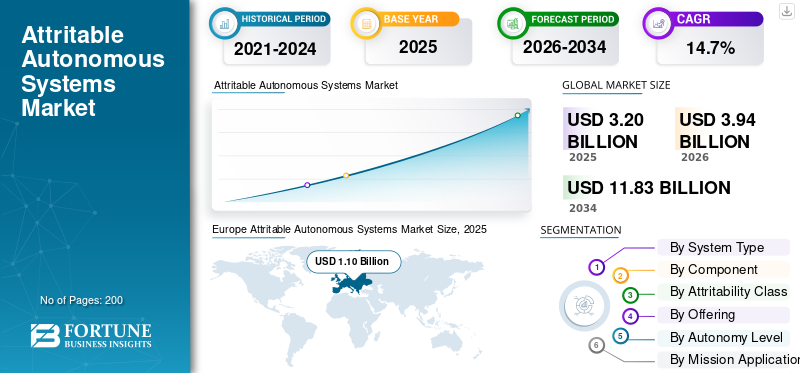
The global attritable autonomous systems market size was valued at USD 3.20 billion in 2025. The market is projected to grow from USD 3.94 billion in 2026 to USD 11.83 billion by 2034, exhibiting a CAGR of 14.7% during the forecast period. Europe dominated the global market with a market share of 34.38% in 2025.
Attritable autonomous systems are low-cost unmanned autonomous platforms designed for contested missions where platform loss is operationally acceptable. The market includes autonomous drones, unmanned ground vehicles (UGVs), collaborative aircraft, maritime systems, and related autonomous mission systems. Growth is driven by demand for affordable combat mass, AI-enabled defense systems, swarming drone technology, resilient navigation, and human-machine teaming.
Key companies include Anduril Industries, Inc., General Atomics, Inc., The Boeing Company, Kratos Defense & Security Solutions, Inc., AeroVironment, Inc., and Shield AI, Inc. These companies are working on collaborative combat aircraft, autonomous strike systems, mission-autonomy software and scalable military robotics, helping to transition next-generation defense technologies from testing to operational deployment.
Download Free sample to learn more about this report.
attritable autonomous systems market KEY TAKEAWAYS
 Global Market Size & Forecast
- 2025 Market Size: USD 3.20 Billion
- 2026 Market Size: USD 3.94 Billion
- 2034 Forecast Market Size: USD 11.83 Billion
- CAGR: 14.7% from 2026-2034
 Market Share
- Europe dominated the market with a revenue share of 34.38% in 2025.
- Airborne systems held the largest market share in 2025.
- Airframe and structural components held the largest market share in 2025.
 Key Regional Highlights
North America
North America is projected to grow at a CAGR of 15.4%, driven by investment in all-domain autonomous defense systems.
Europe
Europe dominated the market in 2025, supported by rising defense investment and autonomous system procurement.
Asia Pacific
Asia Pacific is projected to record the highest CAGR of 17.8% during the forecast period.
U.S.
The market stood at USD 0.95 billion in 2025, supported by investment in autonomous defense systems.
Japan
The market is supported by rising investment in autonomous defense technologies and maritime unmanned systems.
Read More

attritable autonomous systems market TRENDS
Human-Machine Teaming and Collaborative Autonomy are Reshaping Market Development
Defense agencies are moving beyond isolated autonomous drones toward networked unmanned autonomous platforms that operate alongside crewed aircraft and other robotic systems. This shift is accelerating investment in collaborative combat aircraft, shared mission control, autonomous decision support, and coordinated battlefield operations.
In May 2025, the U.S. Air Force began ground testing the General Atomics YFQ-42A and Anduril YFQ-44A production-representative Collaborative Combat Aircraft, evaluating propulsion, avionics, autonomy integration, and ground-control interfaces ahead of flight testing.
MARKET DYNAMICS
MARKET DRIVERS
Download Free sample to learn more about this report.
Scalable Deployment and Electronic-Warfare Capacity of Systems to Drive Market Growth
Attritable autonomous defense systems allow armed forces to expand surveillance, strike, decoy, and electronic-warfare capacity without relying entirely on expensive crewed or exquisite platforms. Their lower replacement cost and scalable deployment potential are supporting wider adoption of AI-enabled defense systems across contested operating environments.
In May 2024, the U.S. Department of Defense announced the first tranche of its Replicator initiative and confirmed approximately USD 500 million in FY2024 funding to accelerate the fielding of all-domain attritable autonomous systems.
MARKET RESTRAINTS
Stringent Safety and Operational-Validation Requirements Restrain Deployment
Military autonomy requires extensive testing to demonstrate reliability, predictable behavior, cybersecurity, and appropriate human control before operational use. These requirements lengthen development cycles and raise certification costs, particularly for autonomous strike systems and other high-consequence intelligent battlefield systems.
MARKET OPPORTUNITIES
Platform-Agnostic Autonomy Creates New Integration and Retrofit Opportunities
Modular autonomy software can convert existing commercial and military platforms into more capable autonomous mission systems, reducing dependence on entirely new vehicle development. This creates opportunities for software companies, sensor suppliers, mission-computing specialists, and system integrators across aerial and ground-based military robotics programs.
MARKET CHALLENGES
Electronic Warfare and Cyber Vulnerabilities Challenge Mission Reliability
Attritable platforms depend on navigation, communications, data links, and onboard processing that may be disrupted or compromised in contested environments. Maintaining secure operations during jamming, network loss, cyberattack, or GNSS denial remains a major challenge for autonomous surveillance platforms and swarming drone technology.
Impact of Ongoing Conflicts and Increasing Geopolitical Tensions
Combat-Proven Demand and Expanding War Reserves Accelerate Market Growth
The Russia-Ukraine war, Middle East instability and rising Indo-Pacific tensions are accelerating the procurement of autonomous defense systems for surveillance, precision strike, electronic warfare, maritime interdiction and force protection. Operational experience has shown unmanned autonomous platforms can deliver affordable combat mass and reduce personnel exposure in contested environments. This is driving governments to increase domestic production, restock rapidly depleted systems and invest in resilient navigation, swarming drone technology and human-machine teaming. But frequent design changes due to jamming and counter-drone measures are compressing technology cycles and raising integration requirements.
In July 2024, the U.K.-led Drone Coalition established a common procurement framework for Ukraine, with participating countries pledging more than USD 48.84 million to the common fund and targeting the delivery of one million FPV drones alongside reconnaissance, strike, and AI-enhanced systems.
Segmentation Analysis
By System Type
Airborne Systems Segment Leads Due to Higher Procurement and Operational Maturity
By system type, the market is categorized into airborne systems (collaborative combat aircraft, loyal wingman systems, jet-powered attritable UAVs, tactical attritable UAVs, air-launched effects, autonomous loitering munitions, autonomous one-way attack systems, attritable decoy and electronic-warfare UAVs), maritime systems (attritable unmanned surface vessels, attritable unmanned underwater vehicles, autonomous maritime strike systems, autonomous reconnaissance and surveillance craft, and maritime decoy and electronic-warfare systems), and ground systems (attritable unmanned ground vehicles, autonomous robotic combat vehicles, autonomous logistics and resupply vehicles, ground-based reconnaissance robots, and autonomous explosive-ordnance and breaching systems).
Airborne systems segment held the largest global attritable autonomous systems market share in 2025, supported by the strong procurement of autonomous drones, loitering systems, tactical UAVs, and collaborative combat aircraft, this system provides detailed surveillance, electronic warfare, and human-machine teaming across disputed areas, providing broader operational adoption than maritime and ground-based systems.
Ground systems segment is expected to grow at a highest CAGR of 17.7% over the forecast period.
To know how our report can help streamline your business, Speak to Analyst
By Component
High Platform Manufacturing Value Boosts Airframe and Structural Components Dominance
On the basis of component, the market is classified into airframe and structural components, propulsion and power systems, navigation, guidance, and flight-control systems, autonomy and mission-computing systems, sensors and mission payloads, communication, data-link, and networking systems, weapons and mission-effect systems, launch and recovery systems, ground-control and operator systems, and others.
Airframe and structural components segment accounted for the largest market share in 2025, since every unmanned autonomous platform requires a mission-specific fuselage, wing, hull, chassis, or protective structure. Advanced composites, modular construction, signature reduction, and lightweight designs further increase structural value, particularly across jet-powered autonomous defense systems and reusable attritable aircraft.
Autonomy and mission-computing systems segment is expected to show the fastest growth, registering a CAGR of 18.4% over the forecast period.
By Attritability Class
Mission-Expendable Autonomous Systems Dominate Driven by its Low-Cost and Scalable Deployment
By attritability class, the market is classified into reusable attritable systems, limited-reuse attritable systems, and mission-expendable autonomous systems.
Mission-expendable autonomous systems segment witnessed the largest market share in 2025, as armed forces increasingly procure loitering munitions, autonomous one-way attack platforms, decoys, and other low-cost systems intended for single-mission use. Their comparatively lower unit cost allows rapid replenishment and deployment at scale during high-intensity operations.
Reusable attritable systems segment is expected to show the fastest growth, registering a CAGR of 17.6% over the forecast period.
By Offering
Higher Hardware and Integration Value Supports Autonomous Platforms Leading Position
On the basis of offering, the market is classified into autonomous platforms, mission payloads, autonomy software and mission management, command, control and communication systems, launch and recovery systems, integration, testing and engineering services, and maintenance, training and lifecycle support.
Autonomous platforms segment held the largest global market share in 2025, since air vehicles, maritime craft, and unmanned ground vehicles combine the highest concentration of structural, propulsion, computing, and mission-system expenditure. Software and payload demand is expanding, but platform production remains the largest revenue source during the present procurement and fielding phase.
Autonomy software and mission management segment is expected to show the fastest growth, registering a CAGR of 18.5% over the forecast period.
By Autonomy Level
Remotely Supervised Autonomous Systems are Highly Preferred for its Command Accountability and Operational Control Requirements
On the basis of autonomy level, the market is classified into remotely supervised autonomous systems, human-on-the-loop systems, human-in-the-loop systems, and highly autonomous mission systems.
Remotely supervised autonomous systems segment held the largest global market share in 2025, as armed forces currently favor platforms capable of autonomous navigation and mission execution while retaining operator oversight for tasking, engagement, and mission modification. This approach supports defense automation without removing human responsibility from high-consequence decisions.
Highly autonomous mission systems segment is expected to show the fastest growth, registering a CAGR of 20.7% over the forecast period.
By Mission Application
Precision Strike Dominates Owing to its High Success Rate Compared to its Counterparts
By mission application, the market is further divided into intelligence, surveillance and reconnaissance, precision strike, suppression and destruction of enemy air defenses, electronic warfare, decoy and deception, swarming and saturation operations, collaborative combat operations, maritime surveillance and interdiction, anti-surface and anti-ship warfare, anti-submarine and undersea operations, logistics and resupply, mine countermeasures, communications relay, border and perimeter security, training, testing and target representation, and others.
Precision strike segment held the largest global market demand in 2025, narrowly exceeding suppression and destruction of enemy air defenses with a market share of 13.05%. The segment benefits from expanding procurement of loitering munitions and autonomous mission systems that allow dispersed units to engage targets beyond line of sight while reducing reliance on crewed strike aircraft and conventional artillery.
Collaborative combat operations segment is expected to show the fastest market growth, registering a CAGR of 18.9% over the forecast period.
By End User
Air Forces is the Leading User Due to Strong Investment in Collaborative Air Combat
Based on end user, the market is segmented into air forces, armies and land forces, navies and marine forces, joint and special operations forces, homeland security and border agencies, defense research and test organizations, and other government agencies.
Air forces segment dominated the market in 2025, driven by collaborative combat aircraft, autonomous surveillance platforms, loyal-wingman programs, and airborne electronic-warfare systems. Larger development budgets and the need to extend the reach and survivability of crewed combat aircraft support continued investment in airborne next-generation defense technologies.
Navies and marine forces segment is expected to show the fastest market growth, registering a CAGR of 16.2% over the forecast period.
attritable autonomous systems market Regional Outlook
By geography, the market is categorized into North America, Europe, Asia Pacific, the Middle East & Africa, and Latin America.
North America
Europe Attritable Autonomous Systems Market Size, 2025 (USD Billion)
To get more information on the regional analysis of this market, Download Free sample
North America is anticipated to grow at a CAGR of 15.4% during the forecast period, led by the U.S. investment in all-domain autonomous defense systems, collaborative combat aircraft, loitering systems, and autonomy software. A strong defense-industrial ecosystem and accelerated procurement pathways are moving unmanned autonomous platforms from experimentation toward operational deployment.
U.S. Attritable Autonomous Systems Market
Based on the strong contribution of North America to the market and the dominance of U.S. within the region, the U.S. market stood at USD 0.95 billion in 2025, growing at a CAGR of 15.0% during forecast period.
Europe
The market in Europe holds the largest market share and is anticipated to grow at a CAGR of 11.1% during the forecast period, supported by the Russia–Ukraine war, rapid consumption of unmanned systems, regional replenishment programs, and rising investment in autonomous defense systems across NATO countries. The region is also strengthening domestic drone production, military robotics, collaborative air platforms, and battlefield autonomy capabilities.
In March 2024, the U.K. Ministry of Defence published the Royal Air Force Autonomous Collaborative Platform Strategy, establishing its approach for integrating collaborative unmanned aircraft with existing and future combat-air capabilities.
Ukraine Attritable Autonomous Systems Market
The market in Ukraine reached USD 0.25 billion in 2025, equivalent to around 23.02% of Europe revenues.
Asia Pacific
Asia Pacific is anticipated to grow at a highest CAGR of 17.8% over the forecast period. Government supported by increased investment in Australia, China, India, Japan and South Korea. Demand for collaborative combat aircraft, autonomous drones and maritime unmanned platforms underpinned by the need for distributed surveillance and strike capabilities, and long maritime boundaries and contestable operating environments.
China Attritable Autonomous Systems Market
The Chinese market revenues stood at USD 0.26 billion in 2025, representing roughly 41.01% of sales.
India Attritable Autonomous Systems Market
The Indian market stood at USD 0.10 billion in 2025, growing at a CAGR of 21.7% during the forecast period.
Middle East & Africa
Middle East & Africa holds a comparatively smaller market share but is expected to grow at a 15.9% CAGR during the forecast period, led by Türkiye, Israel, Iran, the UAE, and Saudi Arabia. Regional conflicts, border-security requirements, and demand for precision strike and persistent surveillance are accelerating adoption of AI-enabled defense systems, autonomous mission systems, and mission-expendable platforms.
Israel Attritable Autonomous Systems Market
The Israel market revenues stood at USD 0.11 billion in 2025, representing roughly 30.89% of sales.
Latin America Attritable Autonomous Systems Market
The market in Latin America reached USD 0.10 billion in 2025, growing at a CAGR of 16.6% during the forecast period. With Brazil as the main demand center. In the region, adoption is still largely in the areas of autonomous surveillance platforms, border monitoring, maritime security and military robotics, not large scale collaborative combat or expendable strike programmes.
Brazil Attritable Autonomous Systems Market
The Brazil market revenues stood at USD 0.04 billion in 2025, representing roughly 45.10% of Latin America sales.
COMPETITIVE LANDSCAPE
Key Industry Players
Strategic Autonomy Portfolios and Scalable Production Strengthen Competitive Positioning
The competitive landscape is led by Anduril Industries, Inc., General Atomics Aeronautical Systems, Inc., The Boeing Company, Kratos Defense & Security Solutions, Inc., and AeroVironment, Inc., supported by established defense groups and specialized military robotics companies. Competition is shifting from isolated prototypes toward production-ready unmanned autonomous platforms, modular autonomy software, resilient communications, and integrated mission payloads. General Atomics’ Gambit family and Boeing’s MQ-28 Ghost Bat illustrate the growing focus on affordable collaborative combat aircraft designed for surveillance, electronic warfare, precision strike, and human-machine teaming in contested environments.
Companies that can integrate airframes, autonomous mission systems, AI-enabled decision support, secure networking, and lifecycle services will benefit as procurement moves to larger operational fleets. Market players are strengthening their positions through government-funded demonstrations, rapid manufacturing expansion, open-architecture integration, and collaborations with armed forces.
LIST OF KEY ATTRITABLE AUTONOMOUS SYSTEMS COMPANIES PROFILED IN REPORT
- Anduril Industries, Inc. (U.S.)
- General Atomics Aeronautical Systems, Inc. (U.S.)
- The Boeing Company (U.S.)
- Kratos Defense & Security Solutions, Inc. (U.S.)
- AeroVironment, Inc. (U.S.)
- Shield AI, Inc. (U.S.)
- Saronic Technologies, Inc. (U.S.)
- BAE Systems plc. (U.K.)
- QinetiQ Group plc. (U.K.)
- Milrem Robotics AS (Estonia)
- WB Electronics S.A. (Poland)
- General Atomics, Inc.
- Israel Aerospace Industries Ltd. (Israel)
- Elbit Systems Ltd. (Israel)
- Baykar Teknoloji A.Ş. (Türkiye)
- Turkish Aerospace Industries, Inc. (Türkiye)
- Hanwha Systems Co., Ltd. (South Korea)
- Helsing GmbH (Germany)
- Rheinmetall AG (Germany)
- Rafael Advanced Defense Systems Ltd. (Israel)
- EDGE Group PJSC (UAE)
KEY INDUSTRY DEVELOPMENTS
- August 2025: The U.S. Air Force began flight testing General Atomics’ YFQ-42A Collaborative Combat Aircraft, advancing the program from digital design and ground testing to airborne evaluation in less than two years.
- April 2025: The U.S. Navy awarded the University of South Carolina with USD 8.42 million modification to develop algorithms, curate data, and improve edge processing for autonomous maritime perception and littoral-object detection.
- March 2025: The U.S. Air Force awarded DCS Corporation a USD 22.11 million contract modification for research involving human teaming with networked unmanned aircraft.
- February 2025: The U.S. Navy awarded SOLUTE an USD 11.55 million contract modification to continue Autonomy Baseline Manager development and management of the Navy’s unmanned-autonomy software repository.
- February 2024: The U.S. Navy awarded SOLUTE a USD 19.25 million contract to develop and manage the Autonomy Baseline Manager and a central software repository supporting naval unmanned-system autonomy.
- April 2024: The U.S. Air Force exercised option awards for Anduril Industries and General Atomics to complete detailed designs, manufacture production-representative Collaborative Combat Aircraft, and conduct flight testing.
- May 2024: The U.S. Department of Defense announced the first Replicator tranche and secured USD 500 million in FY2024 funding to accelerate the production and fielding of all-domain attritable autonomous systems, including Switchblade 600 loitering munitions and uncrewed surface vessels.
- June 2024: The U.S. Navy awarded 49 companies multiple-award contracts with a combined ceiling of USD 982.10 million to support its Unmanned Surface Vehicle Family of Systems.
- September 2024: The U.S. Army awarded a USD 14.42 million first-tranche order for Anduril’s Ghost X and Performance Drone Works’ C-100 attritable small UAS to support company-level reconnaissance, surveillance, and target-acquisition missions.
- September 2024: The U.S. Army awarded American Rheinmetall Vehicles and HDT Expeditionary Systems contracts totaling USD 22 million to each deliver eight Small Multipurpose Equipment Transport Increment II unmanned ground vehicle prototypes for testing.
- October 2024: AeroVironment received a USD 54.90 million funded delivery order for Switchblade loitering-munition systems under a U.S. Army IDIQ contract.
- November 2024: The U.S. Department of Defense expanded the Replicator portfolio to include Anduril’s Altius-600 loitering munition, additional air and maritime platforms, and integrated autonomy software.
REPORT COVERAGE
The global attritable autonomous systems market analysis provides an in-depth study of market size, market segmentation, company profiling & forecast by all the market segments included in the report. It includes details on the market dynamics and trends that are expected to drive the market during the forecast period. It offers information on the technological advancements, new product launches, key industry expert’s developments, and details on strategic partnerships, mergers & acquisitions. The market research report also encompasses detailed competitive landscape with information on the market share and profiles of key players.
Request for Customization to gain extensive market insights.
Report Scope & Segmentation
| ATTRIBUTE | DETAILS |
| Study Period | 2021-2034 |
| Base Year | 2025 |
| Estimated Year | 2026 |
| Forecast Period | 2026-2034 |
| Historical Period | 2021-2024 |
| Growth Rate | CAGR of 12.2% from 2026 to 2034 |
| Unit | Value (USD Billion) |
|
Segmentation |
By System Type
|
|
By Component
|
|
|
By Attritability Class
|
|
|
By Offering
|
|
|
By Autonomy Level
|
|
|
By Mission Application
|
|
|
By End User
|
|
|
By Region
|
Frequently Asked Questions
Fortune Business Insights says that the global market value is expected to stand at USD 3.94 billion in 2026 and is projected to reach USD 11.83 billion by 2034.
In 2025, the Europe’s market value stood at USD 1.10 billion.
The market is expected to exhibit a CAGR of 14.7% during the forecast period.
Airborne systems segment led the market by system type.
Demand for affordable combat mass drives market growth.
Key players in the market include Anduril Industries, Inc., General Atomics Aeronautical Systems, Inc., The Boeing Company, Kratos Defense & Security Solutions, Inc., and AeroVironment, Inc.
Europe held the largest market share.



- 2021-2034
- 2025
- 2021-2024
- 200
Get 30-60 hrs Free Customization
Expand Regional and Country Coverage, Segments Analysis, Company Profiles, Competitive Benchmarking, and End-user Insights.




















Related Reports
-
US +1 833 909 2966 ( Toll Free )
-
Get In Touch With Us