Automotive 3PL Market Size, Share & Industry Analysis, By Service Type (Transportation Management, Warehousing & Distribution, Freight Forwarding, Reverse Logistics, and Packaging & Sequencing Services), By Supply Chain Type (Inbound Logistics, Outbound Logistics, Aftermarket Logistics, and Reverse Supply Chain Logistics), By Transportation Mode (Roadways, Railways, Airways, and Waterways), By End User (Automotive OEMs, Tier-1 Suppliers, Automotive Aftermarket Companies, and Electric Vehicle Manufacturers), and Regional Forecast, 2026–2034
 Download Free Sample
(Offer valid till 15th Oct 2026)

Automotive 3PL Market Size and Future Outlook
 Listen to Audio Version
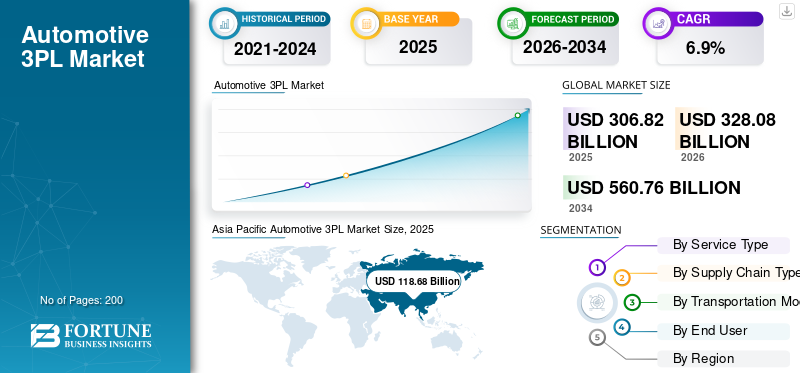
The automotive 3PL market size was valued at USD 306.82 billion in 2025 and is projected to grow from USD 328.08 billion in 2026 to USD 560.76 billion by 2034, with a CAGR of 6.9% over the forecast period. Asia Pacific dominated the automotive 3PL market with a market share of 38.68% in 2025.
Automotive 3PL refers to outsourced logistics services used by OEMs, tier suppliers, aftermarket firms, and EV manufacturers to manage transportation, warehousing, freight forwarding, sequencing, packaging, inventory handling, customs support, and reverse logistics. These providers help automotive products companies improve supply-chain visibility, reduce logistics costs, and support JIT/JIS production models. Rising vehicle production complexity, EV battery logistics, cross-border sourcing, aftermarket parts distribution, warehouse automation, and OEM outsourcing are driving the market growth. Automakers increasingly demand specialized logistics partners for inbound components, finished vehicles, hazardous battery handling, spare parts fulfillment, and reverse logistics as supply chain management become more global, digital, and time-sensitive. Leading players include DHL Supply Chain, DSV A/S, CEVA Logistics, Kuehne + Nagel, Ryder System, Inc., Penske Logistics, GEODIS, Nippon Express Holdings, Yusen Logistics, and XPO Logistics. These companies are moving toward integrated contract logistics, automotive control towers, EV battery handling, digital freight visibility, warehouse automation, and strategic acquisitions to expand regional automotive logistics coverage.
Download Free sample to learn more about this report.
Automotive 3PL Market Key Takeaways
 Global Market Size & Forecast
- 2025 Market Size: USD 306.82 billion
- 2026 Market Size: USD 328.08 billion
- 2034 Forecast Market Size: USD 560.76 billion
- CAGR: 6.9% from 2026–2034
 Market Share
- Asia Pacific dominated the automotive 3PL market with a 38.68% share in 2025.
- The reverse logistics segment is projected to grow at a CAGR of 8.3% during the forecast period.
- The reverse supply chain logistics segment is projected to grow at a CAGR of 8.5% during the forecast period.
 Key Regional Highlights
Asia Pacific
Asia Pacific dominated the global market with a valuation of USD 118.68 billion, driven by large-scale automotive production and expanding EV supply chains.
Europe
Europe remains a major market, supported by strong vehicle production, cross-border trade, and growing demand for battery and reverse logistics services.
North America
North America holds a significant market share, supported by integrated automotive manufacturing networks, nearshoring investments, and advanced logistics infrastructure.
U.S.
The market is estimated to reach USD 54.78 billion in 2026, driven by strong automotive production and high 3PL outsourcing.
Japan
The market is estimated to reach USD 17.97 billion in 2026.
Read More

AUTOMOTIVE 3PL MARKET TRENDS
EV Battery and Digitally Integrated Logistics Reshapes Market Growth
Automotive 3PL providers are increasingly shifting from basic freight movement to digitally integrated logistics platforms that combine route optimization, warehouse automation, battery-compliant handling, real delivery times visibility, and multimodal coordination. EV growth is increasing demand for specialized battery storage, hazardous goods compliance, thermal monitoring, and recycling-linked reverse logistics. This trend is especially evident in China, Europe, and North America, where EV production and battery supply chains require closer synchronization among OEMs, battery makers, ports, and inland warehouses. In May 2025, IEA’s Global EV Outlook showed global electric car sales exceeded 17 million units in 2024 and exceeded 20 million in 2025, directly supporting specialized EV logistics demand.
MARKET DYNAMICS
MARKET DRIVERS
Download Free sample to learn more about this report.
Rising Automotive Supply Chain Complexity Accelerates Market Expansion
Automotive industry manufacturers are outsourcing more logistics functions as modern vehicle production depends on global component sourcing, electronics, semiconductors, batteries, just-in-time deliveries, and just-in-sequence assembly. OEMs and Tier-1 suppliers increasingly rely on 3PL providers to manage inbound logistics, packaging, sequencing, customs clearance, warehousing, and transport coordination across multiple countries. This reduces operational burden and improves visibility in volatile supply chains. In December 2024, Volvo Autonomous Solutions and DHL Supply Chain began autonomous freight operations on the Dallas-Houston route, showing how logistics providers are adopting advanced transport technology to improve automotive freight efficiency and address driver availability challenges.
MARKET RESTRAINTS
Trade Volatility and Cross-Border Disruption Creates Pressure on Logistics Margins
Automotive 3PL providers face pressure from volatile freight rates, changes in customs procedures, tariff uncertainty, port congestion, labor shortages, and unpredictable cross-border flows. Since automotive logistics depends heavily on synchronized supplier deliveries, any policy change or border delay can increase inventory management and order fulfillment costs, disrupt plant schedules, and reduce cost, reduce contract profitability. This restraint is more visible in regions with high automotive trade dependency, such as North America and Europe. In July 2025, DSV reportedly paused certain U.S.-Mexico border investments due to tariff-linked trade uncertainty, despite Mexico remaining critical to North American automotive supply chains. This highlights how policy instability can delay logistics expansion decisions.
MARKET OPPORTUNITIES
Reverse Logistics and Battery Recycling Create High-Value Expansion Potential
Reverse logistics is becoming a stronger opportunity as automakers handle recalls, warranty returns, reusable packaging, remanufacturing, end-of-life components, and EV battery recycling. Automotive 3PL providers can capture higher-value contracts by offering compliant battery returns, damaged-battery isolation, parts recovery, recycling coordination, and circular-economy services. This opportunity is particularly relevant as EV volumes rise and governments tighten sustainability expectations. In May 2025, the IEA reported that China sold over 11 million electric cars in 2024, and global EVs accounted for more than 20% of new car sales, creating a larger future base for battery recycling, returns, and compliant reverse logistics networks.
MARKET CHALLENGES
Managing Specialized EV Logistics Compliance Challenges Market Development
Automotive 3PL providers must manage increasingly complex compliance requirements for lithium-ion batteries, dangerous goods classification, temperature-sensitive storage, handling of damaged batteries, customs documentation, carbon reporting, and multimodal safety rules. These requirements increase training requirements, insurance costs, warehouse investments, packaging standards, and the complexity of transport planning. Smaller regional logistics firms may struggle to meet OEM expectations, while global providers must continuously upgrade facilities and digital monitoring tools. In September 2025, research on large-scale carmaker inbound transport planning highlighted Renault-linked global logistics networks with thousands of commodities and more than a million arcs, showing how automotive supply-chain scale makes optimization and outsourcing decisions highly complex.
Segmentation Analysis
By Service Type
Integrated Fleet Coordination and Real-Time Shipment Visibility Strengthen Transportation Management Segment Leadership
Based on service type, the market is segmented into transportation management, warehousing & distribution, freight forwarding, reverse logistics, and packaging & sequencing services.
Transportation management dominates the market as automotive manufacturers require synchronized inbound component movement, finished vehicle distribution, multimodal coordination, and real-time freight visibility to support just-in-time production. The segment benefits from increased cross-border automotive trade, fleet-optimization technologies, and outsourced transportation operations by OEMs and Tier-1 suppliers.
The reverse logistics segment is projected to grow at a CAGR of 8.3% over the forecast period, driven by rising battery recycling, warranty returns, and circular-economy initiatives. In October 2024, DHL Supply Chain expanded its automotive logistics operations in Mexico to support growing nearshoring-driven automotive freight demand.
By Supply Chain Type
Rising Component Sourcing Complexity Accelerates Inbound Logistics Segment Growth
Based on supply chain type, the market is segmented into inbound logistics, outbound logistics, aftermarket logistics, and reverse supply chain logistics.
Inbound logistics segment dominates the market due to automotive production relies heavily on the uninterrupted delivery of components, electronics, semiconductors, batteries, and subassemblies from global supplier networks. OEMs increasingly depend on specialized 3PL providers for sequencing, customs coordination, inventory optimization, and synchronized plant deliveries. Growth in EV manufacturing and supplier diversification is further increasing the complexity of inbound logistics worldwide.
The reverse supply chain logistics segment is projected to grow at a CAGR of 8.5% over the forecast period, driven by increasing battery recycling, remanufacturing, and sustainable packaging recovery activities. In March 2025, CEVA Logistics announced expanded finished vehicle and inbound automotive logistics capabilities in Southeast Asia to support regional manufacturing growth.
By Transportation Mode
Extensive Dealer Connectivity and Flexible Cargo Handling Sustain Roadways Dominance
Based on transportation mode, the market is segmented into roadways, railways, airways, and waterways.
Roadways dominate the market due to their flexibility, broad geographic reach, and strong suitability for just-in-time deliveries between suppliers, plants, warehouses, ports, and dealerships. Road transport remains critical for short- and medium-distance automotive freight movement, spare parts distribution, and last-mile aftermarket logistics. Increasing highway infrastructure development and telematics-enabled fleet optimization are supporting global segment expansion.
The airways segment is projected to grow at a CAGR of 7.7% over the forecast period, driven by semiconductor shortages and urgent deliveries of EV components that require rapid transportation solutions. In June 2025, Ryder expanded its dedicated transportation solutions for automotive customers across North America to improve supply-chain responsiveness and regional freight efficiency.
To know how our report can help streamline your business, Speak to Analyst
By End User
Large-Scale Manufacturing Networks Reinforce Automotive OEM Logistics Demand
Based on end user, the market is segmented into automotive OEMs, tier-1 suppliers, automotive aftermarket companies, and electric vehicle manufacturers.
Automotive OEMs dominate the market because they operate extensive global manufacturing, supplier, warehousing, and vehicle distribution networks that require highly integrated logistics services. OEMs increasingly outsource transportation, packaging, sequencing, and inventory management to improve operational efficiency and reduce supply chain complexity. Rising production localization and cross-border sourcing are also strengthening demand for OEM logistics outsourcing.
The electric vehicle manufacturers segment is projected to grow at a CAGR of 11.9% over the forecast period, driven by rapid expansion in EV production and rising battery logistics requirements. In April 2025, Kuehne+Nagel strengthened its EV battery logistics and contract logistics services across Asia and Europe to support growing electric vehicle supply chains.
AUTOMOTIVE 3PL MARKET REGIONAL OUTLOOK
By geography, the market is categorized into Europe, North America, Asia Pacific, South America and Middle East & Africa.
North America
Asia Pacific Automotive 3PL Market Size, 2025 (USD Billion)
To get more information on the regional analysis of this market, Download Free sample
North America holds a significant share of the global market due to highly integrated automotive manufacturing networks across the U.S., Mexico, and Canada. Strong OEM presence, advanced warehousing infrastructure, cross-border freight corridors, and rising nearshoring investments are supporting regional logistics demand. The region benefits from mature contract logistics outsourcing and increasing EV supply-chain investments. Growth is further driven by aftermarket distribution, semiconductor transportation, and real-time freight visibility solutions. The expansion of battery manufacturing and U.S.-Mexico automotive trade corridors is also increasing demand for inbound logistics, transportation management, and sequencing services across the region.
U.S. Automotive 3PL Market
The U.S. dominates the North American market. It is estimated to reach USD 54.78 billion in 2026, driven by its extensive automotive production ecosystem, large dealership network, advanced warehousing infrastructure, and high 3PL outsourcing penetration. Strong aftermarket demand, rising EV investments, and integrated freight transportation networks continue supporting logistics expansion. Increasing domestic battery manufacturing and digital freight optimization are also strengthening demand for automotive transportation and warehousing nationwide.
Europe
Europe remains a major Automotive 3PL hub due to strong vehicle production, dense supplier networks, advanced rail-road connectivity, and cross-border automotive trade. Germany, France, the U.K., Italy, Spain, and Central European manufacturing clusters generate substantial demand for inbound logistics, freight forwarding, sequencing, and contract warehousing. Sustainability initiatives and the expansion of EV production are accelerating demand for battery and reverse logistics services. Rising adoption of multimodal transportation and automotive trade across the European Union continues to support market growth. The region also benefits from mature aftermarket logistics industry operations and strong automotive exports to international markets.
U.K. Automotive 3PL Market
The U.K. is projected to reach USD 11.59 billion in 2026, driven by increasing automotive imports, aftermarket logistics demand, and expanding EV supply-chain activities. Rising warehouse automation and port-based automotive distribution operations are supporting market expansion. The increasing reliance on outsourced transportation management and customs coordination after Brexit is further strengthening demand for specialized automotive logistics providers nationwide.
Germany Automotive 3PL Market
Germany accounted for approximately 18.6% of the European market share due to its strong OEM manufacturing base, advanced supplier ecosystem, and high-volume automotive exports. The country benefits from integrated rail-road freight infrastructure, strong Tier-1 supplier presence, and rising EV battery logistics activities. Demand for sequencing services, inbound logistics, and industrial warehousing remains particularly strong across Germany’s automotive manufacturing hubs.
Asia Pacific
Asia Pacific dominates the global market owing to large-scale automotive production in China, Japan, India, and South Korea. The region benefits from extensive supplier networks, export-oriented manufacturing, rapid EV expansion, and increasing contract logistics outsourcing. Growth in semiconductor movement, battery logistics, and port-based freight forwarding is accelerating demand for advanced transportation and warehousing services. The expansion of automotive production facilities and rising regional vehicle demand continue to strengthen logistics operations. Increasing digitalization, smart warehousing adoption, and cross-border automotive trade are also contributing significantly to the market’s long-term growth in the region.
China Automotive 3PL Market
China dominates the Asia Pacific market with approximately 52.8% share, driven by its massive automotive manufacturing scale, a strong EV production ecosystem, and an extensive domestic supply chain network. The country benefits from high-volume component movement, integrated port infrastructure, and advanced warehouse automation. Rising exports of electric vehicles and batteries are further increasing demand for transportation management, freight forwarding, and reverse logistics services.
India Automotive 3PL Market
India is projected to have the highest CAGR of 9.0% in the Asia Pacific, driven by expanding automotive manufacturing capacity, rising vehicle exports, growing aftermarket demand, and increasing EV investments. Government-supported industrial corridor development and warehouse modernization are supporting logistics growth. Increasing localization of automotive component production and rising cross-border trade are further accelerating demand for inbound logistics and transportation management services.
Japan Automotive 3PL Market
Japan’s market is estimated to reach USD 17.97 billion in 2026, driven by strong automotive exports, advanced manufacturing systems, and high-value component transportation requirements. The country benefits from mature multimodal freight infrastructure, port connectivity, and sophisticated sequencing operations supporting global OEMs. Growth in EV component logistics and increasing demand for automated warehousing solutions are further strengthening the country’s automotive logistics sector.
South America
South America is witnessing steady growth in Automotive 3PL, supported by rising vehicle production, increasing aftermarket demand, and improving transportation infrastructure. Brazil and Argentina remain the primary automotive manufacturing centers, generating strong demand for inbound logistics, road transportation, and warehousing services. Expanding regional trade and growing reliance on outsourced logistics operations are also supporting market expansion. The region’s large aging vehicle fleet continues to drive aftermarket logistics demand. Increasing port modernization and automotive import-export activity are further contributing to the growth of freight forwarding and transportation management services across South America.
Brazil Automotive 3PL Market
Brazil dominates the South American market with a nearly 60.6% share, driven by its strong automotive production base, extensive domestic distribution network, and large aftermarket sector. The country benefits from high demand for road transportation, component warehousing, and sequencing services. Increasing investments in automotive manufacturing and regional vehicle exports are further strengthening logistics outsourcing and transportation management activities across Brazil.
Middle East & Africa
The Middle East & Africa market is growing steadily due to increasing vehicle imports, expanding automotive distribution networks, and rising investments in logistics infrastructure. Gulf countries are strengthening port-based automotive trade and warehousing capabilities, while South Africa remains a key automotive manufacturing hub. Increasing aftermarket demand and rising regional trade are supporting growth in transportation management and freight forwarding. The region is also witnessing increasing investment in smart logistics zones, multimodal transportation, and EV-related supply-chain infrastructure, which is expected to support long-term expansion of the market.
UAE Automotive 3PL Market
The UAE market is projected to grow at a CAGR of 7.5% due to its strategic role as a regional automotive trade and re-export hub. Strong port infrastructure, advanced warehousing facilities, and growing vehicle import activities are supporting logistics expansion. The increasing adoption of smart logistics technologies and the expansion of regional distribution operations are further strengthening demand for transportation management and freight forwarding services in the country.
COMPETITIVE LANDSCAPE
Key Industry Players
Integrated Contract Logistics, EV Supply Chains, and Digital Freight Visibility Intensify Market Competition
The global automotive 3PL market is shaped by integrated transportation management, contract warehousing, freight forwarding capabilities, EV battery logistics expertise, and real-time supply chain visibility solutions.Major players, including DHL Supply Chain, DSV, DB Schenker, CEVA Logistics, Kuehne+Nagel, Ryder, Penske Logistics, GEODIS, Nippon Express, and Yusen Logistics, compete through multimodal logistics networks, automotive sequencing services, smart warehousing, and cross-border freight optimization. Companies are increasingly investing in AI-enabled fleet management, warehouse automation, battery-compliant logistics infrastructure, and digital control towers to strengthen operational efficiency and customer retention. Strategic acquisitions, regional warehouse expansion, and partnerships with OEM-focused logistics companies remain key competitive strategies across North America, Europe, and the Asia Pacific. In April 2025, DSV completed its acquisition of Schenker, significantly expanding its automotive logistics footprint, freight network scale, and integrated supply-chain capabilities globally.
LIST OF KEY AUTOMOTIVE 3PL COMPANIES PROFILED
- DHL Supply Chain (Germany)
- DB Schenker (Germany)
- DSV A/S (Denmark)
- Kuehne + Nagel (Switzerland)
- CEVA Logistics (France)
- GEODIS (France)
- Nippon Express Holdings (Japan)
- Yusen Logistics (Japan)
- Ryder System, Inc. (U.S.)
- Penske Logistics (U.S.)
- XPO Logistics (U.S.)
- Expeditors International (U.S.)
- Hellmann Worldwide Logistics (Germany)
- CJ Logistics (South Korea)
- Sinotrans Limited (China)
KEY INDUSTRY DEVELOPMENTS
- May 2026: Amazon launched Amazon Supply Chain Services, opening its freight, warehousing, fulfillment, and last mile delivery network to external businesses, with automotive identified as a target sector. The move positions Amazon as a broader 3PL competitor for vehicle parts, aftermarket components, and complex manufacturer supply chains.
- May 2026: Kuehne+Nagel said India is becoming a key global supply-chain hub and outlined plans to expand warehousing and technology investments. The strategy supports automotive, manufacturing, and export-linked logistics demand as India strengthens multimodal connectivity and digital supply-chain infrastructure.
- April 2026: CEVA Logistics completed the acquisition of Fagioli, an Italy-based heavy-lift and specialized transportation 3PL company. The deal strengthens CEVA’s project logistics capabilities for oversized industrial cargo, supporting automotive plant equipment, production-line machinery, heavy components, and specialized transport requirements.
- January 2026: Ryder acquired Truck Service Depot, an Atlanta-based mobile maintenance provider for commercial trucks and trailers. The acquisition expanded Ryder’s retail mobile maintenance operations in Georgia, strengthening fleet uptime, service coverage, and transport reliability for dedicated transportation and automotive logistics customers.
- December 2025: Motherson’s joint venture Samvardhana Motherson Hamakyorex Engineered Logistics signed an agreement with Dighi Port to develop a dedicated automotive export facility. The facility is expected to handle 200,000 cars annually, strengthening India’s finished-vehicle logistics and export supply chain.
REPORT COVERAGE
The automotive 3PL market analysis provides an in-depth study of the market size & forecast across all market segments included in the report. It contains details on market research dynamics and trends expected to drive the market during the forecast period. It offers information on rapid technological advancements, new product launches, key industry developments, strategic partnerships, mergers & acquisitions. The market forecast provides a comprehensive competitive landscape, including the most significant global market shares, emerging opportunities, and profiles of key players.
Request for Customization to gain extensive market insights.
Report Scope & Segmentation
| ATTRIBUTE | DETAILS |
| Study Period | 2021-2034 |
| Base Year | 2025 |
| Estimated Year | 2026 |
| Forecast Period | 2026-2034 |
| Historical Period | 2021-2024 |
| Growth Rate | CAGR of 6.9% from 2026 to 2034 |
| Unit | Value (USD billion) |
| Segmentation | By Service Type, By Supply Chain Type, By Transportation Mode, By End User, and By Region |
| By Service Type |
|
| By Supply Chain Type |
|
| By Transportation Mode |
|
| By End User |
|
| By Geography |
|
Frequently Asked Questions
Fortune Business Insights says that the global market value stood at USD 306.82 billion in 2025 and is projected to reach USD 560.76 billion by 2034.
In 2025, the Asia Pacific market value stood at USD 118.68 billion.
The market demand is expected to grow at a CAGR of 6.9% from 2026 to 2034.
The roadways segment led the market by transportation mode.
Rising vehicle production complexity, EV battery logistics, cross-border sourcing, aftermarket parts distribution, and warehouse automation are driving market momentum.
Key market players include DHL Supply Chain, DSV A/S, CEVA Logistics, Kuehne+Nagel, Ryder, Penske Logistics, and GEODIS.
The Asia Pacific region accounted for the largest share of the market.
North America Europe Asia Pacific, South America, and the Middle East & Africa are considered in the market.



- 2021-2034
- 2025
- 2021-2024
- 200
-
(Offer valid till 15th Oct 2026)
Get 30-60 hrs Free Customization
Expand Regional and Country Coverage, Segments Analysis, Company Profiles, Competitive Benchmarking, and End-user Insights.




















-
US +1 833 909 2966 ( Toll Free )
-
Get In Touch With Us