Automotive Chemicals Market Size, Share & Industry Analysis, By Type (Lubricants, Functional & Operational Fluids, Paints & Coatings, Cleaning & Maintenance Chemicals, Adhesives & Sealants, and Others), By Application (Powertrain, Body & Exterior, Thermal Management Systems, Interior Components, Battery Systems, and Others), By End-Use (OEMs and Aftermarket {New Vehicles and Used Vehicles}), By Vehicle Type (Passenger Vehicles, Commercial Vehicles, and Others), and Regional Forecast, 2026-203
 Download Free Sample
Automotive Chemicals Market Size and Future Outlook
 Listen to Audio Version
The automotive chemicals market size was valued at USD 134.40 billion in 2025. The market is projected to grow from USD 143.91 billion in 2026 to USD 186.14 billion by 2034, exhibiting a CAGR of 3.3% during the forecast period. Asia Pacific dominated the global market with a market share of 38.58% in 2025.
Automotive chemicals are essential materials used in vehicle manufacturing, maintenance, and performance improvement. These include lubricants, coolants, adhesives, sealants, coatings, cleaning agents, and other specialty fluids. Their demand is closely linked to vehicle production, regular servicing, rising vehicle ownership, and the need for better safety, durability, fuel efficiency, and emission control. Globally, the market is supported by steady automotive production, strong aftermarket consumption, and the growing use of advanced chemical solutions in conventional, hybrid, and electric vehicles. These materials also help reduce wear, improve comfort, support thermal management, and improve overall reliability across vehicle systems.
The market is dominated by a group of large integrated chemical producers and specialty automotive chemical suppliers with strong product portfolios, technical expertise, and established distribution networks. Major players such as Shell plc, ExxonMobil, TotalEnergies SE, PPG Industries, Inc., Axalta Coating Systems, Ltd., 3M, and regional producers focus on product performance, vehicle compatibility, regulatory compliance, and consistent service support. This is resulting in a moderately consolidated market characterized by steady demand, strong aftermarket consumption, high brand loyalty, and continuous product innovation.
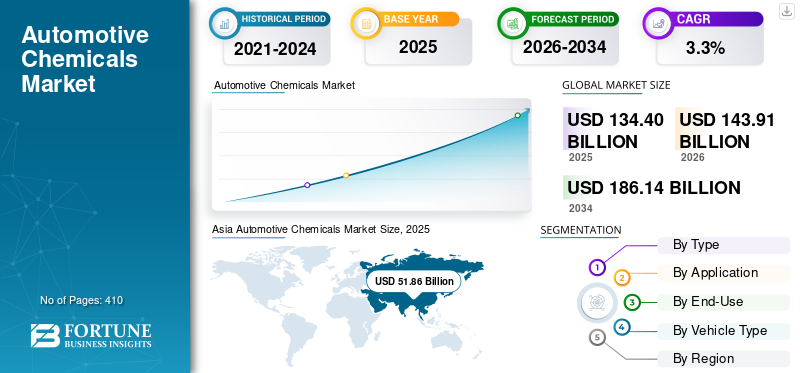
Download Free sample to learn more about this report.
automotive chemicals market KEY TAKEAWAYS
 Global Market Size & Forecast
- 2025 Market Size: USD 134.40 Billion
- 2026 Market Size: USD 143.91 Billion
- 2034 Forecast Market Size: USD 186.14 Billion
- CAGR: 3.3% from 2026-2034
 Market Share
- Asia Pacific dominated the market with a revenue share of 38.58% in 2025.
- Lubricants held the largest market share of 48.0% in 2025.
- Powertrain accounted for the largest market share of 48.5% in 2025.
 Key Regional Highlights
North America
North America held a 25.3% market share in 2025, supported by a large vehicle parc and strong aftermarket activity.
Europe
Europe represented 22.0% of the global market in 2025, driven by advanced automotive manufacturing and maintenance demand.
Asia Pacific
Asia accounted for the largest market share of 38.6% in 2025, driven by strong automotive production and aftermarket demand.
U.S.
The market reached USD 26.41 billion in 2025, supported by high vehicle ownership and aftermarket servicing.
Japan
The market is supported by strong automotive manufacturing, advanced vehicle technologies, and recurring maintenance demand.
Read More

automotive chemicals market TRENDS
Shift Toward Long-Life and Multi-Functional Automotive Chemicals is Reshaping the Market
A key trend in the market is the growing shift toward long-life and multi-functional products. Automakers, service centers, and vehicle owners are increasingly looking for chemicals that improve performance, protect vehicle parts, and reduce the need for frequent maintenance. This is supporting demand for advanced lubricants, coolants, brake fluids, transmission fluids, greases, coatings, adhesives, sealants, and cleaners with better durability, heat resistance, corrosion protection, and compatibility with modern vehicle systems. From a business perspective, chemical suppliers are focusing on improved formulations that offer better protection, reliability, and value across both vehicle manufacturing and aftermarket servicing.
- According to FuelEconomy.gov, using the wrong grade of motor oil can lower vehicle mileage by 1% to 2%, supporting the shift toward performance-focused, vehicle-compatible automotive fluids and long-life formulations.
MARKET DYNAMICS
MARKET DRIVERS
Download Free sample to learn more about this report.
Rising Vehicle Production and Expanding Aftermarket Maintenance Drives Market Growth
Rising vehicle production is a key driver for automotive chemicals market growth, as each newly manufactured vehicle requires several chemical inputs during assembly, finishing, protection, testing, and first-fill operations. These include lubricants, coolants, brake fluids, transmission fluids, greases, adhesives, sealants, coatings, cleaners, anti-corrosion products, and other preparation materials used across OEM operations.
Aftermarket maintenance further supports recurring demand, as vehicles require regular fluid replacement, cleaning, repair, rust protection, polishing, and preventive maintenance throughout their lifecycle. Service centers, fleet operators, dealerships, garages, body shops, and retail maintenance channels continue to consume automotive chemicals, especially as the global vehicle fleet expands and ages.
- According to the International Organization of Motor Vehicle Manufacturers (OICA), global vehicle production increased from 92.7 million units in 2024 to 96.4 million units in 2025.
MARKET RESTRAINTS
Volatility in Petrochemical Feedstock Prices and Increasing Environmental Compliance Pressure Hampers Market Expansion
Fluctuations in petrochemical feedstock prices restrain market growth, as many products depend on petroleum-based inputs such as base oils, solvents, resins, glycols, and additives. Sudden changes in crude oil and petrochemical prices can increase formulation costs and affect manufacturer margins. The market also faces rising environmental compliance pressure, especially for solvent-based coatings, cleaners, adhesives, sealants, and refinishing chemicals. Regulations on VOC emissions, hazardous substances, labeling, and waste handling increase the need for reformulation, testing, and compliance investment, limiting pricing flexibility and creating operational challenges for manufacturers.
- According to the Environmental Protection Agency (EPA), national VOC standards for automobile refinish coatings are estimated to reduce VOC emissions by 31,900 tons per year, representing a 33% reduction from the 1995 baseline estimate.
MARKET OPPORTUNITIES
Growing Shift Toward Sustainable and EV-Compatible Automotive Chemical Solutions is Lucrative Market Opportunity
Automotive chemicals demand is positioned to benefit from the growing shift toward eco-friendly products and EV-compatible solutions. Automakers, fleet operators, repair networks, and aftermarket service providers are increasing adoption of low-VOC products, safer formulations, advanced coolants, adhesives, sealants, coatings, greases, and protection chemicals that support reducing emissions, material compatibility, and longer vehicle life. The rapid growth of electric vehicles further creates opportunities for chemicals used in battery thermal management, electrical safety, corrosion protection, bonding, and lightweight structures. As the automotive industry moves toward electrification and sustainability, chemical suppliers offering safer, durable, and high performance solutions are expected to gain stronger market opportunities.
- According to the International Energy Agency (IEA), global electric car sales exceeded 17 million units in 2024, rising by more than 25% compared to 2023.
MARKET CHALLENGES
Complex Testing and Vehicle Compatibility Requirements Create Market Development Challenges
Automotive chemical manufacturers face challenges due to strict testing, safety, and vehicle compatibility requirements. Products such as lubricants, coolants, brake fluids, coatings, adhesives, sealants, greases, and cleaners must work properly under different temperatures, driving conditions, materials, and vehicle systems. With the growth of electric and hybrid vehicles, chemical suppliers also need to ensure compatibility with batteries, electronics, lightweight materials, sensors, and high-voltage components. This increases the need for product testing, OEM approvals, reformulation, and technical support. As a result, developing and launching new automotive chemical products becomes more time-consuming, costly, and technically challenging.
Segmentation Analysis
By Type
Higher Commercial Vehicle Activity Drives Lubricants Segment Dominance
Based on type, the market is segmented into lubricants, functional & operational fluids, paints & coatings, cleaning & maintenance chemicals, adhesives & sealants, and others.
To know how our report can help streamline your business, Speak to Analyst
Lubricants accounted for the largest share of the market in 2025, representing 48.0% of total revenue. The segment’s dominance is mainly supported by the high and recurring consumption of engine oils, transmission oils, gear oils, greases, and other lubrication products across both OEM and aftermarket channels. Unlike several other automotive chemical categories that are linked mainly to manufacturing or repair events, lubricants are consumed continuously throughout the vehicle life cycle through periodic servicing, oil changes, drivetrain maintenance, and fleet operations. Demand is especially strong in countries with large vehicle parc, high mileage intensity, commercial vehicle activity, and expanding aftermarket service networks. Hence, lubricants remain the core revenue-generating product category in the market.
The adhesives & sealants segment is expected to grow at a 5.2% CAGR over the forecast period.
By Application
Powertrain Maintenance and Performance Requirements Droves Powertrain Segment Dominance
Based on application, the market is segmented into powertrain, body & exterior, thermal management systems, interior components, battery systems, and others.
Powertrain accounted for the largest share of the market in 2025, representing 48.5% of total revenue. The segment’s dominance is mainly supported by the high use of engine oils, transmission fluids, gear oils, greases, fuel additives, coolants, brake fluids, and other performance-critical chemicals used in engines, transmissions, axles, braking systems, and drivetrain assemblies. Powertrain chemicals are consumed throughout the vehicle life cycle, as conventional internal combustion engine vehicles require periodic oil changes, fluid replacement, lubrication, and preventive maintenance. Even with rising electrification, the global vehicle parc remains largely ICE- and hybrid-based, which continues to support strong demand for lubricants and operational fluids. Similarly, hybrid vehicles and commercial fleets still require thermal fluids, greases, brake fluids, and drivetrain-related chemicals. Hence, powertrain remains the most important application area for automotive chemical consumption.
The battery systems segment is expected to grow at a 4.4% CAGR over the forecast period.
By End-Use
Recurring Maintenance Demand Positions Aftermarket as the Dominant Growth
Based on end use, the market is categorized into OEMs and aftermarket (new vehicles and used vehicles).
Aftermarket accounted for the dominant automotive chemicals market share in 2025, representing 73.2% of total revenue. The segment’s leadership is mainly due to the recurring nature of automotive chemical consumption after vehicles enter service. Engine oils, transmission fluids, coolants, brake fluids, car-care products, cleaners, polishes, waxes, repair coatings, sealants, and maintenance additives are repeatedly consumed across the vehicle life cycle. The aftermarket is also supported by the large global vehicle parc, rising vehicle age, higher vehicle retention, growing used-vehicle transactions, and expansion of organized service networks. In the U.S., FHWA data showed that motor vehicles traveled around 3.29 trillion miles in 2024, reflecting the scale of vehicle usage that supports maintenance chemical demand. Hence, the aftermarket remains the primary demand base for automotive chemicals.
The OEMs segment is expected to grow at a 2.3% CAGR over the forecast period.
By Vehicle Type
Large Vehicle Parc and Regular Maintenance Needs Drive Dominance of Passenger Vehicles
Based on vehicle type, the market is segmented into passenger vehicles, commercial vehicles, and others.
Passenger vehicles accounted for the largest share of the market in 2025, representing 62.7% of total revenue. The large global passenger vehicle parc, high ownership base, and recurring use of automotive chemicals across regular servicing, maintenance, cleaning, repair, and appearance protection mainly support the segment’s dominance. Passenger cars consume a wide range of chemicals, including engine oils, transmission fluids, coolants, brake fluids, windshield washer fluids, paints & coatings, adhesives, sealants, waxes, polishes, interior cleaners, and detailing chemicals. The aftermarket plays a major role in this segment, as personal vehicles require periodic oil changes, fluid top-ups, tire and brake servicing, repainting, cleaning, and cosmetic restoration throughout their operating life. Demand is also supported by rising consumer focus on vehicle appearance, resale value, comfort, and preventive maintenance. Hence, passenger vehicles remain the leading vehicle type for automotive chemical consumption globally.
The commercial vehicles segment is expected to grow at a 3.2% CAGR over the forecast period.
automotive chemicals market Regional Outlook
By geography, the market is categorized into North America, Europe, Asia, Australia, South America, the Middle East, and Africa.
Asia
Asia Automotive Chemicals Market Size, 2025 (USD Billion)
To get more information on the regional analysis of this market, Download Free sample
Asia accounted for the largest share of the market in 2025, representing 38.6% of total revenue. The region’s dominance is supported by its large vehicle production base, fast-growing vehicle parc, expanding middle-class mobility, and strong aftermarket service demand across China, India, Japan, South Korea, and other Southeast Asian markets. Asia also has a major role in EV and battery manufacturing, which is increasing demand for battery thermal fluids, adhesives, sealants, coatings, and specialty protection chemicals. India’s PM E-DRIVE scheme, launched by the Ministry of Heavy Industries with an outlay of USD 1.25 billion, is intended to accelerate EV adoption and charging infrastructure development, supporting long-term demand for next-generation automotive chemicals. Thus, Asia leads the global market due to the combined strength of vehicle manufacturing, aftermarket expansion, two-wheeler and passenger-car servicing, and electrification-led chemical demand.
China Automotive Chemicals Market
Based on Asia’s strong contribution and China’s large automotive manufacturing base, the China market reached USD 29.33 billion in 2025, accounting for approximately 56.6% of global revenues. This demand is supported by high vehicle production, rising vehicle ownership, strong aftermarket servicing, and growing use of lubricants, coolants, coatings, adhesives, sealants, cleaning chemicals, and operational fluids across OEM and aftermarket channels across the country.
India Automotive Chemicals Market
The India market in 2025 was at USD 4.76 billion. This growth is supported by rising vehicle production, increasing vehicle ownership, expanding aftermarket servicing, and stronger use of lubricants, coolants, coatings, adhesives, sealants, cleaning chemicals, and operational fluids. Growing passenger vehicle sales, commercial vehicle activity, and electric vehicle adoption support OEM and aftermarket demand.
North America
North America held the second-largest share of the market in 2025, accounting for 25.3% of total revenue. The region benefits from a large vehicle parc, high vehicle miles traveled, strong DIY and professional service culture, extensive car-care retail networks, and high consumption of lubricants, fluids, coatings, detailing chemicals, adhesives, and sealants. The U.S. remains the core market, supported by high vehicle ownership, a large light-truck and SUV fleet, and recurring maintenance demand. FHWA data showed around 297.5 million registered motor vehicles in the U.S. in 2024, highlighting the scale of the operating fleet that drives aftermarket chemical usage. In addition, clean vehicle policies and investments under the Inflation Reduction Act are supporting domestic clean energy manufacturing and EV supply chains, which gradually expand demand for battery-related and thermal management chemicals. Hence, North America remains a high-value market, led by aftermarket intensity and advanced vehicle technologies.
U.S. Automotive Chemicals Market
The U.S. market in 2025 was at USD 26.41 billion, representing approximately 77.5% of regional revenues. Consumption is driven by high vehicle ownership, strong aftermarket servicing, and established automotive manufacturing. Demand is supported by regular use of lubricants, coolants, coatings, adhesives, sealants, cleaners, protection products, and operational fluids across passenger vehicles, commercial fleets, repair networks, and OEM production and long-term maintenance channels nationwide.
Europe
Europe represented 22.0% of the global market in 2025. The region’s demand is supported by a large and aging vehicle fleet, strict environmental standards, a strong repair and maintenance culture, premium vehicle ownership, and advanced OEM production. ACEA reported that EU roads had 249 million cars in 2023, along with around 30.1 million vans, 6 million trucks, and about 680,000 buses, creating a broad base for lubricants, fluids, refinish coatings, cleaners, and maintenance chemicals. Europe is also strongly shaped by vehicle emission regulations. The European Commission notes that revised CO₂ standards introduced a 100% emission reduction target for new passenger cars and vans from 2035, encouraging the shift toward zero-emission vehicles. Therefore, Europe remains an important market for both conventional aftermarket chemicals and emerging EV-related specialty chemicals.
Germany Automotive Chemicals Market
Germany’s market reached USD 5.71 billion in 2025, equivalent to around 19.3% of the regional market. Strong automotive manufacturing, high vehicle maintenance standards, and steady use of lubricants, coolants, coatings, adhesives, sealants, cleaners, and operational fluids across OEM and aftermarket channels nationwide support demand.
U.K. Automotive Chemicals Market
The U.K. market in 2025 was at USD 3.62 billion, accounting for roughly 12.2% of regional revenues. Consumption is supported by vehicle maintenance, aftermarket servicing, repair activities, and established automotive production. Demand is concentrated in lubricants, coolants, coatings, adhesives, sealants, cleaners, protection chemicals, and operational fluids used across passenger vehicles, commercial fleets, workshops, and OEM channels.
South America
South America accounted for 4.8% of the global market in 2025. Brazil is the region’s largest automotive hub, supported by domestic vehicle production, a sizeable vehicle parc, and strong demand for lubricants, functional fluids, maintenance chemicals, refinish coatings, and car-care products. The region’s market is highly aftermarket-oriented as vehicle ownership periods are often longer, and many consumers rely on repair, repainting, and periodic servicing to extend vehicle life. ANFAVEA remains the key industry association tracking Brazil’s automotive manufacturing and sector performance, reflecting the country’s importance within the regional automotive ecosystem. Hence, South America represents a moderate-sized but service-driven market, with Brazil, Argentina, Chile, and Colombia forming the main demand centers.
Middle East
The Middle East held a 4.0% share of the market in 2025. Demand is supported by high vehicle ownership in GCC countries, harsh climatic conditions, frequent air-conditioning use, high coolant and lubricant requirements, and strong demand for cleaning, polishing, detailing, and protective chemicals. Heat, dust, sand exposure, and long-distance driving increase the need for engine oils, coolants, waxes, coatings, glass cleaners, and interior care products. The region is also investing in mobility and EV manufacturing capabilities. Saudi Arabia’s Public Investment Fund has stated that it is investing across the automotive and mobility ecosystem, including the launch of Ceer and broader future mobility initiatives. Thus, the Middle East market is shaped by premium car ownership, climate-driven maintenance needs, and emerging EV manufacturing ambitions.
UAE Automotive Chemicals Market
The UAE market accounted for around USD 0.73 billion in 2025, representing approximately 13.5% of regional revenues. Demand is supported by high vehicle ownership, strong aftermarket servicing, fleet maintenance activity, and the country’s role as a regional hub for automotive trade, repair, and distribution of lubricants, coolants, coatings, cleaners, adhesives, sealants, and operational fluids.
Africa
Africa represented 3.3% of the global market in 2025. The region’s demand is mainly supported by used-vehicle imports, aging vehicle fleets, commercial transport activity, mining and logistics vehicles, and growing urban mobility across South Africa, Egypt, Morocco, Nigeria, and Kenya. The market is strongly aftermarket-led, with high demand for engine oils, coolants, brake fluids, greases, cleaning chemicals, and repair products due to longer vehicle operating life and challenging road conditions. South Africa remains the most developed automotive manufacturing and export base in the region. NAAMSA reported that South African vehicle and automotive component exports reached a record of USD 270.8 billion in 2023, underlining the country’s role in the regional automotive value chain. Therefore, Africa remains a smaller but steadily developing market, supported by vehicle servicing, fleet maintenance, and regional manufacturing activity.
Australia
Australia accounted for 2.0% of the market in 2025. The market is comparatively smaller in global terms. Still, it has high per-vehicle chemical consumption due to long driving distances, strong SUV and light commercial vehicle usage, and a mature aftermarket service structure. Automotive chemicals demand is driven by lubricants, coolants, cleaning products, detailing chemicals, protective coatings, brake fluids, and maintenance products used across passenger cars, SUVs, Utes, commercial vehicles, and off-road vehicles. The Bureau of Infrastructure and Transport Research Economics’ (BITRE’s) Road Vehicles Australia release provides official statistics on vehicles registered for road use, based on state and territory registry data, highlighting the importance of the national vehicle fleet as a demand base. Hence, Australia remains a small but stable market, supported by high vehicle ownership, climate exposure, and recurring vehicle maintenance needs.
COMPETITIVE LANDSCAPE
Key Industry Players
High Capital Intensity and Strategic Asset Management Shape Competition in the Market
The automotive chemicals market is moderately consolidated and performance-driven, as complex product formulations, OEM approval requirements, established distribution networks, and strict environmental compliance create significant barriers to entry. These factors limit new participation in specialized product categories and concentrate supply among a group of global chemical producers, lubricant companies, coating manufacturers, and specialty chemical suppliers with established technical expertise.
Leading players such as Shell plc, ExxonMobil, TotalEnergies SE, PPG Industries, Inc., Axalta Coating Systems Ltd., and 3M focus primarily on improving product performance, strengthening OEM and aftermarket relationships, and developing safer, low-emission, and EV-compatible formulations rather than pursuing aggressive capacity expansion. Recent activities across these companies highlight a strategic emphasis on sustainability, technical service, regulatory compliance, and vehicle compatibility to support long-term market positioning.
LIST OF KEY AUTOMOTIVE CHEMICALS COMPANIES PROFILED
- Shell plc (U.K.)
- ExxonMobil (U.S.)
- Castrol (U.K)
- TotalEnergies SE (France)
- PPG Industries, Inc. (U.S.)
- Axalta Coating Systems Ltd. (U.S.)
- BASF SE (Germany)
- 3M (U.S.)
- SONAX GmbH (Germany)
- Henkel AG & Co. KGaA (Germany)
- The Sherwin-Williams Company (U.S.)
KEY INDUSTRY DEVELOPMENTS
- March 2026: PPG introduced PPG Deltron D8178 Rapid Low Energy clearcoat across Europe, the Middle East, and Africa (fast-drying clearcoat with low-energy curing technology), signaling a stronger focus on energy-efficient refinish processes and faster body-shop cycle times.
- July 2025: Shell completed the acquisition of Raj Petro Specialties, a petrochemicals producer in India, reinforcing its lubricants portfolio and expanding its customer base.
- March 2024: Shell Indonesia announced plans to build its first grease manufacturing plant in Indonesia, expanding its operations alongside the existing Marunda Lubricants Oil Blending Plant in Bekasi.
- March 2023: ExxonMobil invested nearly USD 110 million to build a lubricant manufacturing plant in Raigad, Maharashtra. The plant is predicted to produce 159,000 kiloliters of finished lubricants every year to support India’s growing demand.
- April 2022: Castrol introduced its first dedicated EV transmission fluids for workshops, supporting the rising requirement for specialized fluid solutions in electric vehicle servicing.
REPORT COVERAGE
The global automotive chemicals market analysis provides an in-depth study of market size & forecast by all the market segments included in the report. It includes details on market dynamics and trends expected to drive the market during the forecast period. It offers information on technological advancements, new product launches, key industry developments, and partnerships, mergers & acquisitions. The market research report also includes a detailed competitive landscape, including market share and profiles of key players.
Request for Customization to gain extensive market insights.
Report Scope & Segmentation
| ATTRIBUTE | DETAILS |
| Study Period | 2021-2034 |
| Base Year | 2025 |
| Estimated Year | 2026 |
| Forecast Period | 2026-2034 |
| Historical Period | 2021-2024 |
| Growth Rate | CAGR of 3.3% from 2026-2034 |
| Unit | Value (USD Billion) Volume (Kilotons) |
| Segmentation | By Type, Application, End-Use, Vehicle Type, and Region |
| By Type |
|
| By Application |
|
| By End-Use |
|
| By Vehicle Type |
|
| By Region |
|
Frequently Asked Questions
Fortune Business Insights says that the global market size was valued at USD 134.40 billion in 2025 and is projected to reach USD 186.14 billion by 2034.
Recording a CAGR of 3.3%, the market is slated to exhibit steady growth during the forecast period of 2026-2034.
The passenger vehicles segment led the market.
Asia held the highest market share in 2025.
Growing adoption of high-performance automotive fluids and EV-compatible chemical solutions across OEM and aftermarket channels drive the market growth.



- 2021-2034
- 2025
- 2021-2024
- 410
Get 30-60 hrs Free Customization
Expand Regional and Country Coverage, Segments Analysis, Company Profiles, Competitive Benchmarking, and End-user Insights.


















Related Reports
-
US +1 833 909 2966 ( Toll Free )
-
Get In Touch With Us