Plasma Fractionation Market Size, Share & Industry Analysis, By Product (Albumin, Immunoglobulin {IVIG and SCIG}, Coagulation Factors {Factor IX, Factor VIII, and von Willebrand Factor}, and Protease Inhibitors {Alpha-1 Antitrypsin and C1 Esterase Inhibitor}), By Application (Immunology, Neurology, Hematology, Critical Care, and Pulmonology), By End User (Hospitals & Clinics, Specialty Clinics & Infusion Centers, and Homecare Settings), and Regional Forecast, 2026-2034
 Download Free Sample
Plasma Fractionation Market Size and Future Outlook
 Listen to Audio Version
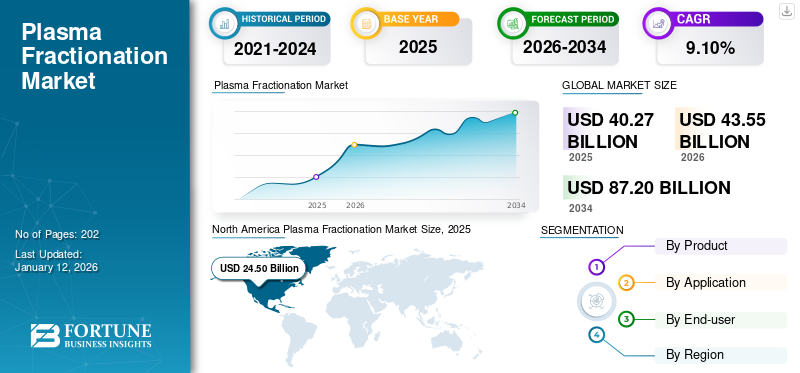
The global plasma fractionation market size was valued at USD 40.27 billion in 2025 and is projected to grow from USD 43.55 billion in 2026 to USD 87.23 billion by 2034, exhibiting a CAGR of 9.1% during the forecast period. North America dominated the plasma fractionation market with a market share of 56.22% in 2025.
Plasma fractionation is a method that separates human plasma into its component proteins for various therapeutic uses. This technique is significant for producing plasma derived therapies, including immunoglobulins (Ig), albumin, coagulation factors, and protease inhibitors, which are essential in treating a wide range of medical conditions such as immune disorders, blood clotting disorders, metabolic deficiencies, and other life-threatening disorders.
The global market is expanding as plasma-derived medicines continue to play an important role in treating immune deficiencies, neurological disorders, bleeding conditions, critical care needs, and rare protein-deficiency diseases. Plasma-derived products are difficult to replace with synthetic alternatives and are often required for long-term or emergency care. As a result, rising diagnosis rates, growing use of immunoglobulin therapy, and the need for secure plasma supply are encouraging companies and governments to invest in plasma collection, fractionation capacity, and localized plasma-derived medicine production.
- For instance, in March 2025, Octapharma announced that NHS patients in the U.K. received immunoglobulins and albumin manufactured from U.K.-donated plasma for the first time in almost 30 years. These plasma-derived medicines are used by patients with chronic diseases and immune deficiencies, and also in emergency care for trauma, burns, and surgery. Such an instance highlights how national plasma self-sufficiency initiatives are supporting market growth by improving local access to essential plasma-derived therapies
Furthermore, CSL, Grifols, S.A., and Takeda Pharmaceutical Company Limited held the majority of the market share owing to their broad portfolios and strong brand reputations.
Download Free sample to learn more about this report.
Plasma Fractionation Market Key Takeaways
 Global Market Size & Forecast
- 2025 Market Size: USD 40.27 billion
- 2026 Market Size: USD 43.55 billion
- 2034 Forecast Market Size: USD 87.23 billion
- CAGR: 9.1% from 2026-2034
 Market Share
- North America dominated the plasma fractionation market with a 56.22% share in 2025.
- The albumin segment is projected to grow at a CAGR of 7.8% during the forecast period.
- The hematology segment is anticipated to grow at a CAGR of 9.1% during the forecast period.
 Key Regional Highlights
North America
North America held a market value of USD 22.64 billion in 2025 and is expected to maintain its leading position during the forecast period.
Asia Pacific
Asia Pacific is estimated to reach USD 8.48 billion in 2026, securing the third-largest regional market.
Europe
Europe is projected to reach USD 9.11 billion in 2026, supported by a CAGR of 8.1% during the forecast period.
U.S.
The U.S. market is estimated to reach USD 22.66 billion in 2026.
Japan
The Japan market is estimated to reach USD 2.29 billion in 2026.
Read More

PLASMA FRACTIONATION MARKET TRENDS
Rising Focus on Plasma Self-Sufficiency to Strengthen Domestic Supply of Plasma-Derived Medicines is Emerging as a Key Trend
A prominent global market trend observed is the shift toward national plasma self-sufficiency. Governments and healthcare systems are aiming to reduce dependence on imported plasma-derived medicines. Immunoglobulins, albumin, and coagulation factors are essential therapies, however, their supply depends on plasma availability, collection infrastructure, and fractionation capacity. As demand for plasma derived continues to rise, especially for immunoglobulins, countries are partnering with plasma fractionators to secure domestic supply chains. This trend is supporting market growth by encouraging long-term manufacturing agreements, local plasma collection, and investments in fractionation capacity.
- For instance, in June 2024, Takeda announced a USD 230.0 million investment to expand plasma-derived therapy production capacity at its Los Angeles manufacturing site. The expansion would increase plasma fractionation capacity and help serve more patients with rare, chronic, and genetic diseases, including immunodeficiencies and bleeding disorders.
MARKET DYNAMICS
MARKET DRIVERS
Download Free sample to learn more about this report.
Increasing Prevalence of Immune and Rare Disorders to Drive Demand for Plasma-Derived Medicines
The rising prevalence of immune deficiencies, autoimmune conditions, neurological disorders, and other rare diseases is creating sustained demand for plasma-derived medicines and driving plasma fractionation market growth. Patients with primary immunodeficiency and related immune-compromised conditions often require lifelong immunoglobulin replacement therapy, which directly increases the need for reliable plasma collection and fractionation capacity. Similarly, the rising use of plasma-derived products in rare bleeding disorders and specialty indications is encouraging manufacturers to expand product portfolios and improve supply availability. As diagnosis improves and more patients are brought into treatment, demand for immunoglobulins, coagulation factors, and specialty plasma proteins is expected to remain strong across hospitals, infusion centers, and homecare settings.
- For instance, in June 2025, Takeda Pharmaceutical Company Limited received approval from the U.S. FDA for GAMMAGARD LIQUID ERC, a ready-to-use liquid immunoglobulin therapy for people aged two years and older with primary immunodeficiency. The product can be administered intravenously or subcutaneously and is expected to begin commercialization in U.S. in 2026.
MARKET RESTRAINTS
Limited Plasma Availability and Donor Dependency to Restrict Market Growth
One of the major factor restraining global market growth is its high dependence on human plasma donations. Plasma-derived medicines cannot be manufactured without a steady donor plasma supply, which makes the market vulnerable to collection delays, donor shortages, regulatory restrictions, and regional dependence on imported plasma. Since plasma fractionation also involves long processing timelines, testing, purification, and quality release steps. As a result, limited plasma availability can lead to product shortages, delayed treatment access, and higher pressure on hospitals and infusion centers, thereby restraining market growth.
- For instance, in June 2024, the European Medicines Agency reported a supply shortage of human normal immunoglobulins, which are plasma-derived products extracted from donated human blood and used to treat primary immunodeficiency disorders, secondary immunodeficiencies, and immunomodulatory diseases. This highlights how dependence on donated plasma and complex manufacturing can affect the availability of essential plasma-derived medicines.
MARKET OPPORTUNITIES
Expansion of Plasma Collection Centers to Bridge the Demand-Supply Gap Offers Lucrative Growth Opportunities
The global market is expected to create strong growth opportunities through the expansion of number of plasma collection centers, as the demand for immunoglobulins, albumin, coagulation factors, and specialty plasma proteins continues to increase. Plasma-derived medicines depend fully on donated human plasma, which makes plasma collection capacity a critical factor for product availability. As more patients are diagnosed with immune deficiencies, neurological disorders, rare bleeding disorders, and critical care conditions, manufacturers need larger and more reliable plasma supply networks. Therefore, companies that expand collection centers and improve collection efficiency can reduce supply pressure, increase fractionation output, and strengthen long-term access to plasma-derived therapies.
- For instance, in 2024, Grifols, S.A. invested USD 180.6 million for its new manufacturing facility in Lliçà de Vall, Spain, to double its plasma fractionation capacity in Europe. The new plasma fractionation facility would include a plasma fractionation plant, logistics operations, a testing laboratory, and warehouses. Such instances support the growth opportunity as capacity expansion helps companies process higher plasma volumes, improve supply reliability, and meet rising demand for immunoglobulins, albumin, and other plasma-derived medicines.
MARKET CHALLENGES
High Manufacturing Complexity and Long Production Timelines to Challenge Market Scalability
The global market faces a major challenge due to the complex and time-consuming manufacturing process of plasma-derived medicines. These plasma-derived products require plasma collection, donor screening, testing, fractionation, purification, viral inactivation, quality control, and regulatory release before they reach patients. The production cycle can take several months. This creates scalability challenges, increasing the risk of shortages, and delayed access to essential therapies, especially for patients who depend on regular immunoglobulin or plasma protein treatment.
- For instance, in 2024, an article published in Frontiers in Pharmacology highlighted that plasma-derived medicinal products are complex, expensive, and long to produce, with production timelines of around 7–12 months. The article also stated that unexpected increases in clinical demand cannot be addressed in the short-term, which directly reflects the scalability challenge faced by the market.
Segmentation Analysis
By Product
Immunology Segment Leads Due to High Dependence on Intravenous And Subcutaneous Immunoglobulin Products
Based on product, the market is segmented into albumin, immunoglobulin, coagulation factors, protease inhibitors, and others.
The immunoglobulin segment dominated the global plasma fractionation market share as it is widely used for the treatment of primary immunodeficiency, secondary immunodeficiency, autoimmune disorders, and neurological conditions such as CIDP. These diseases often require long-term or recurring therapy, which creates continuous demand for both intravenous and subcutaneous immunoglobulin products. Also, immunoglobulins have broader clinical use and higher treatment frequency, which increases their revenue contribution.
- For instance, in October 2025, Grifols, S.A. launched Yimmugo, an intravenous immunoglobulin therapy in the U.S. for the treatment of primary immunodeficiencies. Such developments support the dominance of the immunoglobulin segment.
The albumin segment is projected to grow at a 7.8% CAGR during the forecast period.
To know how our report can help streamline your business, Speak to Analyst
By Application
Immunology Segment Takes the Leading Position Owing to High Dependence on Plasma-Derived Immunoglobulins
By application, the market is segmented into immunology, neurology, hematology, critical care, pulmonology, infectious disease, and others.
The immunology segment dominated the market as immune deficiency disorders are among the major indications treated with plasma-derived immunoglobulins. Patients with primary immunodeficiency and other immune-compromised conditions often need regular immunoglobulin replacement therapy to maintain immune protection and reduce infection risk. This creates a stable and recurring treatment base, which directly increases demand for fractionated plasma products. The segment also benefits from earlier diagnosis, pediatric treatment expansion, and wider use of immunoglobulin therapy across both hospital and non-hospital care settings.
- For instance, in May 2026, ADMA Biologics received approval from the U.S. FDA to expand the label for ASCENIV to include pediatric immunocompromised patients aged two years and older. The expanded label allows treatment needs of younger primary immunodeficiency and immune-compromised patients to be addressed earlier in their treatment journey. Such instances support the growth of immunology as more patient groups are becoming eligible for plasma-derived immunoglobulin treatment.
The hematology segment is anticipated to grow at a 9.1% CAGR over the forecast period.
By End User
Hospitals & Clinics Dominate Due to Higher Use of Plasma-Derived Medicines Under Acute and Specialist Care
On the basis of end user, the market is segmented into hospitals & clinics, specialty clinics & infusion centers, homecare settings, and others.
In 2025, the hospitals & clinics segment dominated the global market as many plasma-derived medicines are used in settings that require physician supervision, infusion support, emergency care, and clinical monitoring. Albumin is widely used in hospitals for trauma, burns, surgery, liver disease, and critical care. At the same time, immunoglobulins and coagulation factors are frequently administered or initiated in clinical settings for immune, neurological, and bleeding disorders. Hospitals also manage high-risk patients who require rapid access to plasma-derived therapies, which increases product utilization in this end-user segment. Although home care and infusion centers are growing, hospitals remain the primary point of care for diagnosis, acute treatment, and complex therapy management. These factors make hospitals & clinics the largest end-user segment in the market.
- For instance, in September 2025, NHS Blood and Transplant reported that 2,221 NHS patients had been treated with life-saving immunoglobulin medicines made from U.K.-donated plasma since the first patients began receiving treatment in March 2025.
In addition, the homecare settings segment is projected to grow at the fastest CAGR of 10.2% over the forecast period.
Plasma Fractionation Market Regional Outlook
By geography, the market is categorized into Europe, North America, Asia Pacific, Latin America, and the Middle East & Africa.
North America
North America Plasma Fractionation Market Size, 2025 (USD Billion)
To get more information on the regional analysis of this market, Download Free sample
North America held the dominant share in 2024 with the valuation of USD 20.96 billion and maintained its leading position in 2025 with USD 22.64 billion. The market is growing due to high plasma collection capacity, strong use of immunoglobulin therapies, and well-established reimbursement for rare and immune disorders. The U.S. also has a large donor plasma network, which supports stable product availability.
U.S. Plasma Fractionation Market
Given North America's substantial contribution and the U.S.’s dominance in the region, the U.S. market is estimated at around USD 22.66 billion in 2026, accounting for roughly 52.0% of the global market.
Europe
Europe is projected to grow at a CAGR of 8.1% over the coming years, the second-highest among all regions, and reach a valuation of USD 9.11 billion by 2026. Growth is supported by rising demand for immunoglobulins, albumin, and coagulation factors across immune, neurological, and hematology indications. The government's focus on plasma self-sufficiency is also encouraging local collection and fractionation partnerships.
U.K Plasma Fractionation Market
The U.K. market is estimated at USD 1.46 billion in 2026, accounting for roughly 3.36% of the global market.
Germany Plasma Fractionation Market
Germany's market is projected to reach approximately USD 1.90 billion in 2026, equivalent to around 4.37% of the global market.
Asia Pacific
Asia Pacific is estimated to reach USD 8.48 billion in 2026 and secure third place in the market. The region is growing rapidly due to increasing diagnoses of immune and bleeding disorders, expanding hospital infrastructure, and strong albumin demand in critical care and liver disease treatment. Countries such as China, Japan, India, and South Korea are improving access to plasma-derived medicines.
Japan Plasma Fractionation Market
The Japanese market in 2026 is estimated at around USD 2.29 billion, accounting for approximately 5.25% of the global market.
China's Plasma Fractionation Market
China's market is projected to be among the largest globally, with 2026 revenues estimated at around USD 3.72 billion, accounting for approximately 8.54% of global sales.
India Plasma Fractionation Market
The Indian market is estimated at around USD 1.03 billion in 2026, accounting for roughly 2.37% of global revenue.
Latin America and the Middle East & Africa
The Latin America region is expected to witness moderate growth in this market during the forecast period and is estimated to reach a valuation of USD 0.98 billion in 2026. Market growth is driven by improving healthcare access, rising use of immunoglobulin and albumin therapies, and increasing government focus on blood and plasma product availability. However, dependence on imports still creates scope for local supply expansion. In the Middle East & Africa, the GCC is set to reach USD 0.21 billion in 2026.
South Africa Plasma Fractionation Market
The South African market is projected to reach approximately USD 0.13 billion by 2026, accounting for roughly 0.31% of global revenue.
COMPETITIVE LANDSCAPE
Key Industry Players
Regulatory Approval and New Product Developments among Key Companies to Strengthen Market Growth
The global plasma fractionation market is characterized by the presence of large plasma-derived therapy manufacturers with strong capabilities in plasma collection, fractionation, purification, and specialty biologics commercialization. Key companies are focusing on launching differentiated immunoglobulin products, expanding coagulation factor portfolios, improving patient convenience, and strengthening supply availability for rare and chronic diseases. The market is also witnessing continuous product innovation in IVIG, SCIG, prothrombin complex concentrates, fibrinogen concentrates, and specialty immune globulins, as demand for plasma-derived medicines continues to rise across immunology, neurology, hematology, and critical care.
- For instance, in December 2025, Grifols, S.A., a leading producer of plasma-derived medicines, received approval for its fibrinogen concentrate, FESILTYTM (fibrinogen, human-chmt), by the U.S. FDA for the treatment of acute bleeding episodes in pediatric and adult patients with congenital fibrinogen deficiency (CFD), including hypo- or afibrinogenemia.
Major players such as CSL Behring, Grifols, Takeda, Octapharma, Kedrion Biopharma, LFB, ADMA Biologics, and GC Biopharma are actively competing through product launches, label expansions, plasma collection expansion, capacity investments, and regional supply partnerships. Companies with broad plasma-derived product portfolios, strong donor plasma networks, high fractionation capacity, and established hospital and infusion-center access are expected to maintain a leading position in the market. In addition, rising demand for immunoglobulin therapy, increasing use of albumin in critical care, and growing treatment needs for bleeding disorders are encouraging key players to develop differentiated products that improve treatment flexibility, reduce supply pressure, and expand access to essential plasma-derived medicines.
LIST OF KEY PLASMA FRACTIONATION COMPANIES PROFILED
- CSL (Australia)
- Grifols, S.A. (Spain)
- Takeda Pharmaceutical Company Limited (Japan)
- Octapharma AG (Switzerland)
- Kedrion S.p.A. (Italy)
- LFB Group (France)
- ADMA Biologics, Inc. (U.S.)
- GC Biopharma (South Korea)
- Beijing Tiantan Biological Products Co., Ltd. (China)
- Shanghai RAAS Blood Products Co., Ltd. (China)
KEY INDUSTRY DEVELOPMENTS
- December 2025: Grifols, S.A., a leading producer of plasma-derived medicines, received approval for its fibrinogen concentrate, FESILTYTM (fibrinogen, human-chmt), by the U.S. FDA for the treatment of acute bleeding episodes in pediatric and adult patients with congenital fibrinogen deficiency (CFD), including hypo- or afibrinogenemia.
- November 2025: Baiyang Pharmaceutical collaborated with CSL Behring. The collaboration provided Baiyang Pharmaceutical exclusive promotion, sales, and distribution rights for CSL Behring's human albumin product, Alprolix, in specific markets within the China (excluding Hong Kong, Macau, and Taiwan).
- July 2024: Kedrion collaborated with the Portuguese Institute of Blood and Transplantation (IPST). The collaboration enabled the Portuguese hospitals with medicines that Kedrion produces by fractionating Portuguese plasma from blood donations from charitable donors.
- January 2024: Takeda Pharmaceutical Company Limited received approval from the European Commission for HYQVIA (subcutaneous human immunoglobulin 10%/recombinant human hyaluronidase as maintenance therapy after stabilization with intravenous human immunoglobulin (IVIG) therapy for patients of all ages with chronic inflammatory demyelinating polyradiculoneuropathy (CIDP).
- February 2022: Grifols, S.A. collaborated with Endpoint Health, Inc., a precision-medicine therapeutics company, to develop and commercialize an Antithrombin III (AT-III) therapy to treat Sepsis.
REPORT COVERAGE
The plasma fractionation market report provides a detailed assessment of all market segments, highlighting key drivers, trends, opportunities, restraints, and challenges influencing industry growth. It also covers product demand across albumin, immunoglobulin, coagulation factors, protease inhibitors, and other plasma-derived products, along with their application across immunology, neurology, hematology, critical care, pulmonology, and infectious disease. The report further evaluates regional market performance, plasma collection and fractionation capacity, supply chain dynamics, regulatory developments, and key industry advancements. It also includes global market analysis, competitive landscape assessment, strategic developments, and comprehensive profiles of leading companies operating in the global market.
Request for Customization to gain extensive market insights.
Report Scope & Segmentation
| ATTRIBUTE | DETAILS |
| Study Period | 2021-2034 |
| Base Year | 2025 |
| Estimated Year | 2026 |
| Forecast Period | 2026-2034 |
| Historical Period | 2021-2024 |
| Growth Rate | CAGR of 9.1% from 2026 to 2034 |
| Unit | Value (USD Billion) |
| Segmentation | By Product, Application, End User, and Region |
| By Product |
|
| By Application |
|
| By End User |
|
| By Region |
|
Frequently Asked Questions
Fortune Business Insights says that the global market value stood at USD 40.27 billion in 2025 and is projected to reach USD 87.23 billion by 2034.
In 2025, the market value in North America stood at USD 22.64 billion.
The market is expected to grow at a CAGR of 9.1% over the forecast period.
The immunoglobulin segment led the market by product.
The key driver of the market is the increasing prevalence of immune and rare disorders, which drives demand for plasma-derived medicines.
CSL, Grifols, S.A., and Takeda Pharmaceutical Company Limited are among the prominent players in the market.
North America dominated the market in 2025.



- 2021-2034
- 2025
- 2021-2024
- 180
Get 30-60 hrs Free Customization
Expand Regional and Country Coverage, Segments Analysis, Company Profiles, Competitive Benchmarking, and End-user Insights.













.webp)






Related Reports
-
US +1 833 909 2966 ( Toll Free )
-
Get In Touch With Us