Automotive Oil Filter Market Size, Share & Industry Analysis, By Vehicle Type (Hatchback/Sedan, SUVs, LCVs, and HCVs), By Product Type (Spin-On Oil Filters, Cartridge Oil Filters, Magnetic Oil Filters, Centrifugal Oil Filters, and Others), By Filter Media (Cellulose Media, Synthetic Media, and Blended Media), By Engine Type (ICE and Hybrid), By Sales Channel (OEM and Aftermarket), and Regional Forecasts, 2026-2034
 Download Free Sample
(Offer valid till 30th Sep 2026)

Automotive Oil Filter Market Size and Future Outlook
 Listen to Audio Version
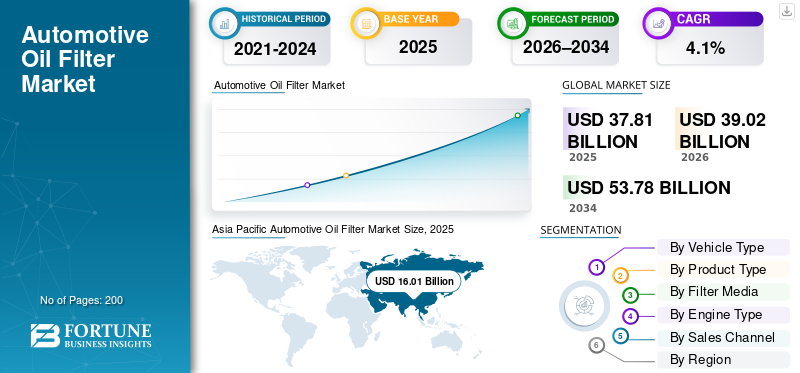
The global automotive oil filter market size was valued at USD 37.81 billion in 2025. The market is projected to grow from USD 39.02 billion in 2026 to USD 53.78 billion by 2034, exhibiting a CAGR of 4.1% during the forecast period. Asia Pacific dominated the automotive oil filter market with a market share of 42.34% in 2025.
The global market represents the demand for filtration components used to remove contaminants from engine oil in vehicles operating across the automotive industry. Oil filters play a critical role in protecting engine components by preventing dirt, metal particles, and sludge from circulating with lubricating oil. These products are used across multiple vehicle types, including passenger vehicles and commercial vehicles, and are essential for maintaining engine durability and fuel efficiency. The market covers oil filters used in internal combustion engines and hybrid vehicles across OEM and aftermarket channels.
Market growth is supported by the expanding global vehicle parc, rising average vehicle age, and the increasing demand for routine vehicle maintenance. Stricter emission standard regulations are encouraging automakers and service providers to adopt advanced filtration technology that supports cleaner combustion and engine efficiency. In addition, consumers are becoming increasingly aware of the benefits of timely oil filter replacement, contributing to a growing number of the demand for high quality filtration components. Growth is also influenced by improving service infrastructure in emerging markets, particularly in Asia Pacific and Latin America.
In the future, the market is expected to evolve through innovations in filtration systems and optimized filtration solutions that enhance oil flow efficiency while extending service intervals. While electric vehicles limit long-term growth potential, the continued dominance of ICE and hybrid vehicles ensures steady demand. Leading key players such as Bosch, Mann+Hummel and Denso are focusing on product innovation, capacity expansion, and strategic collaborations to strengthen their global presence.
Download Free sample to learn more about this report.
AUTOMOTIVE OIL FILTER MARKET KEY TAKEAWAYS
 Market Size & Forecast
- 2025 Market Size: USD 37.81 billion
- 2026 Market Size: USD 39.02 billion
- 2034 Forecast Market Size: USD 53.78 billion
- CAGR: 4.1% from 2026–2034
 Market Share
- Asia Pacific dominated the market with a 42.34% share in 2025.
- Spin-on oil filters led the product type segment in 2025.
- Cellulose media dominated the filter media segment in 2025.
 Key Regional Highlights
North America
North America is projected to reach USD 8.70 billion in 2026 and grow at a CAGR of 3.8%, driven by a large vehicle parc and aftermarket penetration.
Europe
Europe is expected to reach USD 8.36 billion in 2026, supported by strict emission regulations and demand for high-efficiency filtration systems.
Asia Pacific
Asia Pacific generated USD 16.01 billion in 2025 and held a 42.34% market share, supported by strong vehicle production and replacement demand.
U.S.
The market is projected to reach USD 6.21 billion in 2026, accounting for approximately 16.4% of global revenue.
Japan
The market is expected to witness steady growth, supported by routine vehicle maintenance and demand for advanced filtration technologies.
Read More

AUTOMOTIVE OIL FILTER MARKET TRENDS
Shift Toward Advanced and High-Efficiency Filtration Systems Pose as Market Trend
Manufacturers are increasingly focusing on enhanced filtration technology to meet stricter emission standard requirements and improve engine protection. Adoption of improved media and optimized filter designs supports longer service intervals and higher oil cleanliness, driving adoption of premium products.
- For instance, Donaldson introduced high-efficiency oil filters designed to improve engine protection in heavy-duty vehicles.
Download Free sample to learn more about this report.
MARKET DYNAMICS
MARKET DRIVERS
Rising Global Vehicle Parc Drives Oil Filter Replacement Demand
The expanding global vehicle population continues to drive increasing demand for automotive oil filters, as more vehicles require regular servicing throughout their operational life. Growth in passenger vehicles and commercial vehicles, especially across emerging markets, directly increases replacement cycles and aftermarket consumption. Enhanced awareness around engine protection and fuel efficiency further boosts adoption of advanced filtration systems.
- For instance, the International Organization of Motor Vehicle Manufacturers reported steady growth in global vehicles in operation, supporting long-term service part demand.
MARKET RESTRAINTS
Electrification of Vehicles Limits Long-Term Oil Filter Demand
The accelerating shift toward electric mobility presents a restraint for the oil filter market, as battery electric vehicles do not require engine oil filtration. Increasing policy support for EV adoption in Europe and parts of Asia reduces the ICE vehicle base over time. This transition negatively impacts future demand despite continued use in hybrids and commercial vehicles.
- For instance, the International Energy Agency highlighted rising EV penetration as a key disruptor to traditional engine-related components.
MARKET OPPORTUNITIES
Aftermarket Expansion in Emerging Economies Creates Growth Potential
Rapid motorization and aging vehicle fleets in emerging markets create strong opportunities for oil filter manufacturers. Limited penetration of organized service networks in Latin America, South Africa, and parts of Asia allows brands to expand aftermarket reach. Demand for affordable yet efficient filtration solutions supports long-term automotive oil filter market growth.
- For instance, Bosch expanded its aftermarket service offerings in India to cater to rising maintenance demand.
MARKET CHALLENGES
Raw Material Price Volatility Impacts Manufacturing Costs
Fluctuations in raw material prices such as steel and filter media increase production costs for manufacturers. This creates pricing pressure, especially in cost-sensitive emerging markets, limiting margin expansion and affecting long-term profitability across filtration systems suppliers.
- For instance, global steel price volatility has impacted automotive component manufacturers worldwide.
Segmentation Analysis
By Vehicle Type
Hatchbacks and Sedans Lead Global Demand
On the basis of vehicle type, the market is segmented into hatchback/sedan, SUVs, LCVs, and HCVs.
Hatchbacks/sedans dominate the market due to their large global presence and frequent maintenance cycles. These passenger vehicles account for the highest share of vehicles in operation, especially in emerging markets. High ownership levels and routine oil changes drive a large number of the demand for high quality oil filters, supporting consistent growth across the automotive industry.
- For instance, ACEA reports passenger cars account for the largest share of vehicles on European roads.
LCV segment is expected to grow at a CAGR of 5.6% over the forecast period.
To know how our report can help streamline your business, Speak to Analyst
By Product Type
Spin-On Filters Dominate Due to Universal Fitment
On the basis of product type, the market is segmented into spin-on oil filters, cartridge oil filters, magnetic oil filters, centrifugal oil filters, and others.
Spin-on oil filters dominate the market due to their simple installation, broad compatibility, and cost efficiency across multiple vehicle types. Their widespread use in passenger vehicles and commercial vehicles supports high replacement volumes. These filters are preferred in routine servicing as they support reliable filtration systems, improve fuel efficiency, and meet evolving emission standard requirements across global automotive platforms.
- For instance, Fram highlights spin-on oil filters as its most widely sold product category across global aftermarket channels.
Magnetic oil filters is expected to grow at a CAGR of 6.3% over the forecast period.
By Filter Media
Cellulose Media Leads Due to Cost Effectiveness
On the basis of filter media, the market is segmented into cellulose media, synthetic media, and blended media.
Cellulose media dominates due to its affordability and widespread adoption in standard filtration solutions. It is extensively used in mass-market vehicles where cost sensitivity remains high, particularly across Latin America and parts of Asia. Cellulose media supports efficient oil flow and contamination control, making it suitable for routine servicing in price-driven automotive applications.
- For instance, MANN+HUMMEL notes continued high demand for cellulose media in conventional engine oil filtration.
The synthetic media segment is expected to grow at a CAGR of 6.0% over the forecast period.
By Engine Type
ICE Vehicles Sustain Market Leadership
On the basis of engine type, the market is segmented into ICE and hybrid.
Internal Combustion Engine (ICE) vehicles dominate the market as they continue to represent the majority of the global vehicle parc. ICE vehicles rely heavily on oil filtration to maintain performance and fuel efficiency. Despite rising electrification, the large installed base of ICE vehicles ensures sustained demand for oil filters across diverse vehicle types and usage conditions.
- For instance, OICA data shows internal combustion vehicles continue to dominate global vehicles in operation.
Hybrid segment is expected to grow at a CAGR of 6.7% over the forecast period.
By Sales Channel
Aftermarket Dominates Through Replacement Cycles
On the basis of sales channel, the market is bifurcated into OEM and aftermarket.
The aftermarket dominates due to frequent oil filter replacement throughout a vehicle’s lifespan. Aging fleets and increasing maintenance awareness among consumers drive higher service demand. Independent workshops and authorized service centers rely on advanced filtration technology to meet performance needs, strengthening aftermarket leadership across both passenger vehicles and commercial vehicles globally.
- For instance, Bosch states that aftermarket demand is driven by aging vehicles and regular servicing requirements.
The aftermarket segment is expected to grow at a CAGR of 4.2% over the forecast period.
Automotive Oil Filter Market Regional Outlook
By region, the global market is categorized into North America, Europe, Asia Pacific, and the rest of the world.
Asia Pacific
Asia Pacific Automotive Oil Filter Market Size, 2025 (USD Billion)
To get more information on the regional analysis of this market, Download Free sample
Asia Pacific held the dominant automotive oil filter market share in 2025, valuing at USD 16.01 billion, and also maintained the leading share in 2024, with USD 15.56 billion. Asia Pacific dominates the market due to its extensive vehicle population and strong growth in passenger vehicles and commercial vehicles. Rapid urbanization, rising disposable income, and improving service infrastructure support high oil filter replacement rates. Countries such as China and India drive significant volume, while increasing awareness of filtration systems and fuel efficiency sustains growth across key emerging markets in the region.
- For instance, OICA reports Asia Pacific accounts for the largest share of global vehicle production and parc.
China Automotive Oil Filter Market
China’s market is projected to be one of the largest worldwide, with 2025 revenues recorded at around USD 7.28 billion, representing roughly 19.3% of the global market.
India Automotive Oil Filter Market
India market in 2025 was valued at around USD 2.14 billion, accounting for roughly 5.7% of global revenues.
North America
North America is projected to record a growth rate of 3.8% in the coming years, and reach a valuation of USD 8.70 billion by 2026. North America is expected to grow steadily due to a mature vehicle parc and strong aftermarket penetration. High ownership of SUVs and light trucks increases servicing frequency. The U.S. market remains stable, supported by regular maintenance practices, premium filtration solutions, and consumer focus on vehicle performance and compliance with emission standard norms.
U.S. Automotive Oil Filter Market
Based on North America’s strong contribution and the U.S. dominance within the region, the U.S. market can be analytically approximated at around USD 6.21 billion by 2026, representing roughly 16.4% of the global market.
Europe
Europe is estimated to reach USD 8.36 billion in 2026 and secure the position of the third-largest region in the market. Europe will witness moderate growth due to strict emission standard enforcement and demand for high-efficiency filtration technology. Although electrification limits long-term expansion, routine maintenance of ICE and hybrid vehicles continues to support oil filter demand across key automotive manufacturing economies.
Germany Automotive Oil Filter Market
The Germany market in 2025 was valued at around USD 2.31 billion, accounting for roughly 6.1% of global revenues.
U.K. Automotive Oil Filter Market
The U.K. market in 2025 was recorded at around USD 1.89 billion, accounting for roughly 5.0% of global revenues.
Rest of the World
The rest of the world, including the Middle East & Africa and Latin America, is expected to grow due to rising vehicle ownership and aging fleets. Markets such as South Africa benefit from increasing service activity, expanding aftermarket networks, and improving access to affordable filtration systems.
COMPETITIVE LANDSCAPE
Key Industry Players
Competitive Strategies Focused on Innovation and Global Expansion
The competitive landscape of the global automotive oil filter market is characterized by the presence of multinational manufacturers and regional suppliers offering a wide range of filtration solutions. Leading companies compete based on product quality, pricing, brand reputation, and the ability to meet evolving emission standard requirements. Continuous investment in filtration technology enables manufacturers to improve efficiency and durability across different vehicle types, including passenger vehicles and commercial vehicles.
Major key players adopt strategies such as product portfolio expansion, aftermarket penetration, and geographic expansion in emerging markets. Many companies are investing in lightweight materials and optimized designs to enhance fuel efficiency while ensuring compliance with environmental regulations. Partnerships with OEMs and distributors are also critical to strengthening supply chains and reducing dependency on volatile raw material costs. Digitalization of sales channels and improved distribution networks further support competitive advantage.
- For instance, in April 2024, Mann+Hummel announced expansion of its filtration product portfolio to support next-generation engines, strengthening its global aftermarket position.
LIST OF KEY AUTOMOTIVE OIL FILTER COMPANIES PROFILED
- Bosch (Germany)
- Mann+Hummel (Germany)
- Denso (Japan)
- MAHLE (Germany)
- Fram (U.S.)
- Donaldson (U.S.)
- Cummins Filtration (U.S.)
- Hengst (Germany)
- ACDelco (U.S.)
- Toyota Boshoku (Japan)
KEY INDUSTRY DEVELOPMENTS
- June 2025: Premium Guard opened a 377,000-square-foot distribution center in Weirton, West Virginia, enhancing its aftermarket supply capabilities. The expansion supports improved availability of oil filters and fuel filter products and reflects the company’s strategic partnership approach with logistics providers to strengthen distribution efficiency across North America.
- May 2025: Premium Guard partnered with Procter & Gamble to produce Febreze-branded cabin air filters, demonstrating cross-industry branding and expanding product reach.
- March 2025: Purolator introduced its 20K Premium Oil Filter, engineered with advanced synthetic-blend filtration technology to support extended drain intervals. Launched through a strategic partnership with major retail channels, the product complements Purolator’s broader portfolio, including fuel filter offerings, and targets rising demand for high-performance aftermarket filtration solutions.
- March 2024: Atmus Filtration Technologies completed its separation from Cummins, allowing the filtration specialist to pursue focused growth in filtration solutions and aftermarket expansion worldwide.
- March 2024: Following separation from Cummins, Atmus consolidated its global identity and strengthened its brand focus on advanced filtration technology for automotive and industrial markets.
- March 2024: The Biden-Harris Administration finalized stringent emissions standards for passenger cars and light-duty trucks for model years 2027-2032, indirectly boosting demand for higher-efficiency filtration technology in oil filters to help engines meet new performance and emissions targets.
- February 2024: Cummins officially announced plans to spin out Atmus Filtration Technologies through a stock exchange offer, further shaping the competitive landscape of filtration businesses.
REPORT COVERAGE
The global automotive oil filter market analysis provides an in-depth study of market size & forecast by all the market segments included in the report. It includes details on the market dynamics and market trends expected to drive the market in the forecast period. It offers information on the technological advancements, new product launches, key industry developments, and details on partnerships, mergers & acquisitions. The research report also encompasses detailed competitive landscape with information on the market share and profiles of key operating players.
Request for Customization to gain extensive market insights.
Report Scope & Segmentation
| ATTRIBUTE | DETAILS |
| Study Period | 2021-2034 |
| Base Year | 2025 |
| Estimated Year | 2026 |
| Forecast Period | 2026-2034 |
| Historical Period | 2021-2024 |
| Growth Rate | CAGR of 4.1% from 2026-2034 |
| Unit | Value (USD Billion) |
| Segmentation | By Vehicle Type, Product Type, Filter Media, Engine Type, Sales Channel, and Region |
| By Vehicle Type |
|
| By Product Type |
|
| By Filter Media |
|
| By Engine Type |
|
| By Sales Channel |
|
| By Region |
|
Frequently Asked Questions
Fortune Business Insights says that the global market value stood at USD 37.81 billion in 2025 and is projected to reach USD 53.78 billion by 2034.
In 2025, Asia Pacifics market value stood at USD 16.01 billion.
The market is expected to exhibit a CAGR of 4.1% during the forecast period.
Hatchback/sedan segment led the market by vehicle type.
The rising global vehicle parc drives oil filter replacement demand which is driving the global market.
Denso, Mann+Hummel, Bosch, and MAHLE are some of the top players in the market.
Asia Pacific dominated the market in 2025 by holding the largest share.



- 2021-2034
- 2025
- 2021-2024
- 200
-
(Offer valid till 30th Sep 2026)
Get 30-60 hrs Free Customization
Expand Regional and Country Coverage, Segments Analysis, Company Profiles, Competitive Benchmarking, and End-user Insights.




















Related Reports
-
US +1 833 909 2966 ( Toll Free )
-
Get In Touch With Us