Automotive Paint Protection Films Market Size, Share & Industry Analysis, By Type (Thermoplastic Polyurethane (TPU), Polyvinyl Chloride (PVC), and Others), By End-Use (OEMs and Aftermarket), By Vehicle Type (Passenger Vehicles, Commercial Vehicles, and Others), and Regional Forecast, 2026-2034
 Download Free Sample
Automotive Paint Protection Films Market Size and Future Outlook
 Listen to Audio Version
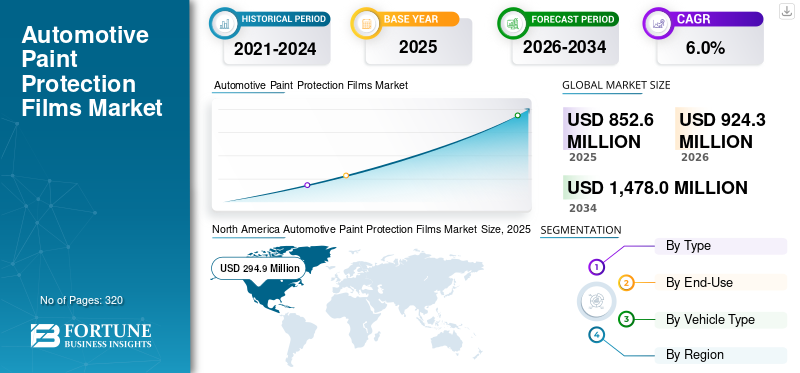
The automotive paint protection films market size was valued at USD 852.6 million in 2025. The market is projected to grow from USD 924.3 million in 2026 to USD 1,478.0 million by 2034, at a 6.0% CAGR during the forecast period. North America dominated the global market with a market share of 34.58% in 2025.
Automotive paint protection film is a transparent or finish-enhancing polymer film applied over painted vehicle surfaces to protect the original paint from stone chips, scratches, road debris, insect stains, bird droppings, UV exposure, and minor abrasions. It is commonly made using flexible thermoplastic polyurethane-based film structures that can conform to curved exterior panels without affecting paint color, gloss, or surface appearance. As it works as a protective layer over factory paint, it is widely used on hoods, bumpers, fenders, side mirrors, door edges, rocker panels, wheel arches, and other high-impact exterior areas.
The market growth is driven by growing demand for passenger and luxury vehicles from across the world is expected to increase the demand from the automotive sector. Moreover, increasing adoption of paint protective films for protecting the exterior of electronic devices from chemicals, harsh environments, water, and other fluids, abrasion, and scratches is anticipated to aid market growth. The low maintenance cost of PPFs is anticipated to boost the demand from the electronics sector.
Furthermore, the market comprises several major players, including XPEL, Inc., Eastman Chemical Company, 3M, Garware Hi-Tech Films, and Avery Dennison Corporation.
Download Free sample to learn more about this report.
AUTOMOTIVE PAINT PROTECTION FILMS MARKET TRENDS
Growing Use of PPF on Electric and Premium Vehicles is a Significant Market Trend
The market is gaining traction as electric vehicles, premium SUVs, and luxury cars become a larger part of new vehicle sales. EV buyers and high-value vehicle owners are increasingly investing in PPF to protect painted panels, bumpers, mirrors, door edges, and high-impact areas from stone chips, insects, weathering, and road debris. Global electric car sales exceeded 17 million units in 2024, strengthening the addressable vehicle base for premium protective solutions. As consumers focus on vehicle appearance, resale value, and long-term paint preservation, PPF adoption is moving beyond enthusiast vehicles toward broader dealer, detailing, and aftermarket channels.
MARKET DYNAMICS
MARKET DRIVERS
Download Free sample to learn more about this report.
Increasing Vehicle Miles and Road Exposure to Drive Aftermarket Installation
Rising road travel and higher vehicle usage are driving automotive paint protection films market growth, as vehicles face frequent exposure to gravel, sand, asphalt particles, road salt, insects, tar, and minor surface abrasion. This makes PPF more relevant for owners who regularly drive on highways, intercity roads, construction zones, and urban routes where exterior paint damage gradually builds up over time.
Paint protection films are especially useful for vehicles exposed to long-distance commuting, ride-sharing, fleet usage, road trips, and performance driving. High-impact areas such as front bumpers, hoods, fenders, mirrors, rocker panels, lower doors, wheel arches, and door cups are more likely to suffer paint chips and visible surface wear, encouraging customers to choose partial or full-body film coverage. The scale of road mobility supports this demand.
- According to the U.S. Department of Transportation’s Federal Highway Administration, total U.S. motor vehicle travel reached around 3.25 trillion vehicle-miles in 2023, highlighting the heavy road exposure that creates demand for exterior protection, paint damage prevention, and aftermarket maintenance solutions across driving-intensive markets.
MARKET RESTRAINTS
High Installation Cost and Skilled Labor Dependence to Restrain Market Growth
PPF requires premium film materials, panel-level surface preparation, precision cutting, adhesive handling, and careful finishing, which increases the total service cost for end users, especially for full-body or multi-panel coverage. Cost pressure is also amplified by the labor-intensive nature of the installation process. Unlike simple coating or detailing services, PPF installation requires trained technicians who can work around curved bumpers, hoods, mirrors, fenders, door edges, rocker panels, and complex body contours. Poor application can cause bubbles, visible edges, stretch marks, adhesive defects, or lifting, making professional installation essential for quality results.
- A government labor benchmark illustrates why skilled service costs can remain a barrier for wider adoption. The U.S. Bureau of Labor Statistics reported that automotive body and related repairers recorded a mean hourly wage of USD 26.55 in May 2023, showing the cost pressure linked with skilled automotive surface repair and installation-related work.
MARKET OPPORTUNITIES
Advancement in Self-Healing and Functional Films to Create Significant Growth Opportunities
New-generation PPF products with improved scratch recovery, optical clarity, stain resistance, hydrophobic surfaces, UV stability, and yellowing resistance allow suppliers to address customers seeking both paint protection and premium exterior appearance. Functional film innovation also supports wider customization across vehicle categories. Matte, gloss, satin, color-tinted, and ceramic-enhanced protection films allow vehicle owners to protect painted surfaces while enhancing exterior styling. These solutions are especially relevant for luxury cars, sports vehicles, electric vehicles, and customized models where owners place a higher value on finish quality, paint depth, and long-term surface appearance. The growing adoption of electric vehicles is expanding the base of advanced vehicle platforms where premium exterior protection can gain relevance.
- According to the U.S. Department of Energy, more than 1.4 million electric vehicles were sold in the U.S. in 2023, reflecting a significant year-on-year increase. This creates opportunities for high-performance films designed for EV body panels, painted bumpers, charging-port areas, and premium exterior finishes.
MARKET CHALLENGES
Installation Complexity and Limited Skilled Installer Availability Can Affect Market Penetration
The market faces challenges due to the technical nature of film installation. PPF application requires surface cleaning, correct installation solutions, stretch control, edge finishing, pattern accuracy, and proper post-installation maintenance. Limited availability of trained installers can restrict adoption, especially in developing markets where professional detailing networks are still expanding. XPEL highlights that expert installation requires hands-on training and certification, while 3M provides detailed installation guidelines and recommends expert installer support. If installation quality is poor, customers may experience bubbles, edge lifting, visible seams, or lower durability, which can reduce confidence in premium PPF solutions.
Segmentation Analysis
By Type
Thermoplastic Polyurethane Segment to Generate High Revenue Due to its Exceptional Performance
Based on type, the market is segmented into thermoplastic polyurethane (TPU), polyvinyl chloride (PVC), and others.
The thermoplastic polyurethane (TPU) segment accounted for the largest automotive paint protection films market share in 2025. The segment's growth is driven by its key performance properties required in modern automotive protection, including self-healing, optical clarity, flexibility, anti-yellowing performance, hydrophobic surface behavior, and resistance to stone chips, scratches, stains, road debris, and weathering. This makes TPU more suitable for premium cars, SUVs, EVs, sports cars, and luxury vehicles where owners are focused on long-term paint preservation and resale-value protection. Furthermore, the segment held a 91.3% share in 2025.
The polyvinyl chloride (PVC) segment is expected to grow significantly. The segment still has relevance in price-sensitive markets where customers look for basic scratch and chip protection at a lower upfront cost, especially in entry-level aftermarket channels. However, PVC films generally have weaker self-healing ability, lower flexibility, shorter durability, and comparatively lower clarity than TPU-based PPF. The segment is projected to grow at around a 2.2% CAGR during the forecast period.
By End-Use
Aftermarket Segment to Hold a Significant Share Due to High Demand from New-car Owners
By end-use, the market is categorized into OEMs and aftermarket.
The aftermarket accounted for the largest share in 2025. New-car owners are more willing to protect factory paint before the vehicle is exposed to road debris, stone chips, scratches, insects, salt, sand, and parking damage. Dealerships, detailing studios, and certified installers actively promote partial-front, full-front, track-package, and full-body protection packages to buyers of premium cars, EVs, SUVs, luxury vehicles, and sports cars.
The OEMs segment is also expected to grow favorably over the projected period. The segment's demand is driven by premium automakers, EV brands, and dealership networks exploring factory-approved or OEM-backed PPF packages for high-value models. OEMs and dealers can position PPF as an accessory revenue opportunity while also helping customers protect factory paint from early damage. The segment is expected to grow at around a 6.1% CAGR over the forecast period.
By Vehicle Type
To know how our report can help streamline your business, Speak to Analyst
Passenger Vehicles Dominates Due to Increase in Demand for OEM Light Vehicles
By vehicle type, the market is categorized into passenger vehicles, commercial vehicles, and others.
The passenger vehicles segment accounted for the largest share in 2025. The growth of this segment is due to installations that are mainly concentrated in privately owned cars, SUVs, EVs, premium sedans, luxury cars, and sports vehicles. Owners of these vehicles are more willing to invest in paint protection as exterior appearance directly affects pride of ownership, resale value, and long-term maintenance costs. Furthermore, the segment held 86.8% share in 2025.
Commercial vehicles are expected to grow at a moderate pace as PPF adoption is more selective and value-driven in this segment. The demand mainly comes from premium pickup trucks, light commercial vehicles, service vans, delivery vehicles, branded fleets, and utility vehicles where exterior appearance, brand image, or resale value matters. The segment is expected to grow at around a 4.0% CAGR over the forecast period.
Automotive Paint Protection Films Market Regional Outlook
By geography, the market is categorized into North America, Europe, Asia Pacific, South America, Australia, the Middle East, and Africa.
North America
North America Automotive Paint Protection Films Market Size, 2025 (USD Million)
To get more information on the regional analysis of this market, Download Free sample
North America held the dominant share in 2025 and reached USD 294.9 million. The market's growth is driven by strong adoption among premium vehicles, SUVs, pickup trucks, EVs, sports cars, and luxury vehicles. The region has a mature aftermarket ecosystem with certified installers, detailing studios, dealership accessory programs, and strong consumer awareness of paint protection.
U.S. Automotive Paint Protection Films Market
In 2026, the U.S. market is estimated to reach USD 273.6 million. The country’s leadership is supported due to its high vehicle ownership, strong premium SUV and pickup truck base, mature detailing industry, and widespread awareness of PPF. New-car buyers often install PPF immediately after purchase to protect factory paint from stone chips, insects, snow, salt, and highway debris.
To know how our report can help streamline your business, Speak to Analyst
Asia Pacific
Asia Pacific is also a significant contributor to the market, valued at approximately USD 272.0 million in 2025. The region’s dominance is rising premium vehicle ownership, growing EV penetration, and rapid development of automotive detailing networks. China, India, Japan, South Korea, and Southeast Asia provide a broad addressable market as new-car buyers increasingly look to protect vehicles from scratches, road debris, dust, parking damage, and resale-value loss. Additionally, local and regional PPF suppliers are widening product availability across premium and economy price points, which helps improve market access.
China Automotive Paint Protection Films Market
In 2026, the China market is estimated to reach USD 161.5 million. China's market growth is supported due to its huge vehicle sales base, rapid EV adoption, premium vehicle growth, and expanding detailing studio network. New-car buyers, especially EV and luxury vehicle owners, increasingly use PPF to protect paint from scratches, dust, parking damage, road debris, and urban driving we.
India Automotive Paint Protection Films Market
The India market in 2026 is estimated at around USD 33.5 million, representing approximately 3.6% of global market revenue.
Japan Automotive Paint Protection Films Market
Japan market is projected to reach approximately USD 28.1 million in 2026, accounting for about 3.0% of global sales.
Australia
Australia will observe healthy demand for automotive PPF due to harsh environmental and driving conditions, including strong UV exposure, gravel roads, highway debris, insects, and long-distance travel. These factors make paint protection especially relevant for SUVs, 4x4s, EVs, premium passenger cars, and lifestyle vehicles. Consumers often install PPF shortly after purchasing a new vehicle to protect factory paint and maintain resale value. Additionally, Australia has strong demand from outdoor and touring vehicle users, where stone chips and road damage are common. The market remains aftermarket-led, with detailing studios and dealerships promoting partial-front, full-front, and high-impact-area packages.
Europe
Europe is expected to experience steady growth in the coming years. During the forecast period, the European region is projected to grow at approximately 4.9%, and reached a valuation of USD 161.2 million in 2025. The demand, mainly driven by premium vehicle ownership and increasing focus on paint preservation among luxury cars, EVs, sports cars, and high-value SUVs. Germany, the U.K., France, and Italy remain important demand centers as premium vehicle buyers are more willing to invest in full-front and high-impact-area protection packages.
U.K. Automotive Paint Protection Films Market
The U.K. market in 2026 is estimated at around USD 34.7 million, representing approximately 4.2% of global market revenue.
Germany Automotive Paint Protection Films Market
Germany’s market is projected to reach approximately USD 42.8 million in 2026, accounting for about 5.2% of global sales.
South America
South America will expand gradually, with demand concentrated in premium vehicles, imported cars, luxury SUVs, and high-income urban markets. Brazil and Argentina remain the main demand centers, where vehicle owners use PPF to protect paint from road debris, scratches, parking damage, and environmental exposure. The demand is highly aftermarket-led, with most installations taking place through detailing studios and selected dealerships rather than OEM programs
Brazil Automotive Paint Protection Films Market
Brazil’s market reached approximately USD 18.94 million in 2026, equivalent to around 2.0% of global sales
Middle East
The Middle East will continue gaining momentum due to high luxury vehicle ownership, harsh climate conditions, sand exposure, intense sunlight, and strong consumer focus on vehicle appearance. The UAE and wider GCC markets are particularly important as premium SUVs, sports cars, luxury sedans, and high-end EVs are often protected with full-front or full-body PPF packages.
UAE Automotive Paint Protection Films Market
UAE is expected to reach USD 24.9 million by 2026, accounting for approximately 2.7% of global revenues.
Africa
Africa will advance from a small base, with demand concentrated mainly in South Africa and selected premium urban markets. PPF adoption is led by owners of luxury vehicles, premium SUVs, and high-value passenger cars who want to protect paint from sunlight, road debris, dust, and scratches. South Africa is the most developed market due to its stronger automotive aftermarket and detailing ecosystem. The wider region remains early-stage, with demand focused mainly on aftermarket new vehicles and premium used vehicles.
South Africa Automotive Paint Protection Films Market
South Africa is expected to reach USD 8.0 million by 2026, accounting for approximately 0.9% of global revenues.
COMPETITIVE LANDSCAPE
Key Industry Players
Key Players Are Strengthening TPU Film Quality to Maintain Their Positions in Market
The market includes a mix of global diversified material companies, specialty automotive film manufacturers, aftermarket protection brands, regional film producers, and installation-network-led PPF companies that supply thermoplastic polyurethane (TPU)-based paint protection films, clear gloss films, matte films, satin films, colored PPF, hydrophobic top-coat films, and self-healing films for passenger cars, luxury vehicles, SUVs, EVs, commercial vehicles, and premium aftermarket applications. Competition is shaped by film durability, optical clarity, stain resistance, scratch and chip protection, yellowing resistance, adhesive performance, ease of installation, warranty coverage, digital pattern availability, installer training, dealer reach, and the ability to support localized installation networks.
Leading companies differentiate through premium PPF brands, advanced top-coat technologies, color and finish customization, certified installer programs, digital cutting software, wide product portfolios, and strong relationships with car detailing studios, dealerships, and aftermarket service providers. XPEL, Inc., Eastman Chemical Company, 3M, Garware Hi-Tech Films, and Avery Dennison Corporation are among the key players, supported by their established automotive film portfolios, global distribution capabilities, technology-led product positioning, and solutions designed to improve paint protection, vehicle appearance, installation efficiency, and long-term customer value.
LIST OF KEY AUTOMOTIVE PAINT PROTECTION FILMS COMPANIES PROFILED
- Eastman Chemical Company (U.S.)
- 3M (U.S.)
- XPEL, Inc. (U.S.)
- STEK Automotive (U.S.)
- HEXIS (France)
- ORAFOL Europe GmbH (Germany)
- Avery Dennison Corporation (U.S.)
- Garware Hi-Tech Films (India)
- Madico, Inc. (U.S.)
- Ceramic Pro (India)
KEY INDUSTRY DEVELOPMENTS
- June 2026: Avery Dennison Graphics Solutions launched PrismaPro Color Paint Protection Film in Mentor, Ohio (dry-apply color PPF with IntelliTack adhesive technology, 8.5 mil TPU protection, self-healing topcoat, 10 launch colors, and installer training support), signaling product portfolio expansion into high-value color PPF and vehicle restyling applications.
- May 2026: XPEL, Inc. announced an approximately USD 110.0 million manufacturing and supply chain investment, including the expansion of its San Antonio operations and the acquisition of a manufacturing facility in China.
- September 2025: Garware Hi-Tech Films commenced commercial production of its new Paint Protection Film line at Waluj, Chhatrapati Sambhaji Nagar, Maharashtra (300 LSF/P.A. capacity and estimated project cost of around USD 14.3 million), signaling PPF capacity expansion and stronger supply capability for automotive surface protection films.
- April 2025: Avery Dennison Graphics Solutions added Chris Figueroa and Sergey Yakobchak to its Paint Protection Film training team in North America (hands-on PPF training program with live demonstrations, real-world practice, and installation skill development), signaling stronger installer support and aftermarket channel development for PPF applications.
- February 2025: Garware Hi-Tech Films approved investment in India’s first-of-its-kind TPU extrusion line at its Waluj plant (USD 13.5 million investment, 360 LSF annual capacity, scheduled production by October 2026, and output intended to support existing and upcoming PPF production lines), signaling backward integration, cost optimization, and stronger raw-material control for PPF manufacturing.
- February 2025: Garware Hi-Tech Films introduced new PPF-related automotive solutions in India (Coloured PPF, Headlight & Taillight Glass Protection Film, Bajaj Finance EMI solutions, and Insurance Dekho PPF insurance coverage), signaling product diversification and improved accessibility for premium automotive paint protection applications.
REPORT COVERAGE
The global market analysis provides an in-depth study of market size & forecast by all the market segments included in the report. It includes details on market dynamics and trends expected to drive the market during the forecast period. It offers information on technological advancements, new product launches, key industry developments, and partnerships, mergers & acquisitions. The market research report also includes a detailed competitive landscape, providing market share and profiles of key players.
Request for Customization to gain extensive market insights.
Report Scope & Segmentation
| ATTRIBUTE | DETAILS |
| Study Period | 2021-2034 |
| Base Year | 2025 |
| Estimated Year | 2026 |
| Forecast Period | 2026-2034 |
| Historical Period | 2021-2024 |
| Growth Rate | CAGR of 6.0% from 2026 to 2034 |
| Unit | Value (USD Million) Volume (Million Sq.M) |
| Segmentation | By Type, End-Use, Vehicle Type, and Region |
| By Type |
|
| By End-Use |
|
| By Vehicle Type |
|
| By Region |
|
Frequently Asked Questions
Fortune Business Insights estimates that the global market size was USD 852.6 million in 2025 and is projected to reach USD 1,478.0 million by 2034.
Recording a CAGR of 6.0%, the market is slated to exhibit steady growth during the forecast period of 2026-2034.
The passenger vehicle type segment led the market.
North America held the highest market share in 2025.
XPEL, Inc., Eastman Chemical Company, 3M, Garware Hi-Tech Films, and Avery Dennison Corporation are some of the prominent players in the market.
The rising consumer focus on vehicle paint protection, resale value preservation, and premium vehicle appearance is driving growth in the global market.
The increasing adoption of self-healing TPU films, color and matte finish options, EV and luxury vehicle sales growth, expanding detailing networks, and improved digital cutting/installation technologies are expected to favor product adoption.



- 2021-2034
- 2025
- 2021-2024
- 320
Get 30-60 hrs Free Customization
Expand Regional and Country Coverage, Segments Analysis, Company Profiles, Competitive Benchmarking, and End-user Insights.


















Related Reports
-
US +1 833 909 2966 ( Toll Free )
-
Get In Touch With Us