Battery Passport Market Size, Share & Industry Analysis, By Battery Type (Lithium-ion Batteries, Solid-state Batteries, Lead-acid Batteries, and Others), By Application (Electric Vehicles, Energy Storage Systems, Consumer Electronics, and Industrial Applications), By Component (Software Platforms, Hardware, and Services), By Deployment Mode (Cloud-based and On-premise), By End User (Battery Manufacturers, Automotive OEMs, Energy Companies & Utilities, Recycling & Second-life Operators, and Regulatory Bodies/Certification Agencies), and Regional Forecast, 2026–2034
 Download Free Sample
(Offer valid till 30th Sep 2026)

Battery Passport Market Size and Future Outlook
 Listen to Audio Version
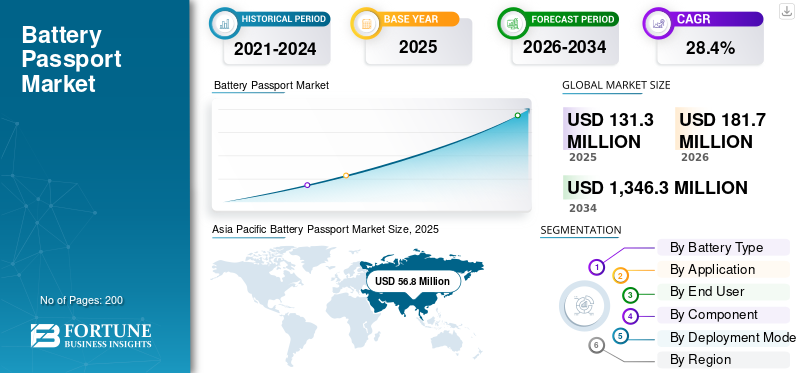
The global battery passport market size was valued at USD 131.3 million in 2025. The market is projected to grow from USD 181.7 million in 2026 to USD 1,346.3 million by 2034, exhibiting a CAGR of 28.4% during the forecast period. Asia Pacific dominated the battery passport market with a market share of 43.26% in 2025.
A battery passport is a digital record containing detailed lifecycle data of a battery, including origin, composition, performance, and recycling information, enabling transparency, traceability, sustainability, and regulatory compliance across the battery value chain. Market growth is driven by rising product demand, technological advancements, supportive batteries regulation, sustainability goals, increasing investments, evolving market trends, and expanding applications, strengthening overall market share and long-term industry development.
Major players in the market include Circulor, Everledger, IBM, SAP, Siemens, and CATL, competing through advanced digital tracking platforms, blockchain integration, lifecycle analytics, regulatory compliance solutions, and sustainability-focused battery data management systems.
Download Free sample to learn more about this report.
Battery Passport Market Key Takeaways
 Global Market Size & Forecast
- 2025 Market Size: USD 131.3 million
- 2026 Market Size: USD 181.7 million
- 2034 Forecast Market Size: USD 1,346.3 million
- CAGR: 28.4% from 2026-2034
 Market Share
- Asia Pacific dominated the battery passport market with a 43.26% share in 2025.
- The solid-state batteries segment is projected to grow at a CAGR of 35.2% during the forecast period.
- The energy storage systems segment is projected to grow at a CAGR of 30.7% during the forecast period.
 Key Regional Highlights
Asia Pacific
Asia Pacific led the market in 2025, driven by strong EV production, battery manufacturing, and sustainability initiatives.
Europe
Europe is projected to register the fastest growth, expanding at a CAGR of 31.0% during the forecast period.
North America
North America remains the third-largest regional market, supported by advanced digital infrastructure and battery management technologies.
U.S.
The market is estimated at USD 30.4 million in 2026, accounting for approximately 16.7% of global revenues.
Japan
The market is estimated at USD 3.8 million in 2026, representing around 2.1% of global revenues.
Read More

BATTERY PASSPORT MARKET TRENDS
Advancements in Blockchain and Digital Technologies Enhancing Data Transparency Drives Market Growth
The integration of blockchain, IoT, and AI technologies is transforming systems by enabling secure, real-time, and tamper-proof data tracking. These innovations improve transparency across the battery value chain, from raw material sourcing to end-of-life recycling. Market trends indicate a shift toward decentralized data platforms that ensure trust and traceability. Companies are leveraging these technologies to gain a competitive advantage and improve operational efficiency. This technological evolution is playing a key role in shaping the future of the market.
- In September 2025, Tata Technologies launched WATTSync, a cloud-based digital passport platform for battery use, using AI-driven battery health monitoring and blockchain-secured data layers, enabling lifecycle tracking, QR-based compliance, and alignment with EU Battery Regulation requirements effective February 2027.
Increasing Collaboration across Battery Value Chain Stakeholders Upscale Market Trends
Stakeholders, including OEMs, battery manufacturers, recyclers, and technology providers, are increasingly collaborating to develop standardized battery passport ecosystems. Partnerships and consortiums are emerging to address interoperability challenges and establish unified data-sharing frameworks. This trend is strengthening market analysis by enabling seamless data exchange and improving overall system efficiency. Collaborative efforts are also accelerating innovation and reducing duplication of efforts. As ecosystem integration improves, it is expected to enhance the scalability and effectiveness of battery passport solutions significantly.
- In February 2026, CATL and BMW signed an MOU to advance battery passport integration using Catena-X, focusing on cross-border data exchange, carbon footprint accounting tools, and standardized data ecosystems to ensure EU compliance and supply chain decarbonization.
MARKET DYNAMICS
MARKET DRIVERS
Download Free sample to learn more about this report.
Stringent Regulatory Frameworks Accelerate Market Growth
Governments, especially in Europe, are mandating passports to enhance transparency and sustainability across the battery lifecycle. Regulations such as the EU Battery Regulation require detailed tracking of battery origin, composition, and carbon footprint. This regulatory push is significantly increasing demand for digital tracking platforms and compliance solutions. As global policymakers align with climate goals, similar frameworks are emerging in other regions, further strengthening market growth and ensuring widespread adoption across automotive and energy storage sectors.
- In October 2025, the EU entered the final year before mandatory battery passport compliance, requiring QR-linked digital records with lifecycle, carbon footprint, and supply chain data, pushing manufacturers to upgrade data systems and ensure full traceability before the February 2027 deadline.
Rising Focus on Circular Economy and Battery Recycling Practices Elevates Market Growth
The growing emphasis on circular economy principles is driving the adoption of passports to enable efficient recycling and second-life applications. Companies are increasingly required to track battery materials to optimize reuse and recovery. This shift is enhancing battery passport market growth by creating demand for lifecycle data management solutions. These passports facilitate better resource utilization, reduce environmental impact, and support sustainability goals. As industries prioritize waste reduction and material traceability, this trend is significantly boosting long-term market expansion.
- In January 2023, the Global Battery Alliance launched the first battery passport proof of concept, creating a digital twin capturing material provenance, carbon footprint, and lifecycle data to support circular economy initiatives and enable standardized, auditable sustainability tracking across global battery value chains.
MARKET RESTRAINTS
High Implementation Costs and Data Standardization Issues Hinder Adoption
The deployment of passport systems involves high initial costs related to digital infrastructure, data integration, and compliance mechanisms. Additionally, the lack of standardized data formats and interoperability across regions creates challenges for seamless implementation. These factors can limit adoption, particularly among small and mid-sized players. Variations in regulatory requirements across countries further complicate global scalability. As a result, despite strong market growth potential, these barriers may slow down widespread implementation in the early stages.
MARKET OPPORTUNITIES
Expansion of the Electric Vehicle Industry Creates New Growth Opportunities
The rapid expansion of the electric vehicle industry is creating significant opportunities for battery passport adoption. As EV production increases, the need for transparent battery tracking systems becomes critical. Passports support compliance, enhance consumer trust, and enable efficient lifecycle management. This growth is directly influencing demand and opening new revenue streams for technology providers. With EV adoption accelerating globally, the market is expected to witness substantial opportunities driven by increased battery usage.
- In 2024, IEA reports that global electric car sales surpassed 17 million units, increasing by over 25%, with the additional 3.5 million units sold exceeding total electric vehicle sales recorded in 2020, highlighting accelerating electrification trends.
Emergence of Second-Life Battery Applications May Unlock New Revenue Streams
Second-life applications of EV batteries in energy storage systems are gaining traction, creating new opportunities for battery passport solutions. These applications require detailed data on battery health, performance, and history, which passports can provide. This is driving market growth by enabling better asset utilization and extending battery lifespan. Energy companies and utilities are increasingly adopting such solutions to optimize storage efficiency. As second-life battery usage expands, it will play a crucial role in shaping future market dynamics.
- In February 2026, OMC Power launched second-life EV battery energy storage systems using retired Honda batteries, integrating them into UPS and hybrid solar solutions, with assembly in Manesar, and plans to build a 1 GWp renewable portfolio by 2030.
MARKET CHALLENGES
Data Privacy and Cybersecurity Concerns Impact Market Expansion
As battery passports rely on extensive data collection and sharing, concerns around data privacy and cybersecurity are becoming significant challenges. Sensitive information related to supply chains and proprietary technologies must be securely managed. Any data breach can undermine trust and hinder adoption. Companies must invest in robust cybersecurity frameworks to protect data integrity. Addressing these concerns is critical for sustaining market growth and ensuring the long-term reliability of systems across global markets.
Segmentation Analysis
By Battery Type
High EV Deployment and Regulatory Focus to Drive Lithium-ion Batteries Segment Dominance
Based on battery type, the market is segmented into lithium-ion batteries, solid-state batteries, lead-acid batteries, and others.
The lithium-ion batteries segment dominates the market due to its widespread adoption in electric vehicles and energy storage systems. This segment growth is driven by high energy density, longer lifecycle, and established supply chains. Regulatory mandates and sustainability goals further support market growth. OEMs and battery manufacturers prioritize lithium-ion technologies, strengthening market share and ensuring consistent deployment across applications.
The solid-state batteries segment is set to grow at a CAGR of 35.2% during the forecast period. Advancements in safety, higher energy density, and next-generation battery innovations are driving segment growth, supported by increasing R&D investments and evolving market trends.
- In February 2026, Karma Automotive and Factorial launched the first U.S. solid-state battery program, integrating FEST high-energy electrolyte technology into EVs, enabling extended range, 80% manufacturing compatibility with lithium-ion lines, and improved performance efficiency.
To know how our report can help streamline your business, Speak to Analyst
By Application
Surging EV Adoption and Regulatory Push to Strengthen Electric Vehicles Segment
Based on application, the market is segmented into electric vehicles, energy storage systems, consumer electronics, and industrial applications.
The electric vehicles segment dominates the market due to rapid global EV adoption and strong regulatory support for battery traceability. Increasing demand for sustainable mobility, coupled with OEM integration of passports, is driving segment growth. Large-scale battery usage, stringent compliance requirements, and rising production volumes enhance market share. Continuous advancements in EV ecosystems and infrastructure further reinforce dominance.
The energy storage systems segment is projected to grow at a CAGR of 30.7% during the forecast period. Rising renewable energy integration and grid-scale storage needs are accelerating segment growth, supported by evolving market trends toward decentralized and sustainable energy systems.
- In April 2025, Farasis Energy launched a battery passport pilot integrating QR-based traceability, structured data governance, and lifecycle compliance systems, aligned with EU regulations and China’s national platform to enable cross-border interoperability and transparent battery lifecycle management.
By End User
Central Role in Battery Data Generation to Drive Battery Manufacturers Segment Growth
Based on end user, the market is segmented into battery manufacturers, automotive OEMs, energy companies & utilities, recycling & second-life operators, and regulatory bodies/certification agencies.
Battery manufacturers dominate the market as they are the primary source of battery data across the lifecycle. High demand for traceability, performance monitoring, and compliance reporting drives adoption. These players integrate passport systems at the production stage, strengthening market share. Increasing production volumes and regulatory requirements further support market growth, making manufacturers central to data standardization during the forecast period.
- In December 2025, Joycube launched the first LMT battery passport using blockchain architecture, integrating over 150 data points, including carbon footprint modeling, ESG tracking, and lifecycle traceability to ensure compliance with EU Regulation 2023/1542 ahead of 2027 requirements.
The energy companies & utilities segment is projected to grow at a CAGR of 30.8% during the forecast period. Expanding grid-scale storage and renewable energy integration are accelerating market growth, supported by evolving market trends toward efficient battery lifecycle management and energy optimization.
By Deployment Mode
Scalability and Real-time Data Access to Boost Cloud-based Segment Dominance
Based on deployment mode, the market is segmented into cloud-based and on-premise.
The cloud-based segment dominates the market due to its scalability, flexibility, and ability to enable real-time data access across the battery value chain. Increasing demand for centralized data management, seamless updates, and integration with advanced analytics tools is driving market growth. Cloud platforms support multi-stakeholder collaboration, enhancing market share. As digitalization accelerates, cloud adoption continues to rise, supported by evolving market trends during the forecast period.
- In February 2026, Sigma Technology Origo launched Origo Product Cloud, a digital platform enabling EU compliance with real-time lifecycle data integration, regulatory validation rules, and secure role-based access ahead of the February 2027 mandate.
The on-premise segment is projected to grow at a CAGR of 26.5% during the forecast period. Organizations with strict data control and security requirements are driving market expansion, particularly in regulated industries prioritizing data sovereignty and internal infrastructure management.
By Component
Rising Demand for Digital Tracking and Analytics to Propel the Software Platforms Segment Growth
Based on component, the market is segmented into software platforms, hardware, and services.
The software platforms segment dominates the market due to its critical role in managing, analyzing, and sharing battery lifecycle data. Increasing demand for digital traceability, compliance management, and real-time analytics is driving market growth. These platforms enable seamless integration across stakeholders, strengthening market share. Continuous innovation in AI, blockchain, and data analytics further supports adoption, aligning with evolving market trends during the forecast period.
The services segment, holding the second-largest share, is projected to grow at a CAGR of 28.0% during the forecast period. Rising demand for system integration, consulting, and maintenance services is accelerating market growth, as organizations seek efficient deployment and optimization of solutions.
Battery Passport Market Regional Outlook
By geography, the market is categorized into Europe, North America, Asia Pacific, and the Rest of the World.
Asia Pacific
Asia Pacific Battery Passport Market Size, 2025 (USD Million)
To get more information on the regional analysis of this market, Download Free sample
Asia Pacific holds the largest battery passport market share, driven by high electric vehicle production, strong battery manufacturing ecosystems, and government-led sustainability initiatives. Countries such as China, Japan, and South Korea are leading contributors, supported by favorable policies and investments in battery traceability systems. Increasing demand for compliance and lifecycle transparency is accelerating adoption. The region’s dominance is further reinforced by expanding supply chains, rising energy storage deployments, and continuous technological advancements during the forecast period.
- In September 2025, Tata Technologies launched WATTSync, a digital battery passport leveraging AI and blockchain for end-to-end EV battery traceability, with pilot projects involving Agratas and Jaguar Land Rover to enhance compliance, sustainability, and lifecycle data management.
China Battery Passport Market
The Chinese market in 2026 is estimated at around USD 59.5 million, accounting for roughly 32.8% of global revenues. Strong EV ecosystem, regulatory push, and digital traceability adoption drive market growth.
Japan Battery Passport Market
The Japan market in 2026 is estimated at around USD 3.8 million, accounting for roughly 2.1% of global revenues. Advanced battery technologies, OEM initiatives, and compliance readiness support steady market growth.
India Battery Passport Market
The India market in 2026 is estimated at around USD 4.7 million, accounting for roughly 2.6% of global revenues. Rapid EV adoption, policy development, and digital infrastructure expansion drive the fastest market growth.
Europe
Europe is the fastest-growing region, projected to expand at a CAGR of 31.0% during the forecast period. The region’s growth is driven by strict regulatory frameworks such as the EU Battery Regulation, mandating battery passports. Strong focus on circular economy principles and carbon footprint reduction is boosting market growth. Increasing collaboration among OEMs, technology providers, and regulatory bodies is shaping market trends. These factors collectively support rapid market growth and innovation across the battery value chain.
- In January 2025, AVL launched its Digital Battery Passport, a cloud-based platform integrating lifecycle data, carbon footprint optimization, and supply chain compliance, using secure authentication and IT integration to exceed EU Battery Regulation requirements ahead of the 2027 mandate.
Germany Battery Passport Market
The Germany market in 2026 is estimated at around USD 12.0 million, accounting for roughly 6.6% of global revenues. Strict EU regulations, strong OEM presence, and sustainability focus accelerate market growth.
U.K. Battery Passport Market
The U.K. market in 2026 is estimated at around USD 10.4 million, accounting for roughly 5.7% of global revenues. Increasing regulatory alignment and digital solutions adoption support consistent market growth.
North America
North America represents the third-largest market, supported by advanced digital infrastructure and early adoption of battery management technologies. The presence of major technology providers and automotive OEMs drives market growth for passport solutions. Government initiatives promoting clean energy and EV adoption are further supporting market growth. Increasing investments in battery supply chains and data transparency solutions are enhancing market analysis. The region continues to witness steady expansion during the forecast period.
- In October 2022, Everledger and Ford launched an EV battery passport pilot using blockchain, AI, and 2D data matrix codes to track battery lifecycle, enabling supply chain transparency, mineral traceability, and efficient end-of-life recycling validation.
U.S. Battery Passport Market
The U.S. market in 2026 is estimated at around USD 30.4 million, accounting for roughly 16.7% of global revenues. Strong technology ecosystem, pilot projects, and supply chain transparency initiatives drive market growth.
Rest of the World
The rest of the world is witnessing gradual growth, driven by increasing awareness of sustainability and battery lifecycle management. Countries in Latin America and the Middle East & Africa are investing in renewable energy and electric mobility, creating new market growth. Although adoption is at an early stage, supportive policies and international collaborations are shaping market trends. Growing infrastructure development and participation in global supply chains are expected to contribute to market growth over the forecast period.
- In January 2025, Saudi Arabia commissioned a 500 MW/2,000 MWh BESS in Bisha using BYD LFP batteries, featuring 122 modular units with 6 MW PCS and 5.365 MWh modules, supporting grid stability and renewable integration under Vision 2030.
COMPETITIVE LANDSCAPE
Key Industry Players
Digital Integration, Blockchain Adoption, and Regulatory Compliance Define Competitive Edge
The market is moderately fragmented, with key players such as Circulor, Everledger, IBM, SAP, Siemens, and CATL competing through advanced digital platforms and lifecycle tracking solutions. Companies focus on blockchain integration, data analytics, and regulatory compliance tools to strengthen market share. To gain a competitive edge, players are enhancing interoperability, offering scalable cloud-based solutions, and forming strategic partnerships across the battery value chain. Collaborations, technology investments, and regional expansions are key strategies to address evolving market growth and global compliance requirements.
- In April 2025, Powin and Circulor partnered to implement battery passports for BESS, enabling traceability of materials such as lithium, graphite, and aluminum, while tracking carbon emissions to ensure responsible sourcing and supply chain transparency.
LIST OF KEY BATTERY PASSPORT COMPANIES PROFILED
- Circulor (U.K.)
- Everledger (U.K.)
- IBM (U.S.)
- SAP (Germany)
- Siemens (Germany)
- Robert Bosch GmbH (Germany)
- Tesla (U.S.)
- LG Energy Solution (South Korea)
- Panasonic Energy (Japan)
- Contemporary Amperex Technology Co. Limited – CATL (China)
- Accenture (Ireland)
- Infosys (India)
- TCS – Tata Consultancy Services (India)
- Atos (France)
- Hexagon AB (Sweden)
- OPTEL Group (Canada)
KEY INDUSTRY DEVELOPMENTS
- March 2026: IDTA, Catena-X, and Battery Pass developed an AAS-based Digital Battery Passport model with seven submodels covering material composition, carbon footprint, and circularity, enabling interoperable, scalable implementation aligned with EU 2027 regulatory requirements.
- November 2025: SAP introduced its Digital Battery Passport solution using SAP BNAC and SAP IPD, enabling lifecycle data integration, regulatory compliance, and interoperable data exchange to support EU 2027 mandates and circular economy-driven product transparency.
- January 2025: DIN and DKE released SPEC 99100, defining standardized data attributes such as material composition, carbon footprint, and lifecycle performance to support EU battery passport implementation and enable transparent, digitally documented battery value chains.
- August 2024: Siemens joined the Global Battery Alliance to advance battery passport development, leveraging digital twin technology and lifecycle data management to support circular economy goals, carbon footprint tracking, and sustainable, transparent battery value chains.
- July 2024: LG Energy Solution joined the second wave of GBA battery passport pilots, enhancing ESG data frameworks, lifecycle tracking, and data verification systems to support circular economy goals and comply with EU Battery Regulation requirements.
- June 2024: the EU Battery Passport framework outlined over 90 mandatory data points covering performance, durability, and carbon footprint, with industry experts highlighting existing digital solutions enabling compliance with evolving EU battery regulations.
- November 2022: Canada explored a battery passport system with the Global Battery Alliance to label EV batteries based on ESG-compliant sourcing, enabling supply chain traceability, ethical mineral verification, and promoting responsible, transparent battery production standards.
- September 2020: Volkswagen partnered with RCS Global to implement supply chain traceability systems, ensuring responsible sourcing of battery raw materials through ESG audits, OECD standards compliance, and enhanced transparency across mining, refining, and recycling stages.
REPORT COVERAGE
The global battery passport market analysis provides an in-depth study of the market size & forecast by all the segments included in the market report. It includes details on the market dynamics and trends expected to drive the market over the forecast period. It offers information on market intelligence, technological advancements, new product launches, key automotive industry developments, and details on partnerships, mergers, and acquisitions. The market report scope also encompasses a detailed competitive landscape with information on the market share and profiles of key operating players.
Request for Customization to gain extensive market insights.
Report Scope & Segmentation
| ATTRIBUTE | DETAILS |
| Study Period | 2021-2034 |
| Base Year | 2025 |
| Estimated Year | 2026 |
| Forecast Period | 2026-2034 |
| Historical Period | 2021-2024 |
| Growth Rate | CAGR of 28.4% from 2026 to 2034 |
| Unit | Value (USD Million) |
| Segmentation | By Battery Type, By Application, By End User, By Deployment Mode, By Component, and By Region |
| By Battery Type |
|
| By Application |
|
| By End User |
|
| By Deployment Mode |
|
| By Component |
|
| By Region |
|
Frequently Asked Questions
Fortune Business Insights says that the global market value stood at USD 131.3 million in 2025 and is projected to reach USD 1,346.3 million by 2034.
In 2025, Asia Pacific’s market value stood at USD 56.8 million.
The market is expected to exhibit a CAGR of 28.4% during the forecast period of 2026-2034.
The lithium-ion batteries segment leads the market in terms of battery type.
Stringent regulatory frameworks accelerate market growth.
Major players in the market include Circulor, Everledger, IBM, SAP, Siemens, and Robert Bosch GmbH.
Asia Pacific holds the largest market share.



- 2021-2034
- 2025
- 2021-2024
- 200
-
(Offer valid till 30th Sep 2026)
Get 30-60 hrs Free Customization
Expand Regional and Country Coverage, Segments Analysis, Company Profiles, Competitive Benchmarking, and End-user Insights.




















Related Reports
-
US +1 833 909 2966 ( Toll Free )
-
Get In Touch With Us