Beauty Subscription Box Market Size, Share & Industry Analysis, By Product (Skincare, Makeup, Haircare, Fragrance, and Others), By Type (Standard Curated Boxes, Personalized/Algorithm-Based Boxes, and Limited Edition / Collaboration Boxes), By Price Range (Mass/Budget, Premium, and Luxury), By Distribution Channel (Direct-to-Consumer (D2C) Online, E-commerce Marketplaces, Retail Partnerships / Store Add-ons, and Corporate / Gifting Subscriptions), and Regional Forecast, 2026-2034
 Download Free Sample
(Offer valid till 15th Oct 2026)

Beauty Subscription Box Market Size and Future Outlook
 Listen to Audio Version
The global beauty subscription box market size was valued at USD 2.77 billion in 2025. The market is projected to grow from USD 3.41 billion in 2026 to USD 17.16 billion by 2034, exhibiting a CAGR of 22.39% during the forecast period. North America dominated the beauty subscription box market with a market share of 42.37% in 2025.
The global beauty subscription box market is witnessing swift growth as individuals are transitioning toward a cost-effective way to try out new products and the excitement of a personalized surprise. A beauty subscription box is a service that can be scheduled monthly, quarterly, or weekly, where customers receive a curated package of beauty and personal care products, including makeup, skincare, haircare, and fragrances. Subscription boxes provide a convenient way to discover new products and brands, often featuring personalization options have been experiencing remarkable growth over the last few years, fueling market growth. For instance, companies in the Subscription Economy Index (SEI) have had CAGRs of ~17.5% over the past 10 years, far outperforming the S&P 500’s ~3.8%. Beauty box brands are leveraging this consumer shift and direct-to-consumer e-commerce marketing, using data to bridge the gap between discover and product sampling.
Key players in the market include Allure Beauty Box, FabFitFun, Birchbox, Ipsy/BoxyCharm, and Glossybox, which contribute the majority of the market share in the global landscape. Strong focus on personalization, strategic collaborations, digital engagements, and product innovation are the major strategies implemented by these players to attract consumers and strengthen retention.
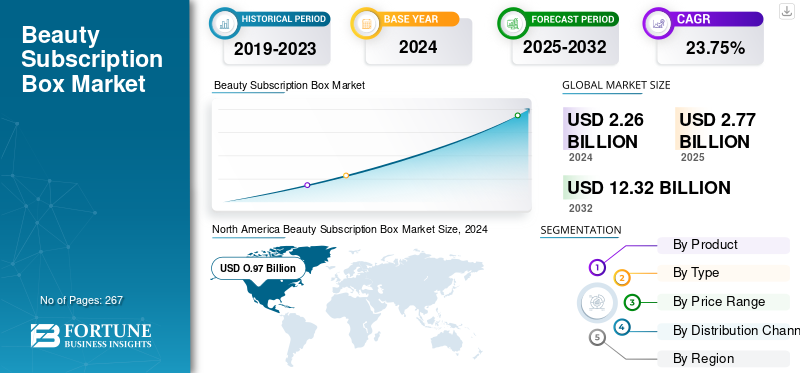
Download Free sample to learn more about this report.
BEAUTY SUBSCRIPTION BOX MARKET KEY TAKEAWAYS
 Market Size & Forecast
- 2025 Market Size: USD 2.77 Billion
- 2026 Market Size: USD 3.41 Billion
- 2034 Forecast Market Size: USD 17.16 Billion
- CAGR: 22.39% from 2026–2034
 Market Share
- North America dominated the beauty subscription box market with a 42.37% share in 2025.
- Premium price range subscriptions are projected to dominate the market with a 56.89% share in 2026.
- Personalized/algorithm-based boxes are projected to lead the market with a 49.85% share in 2026.
 Key Regional Highlights
North America
North America generated USD 1.17 billion in 2025.
Europe
Europe accounted for USD 0.66 billion in 2025 and is projected to grow at a CAGR of 22.90%.
Asia Pacific
Asia Pacific reached USD 0.71 billion in 2025.
U.S.
The market is projected to reach approximately USD 1.21 billion by 2026.
Japan
The beauty subscription box market is projected to reach USD 0.073 billion by 2026.
Read More

MARKET DYNAMICS
MARKET DRIVERS
Consumer Aspirations for Curated Selection and Convenience of Home Delivery to Boost Market Growth
The primary factor driving the beauty subscription box market growth is growing consumer desires for discovery-oriented and personalized beauty experiences. Modern-day shoppers, particularly Gen Z and Millennials, demand custom-made beauty packages that suit their lifestyle, skin type, and time instead of one-size-fits-all supplies. For instance, Vogue Business observes that beauty subscription brands such as Ipsy are conducting customer quiz competitions and running algorithms to curate individual boxes, reflecting a broader shift towards micro-customization retail. Such consumer behavior continues to influence the beauty industry, where personalization stands out as an acquisition engine and customer retention.
Bespoke curated beauty packages prompt brand discovery, a fundamental core for subscription sign-ups. The Guardian, a well-known British news organization, underscores that services such as Glossybox thrive by providing a “try-before-you-buy” choice that assists independent and smaller brands to reach wider audiences while offering individuals a low-risk way to discover. This combination of convenience, exploration, and custom-designed packages as per one’s requirement has reinforced personalization as the primary growth factor in the market space.
MARKET RESTRAINTS
InadequateCustomer Retention and Subscriber Engagements Obstructs Market Growth
High consumer attrition, often elicited by repetitive product offerings and subscription fatigue, stands as a major challenge, hampering global market growth. Multiple subscribers move away from the brand post a few weeks or months as the uniqueness of the brand shrinks or as they find another better choice. For instance, Vogue Business observes that subscribers churn rate within the beauty subscription industry is extremely high, driving brands to innovate constantly and work relentlessly towards subscribers’ engagement. Moreover, since shoppers are consciously spending on discretionary items, upholding long-term loyalty has become more of a challenge. To curtail and overcome these difficulties, market players are spending highly on solid customer retention strategies, value-added features, personalized experiences, and exclusive collaborations to gain consumer trust and maintain recurring revenue flow.
MARKET OPPORTUNITIES
Entering into Developing Economies and Rapidly Expanding Urban Centers to Generate New Growth Prospects.
Entering and establishing in an emerging region with a growing urban center, where rising beauty knowledge and digital adoption are reforming consumer behavior. This, in turn gas creates multiple growth opportunities for market players. Improved penetration of online distribution network and growing smartphone adoption, combined with stronger global internet connectivity, have enabled beauty experiences to reach younger audiences, including countries such as Brazil, India, and Indonesia. Online retail participation in emerging countries has more than doubled over the last five years, according to UNCTAD’s Global E-Commerce Index (2024) report. This indicates consumers’ keenness and enthusiasm for subscription-based commerce. Further, Forbes India also underscores that India’s beauty and personal care online sector has observed more than 25% annual growth, led by influencer-led discovery and social media engagement.
With customers seeking economical access to regional and international beauty brands, subscription models offer an economical, convenient, and trial-based entry point. This transition sets emerging markets and particularly digitally active tier-II towns as lucrative growth opportunities centers for consumer acquisition and localized brand partnerships in the beauty box category.
BEAUTY SUBSCRIPTION BOX MARKET TRENDS:
Upswing of Clean Beauty and Sustainable Packages Curation Fuels Market Trends
A growing trend altering the beauty industry landscape is the growing emphasis on clean and sustainable product offerings, including makeup, skincare, haircare, and other personal care items. Consumers of today’s era have become more socially conscious and make careful choices while purchasing a beauty box subscription. They express their values and demand greater transparency and responsibilities from brands, favoring cruelty-free, paraben-free, and sulfate-free formulations along with eco-friendly packaging. Vogue Business reported that businesses are undertaking this transition by designing beauty boxes that are biodegradable, refillable, and free of inhumane testing on animals. The Guardian underlines that the pursuit for “sustainable beauty on the internet has more than doubled from 2019, indicating a steep increase in consumer intent and awareness.
Also, subscription companies are responding to this evolution by collaborating with clean beauty startups, incorporating recyclable materials in product manufacturing and packaging, emphasizing carbon-neutral shipping while completing their entire fulfillment processes. It has not only reinforced consumer loyalty towards the brands but also distinguishes beauty box services in a crowded market, showing a long-term move in the direction of transparent ingredient procurement and ethical consumption within the subscription economy.
Download Free sample to learn more about this report.
Segmentation Analysis
By Product
Skincare Segment Leads the Market Owing to Daily Use and Personalization Demand
On the basis of product, the market is segmented into skincare, makeup, haircare, fragrance, and others. Others include mixed/all-in-one boxes combination of makeup, skincare, and body care.
To know how our report can help streamline your business, Speak to Analyst
The skincare segment dominates the global market, accounting for roughly 30% of the total market. Segment’s growth is supplemented by growing consumer awareness regarding skin health and the importance of clean beauty ingredients. Also, skincare cosmetics play a critical role in day-to-day schedules, with rising pollution levels and adulteration of food items that harm skin in multiple ways. Skincare cosmetics such as moisturizers, sunscreens, cleansers, and serums are used repetitively on an everyday basis, making them an integral part of the subscription beauty box. As consumers heavily rely on these products due to habitual consumption, they tend to order them without fail, driving the segment’s growth. As per Vogue Business’s survey, shoppers are prioritizing more and more simple skincare formulations compared to color makeup products and perceiving it as a long-term investment in wellness rather than discretionary spending. Moreover, the product category has the advantage of high personalization potential depending upon one’s skin texture, condition, tone, and other aspects. Thus, subscription business has a large scope to offer personalized packages, resolving consumer concerns regarding sensitivity or suitability. This combination of routine-driven demand and customization flexibility has positioned skincare as the most dominant and resilient product segment in the beauty subscription box industry.
Meanwhile, the haircare product segment is projected to expand at a CAGR of 25.17% over the projected years in light of high demand for personalized beauty solutions, scalp-focused, and damage-repair solutions tailored to diverse hair types and textures.
The other segment is projecteed to dominate the market with a share of 35.48% in 2026.
By Type
Rising Data-Driven Customization to Support Growth of Personalized Boxes Segment
By type, the market is categorized into standard curated boxes, personalized/algorithm-based boxes, and limited edition/collaboration boxes.
The personalized or algorithm-based box segment is projecteed to dominate the market with a share of 49.85% in 2026. The growth is led due to rising demand for curated and custom-designed beauty packages as it meets their unique requirements based on their lifestyles, skin types, and skin tone. Market players such as Ipsy are conducting beauty profile quizzes of subscribers and integrating AI to develop a tailor-made combo of beauty products, improving results for consumers, while retaining subscribers for the long term. This data-led customization enhances satisfaction levels and product relevance that help strengthen customer loyalty.
By Price Range
Premium Price Range Leads the Market Growth with Balanced Value and Experience
Based on price range, the market is segmented into mass/budget, premium, and luxury.
The premium segment is projecteed to dominate the market with a share of 56.89% in 2026. The premium segment offers an optimal balance between affordability and high perceived value. Consumers in this tier are willing to pay slightly more for full-size or higher-quality products, personalized curation, and exclusive brand collaborations without entering luxury price points. This segment attracts a broad middle to high disposable incomes individual seeking both discovery and quality, enabling brands such as Ipsy and FabFitFun to achieve strong retention and scale within this price range.
The mass/budget segment is likely to grow as affordable beauty subscriptions attract first-time users and price-sensitive consumers in emerging and digitally expanding markets.
By Distribution Channel
Direct-to-Consumer (D2C) Online Segment Leads the Market Owing to Personalize Offerings
Based on distribution channel, the market is segmented into direct-to-consumer (D2C) online, e-commerce marketplaces, retail partnerships/store add-ons, and corporate/gifting subscriptions.
The direct-to-consumer segment is projecteed to dominate the market with a share of 66.86% in 2026. The brands operating in this channel heavily depend upon exclusive platforms to govern personalize offerings, consumer data, and improve retention via direct engagement. This channel also permits targeted marketing, seamless subscription management, and community building, allowing players such as Birchbox and Ipsy to provide customized experiences and maintain higher profit margins over third-party retail channels.
In addition, e-commerce marketplaces are the fastest-growing channel and are projected to grow at a CAGR of 24.95% during the study period. Broader product accessibility across global markets, swift transition of e-commerce retail channels, and growing customer loyalty towards multi-brand channels such as Amazon, Etsy, and Flipkart supplement the segment’s expansion.
Beauty Subscription Box Market Regional Outlook
By region, the market is categorized into Europe, North America, Asia Pacific, South America, and Middle East & Africa.
North America
North America contributed approximately USD 1.17 Billion to the global market in 2025, accounting for 42.37% share, and is expected to reach USD 1.44 Billion in 2026. The region's growth is highly attributed to high consumer spending on discretionary items such as premium beauty, a rigid online distribution network, and the first-mover advantage of subscription-based retail systems. The U.S. is at the forefront of this trend, with major brand presence, including Birchbox, Ipsy, BoxyCharm, and Allure Beauty Box, inventing and scaling from the country. Moreover, high penetration of smartphone users and well-established internet infrastructure seamlessly handle digital engagement, consumer inclination towards product discovery, personalization, and convenience aligns well with subscription business. In 2025, The U.S. market is valued at USD 1.21 billion by 2026.
North America Beauty Subscription Box Market Size, 2025 (USD Billion)
To get more information on the regional analysis of this market, Download Free sample
Europe
In 2025, the Europe market stood at USD 0.66 Billion, representing 23.92% of global demand, and is projected to grow to USD 0.81 Billion in 2026, expanding at a CAGR of 22.90% during the forecast period. The region benefits from a mature beauty and personal care industry, a highly informed consumer base, and strong demand for premium, clean-label, and sustainable beauty products. Subscription box adoption is particularly strong in countries such as Germany, France, and the U.K., where consumers actively engage with curated product discovery experiences offered by established providers. Regulatory emphasis on ethical sourcing, product transparency, sustainability, and environmentally friendly packaging continues to influence purchasing behavior and strengthen subscriber retention. Furthermore, Europe’s advanced e-commerce infrastructure and efficient cross-border logistics networks support the expansion of subscription-based beauty services across multiple markets. The U.K. market is valued at USD 0.15 billion by 2026, while the Germany market is valued at USD 0.17 billion by 2026.
Asia Pacific
The Asia Pacific region captured 25.67% of the global market in 2025, generating USD 0.71 Billion in revenue, and is projected to reach USD 0.89 Billion in 2026. Market growth is being driven by rapid urbanization, rising disposable incomes, and expanding middle-class populations across key economies. The increasing popularity of personalized shopping experiences among Gen Z and Millennial consumers is accelerating demand for curated beauty subscription services. The Japan market is valued at USD 0.073 billion by 2026, the China market is valued at USD 0.30 billion by 2026, and the India market is valued at USD 0.28 billion by 2026. reflecting strong consumer interest in beauty product discovery and digital retail channels. In addition, the growing influence of social media platforms, beauty influencers, and online content creators is encouraging greater engagement with subscription-based beauty offerings. Expanding e-commerce penetration and increasing expenditure on cosmetics and skincare products across China, Japan, South Korea, and India are expected to further support market growth throughout the forecast period.
South America and Middle East & Africa
In 2025, Middle East & Africa generated USD 0.09 Billion, contributing 3.16% to global market revenue, and is projected to grow to USD 0.01 Billion in 2026. Over the forecast period, South America and Middle East & Africa regions would witness a significant growth in this marketspace. South America market in 2025 is set to record USD 0.14 billion as its valuation. South America’s growth is prompted by growing customer interest in trend-driven, affordable beauty products and digital retail expansion across countries such as Brazil and Argentina. In the Middle East & Africa, the UAE is set to attain the value of USD 0.03 billion in 2025.
Rest of the World
In 2025, Rest of the World represented USD 0.14 Billion, accounting for 4.88% of the worldwide market, and is projected to grow to USD 0.17 Billion in 2026.
COMPETITIVE LANDSCAPE
Key Industry Players
Personalization, Partnerships, and Digital Engagement Define Industry Players’ Market Strategy
The global beauty subscription box market is moderately consolidated, with leading players such as Ipsy/BoxyCharm, Birchbox, Glossybox, Allure Beauty Box, and FabFitFun driving competition through personalization, brand partnerships, and digital engagement. Companies are increasingly leveraging AI-driven algorithms and customer data analytics to curate tailored product assortments that enhance user satisfaction and retention. Strategic collaborations with both established and indie beauty brands help diversify offerings and maintain novelty, while limited-edition and seasonal boxes boost exclusivity and perceived value. Many players are also focusing on sustainability initiatives, including recyclable packaging and clean beauty curation, to align with shifting consumer values. Additionally, social media and influencer marketing play a pivotal role in subscriber acquisition and community-driven brand loyalty.
LIST OF KEY BEAUTY SUBSCRIPTION BOX COMPANIES PROFILED
- Ipsy (U.S.)
- BoxyCharm (U.K.)
- Birchbox (U.S.)
- Glossybox (Germany)
- Allure Beauty Box (U.S.)
- FabFitFun (U.S.)
- LookFantastic(U.K.)
- Sephora Play! (France)
- Beauty Pie (U.K.)
- Petit Vour (U.S.)
KEY INDUSTRY DEVELOPMENTS
- October 2025: Lookfantastic has launched a new “Beauty Vault” box, bundling 15 full-size skincare, makeup, haircare, and body products from brands such as Medik8 and Fenty, offering consumers significant value in a single curated box. This offering is positioned as a premium, limited-edition bundle designed to drive both discovery and perceived savings. By leveraging high-value product assortments in one launch, Lookfantastic strengthens its position in the luxury/subscription gifting space.
- September 2025: Boots has relaunched its K-Beauty limited edition box, offering six premium Korean skincare products (some full-size) in a reusable pouch priced at USD 44 but valued at nearly USD 100, reflecting a ~55% discount. This move underscores Boots’ strategy to leverage its retail brand and inventory access to make curated beauty boxes accessible and surprise-driven for its customer base.
- July 2025: Allure released its July 2025 Beauty Box, featuring a curated assortment of high-end full-size products such as Tatcha Dewy Skin Cream, a Haus Labs cream blush, Benefit Porefessional primer, and Paul Mitchell haircare priced at USD 19.99 but valued at over USD 210 to underscore perceived value. This move highlights a strategy to drive subscriber engagement through exceptional value and surprise, enhancing retention and demonstrating how editorial curation can be leveraged in subscription experiences.
- July 2025: FabFitFun acquired Boox, a sustainable packaging solutions company, to strengthen its eco-friendly credentials and operational capabilities in reusable and low-waste packaging. This move signals a strategic commitment to expanding subscription growth with sustainability imperatives, ensuring better alignment with consumer expectations around environmental sustainability.
- May 2023: Retention Brands, backed by FemTec Health, acquired Birchbox’s subscription business and associated assets in 2023, marking a strategic pivot for the pioneer beauty box company. Under the new ownership, Birchbox is expected to integrate with Retention Brands’ broader subscription and customer-retention platform to optimize operational efficiencies and subscriber lifecycle management.
REPORT COVERAGE
The global beauty subscription box market report analysis provides an in-depth study of the market size & forecast by all the market segments included in the report. It includes details on the market dynamics and market trends expected to drive the market in the forecast period. It offers information on the technological advancements, new product launches, key industry developments, and details on partnerships, mergers & acquisitions. The market research report also encompasses Porter's five forces analysis, a detailed competitive landscape with information on the market share and profiles of key operating players.
Request for Customization to gain extensive market insights.
Report Scope & Segmentation
|
Attribute |
Details |
|
Study Period |
2021-2034 |
|
Base Year |
2025 |
|
Forecast Period |
2026-2034 |
|
Historical Period |
2021-2024 |
|
Growth Rate |
CAGR of 22.39% from 2026-2034 |
|
Unit |
Value (USD Billion) |
|
Segmentation |
By Product, Type, Price Range, Distribution Channel, and Region |
|
By Product |
|
|
By Type |
|
|
By Price Range |
|
|
By Distribution Channel |
|
|
By Region |
|
Frequently Asked Questions
Fortune Business Insights says that the global market value stood at USD 3.41 billion in 2026 and is projected to reach USD 17.16 billion by 2034.
In 2025, the market value stood at USD 1.17 billion.
Which was the The market is expected to exhibit a CAGR of 22.39% during the forecast period
The skincare segment led the market by product.
The key factors driving the market growth are growing consumer preferences, shift toward convenience, surprise & discovery, and personalized curation, coupled with a developing e-commerce ecosystem and strong consumer spending on premium beauty products.
Ipsy / BoxyCharm, Birchbox, Glossybox, Allure Beauty Box, and FabFitFun are some of the prominent players in the market.
North America dominated the market in 2025.
Brand expansion into developing markets and smaller urban centers, where rising digital adoption and growing beauty awareness are reshaping consumer habits expected to favor the product adoption.



- 2021-2034
- 2025
- 2021-2024
- 267
-
(Offer valid till 15th Oct 2026)
Get 30-60 hrs Free Customization
Expand Regional and Country Coverage, Segments Analysis, Company Profiles, Competitive Benchmarking, and End-user Insights.



















Related Reports
-
US +1 833 909 2966 ( Toll Free )
-
Get In Touch With Us