Berries Market Size, Share & Industry Analysis, By Product Type (Strawberries, Blueberries, Raspberries, Blackberries, Cranberries, and Others), By Form (Fresh, Frozen, Dried/Dehydrated, and Processed), By Nature (Organic and Conventional), By Distribution Channel (Retail Consumer, Foodservice, and Food Processing/Industrial {Food and Beverage Industry, Nutraceuticals, and Cosmetics and Personal Care}), and Regional Forecast, 2026-2034
 Download Free Sample
(Offer valid till 30th Sep 2026)

Berries Market Size and Future Outlook
 Listen to Audio Version
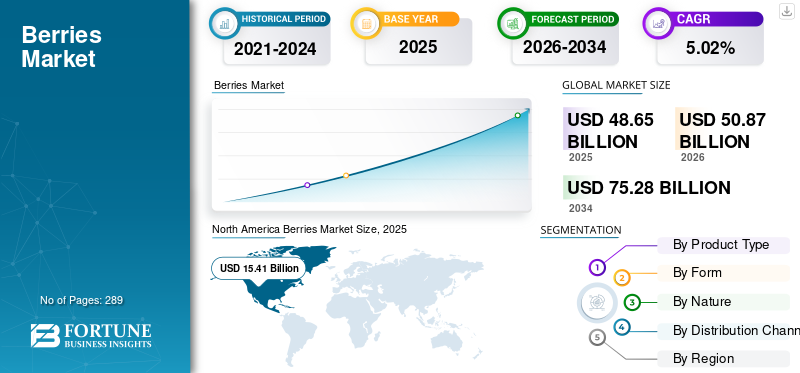
The global berries market size was valued at USD 48.65 billion in 2025. The market is projected to grow from USD 50.87 billion in 2026 to USD 75.28 billion by 2034, exhibiting a CAGR of 5.02% during the forecast period. North America dominated the berries market with a market share of 31.68% in 2025.
Berries are small, nutrient-rich fruits such as strawberries, blueberries, raspberries, blackberries, cranberries, currants, and gooseberries. In the market, berries are valued for their taste and versatility, as well as their high levels of antioxidants, vitamins, and fiber. These qualities make them popular in health-focused diets. People enjoy berries in fresh, frozen, dried, and processed forms. Moreover, they are also used in retail, foodservice, drinks, dairy, baked goods, supplements, and personal care products. The berry market is growing, driven by rising demand for dessert berries, greater demand for organic and sustainably grown fruit, and wider use of berry ingredients in processed foods and wellness products.
Companies such as Driscoll’s, Inc. S.A., Hortifrut S.A., Agroberries, Dole plc, and Camposol Holding PLC, among others are some of the key players operating in this market. Base expansion is the key strategy which is boosting product sales and supporting market growth.
Download Free sample to learn more about this report.
Berries Market Key Takeaways
 Market Size & Forecast
- 2025 Market Size: USD 48.65 billion
- 2026 Market Size: USD 50.87 billion
- 2034 Forecast Market Size: USD 75.28 billion
- CAGR: 5.02% from 2026–2034
 Market Share
- North America dominated the berries market with a 31.68% share in 2025.
- Blueberries held the second-largest market share and are projected to grow at a CAGR of 5.22% during the forecast period.
- Frozen berries represented the second-largest market segment and are expected to grow at a CAGR of 4.79% during the forecast period.
 Key Regional Highlights
North America
North America reached USD 15.41 billion in 2025 and remained the leading regional market.
Asia Pacific
Asia Pacific reached USD 11.41 billion in 2025 and emerged as one of the fastest-growing regional markets.
Europe
Europe was valued at USD 13.81 billion in 2025, supported by strong trade networks and rising demand for organic berries.
U.S
The market reached USD 12.24 billion in 2025, driven by strong fresh-fruit consumption and year-round supply availability.
Japan
The market was valued at USD 1.90 billion in 2025, accounting for 3.90% of global revenue, supported by rising frozen berry adoption.
Read More

BERRIES MARKET TRENDS
Organic Certification and Sustainable Farming is Shaping the Industry
Organic certification is also being increasingly adopted across berry-producing regions as it enables producers to access premium market segments and differentiate their products in competitive retail environments. Certified organic berries are associated with reduced pesticide usage, cleaner production methods, and enhanced consumer trust, which supports higher price realization. Sustainable farming practices are being increasingly integrated into berry production systems to address environmental concerns such as water usage, soil health, and carbon footprint. Practices such as drip irrigation, integrated pest management, reduced chemical inputs, and soil conservation techniques are being adopted to enhance long-term agricultural sustainability.
MARKET DYNAMICS
MARKET DRIVERS
Download Free sample to learn more about this report.
Rising Health & Nutritional Awareness Among Consumers Positively Triggers the Consumption of Berries
As consumers become more attentive to diet quality, fiber intake, clean label antioxidant-rich foods, and lower-calorie everyday eating choices, berries are benefiting from stronger inclusion in food and beverages industry as they are added in breakfast meals, smoothies, yogurt applications, lunchbox formats, and on-the-go snacking. This shift is commercially important as it moves berries beyond seasonal or occasional purchases and positions them as a routine retail basket item in both developed and urbanizing markets. According to the U.S. Department of Agriculture Economic Research Service (ERS), U.S. per capita blueberry consumption surged from 0.26 lbs in 2000 to 2.54 lbs in 2021, a tenfold increase over two decades. It is driven directly by growing consumer awareness of their health benefits. Moreover, berries align with multiple overlapping consumer priorities at the same time. They fit the demand for fresh foods, clean-label eating, plant-forward diets, portion-controlled snacking, and visually appealing products suitable for social media-led food presentation which further boost the berries market growth.
MARKET RESTRAINTS
Climate Change Volatility To Negatively Impact the Market’s Potential
Climate change represents one of the most material structural risks to global berry production, introducing significant variability in yields, crop quality, and supply consistency. Berry cultivation is highly sensitive to temperature, precipitation, and seasonal timing, parameters that are increasingly unpredictable due to shifting climate patterns. For instance, the National Oceanic and Atmospheric Administration (NOAA), reported that 2024 was the warmest year on record for the contiguous U.S., with an average annual temperature of 55.5°F, or 3.5°F above average. NOAA also reported that the U.S. Climate Extremes Index for 2024 ranked highest in the 115-year record, with all nine climate regions in the top 10% of extremes. These conditions materially increase production uncertainty for specialty crops such as berries.
MARKET OPPORTUNITIES
Proliferation of Controlled-Environment Agriculture to Offer Potential Growth Opportunities
The proliferation of Controlled-Environment Agriculture (CEA) and proprietary cultivar development is being recognized as a significant growth opportunity in the global market. This growth is due to the reason that it enables enhanced production efficiency, improved product quality, and greater supply consistency across diverse climatic conditions. According to the USDA Economic Research Service, the number of CEA operations in the U.S. grew from 1,476 in 2009 to 2,994 in 2019. Further, representing a doubling of operations within a decade, with accelerated growth continuing post-2020.
Segmentation Analysis
By Product Type
Versatile Food Application Drive Strawberries Market Leadership
The market is segmented by product type into strawberries, blueberries, raspberries, blackberries, cranberries, and others.
The strawberries segment held the largest berries market share in 2025. Compared to other types, strawberries have higher consumer familiarity, which makes them a popular berry across regions and age groups. This berry is cost-effective compared to blackberries and raspberries, which are mostly premium-priced owing to higher production costs and lower yields. Moreover, it has greater versatility in various food applications (beverages and processed foods), which add up to the segmental growth.
Blueberries hold the second-largest market share, and are expected to grow at a CAGR of 5.22% during the forecast period. Blueberries emerged as the fastest growing segment during the forecast period. In comparison to blackberries and raspberries, blueberries have a prolonged shelf life which allows minimal risk of spoilage during transportation. Due to their improved shelf life, they are more suitable for international trade than soft berries. Moreover, ease of consumption and a versatile flavor profile of fresh blueberries drive its acceptance.
To know how our report can help streamline your business, Speak to Analyst
By Form
Minimal Processing of Fresh Berries for Health Conscious Consumers Drive Fresh Segment Dominance
Based on form, the market is segmented into fresh, frozen, dried/dehydrated, and processed.
The fresh segment accounted for the largest berries market share in 2025. Fresh berries provide distinct benefits in terms of sensory appeal, texture, and taste. Globally, most individuals link fresh berries with juiciness and natural sweetness qualities that cannot be replicated in processed or dried berries. Compared with other forms, fresh berries are perceived as minimally processed and natural, and align with the requirements of health-conscious consumers. Moreover, it gains advantages from in-store visibility, which augments impulse purchases.
Frozen makes up the second-largest market share and is expected to grow at a CAGR of 4.79% during the forecast period. The frozen category is the second-largest segment in the global market. Frozen berries provide a substantial benefit with respect to long shelf life as compared to fresh berries, which are susceptible to spoilage. Moreover, frozen berries produce minimal waste and are highly suitable for industrial and processing applications, which further escalates sales globally.
By Nature
Better Accessibility of Conventional Berries Drive Conventional Berry Type Market Dominance
The market is segmented by nature into organic and conventional.
The conventional segment led the global market in 2025. Compared with organic variants, conventionally grown berries are low-priced, making them accessible to a range of consumers across both emerging and developed markets. This variety of berries is more readily available in retail channels such as grocery chains, supermarkets/hypermarkets, and e-commerce, owing to their large production volume. Moreover, it is ideal for the mass market due to its availability and affordability.
Organic is another major segment is expected to grow at a CAGR of 5.85% during the forecast period. The organic segment is the fastest-growing during the forecast period. Organic berries are considered a healthier and safer variant as they are cultivated without the use of chemical fertilizers and pesticides. Moreover, it aligns with environmentally friendly practices, which are important in shaping consumers' purchasing decisions. Additionally, strong government support further propels the segment’s growth.
By Distribution Channel
Higher Sales Volume and Better Accessibility Drive Retail Consumer Market Leadership
The market is segmented, by distribution channel into retail consumer, foodservice, and food processing/industrial.
The retail consumer segment led the global market in 2025. The retail consumer category dominated the global market. Retail channels offer direct access to individuals, allowing higher sales volumes, due to daily household consumption. Unlike foodservice, retail channels have greater flexibility, especially in pricing strategies, including private-label products and promotional coupons. Moreover, it strengthens customer engagement via packaging innovations and in-store promotions.
The food processing/industrial segment accounted for the second largest market share in 2025 and is expected to register a CAGR of 4.30% during the forecast period. The food processing/industrial segment is ranked second in the market. The food processing sector sources berries in bulk at affordable prices, enabling improved cost management compared to foodservice and retail. Moreover, it has minimal sensitivity to aesthetic quality, as the processing industry primarily focuses on color and flavor. As a result, the aforementioned factors drive the segment’s growth.
Berries Market Regional Outlook
By region, the market is categorized into Europe, North America, Asia Pacific, South America, and the Middle East & Africa.
North America
North America Berries Market Size, 2025 (USD Billion)
To get more information on the regional analysis of this market, Download Free sample
The market in North America reached a valuation of USD 15.41 billion in 2025 and it is the leading region in the world. The North America market is being shaped by a highly interconnected regional ecosystem in which production, trade, consumption, and supply-chain coordination are being woven together to create one of the world’s most commercially dynamic horticultural fruit markets. Within this regional structure, the U.S. is being established as the principal center of berry consumption, Mexico is being positioned as the most important export-oriented production hub supporting year-round supply.
U.S. Berries Market
In 2025, the U.S. market reached USD 12.24 billion. The U.S. market is being sustained by strong fresh-fruit consumption, advanced commercial cultivation systems, and an increasingly import-supported supply structure that is allowing year-round category presence across retail and foodservice channels. The country continues to function as the largest consumption center within North America, and market expansion is being supported by the premiumization of fresh berries and greater household penetration. Growth is further driven by the increasing incorporation of berries into daily diets, snacks, dairy applications, smoothies, and value-added fruit offerings.
Asia Pacific
The Asia Pacific market was valued at USD 11.41 billion in 2025. The Asia Pacific region is one of the fastest-growing regions. The Asia Pacific is still in its progressing stage, rather than fully developed, transitioning from import dependent consumption toward a better-structured ecosystem. Market dynamics are being fueled by improvements in cold chain infrastructure, expansion in berry farming and an inclination toward convenient fruit formats, which enhance the accessibility of berries across urban markets. At the same time, a strong focus on shelf life and product quality is necessitating distributors to upgrade their sourcing strategies and strengthen year-round supply. Key markets include China, Japan, and South Korea with merging markets such as India and Southeast Asia growing at a rapid pace.
India Berries Market
The India market in 2025 was valued at around USD 0.68 billion, accounting for roughly 1.40% of global market revenues. Unlike other daily fruits, berries are not yet an integral part of regular consumption, but their importance is increasing owing to shifting consumer food preferences and strong usage in the foodservice sector.
China Berries Market
China’s market in 2025 was valued at around USD 5.96 billion, representing roughly 12.26% of global market share. China is recognized as one of the prominent sectors for fresh strawberries, with respect to production and consumption. According to the Food and Agriculture Organization, a government agency, China produced 4,123.42 thousand tons of strawberries in 2024. This fruit is no longer considered a premium/seasonal purchase, but a daily part of fruit intake in semi-urban and urban markets.
Japan Berries Market
The Japan market in 2025 reached a valuation of around USD 1.90 billion, accounting for roughly 3.90% of global market revenues. The surging presence of frozen berries in the retail sector is a strong factor influencing consumers’ purchasing decisions. Supermarkets/specialty stores are dedicating specific shelves to frozen fruits in freezer space.
Europe
The European market reached a valuation of USD 13.81 billion in 2025. The European sector is characterized as relatively mature, with growth primarily propelled by supply chain efficiency rather than early market adoption. Similarly, in other regions, berries play a remarkable role in the regional fruit category, supported by well-built trade networks, increasing demand for organic produce, and everyday consumption. Moreover, the surging use of berries in foodservice and breakfast applications is further expanding their utilization beyond fresh consumption. Nutrient dense dessert berries are also growing in popularity in European countries.
Germany Berries Market
The market in Germany in 2025 reached around USD 2.79 billion, representing roughly 5.73% of global market revenues. Within this ongoing trend, berries, especially frozen berries, have gained traction due to their link with wellness-oriented diets and a healthy image supporting the market demand.
U.K. Berries Market
The U.K. market reached approximately USD 2.39 billion in 2025, equivalent to around 4.91% of global market sales. The berry sector is highly driven by consumption habits that favor speed, ease, and ready-to-eat food options. They are broadly used in packed lunches and on-the-go grab meals that require little preparation, making them appropriate for a fast-paced lifestyle.
South America and Middle East & Africa
Over the forecast period, South America is expected to experience significant growth in this market. The South America market in 2025 recorded USD 4.69 billion. The South America market has been increasingly shaped by the region’s strengthening position in global fresh fruit trade, particularly in blueberries, while strawberries continue to support broad-based domestic consumption across several countries. The market has been influenced by favorable agro-climatic conditions, rising investment in export-oriented horticulture, varietal improvement, and expanding access to premium markets in North America, Europe, and Asia. The Middle East & Africa region reached a valuation of USD 3.23 billion in 2025. The Middle East & Africa market is being shaped by a structurally asymmetric regional model in which demand expansion is being concentrated in the Gulf economies, while supply capability is being developed more meaningfully across selected African horticultural corridors. In the Middle East, the market is being driven by climatic unsuitability for large-scale open-field berry production, high dependence on imported fresh produce, premiumization of fruit consumption, and the rapid expansion of organized retail and foodservice channels.
UAE Berries Market
The UAE market is set to grow at a CAGR of 4.79% during the forecast period. The United Arab Emirates is characterized by a near-total structural dependence on imports for its fresh berry supply, a consequence of the country's hyper-arid climate, extreme summer temperatures, limited arable land area, and acute water scarcity.
COMPETITIVE LANDSCAPE
Key Industry Players
Market Expansion is the Key Strategy Adopted by Market Players to Support Growth
The prominent players in the global berries market are embarking upon two major strategies: new product launches and partnerships/collaborations. Following this, the enterprises are also focusing on base expansion and promotion to stay ahead in market competition. The global market is witnessing a strong growth trajectory, due to the increasing utilization in functional food products and surging demand for natural ingredients. After witnessing such an inclination toward berries, the active players in the global s
pace are concentrating on new launches that enhance profit margins and improve market reach. For instance, in October 2023, Angus Soft Fruits Limited, a U.K.-based berry producer, introduced two raspberry varieties, “AVA Monet” and “AVA Deli,” for British consumers. These varieties are produced through the AVA breeding program and are available across key U.K. retailers.
LIST OF KEY BERRIES COMPANIES PROFILED
- California Giant Berry Farms (U.S.)
- Wish Farms, Inc. (U.S.)
- Agroberries (Chile)
- Driscoll's, Inc. (U.S.)
- Angus Soft Fruits Limited (U.K.)
- Camposol Holding PLC (Peru)
- Oxford Frozen Foods Ltd. (Canada)
- Hortifrut S.A. (Chile)
- Dole plc (Ireland)
- S&A Group Holdings Limited (U.K.)
KEY INDUSTRY DEVELOPMENTS
- April 2026: ABD Maestro Private Limited, a subsidiary of Indian spirits firm Allied Blenders & Distillers, announced the launch of ZOYA Pink Mix Berry-based Gin across Maharashtra, India. This beverage is manufactured in small batches and composed of raspberry, strawberry, and other fruits.
- October 2025: Bloom Fresh, a British pioneer in plant breeding, revealed the news of acquiring INKA’s berry breeding program, a Peruvian firm, to expand its footprint in the production of premium-quality berry varieties.
- July 2025: Cizzle Brands Corporation, a Canadian food products company, collaborated with Cole Caufield, a professional ice hockey player, to introduce the Rocket Berry Blast sports drink. This product is available in various flavors; berry crush, cherry lime, and blue raspberry.
- June 2025: Angus Soft Fruits Limited, a Scottish berry producer and supplier, reintroduced its Good Natured Berries brand. Through this brand, the company sells berries in the U.K. retail market and also exports to Asia and Europe.
- February 2025: Driscoll’s Inc., a U.S.-based producer of fresh berries, announced the launch of its sweetest batch premium berry line (blackberries and blueberries) in Germany and the Middle East market.
REPORT COVERAGE
The global market reports provides an in-depth study of market size & forecast by all the market segments included in the report. The market forecast includes details on the berries market analysis, market dynamics, and market trends expected to drive the market during the forecast period. It offers information on the technological advancements, new product launches, key industry developments, and details on partnerships, mergers & acquisitions. The industry also encompasses detailed competitive landscape on the market segmentation, market share and profiles of key operating players.
Request for Customization to gain extensive market insights.
Report Scope & Segmentation
| ATTRIBUTE | DETAILS |
| Study Period | 2021-2034 |
| Base Year | 2025 |
| Estimated Year | 2026 |
| Forecast Period | 2026-2034 |
| Historical Period | 2021-2024 |
| Growth Rate | CAGR of 5.02% from 2026-2034 |
| Unit | Value (USD Billion) |
| Segmentation | By Product Type , Form , Nature , Distribution Channel, and Region |
| By Product Type |
|
| By Form |
|
| By Nature |
|
| By Distribution Channel |
|
| By Region |
|
Frequently Asked Questions
Fortune Business Insights says that the global market value stood at USD 48.65 billion in 2025 and is projected to reach USD 75.28 billion by 2034.
In 2025, the market value stood at USD 15.41 billion.
The market is expected to exhibit a CAGR of 5.02% during the forecast period.
By product type, strawberries segment led the global market in 2025.
The rising health & nutritional awareness among consumers globally positively triggers the consumption of berries.
Driscoll’s, Inc. S.A., Hortifrut S.A., Agroberries, Dole plc, and Camposol Holding PLC are a few of the players in the market.
North America held the largest market share in 2025.
The organic certification and sustainable farming is shaping the industry.



- 2021-2034
- 2025
- 2021-2024
- 289
-
(Offer valid till 30th Sep 2026)
Get 30-60 hrs Free Customization
Expand Regional and Country Coverage, Segments Analysis, Company Profiles, Competitive Benchmarking, and End-user Insights.




















-
US +1 833 909 2966 ( Toll Free )
-
Get In Touch With Us