Big Data in Healthcare Market Size, Share & Industry Analysis, By Component (Software/Platforms, Hardware/Infrastructure, and Services), By Deployment (Cloud-Based, On-Premise, and Others), By Application (Clinical Analytics, Population Health & Public Health Analytics, Operational Analytics, Financial & Revenue Cycle Analytics, Fraud), By End User (Healthcare Providers, Healthcare Payers, Pharmaceutical & Biotechnology Companies, Medical Device & Digital Health Companies, CROs, CDMOs & Research Organizations, Public Health Agencies & Government Bodies), and Regional Forecast, 2026-2034
 Download Free Sample
Big Data in Healthcare Market Size and Future Outlook
 Listen to Audio Version
The global big data in healthcare market size was valued at USD 54.24 billion in 2025 and is projected to grow from USD 61.95 billion in 2026 to USD 157.77 billion by 2034, exhibiting a CAGR of 11.36% during the forecast period. North America dominated the big data in healthcare market with a market share of 45.81% in 2025.
Big data in healthcare refers to the collection, analysis, and utilization of massive, complex health datasets. It transforms how care is delivered by turning raw medical information into actionable, evidence-based insights that improved patient outcomes, predict diseases, and reduce costs. The market includes data generated from EHRs, claims systems, medical imaging, laboratory platforms, wearable devices, genomics, clinical trials, and patient engagement tools. As healthcare organizations face rising patient volumes, cost pressure, fragmented data systems, and the need for faster clinical decisions, big data platforms are becoming important for predictive analytics, population health management, care coordination, drug development, fraud detection, and personalized medicine. The growing use of cloud platforms, AI, machine learning, and real-time analytics is further helping healthcare providers, payers, and life sciences companies convert raw healthcare data into actionable insights.
- In January 2025, Health Catalyst partnered with Databricks to advance healthcare data sharing and analytics through a configurable solution designed for healthcare organizations. The collaboration aimed to support secure cross-platform healthcare data sharing and help healthcare teams use data more effectively to improve care delivery and operational outcomes.
Furthermore, major players, such as Oracle Health, Optum Inc., Microsoft, and Amazon Web Services, are actively adopting technological advancements and deploying strategic collaborations, acquisitions, and investment initiatives to expand their market presence.
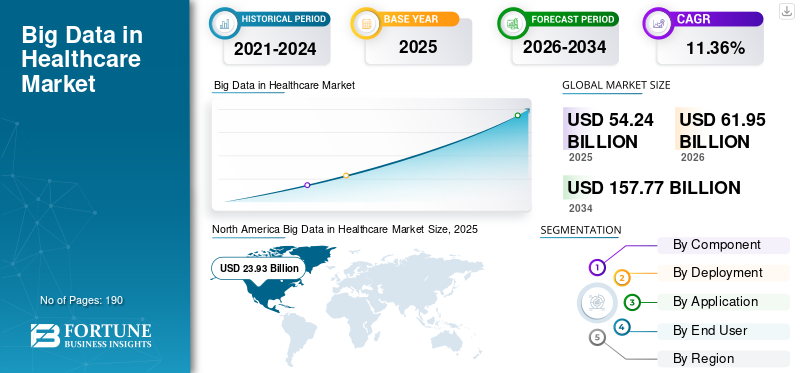
Download Free sample to learn more about this report.
Big Data in Healthcare Market Key Takeaways
 Global Market Size & Forecast
- 2025 Market Size: USD 54.24 billion
- 2026 Market Size: USD 61.95 billion
- 2034 Forecast Market Size: USD 157.77 billion
- CAGR: 11.36% from 2026-2034
 Market Share
- North America dominated the big data in healthcare market with a 45.81% share in 2025.
- The services segment is projected to grow at a CAGR of 11.25% during the forecast period.
- The research, drug development & real-world evidence analytics segment is expected to grow at a CAGR of 14.81% during the forecast period.
 Key Regional Highlights
North America
North America accounted for USD 23.93 billion in 2025 and maintained its leading position, with the U.S. market estimated to reach USD 25.08 billion in 2026.
Asia Pacific
Asia Pacific is estimated to reach USD 14.43 billion in 2026, supported by increasing adoption of healthcare analytics solutions.
Europe
Europe is projected to reach USD 15.62 billion in 2026, registering a CAGR of 11.58% during the forecast period.
U.S.
The market is estimated to reach USD 25.08 billion in 2026, accounting for approximately 40.48% of the global market.
Japan
The market is estimated to reach USD 3.49 billion in 2026, representing around 5.64% of the global market.
Read More

BIG DATA IN HEALTHCARE MARKET TRENDS
Rising Adoption of Predictive Analytics to Improve Clinical and Operational Decision-Making
The global market is witnessing strong growth as healthcare providers are increasingly using predictive analytics to turn large volumes of clinical, operational, and financial data into actionable insights. Hospitals and health systems are facing pressure from rising patient volumes, workforce shortages, delayed care coordination, and increasing operating costs. As a result, predictive analytics is becoming a significant aspect. It helps organizations forecast patient demand, identify high-risk patients, improve resource utilization, reduce avoidable admissions, and support faster clinical decisions. This shift from reactive care delivery to data-driven planning is making predictive analytics a key trend in the market. Key companies are participating in strategic partnerships to bring forth innovative solutions to capitalize on the growth potential.
- In June 2025, TeleTracking Technologies partnered with Palantir Technologies to transform healthcare operations with AI-powered insights. The partnership aimed to improve operational decision-making for healthcare providers by combining TeleTracking’s healthcare operations platform with Palantir’s AI capabilities, supporting better capacity management, patient flow, and long-term operational value.
MARKET DYNAMICS
MARKET DRIVERS
Download Free sample to learn more about this report.
Rising Healthcare Data Volumes to Drive the Adoption of Big Data Analytics Solutions
The market is expanding as healthcare organizations generate large volumes of data from electronic health records, claims systems, diagnostic imaging, laboratory systems, connected devices, and patient engagement platforms. As this data continues to grow, hospitals, payers, and life sciences companies are finding it difficult to manage, integrate, and analyze information through traditional systems. This creates strong demand for big data solutions as they help convert fragmented healthcare data into useful insights for clinical decisions, operational planning, and population health programs. As a result, rising healthcare data volumes are directly driving the adoption of scalable analytics platforms across the healthcare ecosystem.
- For instance, in April 2025, Health Catalyst partnered with Microsoft to accelerate AI adoption and transformation for care delivery organizations. The partnership focused on combining company’s healthcare data and analytics capabilities with Microsoft’s cloud and AI technologies.
MARKET RESTRAINTS
Interoperability Gaps across Healthcare Systems to Restrain Product Adoption
The lack of interoperability across healthcare systems remains a major restraint for big data in healthcare market growth. Healthcare data is often stored in separate EHR platforms, laboratory systems, imaging systems, claims databases, pharmacy systems, and patient engagement tools. Since these systems do not always exchange information smoothly, organizations face difficulty in creating a complete and reliable patient data view. This reduces the accuracy of analytics, delays decision-making, increases integration costs, and limits the full value of big data platforms. As a result, interoperability gaps slow down adoption, especially among providers that operate with legacy systems and fragmented digital Infrastructure.
- For instance, a 2025 MDPI review highlighted that the widespread adoption of EHRs and healthcare information systems has created isolated data silos across healthcare providers, while existing interoperability standards, such as FHIR, still cannot fully address all scenarios where records are stored across multiple providers using different standards. This shows that fragmented systems continue to limit seamless healthcare data exchange and restrain the wider use of big data analytics in healthcare.
MARKET OPPORTUNITIES
Expansion of Real-World Evidence Analytics to Create Strong Growth Opportunities
The global market is creating strong growth opportunities as healthcare and life sciences organizations are increasingly using real-world data from electronic health records, claims databases, wearable devices, and patient-reported outcomes. Pharmaceutical companies and healthcare providers need stronger evidence beyond controlled clinical trials to understand treatment performance, patient behavior, disease progression, safety outcomes, and therapy value in real-world settings. These patient datasets are being used into usable evidence for drug development, regulatory submissions, market access, and clinical decision-making. As a result, the expansion of real-world evidence analytics is opening new opportunities for vendors that can provide secure data integration, advanced analytics, AI-enabled data generation, and scalable healthcare infrastructure.
- In May 2025, Datavant collaborated with Boehringer Ingelheim to support scalable real-world evidence infrastructure. Under the partnership, Boehringer Ingelheim planned to use Datavant’s privacy-preserving tokenization and data connectivity technologies to strengthen its real-world evidence initiatives across clinical development and launch activities.
MARKET CHALLENGES
Data Privacy and Security Risks to Challenge the Wider Adoption of the Product
The global market is expanding as healthcare providers, payers, and life sciences companies use large datasets to improve clinical decisions, patient outcomes, operational planning, and research productivity. However, data privacy and cybersecurity risks remain a major challenge as healthcare data includes highly sensitive information such as medical history, insurance details, diagnostic records, prescriptions, and personal identifiers. As more data moves across cloud platforms, analytics systems, third-party vendors, connected devices, and AI tools, the risk of unauthorized access and data misuse increases. This creates hesitation among healthcare organizations, as any breach can lead to compliance penalties, financial losses, reputational damage, and lower patient trust. As a result, privacy and security concerns continue to slow the wider adoption of big data platforms, especially among organizations with limited cybersecurity budgets and legacy IT infrastructure.
- For instance, in 2025, Fortified Health Security reported that 183 million patient records were exposed in 2024, highlighting the rising cybersecurity pressure on healthcare organizations. The report stated that this scale of exposure showed the escalating threat level facing healthcare data environments, which directly supports concerns around privacy, security, and trust in large-scale healthcare data analytics adoption.
Segmentation Analysis
By Component
Software/Platforms Segment Dominated the Market due to Rising Demand for Integrated Healthcare Analytics
Based on component, the market is categorized into software/platforms, hardware/infrastructure, and services.
The software/platforms segment dominated the market in 2025 as healthcare organizations increasingly need unified systems to collect, clean, integrate, and analyze large volumes of structured and unstructured healthcare data. As a result, the demand is higher for analytics platforms, AI-enabled dashboards, data lakes, interoperability tools, and real-time decision-support systems. Hardware and infrastructure remain important, but software platforms hold a stronger position as they directly support clinical analytics, financial analytics, population health management, and research decision-making.
- For instance, in January 2026, Oracle announced the Oracle Life Sciences AI Data Platform, a generative AI-enabled analytics platform designed to bring together owned and public data with Oracle Health Real-World Data’s de-identified longitudinal EHR records. The platform would support R&D, clinical trials, post-market safety, and commercialization, showing the growing role of advanced software platforms in healthcare big data.
The services segment is expected to grow at a CAGR of 11.25% over the forecast period.
To know how our report can help streamline your business, Speak to Analyst
By Deployment
Cloud-Based Segment Led the Market due to Scalability and Faster Data Access
Based on deployment, the market is segmented into cloud-based, on-premise, and others.
In 2025, the cloud-based segment dominated the market. The segment dominated as healthcare organizations need scalable, flexible, and cost-efficient systems to manage rapidly increasing healthcare data volumes. This is especially important for multi-site hospitals, payers, life sciences companies, and research networks that need secure data sharing, AI integration, and real-time analytics. As a result, cloud-based platforms are becoming the preferred deployment model for big data analytics in healthcare.
- For instance, in April 2025, MedeAnalytics launched Health Fabric on the Snowflake AI Data Cloud. The solution was designed to help healthcare organizations unify disparate data sources and use AI-powered healthcare data capabilities for real-time insights, care quality improvement, and operational efficiency.
The others segment is projected to grow at a CAGR of 10.91% during the forecast period.
By Application
Clinical Analytics Segment Dominated the Market Due to Growing Need for Better Patient Outcomes
Based on application, the market is segmented into clinical analytics, population health & public health analytics, operational analytics, financial & revenue cycle analytics, fraud, waste & abuse analytics, research, drug development & real-world evidence analytics, patient engagement & consumer health analytics, and others.
Based on application, the clinical analytics segment held a dominant big data in healthcare market share in 2025 as healthcare providers increasingly use data to improve diagnosis, treatment planning, risk prediction, readmission reduction, and care quality. Clinical teams handle large volumes of patient records, lab results, imaging data, medication histories, and disease progression data, which creates a strong need for analytics tools that can support faster and more accurate decision-making. Since clinical outcomes are directly linked to patient safety, reimbursement quality measures, and value-based care performance, healthcare organizations are prioritizing clinical analytics over many other use cases. This strong connection between analytics and patient outcomes has helped clinical analytics maintain a leading position in the market.
- For instance, in May 2025, Oracle Health collaborated with Cleveland Clinic and G42 to develop an AI-based healthcare delivery platform. The initiative aims to improve patient care and public health management by using AI, nation-scale data analytics, and intelligent clinical applications, supporting the growing role of clinical analytics in healthcare decision-making.
The research, drug development & real-world evidence analytics segment is projected to grow at a CAGR of 14.81% during the forecast period.
By End User
Healthcare Providers Segment Dominated due to High Data Generation across Care Settings
Based on end user, the market is segmented into healthcare providers, healthcare payers, pharmaceutical & biotechnology companies, medical device & digital health companies, CROs, CDMOs & research organizations, public health agencies & government bodies, academic medical centers & research institutes, and others.
In 2025, the healthcare providers segment captured the largest share in the market. Hospitals, health systems, clinics, and academic medical centers generate the largest volume of patient-level data through EHRs, imaging systems, laboratory systems, pharmacy systems, patient monitoring tools, and care management platforms. Providers are leveraging big data analytics to improve patient flow, reduce readmissions, manage clinical risk, optimize resources, and support quality reporting. Such factors facilitate adoption and further drive segmental growth.
- For instance, in June 2025, Springer Nature published an article titled ‘Health technology adoption model for big data integration in hospitals: a systematic approach in the era of health 4.0’ mentioned the increasing adoption of big data analytics by healthcare providers.
The pharmaceutical & biotechnology companies segment is projected to grow at a CAGR of 13.98% over the analysis period.
Big Data in Healthcare Market Regional Outlook
By geography, the market is categorized into Europe, North America, Asia Pacific, Latin America, and the Middle East & Africa.
North America
North America Big Data in Healthcare Market Size, 2025 (USD Billion)
To get more information on the regional analysis of this market, Download Free sample
North America held the dominant share in 2024 with a value of USD 21.07 billion and maintained its leading position in 2025 accounting for a valuation of USD 23.93 billion. The North America market is growing due to the high adoption of EHRs, strong healthcare IT spending, and wider use of AI-enabled analytics by providers, payers, and pharma companies.
U.S. Big Data in Healthcare Market
Given North America's substantial contribution and the U.S. dominance in the region, the U.S. market is estimated at around USD 25.08 billion in 2026, accounting for roughly 40.48% of the global market.
Europe
The Europe market is projected to grow at a CAGR of 11.58% over the forecast period, the second-highest among all regions, and reach a valuation of USD 15.62 billion by 2026. The regional market growth is supported by rising digital health investments, increasing focus on cross-border health data use, and strong government initiatives for healthcare data standardization.
U.K. Big Data in Healthcare Market
The U.K. market is estimated to reach a value of USD 3.11 billion in 2026, accounting for roughly 5.03% of the global market.
Germany Big Data in Healthcare Market
The Germany market is projected to reach approximately USD 3.72 billion in 2026, equivalent to around 6.01% of the global market.
Asia Pacific
The Asia Pacific market is estimated to reach USD 14.43 billion in 2026 and secure third place in the market. The Asia Pacific market is expanding due to rapid healthcare digitization, rising patient volumes, growing use of cloud platforms, and increasing investments in hospital IT infrastructure.
Japan Big Data in Healthcare Market
The Japanese market is estimated to reach around USD 3.49 billion in 2026, accounting for approximately 5.64% of the global market.
China Big Data in Healthcare Market
The China market is projected to be among the largest markets worldwide, with 2026 revenues estimated to hit around USD 4.70 billion, accounting for approximately 7.59% of global sales.
India Big Data in Healthcare Market
The India market is estimated to touch a value of around USD 2.31 billion in 2026, accounting for roughly 3.73% of global revenue.
Latin America and the Middle East & Africa
The Latin America and Middle East & Africa regions are expected to witness considerable growth during the forecast period. The Latin America market is estimated to reach a valuation of USD 2.87 billion in 2026. Growth is driven by gradual EHR adoption, modernization of hospital systems, and the increasing need to improve public health management and resource utilization. In the Middle East & Africa, the GCC market is set to reach USD 1.01 billion in 2026.
South Africa Big Data in Healthcare Market
The South Africa market is projected to reach approximately USD 0.41 billion by 2026, accounting for roughly 0.66% of global revenue.
COMPETITIVE LANDSCAPE
Key Industry Players
Strategic Product Innovation and Imaging Integration by Key Companies to Strengthen their Market Positions
The presence of large cloud technology providers, healthcare analytics companies, real-world data vendors, payer-provider intelligence platforms, and life sciences data solution providers characterizes the global market. Key companies are focusing on strengthening their healthcare data platforms, improving interoperability, expanding AI-enabled analytics, and developing cloud-based solutions that can manage large clinical, operational, financial, and research datasets. The market is also witnessing growing investment in real-world evidence platforms, predictive analytics, population health tools, healthcare data lakes, and privacy-preserving data connectivity as healthcare organizations continue to shift toward data-driven decision-making.
- For instance, in January 2026, Oracle launched the Oracle Life Sciences AI Data Platform, a generative AI-enabled analytics platform designed to bring together owned and public data with Oracle Health Real-World Data’s de-identified longitudinal EHR records. The platform supports R&D, clinical trials, post-market safety, and commercialization, showing how leading companies are using AI and healthcare data integration to improve decision-making across the healthcare ecosystem.
Major players such as Oracle Health, Optum, Microsoft, AWS, Google Cloud, and SAS Institute are actively competing through advanced analytics platforms, cloud infrastructure, AI-enabled tools, real-world data capabilities, and strategic healthcare partnerships. Companies with strong healthcare data assets, scalable cloud platforms, provider and payer relationships, and life sciences analytics expertise are expected to maintain a leading position in the market. In addition, the rising demand for clinical analytics, value-based care, drug development insights, fraud detection, and population health management is encouraging key players to develop more integrated, secure, and intelligent big data solutions for healthcare organizations.
LIST OF KEY BIG DATA IN HEALTHCARE COMPANIES PROFILED
- Oracle Health (U.S.)
- Optum Inc. (U.S.)
- Microsoft (U.S.)
- Amazon Web Services (U.S.)
- Google Cloud (U.S.)
- SAS Institute (U.S.)
- IQVIA (U.S.)
- Health Catalyst (U.S.)
- Snowflake (U.S.)
- Databricks (U.S.)
KEY INDUSTRY DEVELOPMENTS
- April 2026: Labcorp launched a new AI-powered real-world data platform, designed to help researchers and biopharmaceutical companies analyze Alzheimer’s disease-related data faster. The platform provides access to large, diverse datasets and advanced analytics.
- March 2026: Amazon Web Services, Inc. launched data transformation agent for automated CCDA-to-FHIR data conversion. The solutions can transform legacy clinical documents into queryable FHIR resources in AWS HealthLake in short amount of time.
- February 2026: Thermo Fisher Scientific collaborated with Datavant, the data collaboration platform trusted for healthcare, to make it easier for pharmaceutical and biotech companies to connect real-world data with clinical research and assisting them generate stronger evidence at a faster pace.
- December 2025: MedeAnalytics partnered with Basys.ai, an innovation leader in agentic AI for healthcare, to transform healthcare utilization management, improve MLR. The collaboration aimed to accelerate decision-making, reduce cost, and improve utilization management performance for all payer lines of business.
- March 2023: Fifth Third Bancorp acquired Big Data Healthcare, a technology solutions provider for healthcare payments and remittance. The transaction added national healthcare revenue cycle capabilities, addressing the complex and complicated needs of clients, while building on the company’s legacy of digital innovation and focus on the healthcare sector.
REPORT COVERAGE
The global big data in healthcare market report includes a comprehensive market analysis. The market report focuses on key factors such as major components, deployment models, key applications, end users, and regional adoption across major countries. Further, it covers the recent developments in the market and provides data on product launches, partnerships, collaborations, acquisitions, and technology advancements by key companies. Moreover, the report offers a detailed analysis of market drivers, restraints, opportunities, and trends and highlights key industry developments. It also includes a comprehensive section on the competitive landscape, key company offerings, healthcare data analytics platforms, cloud-based solutions, AI-enabled analytics tools, and real-world data capabilities shaping the growth of the market.
Request for Customization to gain extensive market insights.
Report Scope & Segmentation
| ATTRIBUTE | DETAILS |
| Study Period | 2021-2034 |
| Base Year | 2025 |
| Estimated Year | 2026 |
| Forecast Period | 2026-2034 |
| Historical Period | 2021-2024 |
| Growth Rate | CAGR of 11.36% from 2026 to 2034 |
| Unit | Value (USD Billion) |
| Segmentation | By Component, Deployment, Application, End User, and Region |
| By Component |
|
| By Deployment |
|
| By Application |
|
| By End User |
|
| By Region |
|
Frequently Asked Questions
According to Fortune Business Insights, the global market value stood at USD 54.24 billion in 2025 and is projected to reach USD 157.77 billion by 2034.
In 2025, the North America market value stood at USD 23.93 billion.
The market is expected to grow at a CAGR of 11.36% over the forecast period of 2026-2034.
The software/platforms segment led the market in 2025.
The rising healthcare data volumes is a key factor poised to drive the market.
Oracle Health, Optum Inc., Microsoft, and Amazon Web Services are the major players in the global market.
North America dominated the market in 2025.



- 2021-2034
- 2025
- 2021-2024
- 190
Get 30-60 hrs Free Customization
Expand Regional and Country Coverage, Segments Analysis, Company Profiles, Competitive Benchmarking, and End-user Insights.













.webp)






-
US +1 833 909 2966 ( Toll Free )
-
Get In Touch With Us