Bio-Based Materials Market Size, Share & Industry Analysis, By Material Type (Bio-Based Fibers, Bio-Based Polymers & Plastics, Bio-Based Resins, Bio-Based Coatings & Adhesives, Bio-Based Composites, and Others), By Application (Packaging, Textiles & Fibers, Automotive Components, Building & Construction Materials, Consumer Goods, Agriculture & Horticulture, and Others), and Regional Forecast, 2026-2034
 Download Free Sample
Bio-Based Materials Market Size and Future Outlook
 Listen to Audio Version
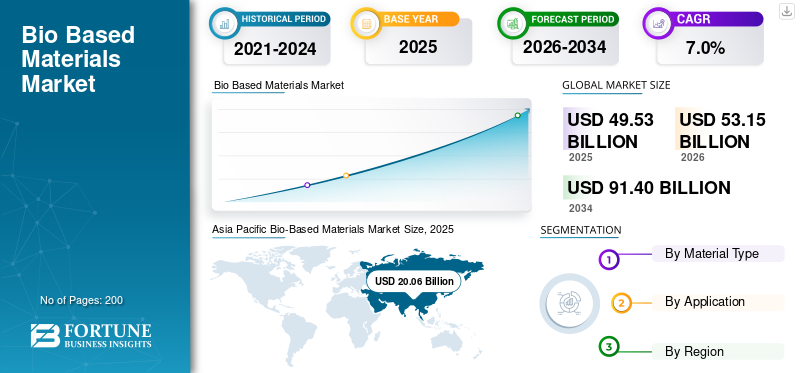
The global bio-based materials market size was valued at USD 49.53 billion in 2025. The market is projected to grow from USD 53.15 billion in 2026 to USD 91.40 billion by 2034, exhibiting a CAGR of 7.0% during the forecast period. Asia Pacific dominated the bio-based materials market with a market share of 40.50% in 2025.
Bio-based materials are processed commercial or industrial materials that are fully or partially derived from renewable biological resources, including agricultural feedstocks, forestry materials, plant oils, starches, sugars, cellulose, lignin, and other biomass-derived intermediates. Commercial demand spans bio-based fibers, bio-based polymers and plastics, bio-based resins, bio-based coatings and adhesives, bio-based composites, and selected specialty materials supplied into automotive components, textiles, automotive components, automotive components materials, consumer goods, agriculture, and other industrial applications.
The growth of the bio-based materials market is driven by brand owners, converters, material producers, and public buyers placing greater emphasis on renewable feedstock use, lower fossil-resource dependence, circularity, product-level sustainability claims, and material substitution across industrial value chains. Growth is further supported by expanding bioplastics capacity, broader use of manmade cellulosic fibers, increasing investment in bio-based chemicals, and the growing availability of drop-in and performance-grade bio-based materials from leading producers.
The market comprises several major players, including Braskem, TotalEnergies Corbion, BASF SE, Covestro AG, and SABIC. Feedstock access, polymerization technology, fiber-processing capability, certification systems, customer qualification, application development, and downstream partnerships support these companies' competitive positioning in the global market.
Download Free sample to learn more about this report.
Bio Based Materials Market Key Takeaways
 Global Market Size & Forecast
- 2025 Market Size: USD 49.53 billion
- 2026 Market Size: USD 53.15 billion
- 2034 Forecast Market Size: USD 91.40 billion
- CAGR: 7.0% (2026–2034)
 Market Share
- Asia Pacific dominated the market with a 40.50% share in 2025.
- The bio-based fibers segment accounted for the largest market share of 21.1% in 2025.
- The packaging segment held the largest application share of 23.9% in 2025.
 Key Regional Highlights
Asia Pacific
Asia Pacific generated USD 20.06 billion in 2025, maintaining its leading market position.
North America
North America is projected to witness steady growth during the forecast period.
Europe
Europe accounted for USD 12.23 billion in 2025 and is expected to grow at a 7.0% CAGR during the forecast period.
U.S.
U.S. market is projected to reach USD 9.16 billion by 2026.
Japan
Japan market is projected to reach USD 2.31 billion by 2026.
Read More

BIO-BASED MATERIALS MARKET TRENDS
Rising Emphasis On Certified Bio-Based Content is a Significant Market Trend
Demand is increasingly driven by the need to reduce reliance on fossil-based raw materials across packaging, textiles, consumer products, automotive interiors, construction products, and industrial formulations, without compromising performance, processability, or supply reliability. Large buyers are placing greater emphasis on certified bio-based content, lifecycle assessment evidence, compostability or recyclability claims, and traceable renewable feedstock sourcing when selecting materials. This trend is strengthening the commercial role of bio-based fibers, PLA, PHA, bio-PE, bio-PET, bio-based polyamides, bio-based polyurethane systems, lignin-based resins, natural-fiber composites, and renewable-content coatings and adhesives.
Alongside policy support, portfolio strategies are increasingly centered on product differentiation, sustainability credentials, and application-specific performance. Manufacturers are investing in fermentation-based monomers, biomass-derived chemical intermediates, natural-fiber reinforcement, cellulosic fiber capacity, and mass-balance-certified renewable polymer routes that can translate sustainability claims into procurement-ready offerings. As sustainability reporting becomes more formalized across packaging, textile, automotive, and construction value chains, suppliers are also highlighting certified renewable content, third-party verification, and scalable commercialization pathways to strengthen customer retention and pricing power.
- For instance, expanding global bioplastics applications, rising bio-based polymer production, certified renewable polymer offerings, and growing demand for cellulosic fibers are strengthening commercial demand signals for bio-based materials.
MARKET DYNAMICS
MARKET DRIVERS
Download Free sample to learn more about this report.
Growing Use of Compostable or Biodegradable Materials to Drive Market Growth
Packaging, textiles, consumer goods, and industrial products are under increasing pressure to reduce dependence on fossil resources and improve sustainability credentials, making renewable-content materials more important in procurement decisions. Bio-based polymers and plastics, cellulosic fibers, bio-based resins, coatings, adhesives, and natural-fiber composites are benefiting as they can lower reliance on petroleum-derived inputs while fitting into established applications and manufacturing systems. This creates a large and relatively durable demand base across regions where brand sustainability targets, packaging reformulation, textile sourcing commitments, and circular-economy policies are influencing purchasing behavior.
Beyond direct sustainability commitments, producers are expanding bio-based portfolios, certification coverage, and downstream partnerships to improve market access and premium realization. Demand is reinforced by the growing use of certified bio-based content labels, mass-balance approaches, renewable-carbon claims, and compostable or biodegradable materials in selected applications. As customers seek scalable ways to reduce exposure to fossil feedstocks and improve product-level sustainability, bio-based materials are becoming a practical route to commercialization as part of broader low-carbon and circular-material strategies.
- For instance, bio-based packaging materials, manmade cellulosic fibers, bio-based resins, certified renewable polymers, and natural-fiber composites are increasingly prioritized in corporate sustainability roadmaps as they support renewable-content claims without requiring a complete redesign of many end-use systems.
MARKET RESTRAINTS
High Production Cost and Supply-side Constraints to Restrict Market Expansion
While bio-based materials are gaining commercial relevance, the market remains sensitive to price premiums, feedstock availability, process scalability, and inconsistent definitions across bio-based, biodegradable, compostable, renewable, and circular materials. Production costs can remain high where bio-based pathways depend on fermentation capacity, purified monomers, specialty biomass feedstocks, certified mass-balance systems, or dedicated conversion assets. These factors can reduce pricing flexibility compared to conventional fossil-based polymers, resins, coatings, and composites, especially in cost-sensitive applications.
Supply-side constraints also continue to limit growth across some applications. Many bio-based material systems are still scaling from specialty grades toward broader industrial availability, while downstream users often require technical validation, food-contact approvals, compostability testing, performance qualification, and reliable delivery before shifting larger volumes. In addition, competition for agricultural and forestry feedstocks, land-use concerns, and uneven collection and processing infrastructure can complicate procurement and slow adoption in regions with underdeveloped or unreliable biomass supply chains.
MARKET OPPORTUNITIES
Higher-Value Adoption of Cellulosic Fibers is Creating Lucrative Growth Opportunities
Significant opportunities are emerging from packaging redesign initiatives, renewable-carbon targets, circular-economy policies, and premium product positioning across polymers, fibers, resins, coatings, and specialty materials. Packaging remains one of the earliest and most visible demand centers, as brand owners and retailers actively assess bio-based plastics, compostable formats, coatings, barriers, and fiber-based alternatives. At the same time, industries such as textiles, nonwovens, consumer goods, automotive industry, and construction are supporting higher-value adoption of cellulosic fibers, natural-fiber composites, bio-based polyamides, bio-based polyurethane systems, and lignin- or plant-oil-derived resins.
Additional opportunities exist where suppliers combine process innovation with certification, regulatory alignment, and application support. Companies that can offer verifiable renewable content, stable supply, consistent performance, and compatibility with existing converting systems are better positioned to capture premium demand. These capabilities can improve conversion rates, customer stickiness, and geographic expansion, especially in regions where packaging policies, textile sustainability programs, and corporate climate commitments are becoming more formalized.
MARKET CHALLENGES
Increases Uncertainty Around Acceptable Claims to Hamper Market Growth
Producers and downstream buyers must navigate evolving definitions surrounding bio-based, biodegradable, compostable, renewable, recyclable, and circular materials while also adapting to changing reporting rules, product certifications, and customer-specific procurement standards. This increases uncertainty around acceptable claims, premium levels, comparability across suppliers, and end-of-life positioning, particularly in markets where standards and labeling practices are still developing.
In addition, many bio-based production routes depend on infrastructure that remains unevenly developed, including biomass collection systems, biorefineries, fermentation capacity, certified feedstock supply, composting systems, and recycling-compatible design ecosystems. End users also require technical validation, supply assurance, and, in some cases, material requalification before shifting large volumes away from conventional materials. These factors can slow adoption even when long-term demand fundamentals remain favorable.
Segmentation Analysis
By Material Type
Bio-Based Fibers Segment Dominated Due to Large-Scale Production of Manmade Cellulosic Fibers
Based on material type, the market is segmented into bio-based fibers, bio-based polymers & plastics, bio-based resins, bio-based coatings & adhesives, bio-based composites, and others.
The bio-based fibers segment accounted for the largest bio-based materials market share of 21.1% in 2025. The segment’s growth is driven by the large-scale production of manmade cellulosic fibers, plant-based fibers, nonwoven materials, and industrial fiber applications across textiles, hygiene, packaging, and technical materials.
The bio-based polymers and plastics segment is expected to grow at a CAGR of 7.0% during the study period. This is driven by rising adoption of PLA, PHA, starch blends, bio-PE, bio-PET, bio-based polyamides, bio-based polyurethane systems, and other renewable-content polymer grades in packaging, consumer goods, automotive, agriculture, and durable applications.
By Application
To know how our report can help streamline your business, Speak to Analyst
Packaging Segment Dominated the Market Due to the Broader Use of Bio-Based Polymers
By application, the market is categorized into packaging, textiles & fibers, automotive components, building & construction materials, consumer goods, agriculture & horticulture, and others.
The packaging segment accounted for the largest share of 23.9% in 2025, driven by broader use of bio-based polymers, compostable materials, coated paper formats, renewable-content films, bottles, trays, and fiber-based packaging across food, beverage, personal care, e-commerce, and consumer goods applications.
The agriculture & horticulture segment is also expected to grow at a CAGR of 7.4% over the forecast period. The segment's growth is driven by biodegradable mulch films, plant clips, seedling pots, soil-contact materials, controlled-release systems, and bio-based binders used in crop production and horticultural applications, where end-of-life performance and the use of renewable inputs are commercially relevant.
Bio-Based Materials Market Regional Outlook
By geography, the market is categorized into North America, Europe, Asia Pacific, Latin America, and the Middle East & Africa.
Asia Pacific
Asia Pacific Bio-Based Materials Market Size, 2025 (USD Billion)
To get more information on the regional analysis of this market, Download Free sample
Asia Pacific held the dominant share in 2024, valued at USD 18.62 billion, and maintained its leading share in 2025, valued at USD 20.06 billion. The region benefits from its large textile, packaging, polymer conversion, fiber processing, and industrial manufacturing base, the central role of China and India in materials production and consumption, and the growing interest in renewable feedstocks across packaging, textiles, consumer goods, and automotive applications. China remains the largest market, while India, Japan, South Korea, and the broader Asia Pacific region continue to support demand, driven by industrial scale, export manufacturing, large consumer markets, and increasing substitution of fossil-based materials with bio-based alternatives.
China Bio-Based Materials Market
The Chinese market is estimated to reach USD 12.06 billion by 2026. China's market demand is supported by its large packaging conversion base, textile and fiber-processing capacity, consumer manufacturing scale, expanding circular-materials activity, and gradual commercialization of bio-based polymers, cellulosic fibers, resins, and composites across major supply chains.
To know how our report can help streamline your business, Speak to Analyst
India Bio-Based Materials Market
The Indian market is estimated at around USD 3.30 billion by 2026, representing approximately 7.5% of global market revenues.
Japan Bio-Based Materials Market
Japan market is projected to reach approximately USD 2.31 billion by 2026, accounting for about 6.6% of global sales.
North America
North America is also a significant contributor to the market, standing at USD 10.11 billion in 2025. The bio-based materials market growth is driven by the U.S. biobased products industry, forest products, biobased chemicals, packaging, textiles, renewable-content procurement, and growing commercialization of bio-based polymers, resins, coatings, adhesives, and specialty materials. Application intensity remains strong in the U.S., supported by advanced industrial capacity, certification systems, brand-owner sustainability programs, and better availability of product disclosures and qualification pathways.
U.S. Bio-Based Materials Market
The U.S. market is estimated to reach USD 9.16 billion by 2026. The U.S. dominates regional consumption due to its large packaging, textile, forest products, chemical, construction, and manufacturing base, early adoption of certified bio-based products, expanding renewable-content polymer offerings, and continued development of bio-based chemicals and specialty material inputs.
Europe
Europe is expected to grow at a rate of 7.0% during the forecast period. The market reached a valuation of USD 12.23 billion in 2025. The market's growth is supported by strong regulatory pressure to reduce fossil-resource use, active commercialization of bio-based polymers and chemicals, mature sustainability reporting practices, and wider acceptance of certified renewable and traceable material grades. The region also benefits from policy support, technical know-how, and a greater willingness among industrial buyers to pay for verifiable renewable content and lower-impact materials.
U.K. Bio-Based Materials Market
The U.K. market is estimated at around USD 1.89 billion by 2026, representing approximately 6.3% of global market revenues.
Germany Bio-Based Materials Market
Germany’s market is projected to reach approximately USD 3.49 billion by 2026, accounting for about 7.8% of global sales.
Latin America
Latin America is experiencing steady growth, reaching a valuation of USD 4.90 billion in 2025. The demand is concentrated in packaging, agriculture and horticulture, consumer goods, and industrial products, with Brazil and Mexico representing the most important country markets. Sugarcane-based feedstocks, packaging demand, agricultural applications, and growing interest in renewable-content exports and industrial supply chains continue to support regional adoption of bio-based materials.
Brazil Bio-Based Materials Market
Brazil’s market reached approximately USD 3.57 billion by 2026, equivalent to around 6.1% of global sales.
Middle East & Africa
The Middle East & Africa region is gradually expanding, supported by GCC-led polymer and chemical conversion capabilities, certified renewable polymer initiatives, infrastructure demand, and growing interest in renewable-feedstock materials for packaging, consumer goods, construction, and export-oriented value chains.
GCC Bio-Based Materials Market
GCC is expected to reach USD 1.26 billion by 2026, accounting for approximately 5.7% of global revenues.
COMPETITIVE LANDSCAPE
Key Industry Players
Key Players Focus on Fermentation or Polymerization Technology to Provide Verifiable Product-Level Sustainability Data
The market includes a mix of bio-based polymer producers, cellulosic fiber manufacturers, chemical companies, resin and coating suppliers, bioplastics specialists, packaging material producers, and renewable feedstock innovators that supply bio-based materials for packaging, textiles, automotive, construction, agriculture, industrial, and consumer applications. Competition is shaped by access to renewable feedstocks, fermentation or polymerization technology, fiber-processing scale, certified bio-based content, compostability or recyclability positioning, commercial scale, and the ability to provide verifiable product-level sustainability data.
Leading companies differentiate through product innovation, integrated biomass or bio-based monomer supply chains, mass-balance certification, application development, and strong relationships with converters, brand owners, textile companies, packaging producers, and industrial buyers. Some key market players include Braskem, TotalEnergies Corbion, BASF SE, Covestro AG, and SABIC.
LIST OF KEY BIO-BASED MATERIALS COMPANIES PROFILED
- Braskem (Brazil)
- NatureWorks LLC (U.S.)
- TotalEnergies Corbion (Netherlands)
- BASF SE (Germany)
- Covestro AG (Germany)
- Lenzing AG (Austria)
- Eastman Chemical Company (U.S.)
- Arkema S.A. (France)
- SABIC (Saudi Arabia)
- Toray Industries, Inc. (Japan)
KEY INDUSTRY DEVELOPMENTS
- April 2026: NatureWorks opened its fully integrated Ingeo PLA biopolymer manufacturing facility in Nakhon Sawan, Thailand (75,000 tons/year PLA capacity integrating lactic acid, lactide, and polymer production from locally sourced sugarcane), signaling major PLA capacity expansion and stronger Asia-based supply for packaging, fibers, and 3D printing.
- March 2026: UPM Specialty Materials and Paramelt introduced a bio-based paper food packaging concept (UPM barrier base papers with Paramelt bio-based heat-seal and barrier technology), signaling product innovation in recyclable and home-compostable food packaging materials.
- January 2026: Arkema started up its new Rilsan Clear transparent polyamide production unit in Singapore (tripling global Rilsan Clear capacity and strengthening Asia-based transparent polyamide supply), signaling greater availability of sustainable, high-performance, bio-based polymers.
- December 2025: UPM started production and commercialization of wood-based chemicals at its Leuna biorefinery in Germany (using industrial sugars as a step toward renewable glycols and lignin-based functional fillers), signaling an industrial-scale expansion of bio-based chemical building blocks for packaging, textiles, cosmetics, and materials.
- October 2025: CJ Biomaterials launched a new PHA platform for extrusion coatings on paper and board (PHACT PHA compounds for foodservice and food packaging, designed for repulpability and home compostability), signaling expansion of PHA use in coated paper packaging.
- October 2024: Avantium officially opened its FDCA Flagship Plant in Delfzijl, Netherlands (a commercial FDCA plant for plant-based, recyclable PEF), marking a key milestone in the commercialization of bio-based bottles, films, packaging, and textile applications.
- June 2024: BASF expanded its biopolymers portfolio by introducing biomass-balanced ecoflex PBAT (certified compostable PBAT with 60% lower product carbon footprint than standard ecoflex), signaling stronger renewable-feedstock options for compostable packaging compounds.
REPORT COVERAGE
The global bio-based materials report analysis provides an in-depth study of the market size & forecast by all the market segments included in the report. It includes details on market dynamics and trends expected to drive the market during the forecast period. It offers information on technological advancements, new product launches, key industry developments, and partnerships, mergers & acquisitions. The market research report also includes a detailed competitive landscape, providing market share and profiles of key players.
Request for Customization to gain extensive market insights.
Report Scope & Segmentation
| ATTRIBUTE | DETAILS |
| Study Period | 2021-2034 |
| Base Year | 2025 |
| Estimated Year | 2026 |
| Forecast Period | 2026-2034 |
| Historical Period | 2021-2024 |
| Growth Rate | CAGR of 7.0% from 2026 to 2034 |
| Unit | Value (USD Billion) and Volume (Kiloton) |
| Segmentation | By Material Type, Application, and Region |
| By Material Type |
|
| By Application |
|
| By Geography |
|
Frequently Asked Questions
Fortune Business Insights estimates that the global market size was valued at USD 49.53 billion in 2025 and is projected to reach USD 91.40 billion by 2034.
Recording a CAGR of 7.0%, the market is slated to exhibit steady growth during the forecast period.
By application, the packaging segment led in 2025.
Asia Pacific held the highest market share.
Braskem, TotalEnergies Corbion, BASF SE, Covestro AG, and SABIC are some of the top players in the market.
The key factor driving market growth is the rising emphasis on certified bio-based content.



- 2021-2034
- 2025
- 2021-2024
- 200
Get 30-60 hrs Free Customization
Expand Regional and Country Coverage, Segments Analysis, Company Profiles, Competitive Benchmarking, and End-user Insights.


















Related Reports
-
US +1 833 909 2966 ( Toll Free )
-
Get In Touch With Us