Mulch Films Market Size, Share & Industry Analysis, By Product Type (Conventional {LDPE, LLDPE, HDPE and EVA} and Biodegradable {PBAT, PLA, Starch-based blends and, Others), By Function (Light-blocking films and Light-transmitting films), By Crop Type (Agriculture {Cereals & Grains, Oilseeds & Pulses, Fiber Crops, and Others} and Horticulture Crops {Fruits & Vegetables, Roots & Tuber, Floriculture & Ornamentals, and Others}), By End User (Commercial farms and plantations, Small and medium growers, and Agricultural cooperatives and contract farmers), and Regional Forecast, 2026-2034
 Download Free Sample
(Offer valid till 15th Oct 2026)

KEY MARKET INSIGHTS
 Listen to Audio Version
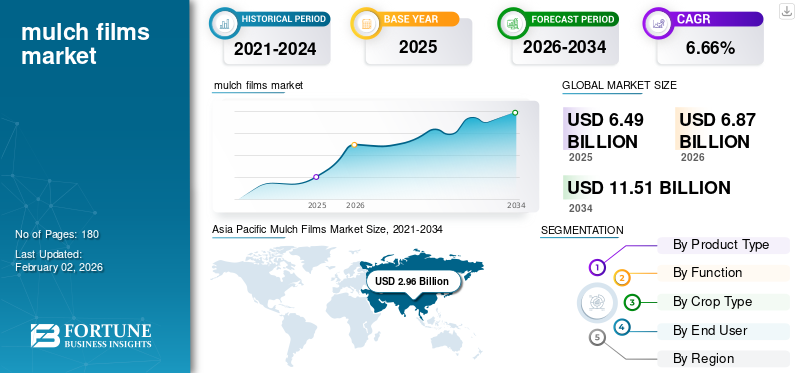
The global mulch films market size was valued at USD 6.49 billion in 2025 and is projected to grow from USD 6.87 billion in 2026 to USD 11.51 billion by 2034, exhibiting a CAGR of 6.66% during the forecast period. Asia Pacific dominated the mulch films market with a market share of 45.58% in 2025.
Mulch films are thin plastic films placed on the soil surface in agricultural lands to manage soil parameters. These films are available in different colors and help to conserve moisture, control weeds, and prevent soil erosion. They also help to increase crop yields and improve soil health, providing a controlled environment for plant growth.
BASF, Novamont, FKuR, Barbier, Armando Alvarez, and RKW Group are some of the key companies operating in this market. Manufacturers' key strategy to increase sales is launching new products in the biodegradable category.
Download Free sample to learn more about this report.
MULCH FILMS MARKET Key Takeaways
 Global Market Size & Forecast
- 2025 Market Size: USD 6.49 billion
- 2026 Market Size: USD 6.87 billion
- 2034 Forecast Market Size: USD 11.51 billion
- CAGR: 6.66% from 2026–2034
 Market Share
- Asia Pacific dominated the mulch films market with a market share of 45.58% in 2025.
- The conventional films segment accounts for the largest market share 86.90% in 2026.
- Light-blocking films accounted for the largest market share in 2026 with 82.82%.
 Key Regional Highlights
Asia Pacific
The market in Asia Pacific reached USD 2.96 billion in 2025, representing 45.58% of total market revenue, and is projected to reach USD 3.15 billion in 2026.
Europe
Europe held 16.78% of the global market, reaching a valuation of USD 1.09 billion in 2025, and is projected to grow to USD 1.14 billion in 2026.
North America
The North America market was valued at USD 0.92 billion in 2025, capturing 14.21% of global revenue, and is estimated to reach USD 0.97 billion in 2026.
U.S.
In the U.S., states such as California, Florida, and Arizona use mulch films extensively, pushing the country’s market size to USD 0.69 billion for 2026.
Japan
Japan has adopted the use of plastic films for mulching, irrigation, and greenhouse farming, supporting the growth of the Asia Pacific market.
Read More

MARKET DYNAMICS
MARKET DRIVERS
Cultivation Practices via Mulch Films Protect Crop Yield from Effects of Environment Changes
Weather aberrations are another major factor impacting crop yield, and the usage of mulch films can help to prevent climate shocks. Increasing temperature extremes and irregular rainfall are key factors prompting farmers to adopt protective cultivation practices such as mulching. These films act as a barrier against soil temperature fluctuations, thereby helping the crops to survive severe climate conditions. They also help retain soil moisture, regulate temperature, and suppress weed growth. Therefore, to maintain optimal growth conditions for plants, the mulch film market growth is expected to continue in the future.
MARKET RESTRAINTS
Plastic Pollution and High Cost of Biodegradable Films are Key Factors Hindering Market Growth
Conventional polyethylene-based films, when used in soil for a long time, lead to microplastic pollution, degrading soil health. Governments in several countries are placing bans or restrictions on the use of such plastics in Europe and parts of Asia to reduce plastic pollution, pushing farmers to use biodegradable products. The cost of biodegradable mulch films is higher than conventional films. Due to the limited large-scale production at the domestic level and high dependency of Asian economies on imported raw materials (For instance, Polylactic acid PLA from Europe) for manufacturing biodegradable films, the cost remains high. Therefore, the mulch films market growth is discouraged as farmers in emerging markets find it economically challenging to adopt them.
MARKET OPPORTUNITIES
Expanding Commercial Agriculture and Mechanization in Asian Economies Create Opportunity to Expand Sales
In Asia Pacific, commercial agriculture for crop production is expanding rapidly due to rising incomes, changing consumer preferences, adoption of advanced technology for farming practices, and strong government policies that support agriculture. Such a shift is prompting farmers to produce high-value and high-demand crops such as fruits, vegetables, and nuts that can be consumed in both domestic and international markets. Moreover, there is a growing proportion of agribusinesses and cooperatives that emphasize uniformity and yield optimization using advanced materials in their fields. This creates an opportunity for manufacturers to develop product lines for untapped markets and expand their presence in such regions.
MULCH FILMS MARKET TRENDS
Shift Toward Sustainable and Biodegradable Materials is a Key Trend Influencing Market
There is a strong push from regulatory agencies across the world, with wider emphasis on the European and North American markets, to reduce plastic waste. The usage of plastic-based films needs to be replaced with films that are made of environment friendly biodegradable materials. Regulatory policies, which include subsidies and sustainability programs, are accelerating the transition from linear low-density polyethylene LLDPE to biobased films (PLA, PBAT, and others). This growing demand for low environmental impact biodegradable films, combined with the regulatory push, is driving the demand for biodegradable mulch film adoption.
Download Free sample to learn more about this report.
Segmentation Analysis
By Product Type
Cost-Effectiveness and Affordability contribute to popularity of Conventional Films
The market is divided by product type into conventional and biodegradable. Conventional films are further segmented into LDPE, LLDPE, HDPE, EVA. Biodegradable films are sub-segmented into PBAT, PLA, starch-based blends and others.
The conventional films segment accounts for the largest market share 86.90% in 2026. As conventional products are economical compared to biodegradable or compostable films, price-sensitive farmers, especially in Asia, Africa, and South America, use this type. Their lower investment cost makes them an ideal type for large-scale and smallholder farms alike.
The biodegradable segment is expected to grow at a CAGR of 6.64% over the forecast period owing to restrictions for the usage of non-biodegradable polyethylene mulch films in many regions, further accelerating its demand.
By Function
Light Blocking Films are Highly Preferred as they are Suitable for Large Open Fields and Arid Climate Conditions
The market is segmented by product type into light-blocking films and light-transmitting films.
Light-blocking films accounted for the largest market share in 2026 with 82.82%, as these films prevent sunlight from reaching the soil and inhibit weed germination and growth. They are also suitable for large open-field crops and water conservation, which is critical for farmers in arid and semi-arid regions.
Light-transmitting films segment is expected to grow at a 5.57% CAGR during the projected period. This film is widely used in fruits, vegetables, and floriculture, where plants require optimum light intensity and a controlled microclimate for high yields.
By Crop Type
Agriculture Segment Leads as Mulch Films are Beneficial in Large Scale, Broadacre Farming
The market is segmented by crop type into agriculture and horticulture crops. Agriculture is further segmented into cereals & grains, oilseeds & pulses, fiber crops, and others. Horticulture crops are further segmented into fruits & vegetables, roots & tubers, floriculture & ornamentals
and others.
Agriculture crops accounted for the largest market share of 58.95% in 2024, as mulch films are used for water and weed management on several large and small agricultural farms, which is essential for large-scale, broadacre farming.
The horticulture crops segment is estimated to grow at a CAGR of 6.45% as the demand for nutrient-rich fruits and vegetables is growing rapidly. In numerous countries, farmers are investing heavily in growing high-quality horticulture crops. In these settings, mulch films are used for specific temperature control, pest management, and crop quality enhancement.
By End User
Operational Efficiency of Commercial Farmers Contributes To Higher Usage Of In Such Plantations
The market is segmented by end user into commercial farms and plantations, small and medium growers, and agricultural cooperatives and contract farmers.
Commercial farms registered the highest mulch films market share in 2026 with 59.97%, as mulch films’ usage here supports uniform yield, efficient resource use, and mechanization. Along with these benefits, it helps to achieve consistent crop quality and higher productivity per hectare, assisting the profitability of the farmers.
Small and medium growers, especially in India, China, and Africa, use films along with low-pressure drip systems to maximize efficiency and increase crop yield. The segment is expected to grow at a CAGR of 6.12% during the forecast period.
To know how our report can help streamline your business, Speak to Analyst
Mulch Films Market Regional Outlook
By geography, the market is categorized into Europe, North America, Asia Pacific, South America, and the Middle East & Africa.
Asia Pacific Mulch Films Market Size, 2021-2034 (USD Billion)
To get more information on the regional analysis of this market, Download Free sample
Asia Pacific
The market in the Asia Pacific reached USD 2.96 billion in 2025, representing 45.58% of total market revenue, and is projected to reach USD 3.15 billion in 2026. China, India, Japan, and many other Asian countries have adopted the use of plastic films for mulching, irrigation, and greenhouse farming, propelling the region’s growth further to an estimated USD 2.96 billion in 2025. The shift in agricultural practices is driven by government support for intensive and high-efficiency farming in areas with water scarcity and fragmented landholdings among farmers. These initiatives promote market development in China and India, with an estimation for 2026 to reach USD 1.28 billion and USD 0.7 billion, respectively.
Europe
Following Asia Pacific, in 2025, Europe held 16.78% of the global market, reaching a valuation of USD 1.09 billion, and is projected to grow to USD 1.14 billion in 2026. The region’s farming emphasizes quality over quantity, where the U.K., Germany, France, Italy, Spain, and other countries use mulching films in their fields. This film helps in microclimate control, weed suppression, and moisture retention as the region focuses on producing high-value horticultural crops such as fruits, vegetables, berries, and ornamentals. Backed by these factors, in 2026 Germany will gain a market size of USD 0.21 billion, followed by France with USD 0.17 billion, and the U.K. at USD 0.1 billion.
North America
The North America market was valued at USD 0.92 billion in 2025, capturing 14.21% of global revenue, and is estimated to reach USD 0.97 billion in 2026. fostered by the cultivation of high-value crops such as strawberries, melons, tomatoes, peppers, and ornamental plants. Such crops require microclimate regulation, soil moisture balance, and weed suppression, which requires the usage of mulch films as they are effective in providing protection. In the U.S. states such as California, Florida, and Arizona, use such films to cultivate fruits, vegetables, and nursery crops effectively pushing the country’s market size to USD 0.69 billion for 2026.
Rest of The World
Latin America maintained a strong presence in the global market, reaching USD 0.87 billion in 2025, accounting for 13.34% share, and is expected to reach USD 0.92 billion in 2026. South America and the Middle East & Africa would witness high growth, where South America will capture USD 0.87 billion in 2025, fostered by the growing cultivation of specialty crops, which require optimal temperature and environment. In the Middle East & Africa, Turkey's mulch film market forecast is set at a CAGR of 6.04% for the outlook period as several Middle Eastern countries promote nutrition and preventive healthcare. In 2025, the Middle East & Africa market stood at USD 0.65 billion, representing 10.08% of global demand, and is projected to grow to USD 0.69 billion in 2026.
COMPETITIVE LANDSCAPE
Key Industry Players:
Major Companies are Launching Sustainable Products to Maintain Competitive Edge
The global market exhibits a fragmented structure as there are several well-established multinational companies, startups, and regional manufacturers competing. Companies are focused on manufacturing biodegradable and compostable mulch films, due to strong pressure from governments across the world to reduce plastic pollution. BASF, Novamont, FKuR, Barbier, Armando Alvarez, and RKW Group are few prominent names focusing on strong research and development to expand market presence and increase sales.
LIST OF KEY MULCH FILMS COMPANIES PROFILED:
- BASF SE (Germany)
- Novamont S.p.A. (Italy)
- Armando Alvarez Group (Spain)
- Barbier Group (France)
- RKW Group (Germany)
- Trioplast Industrier AB (Sweden)
- Ginegar Plastic Products (Israel)
- Berry Global Inc. (U.S.)
- Kurary (Japan)
- Exxon Mobil Corporation (U.S.)
KEY INDUSTRY DEVELOPMENTS:
- April 2025: Sirmax Group completed open field testing of its biodegradable mulch film named “BioComp”, which was developed by collaborating with the University of Turin.
- February 2025: BASF SE, India stated that it continues to develop new varieties of biopolymers with expanded application in agriculture and other areas.
- June 2024: Mulch film manufacturer Novamont launched an initiative named “Terrific” which is aimed at accelerating the production of sustainable agricultural films and supporting advanced bio-based packaging.
- February 2024: NUREL SA launched biopolymers named Inzea for manufacturing agricultural mulch films. Moreover, the company also received TÜV OK biodegradable SOIL certification for its biopolymers in the same year.
- October 2023: Mondi Group partnered with Cotesi S.A. and developed and launched compostable mulch paper named “Advantage Craft Mulch” in the market. This product is made of paper and therefore are sustainable farming practices to traditional plastic mulching films.
REPORT COVERAGE
The global mulch films analysis provides an in-depth study of market size & forecast by all market segments included in the report. The report also includes details on market dynamics and market trends that are expected to drive the market during the forecast period. It offers information on the technological advancements, new product launches, key industry developments, and details on partnerships, mergers & acquisitions. Furthermore, it encompasses detailed competitive landscape with information on market share and profiles of key operating players.
Request for Customization to gain extensive market insights.
Report Scope & Segmentation
|
ATTRIBUTE |
DETAILS |
|
Study Period |
2021-2034 |
|
Base Year |
2025 |
|
Forecast Period |
2026-2034 |
|
Historical Period |
2021-2024 |
|
Growth Rate |
CAGR of 6.66% from 2026-2034 |
|
Unit |
Value (USD Billion) |
|
Segmentation |
By Product Type
By Function
By End User
By Crop Type
By Geography North America (By Product Type, Function, End User, Crop Type, and Country)
Europe (By Product Type, Function, End User, Crop Type, and Country)
Asia Pacific (By Product Type, Function, End User, Crop Type, and Country)
South America (By Product Type, Function, End User, Crop Type, and Country)
Middle East & Africa (By Product Type, Function, End User, Crop Type, and Country)
|
Frequently Asked Questions
Fortune Business Insights says that the global market value stood at USD 6.49 billion in 2025 and is projected to reach USD 11.51 billion by 2034.
In 2025, Asia Pacific’s anticipated market value is USD 2.96 billion.
The market is expected to exhibit a CAGR of 6.66% during the projected timeframe.
By product type, the conventional segment leads in the global market.
Mitigation of climate change through usage of mulch films drives growth.
BASF, Novamont, Barbier Group, Armando Alvarez, and RKW Group are few of the leading players.
Asia Pacific held the largest market share in 2025.
Shift toward sustainable & biodegradable materials is a key trend influencing market.



- 2021-2034
- 2025
- 2021-2024
- 180
-
(Offer valid till 15th Oct 2026)
Get 30-60 hrs Free Customization
Expand Regional and Country Coverage, Segments Analysis, Company Profiles, Competitive Benchmarking, and End-user Insights.














Related Reports
-
US +1 833 909 2966 ( Toll Free )
-
Get In Touch With Us