Biomass Gasification Market Size, Share & Industry Analysis, By Feedstock (Agricultural Residues, Forest Residues, Municipal Solid Waste (MSW), Animal Waste and Others), By Technology (Fixed-Bed Gasification, Fluidized-Bed Gasification, Entrained-Flow Gasification, Plasma Gasification, Others), By End-Use Industry (Power Generation, Biofuels Production, Heat & CHP, Hydrogen & Synthetic Gas Production, Others), and Regional Forecast, 2026-2034
 Download Free Sample
Biomass Gasification Market Size and Future Outlook
 Listen to Audio Version
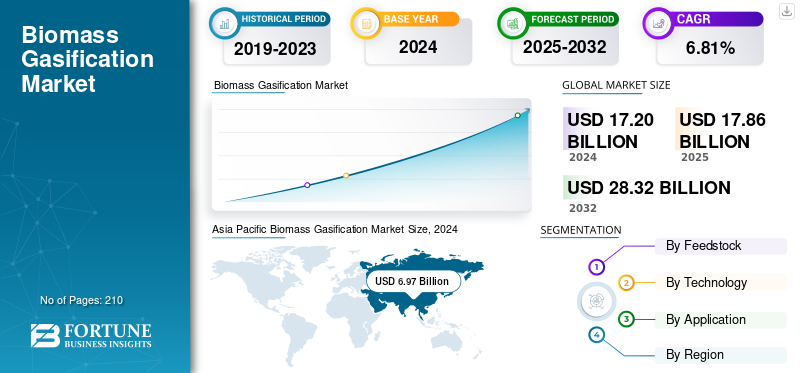
The global biomass gasification market size was valued at USD 17.86 billion in 2025 and is expected to reach USD 18.63 billion in 2026. Furthermore, the market is projected to reach USD 34.56 billion by 2034, exhibiting a CAGR of 8.03% during the forecast period of 2026-2034. Asia Pacific dominated the global biomass gasification market with a market share of 40.65% in 2025. Moreover, the Asia Pacific accounts for the largest market revenue share due to demand for renewable energy and Decarbonization efforts.
Biomass gasification is a thermochemical process that converts solid organic matter, such as wood, agricultural waste, or municipal solid waste, into a combustible gas mixture known as producer gas or syngas. This is achieved by heating the biomass in a low-oxygen environment, a process that includes drying, pyrolysis, oxidation, and reduction within a gasifier.
- According to the International Energy Agency, Bioenergy, including liquid, gaseous, and solid fuels, will drive 95% of renewable fuel growth by 2030, led by new industrial sector demand, with additional expansion in transport and buildings, each sector utilizing distinct types of bioenergy.
The primary drivers of the market are growing demand for renewable energy, need to mitigate greenhouse gas emissions, and availability of abundant biomass feedstock from agricultural and waste sources. Other key factors include government support through reassuring policies and incentives, the need for decentralized energy production, and technological advancements that improve efficiency and scalability. Aforementioned factors are expected to boost market growth in coming years.
Valmet is a prominent and leading global player in the market, particularly recognized for its large-scale Circulating Fluidized Bed (CFB) technology. The company holds a significant position among key industry competitors, including Mitsubishi Heavy Industries, Andritz and Enerkem.
Download Free sample to learn more about this report.
Biomass Gasification Market KEY TAKEAWAYS
 Market Size & Forecast
- 2025 Market Size: USD 17.86 billion
- 2026 Market Size: USD 18.63 billion
- 2034 Forecast Market Size: USD 34.56 billion
- CAGR: 8.03% from 2026–2034
 Market Share
- Asia Pacific dominated the biomass gasification market with a 40.65% share in 2025.
- The agricultural residues segment is expected to account for 32.05% of the market in 2026.
- The fixed-bed gasification segment will hold a 39.19% market share in 2026.
 Key Regional Highlights
Asia Pacific
Asia Pacific generated USD 7.26 billion in 2025 and maintained its leadership position due to strong biomass availability and renewable energy investments.
Europe
Europe accounted for USD 5.33 billion in 2025, supported by stringent emission reduction policies and growing adoption of sustainable energy solutions.
North America
North America reached USD 3.18 billion in 2025, driven by increasing investments in clean energy infrastructure and bioenergy projects.
U.S.
U.S. The market is estimated to reach USD 2.59 billion in 2025, supported by rising demand for low-carbon energy generation technologies.
Japan
Japan Increasing efforts to reduce dependence on fossil fuels and enhance renewable energy generation are driving demand in the biomass gasification market.
Read More

MARKET DYNAMICS
MARKET DRIVERS
Growing Adoption of Biofuels and Hydrogen to Boost Market Growth
The market is driven by increasing demand for renewable energy, amid rapid depletion of fossil fuels and stringent emissions regulations. Technological advancements are improving efficiency, coupled with availability of abundant biomass feedstock, thus fueling the market expansion. Government initiatives and incentives supporting the adoption of clean energy also accelerates its deployment.
- According to the International Renewable Energy Agency, global bioenergy power capacity reached 151 GW, accounting for approximately 4.4% of all renewable energy capacity. Unlike other renewables that have experienced notable cost declines, bioenergy’s levelized cost of electricity (LCOE) rose slightly to USD 0.087/kWh in 2024 from USD 0.086/kWh in 2010, due to fluctuating feedstock and logistics costs.
Growing awareness of environmental benefits and the importance of carbon reduction further boosts its adoption across industrial, rural, and commercial sectors. Strategic collaborations and integration with emerging technologies, such as carbon capture and hydrogen production, enhance the market’s sustainability and expansion prospects.
Government Incentives & Carbon Credit Schemes to Fuel Market Development
Government incentives and carbon credit schemes are crucial in accelerating the adoption of biofuels and hydrogen, driving biomass gasification market growth. Tax credits, such as the U.S. CREST Act, supports sustainable biomass carbon removal, making projects financially viable and attractive to investors. In India, the Carbon Credit Trading Scheme incentivizes industries to reduce their emissions, thereby facilitating the adoption of clean technology. These policies boost private investments, encourage research and innovation in biomass gasification and hydrogen production, and promote low-carbon, renewable energy solutions. Carbon credits also foster rural economic development by creating new income streams for biomass suppliers, strengthening the global transition toward Decarbonization and net-zero goals.
MARKET RESTRAINTS
High Capital and Maintenance Costs Limit Market Growth
Feedstock supply inconsistency is a major restraint to the market. Variability in biomass quality, seasonal availability, and regional disparities complicate the stable sourcing of feedstock. The low energy density and high moisture content of biomass increase storage and transportation costs. Supply chain fragmentation and lack of long-term contracts further hinder reliable access to feedstock.
Additionally, feedstock handling challenges, such as bridging and clogging, disrupt gasifier operation. High capital costs required for infrastructure to manage diverse feedstock types also pose barriers to market growth. These constraints impact system efficiency and economic viability, limiting the adoption of large-scale biomass gasification despite its growing demand.
MARKET OPPORTUNITIES
Integration with Carbon Capture & Utilization (CCU) Creates Lucrative Opportunities
The integration of carbon capture and utilization (CCU) with biomass gasification creates significant market opportunities, enabling the production of carbon-negative energy. This integration captures CO2 emissions during gasification and converts them into valuable products, such as methanol, thereby enhancing economic viability. It supports global sustainability goals by reducing greenhouse gas emissions and achieving near-zero or negative carbon footprints. CCU combined with biomass gasification improves energy efficiency and reduces operational costs compared to separate systems. This synergy attracts regulatory support, funding, and investment, fostering innovation, job creation, and accelerated adoption in renewable energy, chemicals, and fuels the market globally.
MARKET CHALLENGES
Financing Barriers for Emerging Economies Deters Market Growth
Financing barriers in emerging economies pose significant challenges to the growth of the market. High upfront capital costs and a lack of tailored financing mechanisms limits access to affordable investment. Many rural entrepreneurs and small-scale operators struggle to mobilize funds due to perceived technological risks and limited access to credit. Weak financial infrastructure and insufficient public-private partnerships further hinder the scaling process.
Additionally, government subsidies often prioritize fossil fuels, reducing the competitiveness of biomass projects. Without clear policy support, risk mitigation instruments, and innovative financing models, such as microcredit or impact investment, biomass gasification projects face slow adoption and constrained market expansion across developing regions.
BIOMASS GASIFICATION MARKET TRENDS
Shift Toward Fluidized-Bed & Plasma Gasification is Key Market Trend
The market is shifting toward advanced technologies, such as fluidized-bed and plasma gasification, which offer higher efficiency and better feedstock flexibility. Fluidized-bed gasifiers improve heat and mass transfer, enhancing carbon conversion rates and reducing tar production.
Plasma gasification operates at very high temperatures, enabling the breakdown of complex waste materials and producing cleaner syngas with minimal residues. These technologies support scaling for industrial and commercial applications, addressing environmental regulations and sustainability goals. Growing investments in R&D, the adoption of green hydrogen and biofuel production, and integration with carbon capture further drive market expansion, particularly across the Asia Pacific region and emerging economies.
Download Free sample to learn more about this report.
IMPACT OF TARIFFS
Tariffs significantly impacted the market by increasing the cost of critical raw materials and specialized equipment, such as steel, reactor vessels, and control systems. The U.S. tariffs imposed under Section 232 and Section 301 on steel, aluminum, and advanced machinery have driven up prices, stretching project budgets and delaying timelines. These higher costs have prompted project developers to seek alternative suppliers or localize production, fostering domestic manufacturing, however, increasing short-term expenses. Smaller projects in the commercial and residential sectors face deferrals. Despite challenges, tariff-driven localization may strengthen supply chain resilience and long-term industry competitiveness globally.
SEGMENTATION ANALYSIS
By Feedstock
The Municipal Solid Waste (MSW) segment Dominated Market Owing to Increase in Utilization of Waste in Power Generation
Based on feedstock, the market is segmented into agricultural residues, Forest Residues, Municipal Solid Waste (MSW), Animal Waste, and Others.
The Municipal Solid Waste (MSW) segment accounted for the largest market revenue share of 31.66% in 2024. Gasification of MSW offers an efficient waste-to-energy solution, reducing landfill use and greenhouse gas emissions while producing valuable syngas for power generation and biofuels.
- In November 2024, NTPC’s NETRA R&D announced development of a demonstration plant using plasma oxy gasification of MSW and agri-waste to produce 1 ton/day green hydrogen with over 99.9% purity, plus electricity from separated carbon monoxide. This pioneering process supports India’s energy transition and circular economy models.
Meanwhile, The Agricultural Residues segment is expected to account for 32.05% of the market in 2026, driven by vast availability of crop residues, including rice husks, wheat straw, and sugarcane bagasse. These residues provide a consistent, cost-effective feedstock that supports decentralized energy production.
By Technology
Fluidized-Bed Gasification Segment Leads Due to Superior Heat Transfer Efficiency
Based on technology, the market is segmented into Fixed-Bed Gasification, Fluidized-Bed Gasification, Entrained-Flow Gasification (entrained flow gasifier), Plasma Gasification, and Others.
The fixed-bed gasification segment will account for 39.19% market share in 2026, due to its operational flexibility, ability to handle diverse and moist biomass feedstocks, and superior heat transfer efficiency, making it ideal for large-scale power generation and industrial applications.
Meanwhile, the fixed-bed gasification segment is the fastest growing, favored for its simple design, lower capital costs, and suitability for small to medium-scale projects, particularly in rural electrification and district heating. Fixed bed gasifier systems offer high fuel flexibility with minimal pretreatment, supporting their rapid adoption across developing regions and decentralized energy projects.
By Application
Power Generation Segment Dominated Market Owing to Increasing Demand for Sustainable Energy Sources
Based on application, the market is segmented into Power Generation, Biofuels Production, Heat and CHP, Hydrogen and Synthetic Gas Production, and Others.
Power Generation dominated the market in 2026, with a revenue share of 45.25%, driven by increasing demand for renewable and sustainable energy sources, as well as global efforts to decarbonize and address energy security needs.
- In October 2024, Honeywell and SGP BioEnergy are collaborating to develop scalable gasifier technology that converts industrial hemp and other plant-based materials into biochemicals for plastics and everyday products. The initiative offers alternatives to fossil fuel-derived chemicals, supporting the energy transition using second-generation feedstock.
However, hydrogen and synthetic gas production represent the fastest-growing segment, driven by increasing industrial demand for clean energy carriers and feedstocks, as well as government incentives supporting the production of green hydrogen. Biomass gasification provides an efficient, carbon neutral or low carbon pathway for producing hydrogen and syngas, driving investment and innovation, particularly in the Asia Pacific and Europe regions, where industrial growth and stringent environmental regulations are encouraging adoption.
To know how our report can help streamline your business, Speak to Analyst
BIOMASS GASIFICATION MARKET REGIONAL OUTLOOK
By geography, the market is categorized into North America, Europe, Asia Pacific, Latin America, and the Middle East & Africa.
Asia Pacific
Asia Pacific Biomass Gasification Market Size, 2025 (USD billion)
To get more information on the regional analysis of this market, Download Free sample
The Asia Pacific market generated USD 7.26 Billion in 2025, representing 40.65% of the global market landscape, and is expected to reach USD 7.61 Billion in 2026, driven by increasing demand for renewable energy and decarbonization efforts. The market is growing due to massive agricultural waste, rising energy needs, and supportive government policies in countries like China and India
- According to the 2025 China Biomass Energy Industry Report, by the end of 2024, China’s installed biomass power capacity had reached 45.99 billion kilowatts, 208.3 billion kilowatt-hours of electricity generated annually.
North America
After Asia Pacific, North America recorded a market size of USD 3.18 Billion in 2025, capturing 17.81% of the global market share, and is projected to reach USD 3.28 Billion in 2026. The market growth is driven by increasing demand for renewable energy and technological advancements. Abundant solid biomass feedstock such as wood chips and agricultural residues, supportive government policies with tax credits and subsidies, and growing industrial applications in cement, steel, and chemicals propel regional market growth. The U.S. market is estimated to reach USD 2.59 billion in 2025. The U.S. market is driven by the need for renewable energy, stringent emission regulations, vast biomass availability (wood/ag waste), and rising waste management costs across country.
Europe
In 2025, Europe represented USD 5.33 Billion, accounting for 29.86% of the worldwide market, and is projected to grow to USD 5.57 Billion in 2026, driven by stringent climate policies, renewable energy targets such as European Green Deal, and availability of abundant biomass feedstock. Supportive government incentives and investments in district heating integration further fuel regional market growth.
Latin America
In 2025, Latin America held 6.13% of the global market, reaching a valuation of USD 1.09 Billion, and is projected to grow to USD 1.14 Billion in 2026. Countries including Brazil and Argentina drive the market in Latin America through sustainable sugarcane bagasse utilization and bioethanol production programs. Expanding biogas and waste to energy projects in urban areas further accelerate market growth, supported by regional climate commitments and investments in clean industrial energy solutions.
Middle East & Africa
Furthermore, Middle East & Africa accounted for USD .1 Billion in 2025, representing 5.55% of the global market share, and is projected to reach USD 1.03 Billion in 2026. The Middle East & Africa market is driven by increasing focus on reducing carbon emissions and fossil fuel dependency, aligned with global energy transition goals. Supportive government policies, abundant agricultural and forestry residues, growing demand for decentralized energy solutions, and investments in clean industrial heating accelerates the market growth.
COMPETITIVE LANDSCAPE
KEY INDUSTRY PLAYERS
Key Players Are Focused on Developing Emerging Biomass Gasification Technologies to Enhance their Market Share
The competitive landscape is moderately fragmented, with key players including Valmet, Synthesis Energy Systems Inc., EQTEC, and others. For instance, in August 2023, Reliance Industries (RIL) in India announced advancing green hydrogen production from biomass, with successful trials using torrefied biomass and plans for catalytic gasification. RIL is designing demonstration plants with a target of 50 tons per day of hydrogen output, aiming to provide low-cost green hydrogen. Biomass gasification market players focus on technology innovation, strategic partnerships/M&As, leveraging government support, regional expansion, and product diversification. Such developments are expected to foster market growth over the forecast period.
List of the Key Biomass Gasification Companies Profiled:
- Valmet (Finland)
- Synthesis Energy Systems Inc. (U.S.)
- EQTEC (Ireland)
- Bellwether Recuperative Gasification Ltd (Germany)
- SynTech Bioenergy, LLC (U.S.)
- HaiQI Inc. (China)
- thyssenkrupp AG (Germany)
- Bio Energy Netherlands (Netherlands)
- Mitsubishi Heavy Industries, Ltd. (Japan)
- Infinite Energy (India)
KEY INDUSTRY DEVELOPMENTS
- In June 2026: ANDRITZ Group announced that Rainbow Pellet Sdn Bhd started the world’s first commercial-scale Steam-Ex pellet plant in Malaysia for processing empty fruit bunches. The facility converts oil-palm residues into advanced solid biofuels for coal replacement. The strategic objective was to commercialize underutilized agricultural residues. Technologies involved included steam-explosion pretreatment, pelletizing, automation, process integration, and biomass-fuel production.
- In January 2026: Drax Group plc launched its Biomass Tracker, a digital platform providing visibility across its woody-biomass supply chain. The tool displays fibre origins, transportation routes, carbon data, and sustainability certifications. The strategic objective was to strengthen supply-chain transparency and sustainability reporting. Technologies involved included data visualization, Sankey diagrams, supply-chain analytics, carbon tracking, and biomass-fuel traceability.
- In November 2025: K2 Ethanol Pvt. Ltd. awarded ANDRITZ Group a contract to build integrated ethanol and animal-feed production facilities in India. The project includes a 150,000-liter-per-day ethanol plant powered by agricultural residues and a 400-ton-per-day feed-pellet facility. The strategic objective was to expand renewable-fuel production. Technologies involved included biomass processing, ethanol distillation, residue conversion, pelletizing, and biomass-fuel utilization.
- In October 2025: Dall Energy announced the supply of four biomass boilers to expand the Caen Nord and Hérouville-Saint-Clair heating networks in France, aiming to power nearly 40,000 homes with 100% renewable energy by 2031. The USD 287 billion deal marks their largest French project with Coriance.
- In October 2025: Powermax showcased its Powermax Biowatt Compact Biomass Gasification Power Generation System at Nigeria Energy 2025 in Lagos. Designed for African markets, it converts local biomass into clean, cost-effective electricity, featuring a compact design, modularity, and rapid deployment potential.
- In March 2025: Compact Syngas Solutions, funded by UNIDO and the private sector, announced the launch of 500kW MicroHub biomass gasification plant for a tea factory in Kenya. It aims to enhance energy reliability, reduce costs, and improve sustainability in Kenya’s tea industry, with plans to expand regionally.
- In February 2025: TERI (The Energy and Resources Institute) and the Swiss Agency for Development and Cooperation (SDC) announced installation of 650 biomass gasifiers across India to help MSMEs generate clean energy from biomass, replacing fossil fuels with renewable thermal energy.
- In November 2024: Clariant’s MegaMax catalyst was selected for China’s first biomass gasification-to-green methanol project, producing up to 250,000 tons annually. The catalyst offers high stability, exceptional activity at low temperatures, and improved economics through reduced by-products, supporting China’s green energy goals.
REPORT COVERAGE
The Global Biomass Gasification Market report delivers a detailed insight into the market. It focuses on key aspects, such as leading companies in the market. Additionally, the report provides regional insights and global market trends, as well as pressure ranges, and highlights key industry developments. In addition to the factors mentioned above, the report encompasses several other factors and challenges that contributed to the market's growth and decline in recent years.
Request for Customization to gain extensive market insights.
Report Scope & Segmentation
|
ATTRIBUTE |
DETAILS |
|
Study Period |
2021-2034 |
|
Base Year |
2025 |
|
Forecast Period |
2026-2034 |
|
Historical Period |
2021-2024 |
|
Growth Rate |
CAGR of 8.03% from 2026 to 2034 |
|
Unit |
Value (USD Billion) |
|
Segmentation |
By Feedstock
By Technology
By Application
By Region
Rest of Middle East & Africa (By Application) |
Frequently Asked Questions
According to a Fortune Business Insights study, the market size was USD 17.86 billion in 2025.
The market is likely to grow at a CAGR of 8.03% over the forecast period (2026-2034).
The Power Generation segment is expected to lead the market over the forecast period.
The market size of North America stood at USD 3.18 billion in 2025.
Growing Adoption of Biofuels and Hydrogen to boost the Market Growth
Some of the top players in the market are Valmet, Synthesis Energy Systems Inc., EQTEC, and others.
The global market size is expected to reach USD 34.56 billion by 2034.


- 2021-2034
- 2025
- 2021-2024
- 210
Get 30-60 hrs Free Customization
Expand Regional and Country Coverage, Segments Analysis, Company Profiles, Competitive Benchmarking, and End-user Insights.
















Related Reports
-
US +1 833 909 2966 ( Toll Free )
-
Get In Touch With Us