Biomaterial Wound Dressing Market Size, Share & Industry Analysis, By Product (Natural and Synthetic), By Application (Diabetic Foot Ulcers, Pressure Ulcers, Venous Leg Ulcers, Surgical Wounds, and Others), By End-user (Hospitals, Clinics, Homecare Settings, and Others), and Regional Forecast, 2026-2034
 Download Free Sample
Biomaterial Wound Dressing Market Size and Future Outlook
 Listen to Audio Version
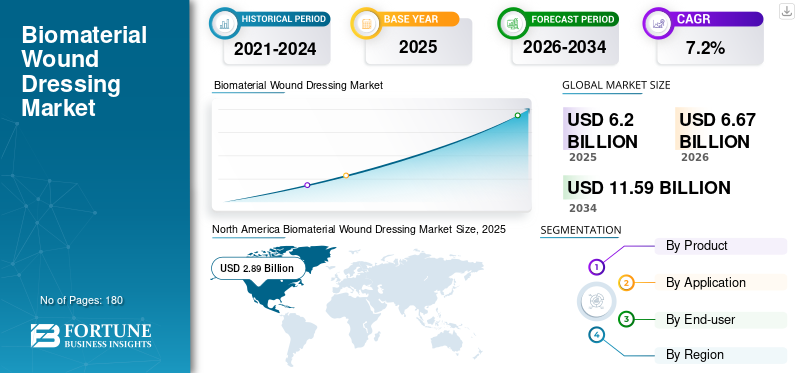
The global biomaterial wound dressing market size was valued at USD 6.20 billion in 2025 and is projected to grow from USD 6.67 billion in 2026 to USD 11.59 billion by 2034, exhibiting a CAGR of 7.2% during the forecast period. North America dominated the global biomaterial wound dressing market with a market share of 46.61% in 2025.
Biomaterial wound dressings are advanced wound care products made from natural or synthetic biomaterials such as collagen, alginate, chitosan, and hyaluronic acid. These dressings help wounds heal faster by keeping the wound moist, absorbing exudate, and reducing infection risk. The market growth is attributed to their rising usage in chronic and acute wounds, such as diabetic foot ulcer, pressure ulcer, surgical wounds, burns & traumatic wounds, and more, which is influencing key players to increase product availability.
Furthermore, Mölnlycke Health Care AB, ConvaTec, and Smith+Nephew held the highest market share due to a diversified portfolio and strategic initiatives to expand their product reach.
Download Free sample to learn more about this report.
Biomaterial Wound Dressing Market Key Takeaways
 Market Size & Forecast
- 2025 Market Size: USD 6.20 billion
- 2026 Market Size: USD 6.67 billion
- 2034 Forecast Market Size: USD 11.59 billion
- CAGR: 7.2% from 2026–2034
 Market Share
- North America dominated the biomaterial wound dressing market with a 46.61% share in 2025.
- The synthetic segment is projected to grow at a CAGR of 7.4% during the forecast period.
- The clinics segment is expected to expand at a CAGR of 7.3% during the forecast period.
 Key Regional Highlights
North America
North America led the market, reaching USD 2.89 billion in 2025.
Europe
Europe is projected to grow at a CAGR of 7.4% and reach USD 1.46 billion by 2026.
Asia Pacific
Asia Pacific is expected to reach USD 1.44 billion by 2026, supported by a large patient population and rising wound care demand.
U.S.
The market is projected to reach USD 2.91 billion in 2026, accounting for approximately 28.9% of the global market.
Japan
The market is expected to generate USD 0.38 billion in revenue by 2026, representing nearly 5.7% of the global market.
Read More

BIOMATERIAL WOUND DRESSING MARKET TRENDS
Innovation in Natural Biomaterials to Emerge as a Key Trend
Currently, there has been an increasing use of natural biomaterials, such as collagen, alginate, and chitosan, in dressings, as these materials support natural wound healing and are well accepted by the body.
Companies are focusing on combining natural biomaterials with antimicrobial agents, such as silver. As a result, companies such as Integra LifeSciences are continuously investing in collagen-based wound matrices for chronic wound management.
Download Free sample to learn more about this report.
MARKET DYNAMICS
MARKET DRIVERS
Rising Incidence of Chronic Wounds to Fuel the Market Expansion
Over the past few years, there has been an increasing number of chronic wounds, especially diabetic foot ulcers. Biomaterial dressings help manage infection, promote tissue regeneration, and reduce complications in these conditions. As a result, these dressings are being highly preferred due to improved clinical outcomes. Such a scenario is anticipated to drive the global biomaterial wound dressing market growth during the forecast period.
- For instance, according to data published by the Journal of the American Medical Association in November 2023, around 18.6 million people worldwide and 1.6 million in the U.S. are affected by diabetic foot ulcers each year.
MARKET RESTRAINTS
High Cost of Devices and Maintenance to Restrict Market Growth
Despite high demand, biomaterial wound dressings are more expensive than traditional wound care products, limiting their adoption in low- and middle-income countries. Moreover, budget constraints in public hospitals and limited reimbursement coverage in low- and middle-income regions are expected to further slow usage.
As a result, some healthcare providers still prefer low-cost gauze due to pricing pressure, which is expected to limit market growth, especially in developing regions.
MARKET OPPORTUNITIES
Growth in Homecare and Outpatient Settings to Create Significant Opportunities
In recent years, there has been a growing shift toward homecare and outpatient wound treatment. Patients are preferring treatments that reduce hospital visits and allow faster recovery at home.
Biomaterial dressings are easy to use and require less frequent changes, making them suitable for homecare. This is expected to offer significant opportunities for companies to design user-friendly products for this setting.
- For instance, in December 2025, Conkote stated that more patients are opting for home or outpatient care due to its convenience, comfort, and support for ongoing management.
MARKET CHALLENGES
Lower Diagnosis and Treatment Rates in Emerging Countries to Challenge Market Expansion
Despite the efforts of organizations, there are many cases of delayed diagnosis of chronic wounds due to delayed referrals of patients with chronic wounds and the lack of expertise among physicians to identify DFU and other conditions, especially in the emergency departments.
- For instance, a 2023 study in the Diabetic Foot Journal examined delays in the management of chronic limb-threatening ischemia and diabetic foot ulcers. It found median times from symptom onset to specialist assessment ranging from 15 to 126 days, with subsequent median times from assessment to treatment varying from 1 to 91 days.
This delayed diagnosis is considerably higher in emerging countries due to limited awareness and accessibility, which is anticipated to limit the use of biomaterial wound dressings, thereby challenging market expansion.
Segmentation Analysis
By Product
Strong Healing Properties and High Patient Acceptance to Boost the Natural Segment’s Growth
By product, the market is bifurcated into natural and synthetic.
To know how our report can help streamline your business, Speak to Analyst
The natural segment accounted for the largest global biomaterial wound dressing market share in 2025, driven by strong wound healing properties and high patient acceptance. Materials such as collagen and alginate support tissue regeneration and maintain a moist wound environment, which is anticipated to drive product demand, contributing to the segment’s growth.
Additionally, the synthetic segment is aniticipated to grow at a CAGR of 7.4% during the forecast period.
By Application
High Prevalence of Diabetes to Fuel the Diabetic Foot Ulcers Segment’s Growth
By application, the market is segmented into diabetic foot ulcers, pressure ulcers, venous leg ulcers, surgical wounds, and others.
The diabetic foot ulcers segment accounted for the largest market share in 2025. Over the past few years, the number of diabetes patients worldwide has been increasing, leading to an increase in cases of diabetic foot ulcers and thereby driving the demand for biomaterial dressings. The segment is estimated to hold a 33.9% share in 2026.
- For instance, according to the data from the International Diabetes Federation (IDF) approximately 6.3% of adults with diabetes worldwide suffer from DFU as of May 2025.
Additionally, the surgical wounds segment is anticipated to grow at a CAGR of 7.0% over the forecast period.
By End-user
High Volume of Chronic and Complex Acute Wounds to Drive the Segment’s Growth
Based on end-user, the market is distributed into clinics, hospitals, homecare settings, and others.
In 2025, the hospitals segment dominated the market as an end user. These facilities have better access to advanced and premium wound care products. As a result, most chronic and complex wounds are treated in hospital settings, which is anticipated to drive the segment’s growth. Moreover, the segment is likely to hold a 55.2% share in 2026.
The clinics segment is estimated to grow at a CAGR of 7.3% over the forecast period.
Biomaterial Wound Dressing Market Regional Outlook
Based on geography, the market is studied across Asia Pacific, North America, Europe, Latin America, and the Middle East & Africa.
North America
North America Biomaterial Wound Dressing Market Size, 2025 (USD Billion)
To get more information on the regional analysis of this market, Download Free sample
North America accounted for the largest market share valued at USD 2.68 billion in 2024 and USD 2.89 billion in 2025. The growth is attributed to the high prevalence of DFU among diabetic individuals in the region, which is fueling demand for advanced wound care products, such as biomaterial dressings.
- For instance, in May 2025, the International Diabetes Federation (IDF) stated that around 13.0% of adults with diabetes are affected by DFU.
U.S. Biomaterial Wound Dressing Market
In 2026, the U.S. is projected to reach USD 2.91 billion, accounting for approximately 28.9% of the global market.
Europe
Europe is projected to record a 7.4% growth rate during the forecast period, the second highest globally, reaching USD 1.46 billion by 2026. The growth is attributed to the significant availability of biomaterial dressings in the region through well-established distribution channels.
U.K. Biomaterial Wound Dressing Market
The U.K. market is expected to reach USD 0.30 billion by 2026, accounting for roughly 4.5% of global revenues.
Germany Biomaterial Wound Dressing Market
Germany's market is projected to reach USD 0.31 billion by 2026, accounting for approximately 4.6% of global revenue.
Asia Pacific
By 2026, the Asia Pacific market is expected to reach USD 1.44 billion, ranking third globally. The growth is attributed to the large patient populations for surgical wounds, traumatic & burn wounds, and diabetic foot ulcers in countries such as India, China, and others, which is anticipated to drive demand for the product.
Japan Biomaterial Wound Dressing Market
Japan is expected to reach USD 0.38 billion in revenue by 2026, capturing nearly 5.7% of the global market.
China Biomaterial Wound Dressing Market
China’s market is expected to reach around USD 0.54 billion by 2026, representing nearly 8.1% of global revenues.
India Biomaterial Wound Dressing Market
India’s market is expected to reach approximately USD 0.18 billion by 2026, accounting for around 2.7% of global market revenue.
Latin America and the Middle East & Africa
Latin America and the Middle East & Africa are expected to showcase moderate growth, with the Latin America market predicted to reach USD 0.38 billion by 2026. The growth of these regions is mainly driven by rising awareness of chronic wounds, which is creating substantial demand for the product.
GCC Biomaterial Wound Dressing Market
By 2026, the GCC market is estimated to reach approximately USD 0.19 billion, representing around 2.9% of global revenues.
COMPETITIVE LANDSCAPE
Key Industry Players
Diversified Portfolios and Strategic Initiatives to Strengthen the Market Position of Key Companies
In 2025, Mölnlycke Health Care AB, ConvaTec, and Smith+Nephew held the majority of the global market share. These companies have strong brand trust, product portfolios, and global distribution networks, which serve as a competitive advantage over smaller firms.
Moreover, key players are implementing strategic initiatives, such as collaborations and partnerships with hospitals and research institutes to improve clinical outcomes and strengthen product credibility. Also, these companies are offering cost-effective solutions in emerging regions.
LIST OF KEY BIOMATERIAL WOUND DRESSING COMPANIES PROFILED
- Coloplast A/S (Denmark)
- Smith+Nephew (U.K.)
- Integra LifeSciences Corporation (U.S.)
- Solventum (U.S.)
- Mölnlycke Health Care AB (Sweden)
- ConvaTec (U.K.)
- Braun SE (Germany)
- Hollister Incorporated (U.S.)
- Essity (Sweden)
- Organogenesis Inc. (U.S.)
KEY INDUSTRY DEVELOPMENTS
- December 2025: MPM Medical launched TripleHelix Collagen At-Home Wound Care Kits and a proprietary portal for easy insurance verification and direct patient shipping.
- May 2025: Summit Products Group announced an exclusive distribution partnership with NovaBone Products for NovaForm Wound Matrix, a newly FDA 510(k)- cleared bioglass-collagen dressing for partial- and full-thickness wounds, including pressure, venous, diabetic ulcers, and surgical sites.
- April 2025: AVITA Medical launched Cohealyx, a collagen-based dermal matrix co-developed with Regenity Biosciences, to accelerate wound bed preparation for full-thickness acute wounds, such as burns.
- March 2025: BioLab Holdings, Inc. announced a partnership with Real Collagen GmbH to develop innovative wound care products using fish collagen hydrogel
- January 2024: Coloplast A/S introduced Biatain Silicone Fit for wound management and pressure injury prevention, aiming to grow its product offerings in the U.S.
- June 2022: Collagen Matrix, Inc. received FDA 510(k) clearance for its new Fibrillar Collagen Wound Dressing, marking the company's 40th approval and expanding into the advanced wound care market.
REPORT COVERAGE
The report delivers an in-depth analysis of all segments included. It also covers drivers, trends, opportunities, restraints, and challenges influencing the landscape. It also offers key insights on technological advancements, prevalence/incidence of key chronic and acute wounds, key industry developments, company market share analysis, and detailed profiles of key companies.
Request for Customization to gain extensive market insights.
Report Scope & Segmentation
| ATTRIBUTE | DETAILS |
| Study Period | 2021-2034 |
| Base Year | 2025 |
| Estimated Year | 2026 |
| Forecast Period | 2026-2034 |
| Historical Period | 2021-2024 |
| Growth Rate | CAGR of 7.2% from 2026-2034 |
| Unit | Value (USD Billion) |
| Segmentation | By Product, Application, End-user, and Region |
| By Product |
|
| By Application |
|
| By End-user |
|
| By Geography |
|
Frequently Asked Questions
Fortune Business Insights says that the global market value stood at USD 6.20 billion in 2025 and is projected to reach USD 11.59 billion by 2034.
In 2025, the North Americas market value stood at USD 2.89 billion.
The market is expected to grow at a CAGR of 7.2% over the forecast period.
The natural segment led the market in terms of product in 2025.
The key factor driving the market is the rising incidence of chronic wounds.
Molnlycke Health Care AB, ConvaTec, and Smith+Nephew are among the prominent players in the market.
North America dominated the market in 2025.



- 2021-2034
- 2025
- 2021-2024
- 180
Get 30-60 hrs Free Customization
Expand Regional and Country Coverage, Segments Analysis, Company Profiles, Competitive Benchmarking, and End-user Insights.













.webp)






Related Reports
-
US +1 833 909 2966 ( Toll Free )
-
Get In Touch With Us