Bioresorbable Coronary Stents Market Size, Share & Industry Analysis, By Material (Metal and Polymer), By Application (Acute Coronary Syndrome (ACS) and Chronic Coronary Syndrome (CCS)), By End-user (Hospitals & ASCs, Specialty Clinics, and Others), and Regional Forecast, 2026-2034
 Download Free Sample
KEY MARKET INSIGHTS
 Listen to Audio Version
The global bioresorbable coronary stents market size was valued at USD 356.03 million in 2025 and is projected to grow from USD 372.81 million in 2026 to USD 593.15 million by 2034, exhibiting a CAGR of 5.98% during the forecast period. North America dominated the bioresorbable coronary stents market with a market share of 5.89% in 2025.
A bioresorbable coronary stent, also known as a bioresorbable scaffold or biodegradable stent, is an implant to open blocked heart arteries. Unlike traditional metal stents, these stents are designed to be absorbed by the body over time, potentially reducing long-term complications. They are typically made of polymers or metals that degrade and are eventually eliminated from the body.
The increasing demand for bioresorbable coronary stents is primarily driven by the rising prevalence of cardiovascular diseases and the need for minimally invasive procedures. These stents offer advantages such as the potential for restored vasomotion and reduced long-term complications. This is expected to increase their adoption, driving the global market growth over the forecast period.
Key players in the market include Boston Scientific Corporation, Terumo Corporation, and MicroPort Scientific Corporation. These players focus on expanding their geographic presence and product portfolio to capture a significant market share.
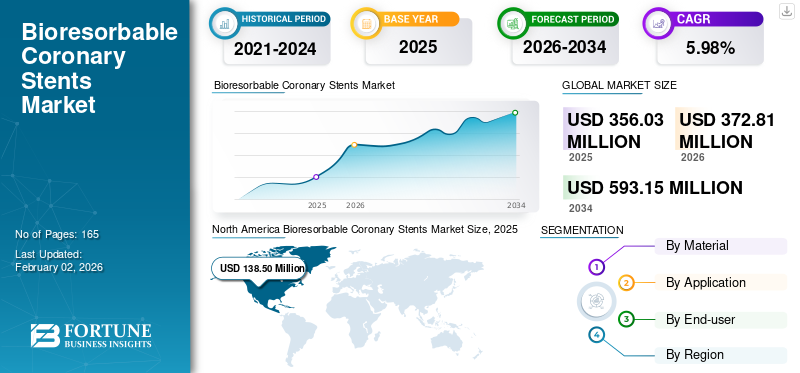
Download Free sample to learn more about this report.
Bioresorbable Coronary Stents Market KEY TAKEAWAYS
 Global Market Size & Forecast
- 2025 Market Size: USD 356.03 million
- 2026 Market Size: USD 372.81 million
- 2034 Forecast Market Size: USD 593.15 million
- CAGR: 5.98% from 2026–2034
 Market Share
- North America dominated the bioresorbable coronary stents market with a 5.89% share in 2025.
- The Metal segment led the market, driven by advances in safer and more effective metal-based bioresorbable stents.
- The Hospitals & ASCs segment accounted for the largest market share.
 Key Regional Highlights
North America
The market was valued at USD 138.5 million in 2025 and is projected to reach USD 146.18 million in 2026.
Europe
The market reached USD 116.3 million in 2025 and is projected to grow to USD 121.94 million in 2026.
Asia Pacific
The market was valued at USD 64.72 million in 2025 and is expected to reach USD 67.67 million in 2026.
U.S.
The market is expected to grow steadily, driven by strong healthcare infrastructure.
Japan
Japan is expected to witness steady market growth, driven by rising cardiovascular disease prevalence.
Read More

MARKET DYNAMICS
Market Drivers
Rising Prevalence of Coronary Artery Diseases to Fuel Market Growth
The increasing prevalence of coronary heart diseases globally is driving the need for frequent intervention, thereby fueling the usage of bioresorbable coronary stents. In coronary artery disease, they offer several potential advantages, including restoring natural vessel function, avoiding long-term metallic presence, and potentially reducing the risk of late stent thrombosis.
- For instance, in October 2024, the Centers for Disease Control and Prevention (CDC) stated that nearly 1 in 20 U.S. adults aged 20 and older suffered from coronary artery disease (CAD) in 2023.
Increasing consumption of alcohol, excessive smoking, sedentary lifestyles, and growing stress levels are increasing the susceptibility to cardiac conditions. Moreover, the aging population is also a significant factor posing a higher risk of coronary artery disease, thus driving the global bioresorbable coronary stents market growth.
Market Restraints
Competition from Drug-Eluting and Metallic Stents May Hamper Market Growth
Drug-eluting and bare metal stents, which are well-established and have a proven track record, may pose significant competition to bioresorbable coronary stents. Their established efficacy, durability, and lower cost make them a preferred choice in various cases. This is expected to hinder the adoption of these stents.
Moreover, the early clinical trials have shown promising results. However, bioresorbable coronary stents' long-term safety and efficacy are under investigation. More robust and extensive clinical data are needed to fully establish their long-term benefits and address potential long-term complications, such as restenosis. This scenario may hamper the market growth in the coming years.
Market Opportunities
Improving Healthcare Infrastructure and Increasing Awareness of Heart Diseases in Developing Regions to Encourage Market Expansion
In recent years, there has been an increasing awareness about coronary artery disease and its available treatment options in developing countries, which can generate significant growth opportunities for the market expansion.
- For instance, in September 2023, the Indian Ministry of Health launched a public campaign on heart health during World Heart Day.
Moreover, the higher focus on expanding cardiology services by multispecialty hospitals is expected to cater to the growing demand for coronary artery interventions, further propelling the utilization of bioresorbable coronary stents.
- For instance, in August 2024, Canberra Hospital launched its critical services building in Garran, Australia, expanding its cardiology services.
Market Challenges
High Costs of Bioresorbable Coronary Stents May Hamper Market Growth
Innovative devices such as bioresorbable coronary stents utilize advanced biomaterials and manufacturing processes, often resulting in elevated production expenses. Consequently, the higher prices may deter healthcare providers and patients, limiting their widespread adoption.
- For instance, as of June 2025, the data by IndiaCardiacSurgerySite mentioned that the average cost of bioresorbable vascular scaffold (BVS) treatment is approximately USD 2,500 to USD 5,000 in India.
This high cost acts as a barrier to entry in price-sensitive regions and countries with limited reimbursements. Moreover, substantial investments are needed to meet safety standards and conduct extensive long-term clinical studies. These factors are expected to limit the availability of advanced devices and hinder the overall market growth.
BIORESORBABLE CORONARY STENTS MARKET TRENDS
Innovations in Bioresorbable Coronary Stents are a Key Market Trend
The ongoing research and development efforts are focused on improving bioresorbable coronary stents' performance, safety, and efficacy. This includes exploring new materials, optimizing stent design, and developing stents with improved drug capabilities.
- In May 2024, BIOTRONIK enrolled the first patient in the BIOMAG-II trialto evaluate the safety and clinical performance of its Freesolve, a new-generation resorbable magnesium scaffold (RMS) over a traditional drug-eluting stent (DES).
Moreover, incorporating biosensors into these stents offers the potential for real-time patient monitoring and personalized treatment approaches. This can lead to more timely interventions and improved patient outcomes. Additionally, introducing hybrid designs that combine bioresorbable and permanent stent components may offer a balance of benefits, potentially improving long-term outcomes and addressing few limitations of fully bioresorbable stents.
Download Free sample to learn more about this report.
IMPACT OF COVID-19
The COVID-19 pandemic negatively impacted market growth in 2020. This was mainly due to the shift of the healthcare systems toward prioritizing COVID-19 treatments. This led to postponement or cancellations of surgical procedures, including coronary stent placements.
However, the market regained momentum in 2021 due to frequent interventions postponed during the early phase of the COVID-19 outbreak. Moreover, major players experienced significant growth in their cardiovascular businesses due to higher product sales to cater to the rising surgical procedures. The market is projected to witness faster growth in the coming years due to the increasing burden of cardiac disorders, further leading to coronary interventions.
SEGMENTATION ANALYSIS
By Material
Advancements in Metal-based Stents Contributed to Segment Growth
Based on material, the market is classified into metal and polymer.
The metal segment dominated the market in 2024. This growth is attributed to technological advancements in metal-based biosorbable stents, which enhance their outcomes in treating coronary artery diseases. This is expected to increase the utilization of metal-based stents in the coming years.
- For instance, according to the data published by the Journal of Magnesium and Alloy in March 2025, advancements in the surface engineering and alloying of Mg-based stents have potentially addressed the limitations of traditional stents, including in-stent restenosis and long-term complications.
The polymer segment is expected to grow significantly in the coming years. The adoption of polymer-based stents is growing due to their potential to overcome limitations associated with metallic stents, such as prolonged anticoagulation. This is anticipated to fuel the segment’s growth in the coming years.
By Application
High Burden of Coronary Artery Disease Fueled Chronic Coronary Syndrome (CCS) Segment Growth
Based on application, the market is classified into acute coronary syndrome (ACS) and chronic coronary syndrome (CCS).
The chronic coronary syndrome (CCS) segment dominated the market in 2024. The growth can be attributed to the increasing cases of coronary artery disease. Bioresorbable vascular scaffolds (BVS) have emerged as a significant advancement in treating coronary lesions, which is expected to fuel the segment's growth in the coming years.
- For instance, in April 2024, the data reported by the Journal of the American College of Cardiology stated that around 315.0 million coronary artery disease (CAD) cases occurred globally in 2022.
The acute coronary syndrome (ACS) segment held a substantial market share in 2024. This growth is attributed to the increasing percutaneous coronary intervention (PCI) procedures for treating ACS, which may involve the usage of bioresorbable coronary stents.
By End-user
Strategic Openings of Cardiovascular Facilities Augmented Hospitals & ASCs Segment Growth
Based on the end-user, the bioresorbable coronary stents market is segmented into hospitals & ASCs, specialty clinics, and others.
The hospitals & ASCs segment dominated the market in 2024. The segment's dominance is attributed to the increasing number of angioplasties in hospital settings, which involves stent placement. Moreover, the increasing number of new ASCs also supports the significant number of procedures performed, which is expected to contribute to the segment’s growth.
- For instance, in October 2024, Bon Secours Mercy Health, Compass Surgical Partners, and AlignedCardio planned to open a cardiovascular ASC in late 2025 in the Short Pump area of Henrico, Virginia, to provide coronary interventions and other cardiovascular procedures.
The specialty clinics segment held the second-largest share in 2024. The growth is attributed to the increasing number of cardiology clinics globally, thereby increasing the availability of specialty care to patients and further driving the cardiac interventions.
BIORESORBABLE CORONARY STENTS MARKET REGIONAL OUTLOOK
By region, the market is categorized into North America, Europe, Asia Pacific, Latin America, and the Middle East & Africa.
North America
North America Bioresorbable Coronary Stents Market Size, 2025 (USD Million)
To get more information on the regional analysis of this market, Download Free sample
In 2025, the North America market stood at USD 138.5 million, representing 5.89% of global demand, and is projected to grow to USD 146.18 million in 2026. This market growth can be attributed to a well-established healthcare infrastructure, which may support a significant number of coronary interventions and increase the adoption of advanced devices such as bioresorbable coronary stents.
In the U.S., high burden of coronary artery diseases due to increased alcohol consumption is driving the demand for cardiovascular surgeries, expanding the usage of bioresorbable stents.
- For instance, according to the Journal of the American College of Cardiology in December 2024, more than 18.0 million U.S. individuals have CAD.
Europe
The Europe region captured 5.43% of the global market in 2025, generating USD 116.3 million in revenue, and is projected to reach USD 121.94 million in 2026. Strong emphasis of prominent players on introducing their bioresorbable coronary stents to the European market is expected to drive the market growth during the forecast period. Moreover, the increasing obesity rates in the region are expected to result in an increased incidence of CAD, further driving the market growth.
- For instance, as of May 2024, 25.6% of adults were estimated to be living with obesity between 2021 and 2022 in England.
Asia Pacific
Asia Pacific maintained a strong presence in the global market, reaching USD 64.72 million in 2025, accounting for 4.44% share, and is expected to reach USD 67.67 million in 2026. The increasing population of smokers and the burdensome lifestyle of individuals are posing a major risk to heart health, leading to coronary artery disease. This is surging the number of stent placements in the region, which is expected to propel the market growth over the forecast period.
- For instance, according to the study published by the NCBI in November 2023, the proportion of cases receiving stent treatment increased from 13.8% in 2019 to 19.4% in 2021.
Latin America and Middle East & Africa
The Latin America and Middle East & African markets held a lower share in 2024. The Middle East & Africa market accounted for USD 12.41 million in 2025, representing 3.07% of the global industry, and is expected to reach USD 12.53 million in 2026. The growth of these markets is attributed to the rising prevalence of traditional risk factors such as dyslipidemia, hypertension, and diabetes, coupled with lifestyle changes such as physical inactivity, further driving the need for coronary intervention. In 2025, Latin America represented USD 24.1 million, accounting for 3.65% of the worldwide market, and is projected to grow to USD 24.49 million in 2026.
- For instance, according to the data published by Frontiers Media S.A. in September 2023, around 35.0% of the adult population had hypertension in Brazil.
COMPETITIVE LANDSCAPE
Key Industry Players
Emphasis of Market Players on Strategic Acquisitions and Expand Product Portfolio Aids in Enhancing Their Market Share
Boston Scientific Corporation, Terumo Corporation, and MicroPort Scientific Corporation accounted for the largest global bioresorbable coronary stents market share in 2024. This dominant share is attributed to the increasing focus of these companies on introducing new products.
Moreover, other players, such as Lepu Medical, Elixir Medical, and others, are focused on expanding their geographic presence through partnerships, new facility launches, and the commercialization of their products in untapped markets. Such initiatives are expected to help them capitalize on the market with a significant share.
LIST OF KEY BIORESORBABLE CORONARY STENT COMPANIES PROFILED
- Boston Scientific Corporation (U.S.)
- Terumo Corporation (Japan)
- Relisys Medical Devices Limited (India)
- MicroPort Scientific Corporation (China)
- Lepu Medical (China)
- Elixir Medical (U.S.)
- SINOMED (China)
- Reva Medical, LLC. (U.S.)
- ELLA – CS, s.r.o (Czechia)
KEY INDUSTRY DEVELOPMENTS
- April 2025: MicroPort Scientific Corporation and its 16 affiliates presented over 80 advanced innovations at the 91st China International Medical Equipment Fair (CMEF), including bioresorbable coronary stents.
- July 2024: MicroPort Scientific Corporation’s subsidiary Shanghai MicroPort Medical (Group) Co., Ltd. received approval from the National Medical Products Administration (NMPA) for Firesorb, a fully bioresorbable cardiac stent.
- February 2024: Biotronik announced the CE approval and market introduction of Freesolve resorbable magnesium scaffold in the European market.
- August 2022: Reva Medical, LLC. returned with an investment of USD 45.0 million to complete its work in the bioresorbable coronary stents market.
- March 2021: Meril launched India's indigenously researched and developed bioresorbable scaffold (BRS), MeRes100.
REPORT COVERAGE
The market analysis provides market size & forecast by material, application, and end-user segment. It includes market dynamics and trends anticipated to drive the market growth during the projection period. It provides information on the prevalence of coronary artery disease (CAD), technological advancements, and key industry developments. The report covers a detailed competitive landscape with information on the market share and company profiles of major companies.
Request for Customization to gain extensive market insights.
Report Scope & Segmentation
|
ATTRIBUTE |
DETAILS |
|
Study Period |
2021-2034 |
|
Base Year |
2025 |
|
Estimated Year |
2026 |
|
Forecast Period |
2026-2034 |
|
Historical Period |
2021-2024 |
|
Growth Rate |
CAGR of 5.98% from 2026-2034 |
|
Unit |
Value (USD Million) |
|
Segmentation |
By Application
|
|
By End-user
|
|
|
By Geography
|
Frequently Asked Questions
The global bioresorbable coronary stents market size was valued at USD 356.03 million in 2025 and is projected to grow from USD 372.81 million in 2026 to USD 593.15 million by 2034, exhibiting a CAGR of 5.98% during the forecast period.
In 2025, the market value stood at USD 356.03million.
The market is expected to exhibit a CAGR of 5.98% during the forecast period of 2026-2034.
The metal segment led the market by material.
The key factors driving the market are the increasing prevalence of coronary artery disease and technological advancements.
Boston Scientific Corporation, Terumo Corporation, and MicroPort Scientific Corporation are the top players in the market.
North America dominated the market in 2025.



- 2021-2034
- 2025
- 2021-2024
- 165
Get 30-60 hrs Free Customization
Expand Regional and Country Coverage, Segments Analysis, Company Profiles, Competitive Benchmarking, and End-user Insights.













.webp)






Related Reports
-
US +1 833 909 2966 ( Toll Free )
-
Get In Touch With Us