Bone Cancer Treatment Market Size, Share & Industry Analysis, By Drug Class (Cytotoxic Chemotherapy Agents, Tyrosine Kinase Inhibitors, Immune Checkpoint Inhibitors, RANKL & IDH Inhibitors, Bisphosphonates), By Cancer Type (Osteosarcoma, Ewing Sarcoma, Chondrosarcoma, Chordoma), By Age Group ( Pediatric & Adults), By Therapy (Chemotherapy, Targeted Therapy, Immunotherapy), By Route of Administration (Oral & Parenteral), By Distribution Channel (Hospital Pharmacies, Specialty Pharmacies, Drug Stores, Retail & Online Pharmacies), and Regional Forecast, 2026-2034
 Download Free Sample
Bone Cancer Treatment Market Size and Future Outlook
 Listen to Audio Version
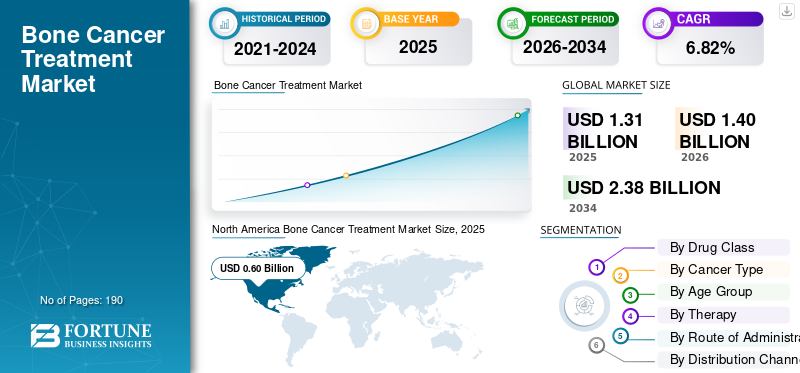
The global bone cancer treatment market size was valued at USD 1.31 billion in 2025. The market is projected to grow from USD 1.40 billion in 2026 to USD 2.38 billion by 2034, exhibiting a CAGR of 6.82% during the forecast period. North America dominated the bone cancer treatment market with a market share of 45.8% in 2025.
The market includes treatment options for primary bone cancers, such as osteosarcoma, Ewing sarcoma, chondrosarcoma, and chordoma, as well as therapies for managing advanced disease and bone-related complications. The global market is gaining importance as bone cancers create a strong need for effective treatment pathways and supportive care. As recurrence and metastatic disease remain difficult to treat, key companies are increasingly focusing on developing advanced targeted therapies, antibody drug conjugates, and pipeline candidates, and on obtaining subsequent approvals from the relevant regulatory bodies to address unmet needs in rare and aggressive bone cancers and boost their market positions.
- For instance, in January 2025, GSK plc announced that its lead candidate GSK5764227, also known as GSK’227, received Breakthrough Therapy Designation from the U.S. FDA. This pipeline candidate is a B7-H3-targeted antibody-drug conjugate being evaluated for adult patients with relapsed or refractory osteosarcoma who progressed after at least two prior lines of therapy. Such developments highlight the growing focus on innovation in relapsed and refractory osteosarcoma.
Furthermore, major players, such as Amgen Inc., Novartis AG, Pfizer Inc., and Fresenius Kabi AG, are streamlining their resources toward research and development, expanding their pipelines, diversifying their offerings, and improving patient outcomes.
Download Free sample to learn more about this report.
BONE CANCER TREATMENT MARKET TRENDS
Increasing Adoption of Multimodal Treatment Approaches in Bone Cancer Care is an Emerging Trend Observed in Market
The significant global market trend is a shift toward multimodal treatment, combining various therapies and supportive care tailored to each patient's condition. Bone cancers such as osteosarcoma and Ewing sarcoma are aggressive, and single-treatment approaches often provide limited disease control, thus driving demand for multimodal treatment approaches. As a result, hospitals and oncology centers are using coordinated treatment plans to improve tumor removal, reduce the risk of recurrence, preserve limb function, and support better long-term outcomes. The growing focus on relapsed, refractory, and metastatic bone cancer is also encouraging companies and research groups to invest in and develop newer therapies that can be added to existing treatment pathways.
- For instance, in September 2025, Break Through Cancer announced a USD 15.0 million investment to launch the Defying Osteosarcoma TeamLab, involving eight leading research institutions and more than 20 researchers to advance pediatric osteosarcoma research. These developments, as the initiative focuses on building stronger, coordinated research efforts for osteosarcoma and on new treatment combinations to improve outcomes.
MARKET DYNAMICS
MARKET DRIVERS
Download Free sample to learn more about this report.
Increasing Prevalence of Bone Cancer is Driving Market Growth
A prominent factor driving the global bone cancer treatment market growth is the rising incidence of both primary bone cancers and bone metastases, which continues to create higher demand for oncology drugs, bone-modifying agents, pain management therapies, and supportive care solutions. Primary bone cancers such as osteosarcoma remain difficult to treat. In contrast, bone metastases from breast, prostate, lung, and other solid tumors increase the need for therapies that reduce skeletal-related complications and improve quality of life. As the diagnosed patient pool grows, hospitals and cancer centers are increasingly using advanced therapies and palliative care products. As a result, rising disease burden is directly increasing treatment demand and encouraging companies to invest in new therapies for rare bone tumors and advanced cancers involving bone.
- For instance, in January 2025, OS Therapies Incorporated announced that its Phase 2b clinical trial of OST-HER2 met its primary endpoint, demonstrating statistical significance in preventing recurrence among patients with fully resected, lung-metastatic osteosarcoma. The study showed a significant improvement in 12-month event-free survival, supporting the need for new treatment options in recurrent osteosarcoma.
MARKET RESTRAINTS
High Recurrence of Metastatic Disease Burden Limiting to Restrain Market Growth
The global market faces restraint as many aggressive bone cancers relapse or spread even after surgery and Chemotherapy. When cancer returns or becomes metastatic, treatment becomes more complex, survival outcomes decline, and patients often require multiple lines of care with limited proven options. These factors slow market growth as physicians continue to rely on older chemotherapy-based regimens. At the same time, newer targeted and immune-based therapies still need stronger clinical evidence before they can be widely adopted.
- For instance, in April 2025, The ASCO Post reported findings from the Japanese JCOG0905 trial, where adding high-dose ifosfamide to standard methotrexate, doxorubicin, and cisplatin therapy did not improve disease-free survival in newly diagnosed high-grade osteosarcoma patients who had a poor response to preoperative Chemotherapy. These observations highlight that intensifying older chemotherapy regimens may not deliver better outcomes, keeping treatment progress slow and limiting stronger growth in the market.
MARKET OPPORTUNITIES
Expansion of Rare Cancer and Orphan Drug Programs Creating New Growth Opportunities
The global market offers significant growth opportunities through rare cancer and orphan drug development programs. Primary bone cancers such as osteosarcoma, Ewing sarcoma, chordoma, and chondrosarcoma affect smaller patient groups but have high unmet treatment needs. Since these diseases have limited approved therapies and slow innovation in standard care, orphan drugs incentives make development more commercially attractive for companies. These programs can reduce development barriers, offer user-fee exemptions, regulatory support, and potential market exclusivity after approval. As a result, more companies are encouraged to invest in targeted therapies, localized drug delivery, immunotherapies, and other novel approaches for rare and aggressive bone cancers.
- For instance, in July 2025, Lithea Pharma received Orphan Drug Designation for LIT1001, its lead investigational therapy for osteosarcoma, from the U.S. FDA. The LIT1001 is designed to deliver Chemotherapy directly to the tumor. These developments can help advance novel therapies for small, high-need bone cancer populations where conventional Chemotherapy and surgery still dominate treatment.
MARKET CHALLENGES
Limited Treatment Progress and Poor Outcomes in Recurrent Bone Cancer Remain a Key Market Challenge
The global market faces a major challenge as treatment outcomes remain difficult to improve, especially in patients with metastatic or recurrent osteosarcoma. Standard care still depends heavily on surgery and intensive Chemotherapy. But Chemotherapy can cause severe side effects and has not delivered major survival improvements in recent years. This limits treatment adoption in fragile patients and creates a high unmet need for safer targeted therapies, immunotherapies, and novel drug-delivery approaches. As a result, companies face longer development timelines, higher clinical trial risk, and difficulty proving meaningful survival benefits in rare and aggressive bone cancers.
- For instance, a 2025 review titled ‘Systemic strategies for osteosarcoma: advances and future directions’ highlighted that although surgery has become more limb-preserving, prognosis remains challenging, with 5-year survival of around 60–70% for localized disease and much lower survival for advanced stages. The review also noted that Chemotherapy remained a main treatment option but can cause severe side effects, showing why toxicity and limited survival improvement continue to challenge global market growth.
Bone Cancer Treatment Market Segmentation Analysis
By Drug Class
High Volume Application of Cytotoxic Agents Led Segmental Growth
Based on drug class, the market is categorized into cytotoxic chemotherapy agents, tyrosine kinase inhibitors (TKIs), immune checkpoint inhibitors, RANKL inhibitors, IDH inhibitors, bisphosphonates, and others.
The cytotoxic chemotherapy agents segment accounted for the largest bone cancer treatment market share. Cytotoxic chemotherapy agents remain a core treatment approach among the most clinically important bone cancers. Drugs such as methotrexate, doxorubicin, cisplatin, ifosfamide, etoposide, and cyclophosphamide are widely used in standard regimens. This creates consistent treatment demand. As targeted and immune-based therapies are still emerging in many bone cancer settings, cytotoxic Chemotherapy continues to account for the largest share of treatment.
- For instance, in February 2024, Fresenius Kabi AG introduced Cyclophosphamide for Injection, USP in the U.S. as a generic substitute for Cytoxan. The development expanded the generic oncology injectable portfolio to help make cancer therapies more affordable and accessible, developments expected to drive growth in the segment.
The IDH Inhibitors segment is expected to grow at a CAGR of 10.78% over the forecast period.
To know how our report can help streamline your business, Speak to Analyst
By Cancer Type
High Value Contribution Per Patient of Osteosarcoma Propelled Growth in Segment
Based on cancer type, the market is segmented into osteosarcoma, Ewing sarcoma, chondrosarcoma, chordoma, and others.
In 2025, the osteosarcoma segment accounted for the largest share of the market. The high share was allocated to the segment as it is the most common primary bone cancer overall and is a major treatment focus in children, adolescents, and young adults. Its treatment usually requires intensive chemotherapy, surgery, and long follow-up, which increases the value contribution per patient. The indication also has a high unmet need in relapsed and metastatic cases, encouraging companies to develop new therapies and expand pipeline candidates.
- For instance, in January 2025, OS Therapies, Inc. announced that its Phase 2b trial of OST-HER2 achieved the 12-month event-free survival primary endpoint with statistical significance in recurrent, fully resected lung metastatic osteosarcoma. This supports osteosarcoma’s leading market position as companies are prioritizing osteosarcoma-specific development in areas where no currently approved therapies exist.
The others segment is projected to grow at a CAGR of 8.07% during the forecast period.
By Age Group
Higher Revenue Share of Adult Segment Boosted Segmental Growth
Based on age group, the market is segmented into pediatric and adults.
In 2025, the adults segment dominated the market as overall treatment spending is higher in adults. While osteosarcoma and Ewing sarcoma are strongly associated with children, adolescents, and young adults, adults account for a broader treated population across primary and secondary bone malignancy settings. Adult patients are also more likely to receive high-value therapies, supportive care, and multiple lines of treatment. As a result, the adult segment generates a higher revenue share.
- For instance, in July 2025, Celltrion USA launched STOBOCLO (denosumab-bmwo) and OSENVELT (denosumab-bmwo), biosimilars referencing PROLIA\ (denosumab) and XGEVA (denosumab), respectively, in the U.S. This supports adult segment dominance as companies are advancing high-value targeted therapies for adult late-line bone cancer patients with limited approved treatment options.
The pediatric segment is projected to grow at a CAGR of 6.24% during the forecast period.
By Therapy
Use of Chemotherapy as a Standard for Bone Cancer Treatment to Lead to Segmental Dominance
Based on therapy, the market is segmented into chemotherapy, targeted therapy, immunotherapy, and others.
In 2025, chemotherapy segment dominated the market. It remains the backbone of treatment for major bone cancers. Chemotherapy is commonly given before surgery to shrink the tumor and after surgery to reduce the risk of recurrence. Since Chemotherapy is used across early-stage, localized, metastatic, and recurrent disease settings, it continues to generate the highest treatment volume.
- For instance, in August 2025, a report published in The ASCO Post highlighted pooled clinical evidence showing activity when mifamurtide was added to Chemotherapy in nonmetastatic high-grade osteosarcoma with an unfavorable prognosis. This supports Chemotherapy’s dominance as new treatment strategies are still being built around chemotherapy-based backbones rather than replacing them completely.
The immunotherapy segment is projected to grow at a CAGR of 10.44% during the forecast period.
By Route of Administration
Parenteral Administration Dominated as Most High-Value Bone Cancer Treatments are Delivered Intravenously in Hospital
Based on route of administration, the market is segmented into oral and parenteral.
In 2025, the parenteral administration dominated as most high-value bone cancer treatments are delivered intravenously in hospital or through oncology infusion settings. Healthcare providers prefer the parenteral route as these therapies require controlled dosing, monitoring for toxicity, supportive medications, and specialist supervision. As a result, parenteral treatment remains more commercially significant than oral therapy in the market, prompting key companies to launch new products.
- For instance, in January 2026, Alembic Pharmaceuticals Limited received final approval from the U.S. FDA for its Methotrexate Injection USP, covering 50 mg/2 mL multi-dose vials and 1 g/40 mL single-dose vials. Such developments support the parenteral route of administration segment.
The oral segment is projected to grow at a CAGR of 9.38% during the forecast period.
By Distribution Channel
High Patient Load in Hospitals Pharmacies to Allow for Segmental Dominance
Based on distribution channel, the market is segmented into hospital pharmacies, specialty pharmacies, drug stores & retail pharmacies, and online pharmacies.
The hospital pharmacies are expected to dominate. The bone cancer treatment is complex, high-risk, and primarily delivered in specialist cancer centers or hospitals. Many products used in this market are injectable oncology drugs that require cold-chain handling, dose preparation, infusion services, and trained healthcare professionals. This makes hospital pharmacies the primary channel compared with retail or online pharmacies. Underscoring its high importance, key companies are actively participating in strategic collaborations among operating entities.
- For instance, in February 2026, A Royal Orthopedic Hospital NHS Foundation Trust (ROH) collaborated with Aston University to develop a minimally invasive injectable paste for anti-cancer and bone regenerative applications, leveraging the cancer-killing properties of gallium.
The specialty pharmacies segment is projected to grow at a CAGR of 9.05% over the study period.
Bone Cancer Treatment Market Regional Outlook
By geography, the market is categorized into Europe, North America, Asia Pacific, Latin America, and the Middle East & Africa.
North America
North America Bone Cancer Treatment Market Size, 2025 (USD Billion)
To get more information on the regional analysis of this market, Download Free sample
North America held the dominant share in 2024 at USD 0.57 billion and maintained its leading position in 2025 at USD 0.60 billion. The market is growing due to strong oncology infrastructure, early access to clinical trials, and higher adoption of advanced therapies for rare cancers. The U.S. also has a structured cancer surveillance system that supports disease tracking and treatment planning for bone and joint cancers.
U.S. Bone Cancer Treatment Market
Given North America's substantial contribution and the U.S. dominance in the region, the U.S. market is estimated at around USD 0.60 billion in 2026, accounting for roughly 42.39% of the global market.
Europe
Europe is projected to grow at 6.39% over the coming years, the second-highest among all regions, and is set to reach a valuation of USD 00.38 billion by 2026. Growth in the region is supported by specialized sarcoma networks, updated clinical guidelines, and better coordination across rare cancer centers.
U.K. Bone Cancer Treatment Market
The U.K. market is estimated at around USD 0.07 billion in 2026, representing roughly 4.92% of the global market.
Germany Bone Cancer Treatment Market
Germany's market is projected to reach approximately USD 0.09 billion in 2026, equivalent to around 6.22% of the global market.
Asia Pacific
Asia Pacific is estimated to reach USD 0.28 billion in 2026 and secure the position of the third-largest region in the market. Asia Pacific is growing strongly as markets are expanding cancer care capacity, improving radiation oncology standards, and expanding treatment access across major countries. Regional initiatives to strengthen cancer care and data collection are helping improve training, outcomes, and access to oncology services.
Japan Bone Cancer Treatment Market
The Japanese market is estimated at around USD 0.06 billion in 2026, accounting for approximately 4.59% of the global market.
China Bone Cancer Treatment Market
China's market is projected to be one of the largest globally, with 2026 revenues estimated at around USD 0.09 billion, representing approximately 6.34% of global sales.
India Bone Cancer Treatment Market
The Indian market is estimated at around USD 0.04 billion in 2026, accounting for roughly 2.82% of global revenue.
Latin America and Middle East & Africa
The Latin America and Middle East & Africa regions are expected to witness moderate growth in this market during the forecast period. The market in Latin America reached a valuation of USD 0.06 billion in 2025. Latin America is witnessing growth driven by rising awareness of rare cancers and efforts to improve sarcoma care, despite existing diagnostic and registry gaps.
Middle East & Africa Bone Cancer Treatment Market
The GCC is set to reach USD 0.02 billion in 2026.
South Africa Bone Cancer Treatment Market
The South African market is projected to reach approximately USD 0.01 billion by 2026, accounting for roughly 0.46% of global revenue.
COMPETITIVE LANDSCAPE
Key Industry Players
New Product Launches by Key Players to Propel Market Progress
The global bone cancer treatment market is moderately fragmented, with pharmaceutical companies leading through branded bone-modifying agents, strong global supply chains, and established access to cancer centers. Companies such as Amgen Inc., Novartis AG, Pfizer Inc., Fresenius Kabi AG, Hikma Pharmaceuticals PLC, Teva Pharmaceutical Industries Ltd., Accord Healthcare Ltd., Baxter International Inc., and Viatris Inc. have an advantage as they supply high-use therapies and other oncology injectables. Their leading position is supported by strong hospital relationships, wide product availability, regulatory approvals, and the continued use of Chemotherapy and bone-supportive drugs in osteosarcoma, Ewing sarcoma, chondrosarcoma, chordoma, and bone metastasis-related complications.
- For instance, in January 2025, GSK plc announced that the U.S. FDA granted Breakthrough Therapy Designation to GSK5764227/GSK’227, a B7-H3-targeted antibody-drug conjugate being evaluated for adult patients with relapsed or refractory osteosarcoma after at least two prior lines of therapy.
Other notable players in the global market include GSK plc, OS Therapies, Inc., Inhibrx Biosciences, Inc., Lithea AB, Servier Group, and Actuate Therapeutics, Inc. These companies are shaping the next phase of competition for rare sarcoma indications. As a result, companies that can prove better survival outcomes, lower toxicity, stronger recurrence prevention, and practical hospital-based commercialization are expected to gain stronger market share over the forecast period.
LIST OF KEY BONE CANCER TREATMENT COMPANIES PROFILED IN REPORT
- Amgen Inc. (U.S.)
- Novartis AG (Switzerland)
- Pfizer Inc. (U.S.)
- Fresenius Kabi AG (Germany)
- Hikma Pharmaceuticals PLC (U.K.)
- Teva Pharmaceutical Industries Ltd. (Israel)
- Accord Healthcare Ltd. (U.K.)
- Baxter International Inc. (U.S.)
- Viatris Inc. (U.S.)
- GSK plc. (U.K.)
KEY INDUSTRY DEVELOPMENTS
- February 2026: Iterion Therapeutics dosed its first patient in a clinical study evaluating tegavivint, a first-in-class inhibitor of the Wnt/β-catenin pathway, in combination with gemcitabine for patients with relapsed or refractory osteosarcoma. The trial is sponsored by Emory University, conducted at the Aflac Cancer and Blood Disorders Center of Children's Healthcare of Atlanta, and supported by funding from the Peach Bowl Legacy Fund, reflecting a strong academic, clinical, and philanthropic commitment to advancing new therapies for this rare pediatric cancer.
- October 2025: Telix Pharmaceuticals Limited dosed the first patient in a Phase 1 clinical trial of TLX090 (153Samarium (Sm)-DOTMP), a therapeutic radiopharmaceutical candidate for the treatment of pain associated with bone metastasis. TLX090 is designed to deliver targeted radiation to bone tumors while minimizing damage to surrounding healthy tissues. SOLACE (Samarium Optimized for Long-lasting Analgesia in Cancerous End-stage bone pain) is an open-label Phase 1 clinical trial enrolling up to 33 patients with advanced cancer that has metastasized to the bony skeleton1.
- April 2025: OS Therapies acquired the listeria-based cancer immunotherapy assets from Advaxis Immunotherapies, which Ayala Pharmaceuticals previously owned. The company has a lead asset, OST-HER2, for the prevention of recurrence in fully resected, lung metastatic osteosarcoma, targeted for year-end 2025.
- March 2025: Xenetic Biosciences, Inc. collaborated with PeriNess Ltd. and entered into a Clinical Study Agreement to support an exploratory clinical study of Xenetic's systemic DNase I candidate, XBIO-015, in patients with relapsed/refractory osteosarcoma and Ewing sarcoma.
- April 2023: Sumitomo Pharma Oncology, Inc., recieved Orphan Drug Designation from the U.S. FDA for TP-1287, an investigational oral CDK9 inhibitor, for the treatment of Ewing sarcoma. TP-1287 is currently being evaluated in a Phase 1, first-in-human study of oral TP-1287 in patients with advanced metastatic or progressive solid tumors.
REPORT COVERAGE
The global bone cancer treatment market report covers drugs and therapies used to treat primary and metastatic bone cancers, reduce tumor progression, manage pain, and improve patient outcomes. The report provides a detailed global market analysis by drug class, therapy type, route of administration, cancer type, age group, distribution channel, and region. It studies the role of Chemotherapy, targeted therapy, immunotherapy, bisphosphonates, RANKL inhibitors, pain management drugs, and supportive care products in improving disease control, reducing skeletal-related complications, and supporting quality of life. As a result, the report helps identify which treatment categories and patient groups are likely to generate stronger demand, where companies are investing in product development, and how hospitals, oncology centers, specialty clinics, and retail or specialty pharmacies are adopting bone cancer treatment products.
Request for Customization to gain extensive market insights.
Report Scope & Segmentation
| ATTRIBUTE | DETAILS |
| Study Period | 2021-2034 |
| Base Year | 2025 |
| Estimated Year | 2026 |
| Forecast Period | 2026-2034 |
| Historical Period | 2021-2024 |
| Growth Rate | CAGR of 6.82% from 2026 to 2034 |
| Unit | Value (USD Billion) |
| Segmentation | By Drug Class, Cancer Type, Age Group, Therapy, Route of Administration, Distribution Channel, and Region |
| By Drug Class |
|
| By Cancer Type |
|
| By Age Group |
|
| By Therapy |
|
| By Route of Administration |
|
| By Distribution Channel |
|
| By Region |
|
Frequently Asked Questions
According to Fortune Business Insights, the global market value stood at USD 1.31 billion in 2025 and is projected to reach USD 2.38 billion by 2034.
In 2025, the North America’s market value stood at USD 0.60 billion.
The market is expected to grow at a CAGR of 6.82% over the forecast period of 2026-2034.
The cytotoxic chemotherapy agents drug class segment led the market.
The rising incidence of primary and metastatic bone cancer is driving market growth.
Amgen Inc., Novartis AG, Pfizer Inc., Fresenius Kabi AG, are the top market players in the global market.
North America held the largest market share in 2025.



- 2021-2034
- 2025
- 2021-2024
- 190
Get 30-60 hrs Free Customization
Expand Regional and Country Coverage, Segments Analysis, Company Profiles, Competitive Benchmarking, and End-user Insights.













.webp)






Related Reports
-
US +1 833 909 2966 ( Toll Free )
-
Get In Touch With Us