Bovine Vaccines Market Size, Share & Industry Analysis, By Product (Inactivated, Live Attenuated, Recombinant, and Others), By Route of Administration (Oral, Parenteral, and Intranasal), By Distribution Channel (Veterinary Hospitals, Veterinary Clinics, Pharmacies & Drug Stores, and Others), and Regional Forecast, 2026-2034
 Download Free Sample
(Offer valid till 30th Sep 2026)

Bovine Vaccines Market Size and Future Outlook
 Listen to Audio Version
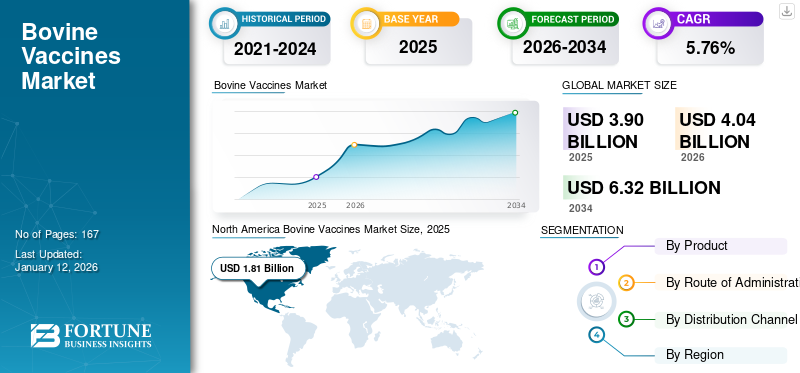
The global bovine vaccines market size was valued at USD 3.90 billion in 2025. The market is projected to grow from USD 4.04 billion in 2026 to USD 6.32 billion by 2034, exhibiting a CAGR of 5.76% during the forecast period. North America dominated the bovine vaccines market with a market share of 46.41% in 2025.
Bovine vaccines are extensively utilized to shield cattle from contagious illnesses. The growing occurrence of different illnesses such as Foot and Mouth Disease (FMD), hemorrhagic septicemia, black quarter, brucellosis, and others in cattle heightens the need for efficient vaccination. This stops the spread of the disease and preserves the quality of dairy and meat products. The market is anticipated to experience considerable expansion over the forecast period. Additionally, the increasing worldwide demand for dairy and meat items, along with heightened awareness about animal health and preventive veterinary care, is also greatly driving market expansion.
Additionally, the involvement of major market entities such as Zoetis Services LLC, Elanco, and HIPRA, which engage in significant research & development efforts and solid strategic collaborations with agricultural partners, further propelled the advancement of innovative vaccine solutions.
Download Free sample to learn more about this report.
BOVINE VACCINES MARKET KEY TAKEAWAYS
 Global Market Size & Forecast
- 2025 Market Size: USD 3.90 billion
- 2026 Market Size: USD 4.04 billion
- 2034 Forecast Market Size: USD 6.32 billion
- CAGR: 5.76% from 2026–2034
 Market Share
- North America dominated the bovine vaccines market with a 46.41% share in 2025.
- The inactivated segment held the largest market share in 2025.
- The parenteral segment accounted for the leading market share in 2025.
 Key Regional Highlights
North America
North America the market reached USD 1.81 billion in 2025, driven by a large commercial cattle population, strong herd health programs, and regulatory support for veterinary vaccines.
Europe
Europe the region is projected to grow at a 5.78% CAGR, supported by rising disease outbreaks and structured livestock vaccination programs.
Asia Pacific
Asia Pacific the market is expected to reach USD 0.54 billion in 2026, fueled by a large bovine population and expanding government vaccination initiatives.
U.S.
The market is projected to reach USD 1.75 billion in 2026, maintaining its leadership through strong cattle health management and preventive vaccination practices.
Japan
The market is estimated at USD 0.02 billion in 2026, supported by continued livestock disease prevention and vaccination efforts.
Read More

BOVINE VACCINES MARKET TRENDS
Increasing Attention to Intranasal and Alternative-Route Vaccination is a Prominent Market Trend
Increasing attention to intranasal and alternative-route vaccination is emerging as a prominent trend in the market. The market is gradually expanding beyond conventional injectable formats toward vaccine approaches that offer rapid local immunity, easier use in young calves, reduced injection-site concerns, and stronger fit in respiratory disease prevention programs. This trend is becoming more visible as producers and veterinarians seek route-specific solutions for early-life calf protection, Bovine Respiratory Disease (BRD) management, and improved herd-level convenience.
Moreover, intranasal vaccination is gaining importance as it can support faster mucosal immune response in calves exposed to respiratory pathogens at a very early age. This is particularly relevant in dairy, veal, and beef systems where calves face stress from birth, transport, grouping, and weaning. The trend is therefore being supported by increasing commercial focus on young-calf respiratory protection and by wider availability of branded intranasal cattle vaccines from major animal health companies.
- For example, in October 2025, MSD Animal Health announced new data indicating that intranasal vaccination with BOVILIS NASALGEN-C significantly improved production outcomes in veal calves vaccinated against bovine coronavirus, highlighting the growing market attention toward intranasal bovine vaccination.
MARKET DYNAMICS
MARKET DRIVERS
Download Free sample to learn more about this report.
Expansion of Government-Led Vaccination and Disease-Control Programs to Propel Market Development
The expansion of government-funded vaccination and disease-control programs is projected to greatly drive the global bovine vaccines market growth. Widespread public vaccination campaigns are increasing vaccine supplies in nations with significant cattle herds by enabling bulk purchases, multiple doses, wider field engagement, and improved farmer participation. These efforts are essential for controlling endemic and transboundary diseases such as Foot-and-Mouth Disease (FMD), brucellosis, rabies, and other notable infections in livestock, which continually affect livestock productivity, trade, and food safety. Moreover, structured national vaccination initiatives are improving long-term vaccine uptake by linking immunization to wider disease-control goals such as limiting outbreaks, boosting livestock efficiency, and protecting export markets. In various nations, authorities are financing vaccines as well as enhancing field delivery via veterinary infrastructure, campaign-oriented administration, and emergency preparedness mechanisms. This is establishing a more consistent demand landscape for bovine vaccines and fostering market growth in both advanced and developing livestock economies.
- For instance, in January 2025, the Government of India stated that cumulative vaccination under national programs had reached 107.34 crore doses against FMD and 4.39 crore doses against brucellosis, highlighting how large-scale state-supported vaccination is directly supporting global market demand.
MARKET RESTRAINTS
Supply Chain and Access Constraints to Hinder Market Growth
Supply chain and access challenges are expected to significantly hinder the market growth. The demand for bovine vaccines greatly hinges on suitable storage, temperature-controlled transport, timely field delivery, and reliable veterinary access, especially in remote cattle-production regions. Ineffective vaccine management systems can damage product quality, diminish immunization rates, and erode farmer trust, thereby directly restricting market expansion. Moreover, global animal health organizations repeatedly highlight that access to vaccines is often obstructed by distribution difficulties, cold-chain requirements, last-mile delivery obstacles, financial limitations, and inadequate cooperation between public and private sectors.
- For instance, in April 2025, WOAH, through its Animal Health Forum materials for the 92nd General Session, explicitly stated that animal vaccine access and use are constrained by distribution, cold chain, and last-mile delivery challenges.
MARKET OPPORTUNITIES
Research & Development Initiatives to Launch New Vaccines for Various Diseases Offer a Lucrative Growth Opportunity
The market offers a profitable growth potential fueled by rising research and development efforts focused on introducing new vaccines for different diseases impacting cattle. The growing incidence of animal diseases can greatly affect meat and dairy output, thereby raising the need for efficient vaccines. Additionally, advancements in biotechnology and immunology resulted in the creation of more effective and specific vaccines, improving disease prevention and control in animal populations.
- For example, in August 2024, researchers at the University of Missouri created a vaccine to shield cattle from a serious tick-borne disease called bovine anaplasmosis. This initiative seeks to protect livestock well-being and the farming economy.
MARKET CHALLENGES
Limited Farmer Awareness and Low Compliance with Complete Vaccination Schedules to Challenge Market Growth
Due to the need for accurate timing, compliance with booster shots, and schedules set by veterinarians, a lack of understanding among farmers and uneven vaccination practices continue to obstruct full market acceptance. This is particularly important for cattle well-being since missed boosters, delayed vaccinations, or poor adherence to schedules can reduce protection and undermine producer confidence, thereby constraining repeat demand and overall market growth.
- For instance, in 2025, India’s National Animal Disease Control Programme (NADCP) continued to emphasize publicity and mass awareness campaigns at national, state, block, and village levels alongside six-monthly FMD vaccination and calf brucellosis vaccination.
SEGMENTATION ANALYSIS
By Product
Increasing Number of Product Launches along with Regulatory Support for Inactivated Vaccines led to Segment Dominance
On the basis of product, the global market is segmented into live attenuated, inactivated, recombinant, and others.
The inactivated segment held dominating the global bovine vaccines market share in 2025. The growth of the segment is due to the strong use of injectable killed vaccines across the global dairy and beef herds for routine respiratory, reproductive, and preventing disease.
- For instance, in May 2024, Boehringer Ingelheim International GmbH launched BULTAVO 3, an inactivated vaccine. It is injected intramuscularly in cattle to protect them against Bluetongue Virus Serotype 3 (BTV-3).
The recombinant vaccines segment is anticipated to rise with a CAGR of 9.52% over the forecast period.
To know how our report can help streamline your business, Speak to Analyst
By Route of Administration
Various Benefits Associated with Parenteral Administration Boosted Segment Growth
Based on route of administration, the global market is divided into parenteral, oral, and intranasal.
In 2025, the parenteral segment accounted for the leading portion of the global market. The effectiveness and common usage of subcutaneous and intramuscular methods, and new product launches are the contributing factors to the segment growth over the forecast period. Additionally, various benefits associated with this route of administration, such as reliable immune response induction, versatility, established practice, and rapid onset of immunity are expected to boost the demand.
- For instance, in September 2025, Indian Immunologicals Ltd. introduced, the Raksha-IBR, a new marker vaccine for Infectious Bovine Rhinotracheitis which is caused by BHV-1 to address substantial productivity declines.
The intranasal segment is anticipated to rise with a CAGR of 8.65% over the forecast period.
By Distribution Channel
Rising Awareness Programs to Boost Veterinary Clinic’s Segment Growth
On the basis of distribution channel, the market is segmented into veterinary hospitals, veterinary clinics, pharmacies & drug stores, and others.
In 2025, the veterinary clinics segment held the largest share of the global market. Dairy and beef producers commonly choose veterinary clinics for their expert advice on product choices, vaccination timelines, booster needs, and disease-risk strategies, enhancing adherence and treatment results. Additionally, the growing focus on preventive herd health and continuous veterinary engagement at the farm level helps to strengthen the segment's leading market position.
- For instance, UC Davis Veterinary Medicine’s Livestock Herd Health and Reproduction Service works directly with cattle producers on preventive herd-health programs, including vaccination and parasite-control planning.
The pharmacies & drug stores segment is poised to witness a growth of 5.96% over the forecast period.
BOVINE VACCINES MARKET REGIONAL OUTLOOK
Geographically, the market is segmented into North America, Asia Pacific, Europe, Latin America, and the Middle East & Africa.
North America
North America Bovine Vaccines Market Size, 2025 (USD Billion)
To get more information on the regional analysis of this market, Download Free sample
North America's market size was valued at USD 1.76 billion in 2024 and dominated the global market. The region maintained its dominance in 2025 as well with USD 1.81 billion. Prominent factors such as high burden of BRD, strong preventive herd-health practice, large commercial cattle base are supporting the regional growth. Additionally, strong regulatory support and funding activities for veterinary vaccines R&D further stimulate market growth in the North America region.
U.S. Bovine Vaccines Market
The U.S. market led the North American region and is projected to reach approximately USD 1.75 billion in 2026, representing about 43.5% of the global market.
Europe
Europe is expected to grow significantly with a CAGR of 5.78% during the forecast period. The market growth in the region is driven by rising bluetongue outbreaks and stronger vector-borne disease control, strong dairy and cattle-health focus in developed livestock systems, and structured vaccination practices.
U.K. Bovine Vaccines Market
The U.K. market in 2026 is estimated at around USD 0.14 billion, representing roughly 3.4% of global revenues.
Germany Bovine Vaccines Market
Germany’s market size is projected to reach approximately USD 0.14 billion in 2026, equivalent to around 3.6% of global sales.
Asia Pacific
The Asia Pacific market size is expected to reach a valuation of USD 0.54 billion by 2026. The large bovine population and strong dairy dependence coupled with expansion of government-led FMD and brucellosis vaccination programs are some of the prominent reasons for the market growth.
Japan Bovine Vaccines Market
The Japanese market in 2026 is estimated at around USD 0.02 billion, accounting for roughly 0.5% of global revenues.
China Bovine Vaccines Market
China’s market is projected to reach revenues of around USD 0.14 billion in 2026, representing roughly 3.5% of global sales.
India Bovine Vaccines Market
The Indian market in 2026 is estimated at around USD 0.18 billion, accounting for roughly 4.6% of global revenues.
Latin America and the Middle East & Africa
The markets in the Middle East & Africa and Latin America are projected to experience steady CAGR during the forecast period. The growing incidence of illnesses in livestock and the escalating need for efficient immunization to guard against lethal and infectious diseases is driving the demand for bovine vaccines in these areas. Moreover, the rise in government programs for vaccinating livestock animals supports the growth of the market in the area. The Latin America’s market in 2026 is estimated at around USD 0.35 billion.
In the Middle East & Africa region, the GCC market is projected to reach approximately USD 0.02 billion by 2026, representing about 0.5% of worldwide revenues.
COMPETITIVE LANDSCAPE
KEY INDUSTRY PLAYERS
Strong Product Portfolio and Extended Research Activities Boost Key Companies Growth
In the competitive market, various companies have achieved prominence through their strong product lines and tactical choices. Key market participants comprise Zoetis Services LLC, Merck & Co., Inc., HIPRA, and Elanco. Continuous research and development for new product introductions, paired with a wide geographical reach, are expected to boost these companies' market shares.
- In March 2024, Zoetis Services LLC purchased a 21-acre manufacturing site in Melbourne, Australia to expand its current operations and increase future capabilities to develop and manufacture vaccines for sheep, cattle, dogs, cats and horses.
Other prominent players include Boehringer Ingelheim International GmbH, Virbac, Ceva, and others. Moreover, the introduction of advanced products in the market is creating immense competition, leading to the further strengthening of these companies’ market share.
LIST OF KEY BOVINE VACCINES COMPANIES PROFILED
- Elanco (U.S.)
- HIPRA (Spain)
- Boehringer Ingelheim International GmbH (Germany)
- Virbac (France)
- Merck & Co., Inc. (U.S.)
- Zoetis Services LLC (U.S)
- Ceva (France)
- Indian Immunologicals Ltd. (India)
KEY INDUSTRY DEVELOPMENTS
- March 2026: South Africa government confirmed a broader FMD vaccine sourcing framework covering Biogénesis Bagó (Argentina), BVI (Botswana), Dollvet (Türkiye) and ARC scale-up.
- July 2025: Elanco launched NUPLURA PH+5, a new low-endotoxin vaccine that prevents calves from several respiratory diseases.
- May 2025: Boehringer Ingelheim International GmbH announced that its BTV-3 vaccine received market authorization in Germany for use in cattle and sheep.
- May 2025: HIPRA announced the local launch of a BRD-focused cattle vaccine - HIPRABOVIS SOMNI/Lkt after local registration
- February 2025: Elanco entered South Dakota-based Medgene for the commercialization of highly pathogenic avian influenza vaccine in dairy cattle.
REPORT COVERAGE
The global bovine vaccines market analysis offers a comprehensive examination of the industry. The report emphasizes essential segment analysis based on products, administration routes, and distribution methods. Moreover, it provides an understanding of the market dynamics, including driver limitations, opportunities, and trends that affected the market. In addition, the global market forecast report provides regulatory standards, vaccination protocols for cattle, significant industry advancements, and recent product introductions. Alongside the previously mentioned elements, the report includes various factors that have driven market growth in recent years.
Request for Customization to gain extensive market insights.
Report Scope & Segmentation
| ATTRIBUTE | DETAILS |
| Study Period | 2021-2034 |
| Base Year | 2025 |
| Estimated Year | 2026 |
| Forecast Period | 2026-2034 |
| Historical Period | 2021-2024 |
| Growth Rate | CAGR of 5.76% from 2026 to 2034 |
| Unit | Value (USD Billion) |
| Segmentation | Product, Route of Administration, Distribution Channel, and Region |
| By Product |
|
| By Route of Administration |
|
| By Distribution Channel |
|
| By Region |
|
Frequently Asked Questions
Fortune Business Insights says that the market size was valued at USD 3.90 billion in 2025 and is projected to reach USD 6.32 billion by 2034.
In 2025, the North America market stood at USD 1.81 billion.
By registering a CAGR of 5.76%, the market will exhibit steady growth during the forecast period.
Based on the product, the inactivated segment led the market in 2025.
Expansion of government-led vaccination and disease-control programs is the key factor driving the global market.
Zoetis Services LLC, Merck & Co., Inc., and HIPRA are the top players in the market.
North America held the largest share of the market in 2025.
The current market trends are increasing attention to intranasal and alternative-route vaccination.



- 2021-2034
- 2025
- 2021-2024
- 138
-
(Offer valid till 30th Sep 2026)
Get 30-60 hrs Free Customization
Expand Regional and Country Coverage, Segments Analysis, Company Profiles, Competitive Benchmarking, and End-user Insights.













.webp)






Related Reports
-
US +1 833 909 2966 ( Toll Free )
-
Get In Touch With Us