 Download Free Sample



Get a Quote
Receive a tailored pricing based on your needs.
- Choose license type
- Multiple user options
- Custom scope & coverage
- Fast turnaround
"Electrifying your pathway to success through in-depth market research"
 Listen to Audio Version
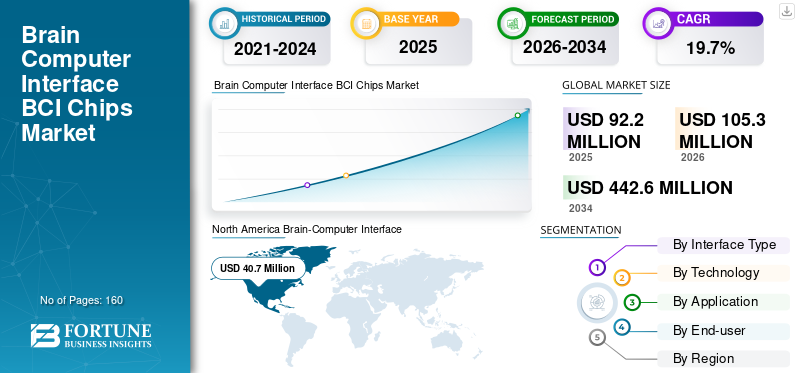
The Brain-Computer Interface (BCI) chips market size was valued at USD 92.2 million in 2025. The market is projected to grow from USD 105.3 million in 2026 to USD 442.6 million by 2034, exhibiting a CAGR of 19.7% during the forecast period. North America dominated the Brain-Computer Interface (BCI) chips market with a market share of 44.14% in 2025.
BCI chips are designed to capture, process, and transmit neural signals between the brain and external devices, enabling applications such as assistive communication, motor function restoration, prosthetic control, neurorehabilitation, and neurological monitoring. Unlike conventional medical electronics, BCI chips require high signal accuracy, low power consumption, compact form factors, biocompatibility, and stable long-term performance, especially for implantable systems. The growing demand for real-time neural signal processing, high-density electrode arrays, wireless data transfer, and patient-specific brain signal decoding is driving the development of advanced BCI chip platforms across healthcare, research, and assistive technology applications.
The rising prevalence of neurological disorders, increasing clinical interest in restoring communication and mobility for patients with paralysis, and growing investment in implantable neurotechnology devices are strengthening demand for BCI chips. Hospitals, neurology clinics, rehabilitation centers, and research institutes are adopting BCI-enabled systems to improve brain signal monitoring, digital device control, speech restoration, and movement assistance. As BCI systems move from experimental research toward clinical deployment, chip manufacturers and neurotechnology companies are focusing on signal fidelity, miniaturization, safety, wireless operation, and long-term implant reliability.
Key players such as Neuralink, Synchron, Blackrock Neurotech, and INBRAIN Neuroelectronics are driving innovation in the market through advanced neural implants interfaces, high-density electrode systems, wireless communication platforms, and next-generation neural signal processing technologies. These companies are focusing on improving signal accuracy, device miniaturization, power efficiency, biocompatibility, and long-term implant reliability to support applications such as assistive communication, motor function restoration, prosthetic control, and neurological monitoring. They are also strengthening their market presence through clinical trials, regulatory progress, research collaborations, and product development aimed at accelerating the commercialization of BCI chip-enabled solutions.
Download Free sample to learn more about this report.
 Global Market Size & Forecast
 Market Share
 Key Regional Highlights
North America
The market reached USD 40.7 million in 2025, driven by advanced neuroscience research and clinical adoption.
Asia Pacific
The market reached USD 33.0 million in 2025, supported by semiconductor innovation and brain science research.
Europe
The market reached USD 11.19 million in 2025, driven by medical device innovation and neurological care.
U.S.
The market reached USD 34.4 million in 2025, supported by strong clinical trials and neurotechnology adoption.
Japan
The market reached USD 5.5 million in 2025, driven by government support for brain-computer interface research.
Read More

AI-Enabled Neural Signal Decoding Enhance Commercial Potential of BCI Chips
AI is becoming a core value driver in the market as chip alone does not create usable output unless advanced algorithms can decode noisy neural signals into commands, text, speech, or movement intent in real time. In practical terms, AI improves signal classification, adaptive learning, personalization, low-latency decoding, and error correction, which makes BCI chips more commercially relevant for medical applications such as speech restoration, paralysis support, prosthetic control, and neurorehabilitation. It also shifts product differentiation from only electrode density, power efficiency, and implant safety toward the combined performance of chip architecture and AI decoding software. For instance,
Growing Focus on Speech Restoration and Communication Control is Emerging Market Trend
Growing focus on speech restoration and communication control is emerging as a major trend in the market, as companies are moving beyond basic cursor movement toward high-speed speech decoding, text generation, synthesized voice, and digital communication for people with paralysis or speech loss.
This trend is strongly supported by recent product-level progress from Paradromics, which completed the first human implantation of its Connexus BCI in June 2026 as part of the FDA-approved Connect-One Early Feasibility Study. The company’s Connexus system is designed to record, decode, and translate neural signals through an implantable high-density microelectrode array and transmit the data wirelessly to an external receiver for communication and computer control. In the first implant case, the device reportedly used 421 ultra-thin microwires to record speech-associated neural signals from a patient with motor neuron disease affecting speech, showing how BCI chips and neural-interface hardware are being developed for direct brain-to-text and brain-to-voice applications. Academic progress also supports this shift, as a Nature study demonstrated attempted speech decoding at 62 words per minute, which was 3.4 times faster than the previous BCI record and closer to natural conversation speed.
These developments indicate that speech restoration is becoming one of the most commercially relevant use cases for BCI chips, high-density electrodes, neural processors, and real-time decoding hardware.
Download Free sample to learn more about this report.
Rising Demand for High-Performance Neural Signal Processing Chips to Drive Market Growth
The market is expected to grow as next-generation brain-computer interface systems require chips that can record, compress, process, and decode neural signals directly at the device level with low power consumption and high reliability. High-performance neural signal processing chips are becoming essential because BCI systems generate large volumes of brain-signal data, and faster on-chip processing helps reduce latency, improve command accuracy, and support practical applications such as assistive communication, prosthetic control, digital device operation, and rehabilitation support.
High Surgical Risks and Implantation Challenges to Restrain Market Growth
High surgical risk and invasive implantation challenges are major restraints for the market, as many advanced BCI chips must be placed directly on or inside the brain through specialized neurosurgical procedures. This increases the risk of infection, bleeding, tissue response, electrode displacement, and post-surgical complications, which limits adoption mainly to patients with severe paralysis, ALS, spinal cord injury, or other critical neurological conditions. The challenge is also visible in current clinical programs. For instance,
These surgical and technical barriers make hospitals, regulators, physicians, and patients cautious, thereby slowing the near-term commercialization of implantable BCI chips.
Rising Development of Implantable Neural Interfaces to Unlock New Opportunities for BCI Chip Manufacturers
Rising development of high-channel implantable neural interfaces is creating a strong opportunity for the market, as companies are increasingly focusing on neural-interface systems that can capture larger volumes of brain-signal data with higher accuracy. High-channel implants improve the ability to decode speech, movement intention, cursor control, and digital commands, which directly increases demand for advanced neural recording chips, signal processors, electrode arrays, and low-noise front-end electronics. For instance,
These developments indicate that future BCI systems will depend heavily on compact, high-performance chips and electrode architectures capable of handling richer neural data acquisition systems at low power and low latency.
Hospitals & Neurology Clinics Dominate Market Driven by Strong Clinical Adoption and Neurological Care Infrastructure
Based on the end-user, the market is segmented into hospitals & neurology clinics, rehabilitation centers, research institutes & universities, defense organizations, and consumer electronics companies.
Hospitals & neurology clinics held the majority market share of 30.7% in 2025, as they are the primary centers for diagnosis, treatment, implantation, and monitoring of neurological disorders. These facilities use BCI-enabled systems for paralysis support, epilepsy monitoring, stroke rehabilitation, neurodegenerative disease management, and assistive communication, where accurate neural signal processing is clinically important. Compared to rehabilitation centers, research institutes, defense organizations, and consumer electronics companies, hospitals and neurology clinics have stronger patient access, specialist availability, medical infrastructure, and clinical trial participation, making them the leading end-use segment.
Consumer electronics companies are expected to witness highest CAGR of 24.1% during the forecast period.
To know how our report can help streamline your business, Speak to Analyst
Invasive BCI Dominates Market Due to Superior Neural Signal Accuracy and Clinical Suitability
Based on the interface type, the market is segmented into invasive BCI, semi-invasive BCI, and non-invasive BCI.
Invasive BCI held the majority share of 78.2% of the market in 2025, as it offers the highest signal accuracy and resolution by placing electrodes directly in or on brain tissue. This enables faster and more reliable neural data capture, making it more suitable for advanced medical applications such as paralysis treatment, speech restoration, prosthetic control, and neurological rehabilitation. The segment also benefits from rising clinical trials and investments in implantable BCI systems, where high-performance chips are essential for real-time neural signal processing.
Semi-invasive BCI segment is expected to witness second- highest CAGR of 18.4% during the forecast period.
Electroencephalography (EEG) Dominates Market Driven by Non-Invasive Adoption and Cost-Effective Brain Signal Monitoring
Based on technology, the market is categorized into electroencephalography (EEG)), electrocorticography (ECoG), magnectoenephalography (MEG), and functional magnetic resonance imaging (fMRI).
Electroencephalography (EEG) held majority share of the market of 67.1% in 2025. This is due to its non-invasive nature, lower cost, easier setup, and wider use across research, healthcare, gaming, neurofeedback, and assistive communication applications. EEG-based BCI systems use scalp-level brain signal recording, which reduces surgical risk and makes the technology more acceptable for large-scale adoption compared to ECoG, MEG, and fMRI. The segment also benefits from portable EEG headsets and compact signal-processing chips that support real-time brain activity monitoring in clinical and consumer-grade BCI devices.
Functional Magnetic Resonance Imaging (fMRI) are expected to witness highest CAGR of 24.0% during the forecast period.
Healthcare & Medical Applications Dominate Market Due to Rising Use in Neurological Treatment and Assistive Care
Based on application, the market is categorized into healthcare & medical application, assistive communication, rehabilitation & neuro-recovery, mental health & cognitive monitoring, gaming & entertainment, defense & military application, and research & neuroscience.
Healthcare & medical applications segment held the majority share of 29.5% in 2025, as clinical use cases require the most advanced and reliable neural signal processing capabilities. BCI chips are highly relevant in applications such as paralysis support, speech restoration, prosthetic limb control, epilepsy monitoring, stroke rehabilitation, and neurodegenerative disease management, where accurate brain-signal capture directly supports patient outcomes. Compared to gaming, defense, or research applications, healthcare has stronger funding, regulatory focus, hospital adoption, and clinical trial activity, making it the leading revenue-generating segment.
Gaming & entertainment are expected to witness highest CAGR of 22.4% during the forecast period.
By region, the market is categorized into North America, South America, Europe, the Middle East & Africa, and Asia Pacific.
North America Brain-Computer Interface (BCI) Chips Market Size, 2025 (USD Million)
To get more information on the regional analysis of this market, Download Free sample
North America holds the majority of the Brain-Computer Interface (BCI) Chips market share due to its strong neuroscience research ecosystem, advanced hospital and neurology infrastructure, early clinical adoption of implantable neurotechnologies, and the presence of leading BCI companies and academic research centers in the U.S. The region has a higher concentration of clinical trials, FDA-backed early feasibility studies, venture funding, and semiconductor design capabilities, which supports faster development of high-performance neural signal processing chips. Demand is also supported by the large patient pool for neurological conditions, paralysis, stroke, ALS, and spinal cord injuries, where BCI systems can support communication, mobility, and rehabilitation. For instance,
Given North America’s strong contribution, the U.S. market was at around USD 34.4 million in 2025, accounting for roughly 37.3% of sales.
Europe is projected to grow at CAGR of 18.0% over the forecast period and reached a valuation of USD 11.19 million in 2025, due to its strong focus on regulated medical device development, ethical neurotechnology deployment, and hospital-led adoption of advanced neurological care solutions. Unlike North America, where growth is led by commercial BCI companies and clinical trials, and Asia Pacific, where growth is supported by advanced semiconductor chips and government-backed technology expansion, Europe’s growth is more closely linked to university-hospital research networks, precision rehabilitation, and assistive technologies for aging populations. The region is also seeing wider use of neurostimulation, brain monitoring technology, and rehabilitation systems across specialized neurology centers, creating demand for reliable, safety-compliant BCI chips. For instance,
The U.K. market in 2025 was valued at USD 2.8 million, representing roughly 3.0% of global revenues.
Germany’s market reached USD 2.4 million in 2025, equivalent to around 2.6% of global sales.
Asia Pacific is expected to grow at the highest CAGR and reached a valuation of USD 33.0 million in 2025, due to the region’s strong semiconductor manufacturing base, rising government support for brain science research, and increasing demand for affordable neurotechnology solutions across major economies. Unlike North America, where growth is mainly driven by advanced clinical trials and established neurotechnology firms, Asia Pacific is benefiting from rapid electronics miniaturization, local chip design capabilities, and public funding for neuroscience, brain mapping, medical device innovation, and rehabilitation technologies. Government-backed research programs and healthcare modernization efforts are helping accelerate the development of neural interfaces and brain signal processing systems. For instance,
The Japan market in 2025 was valued at USD 5.5 million, accounting for roughly 6.0% of global revenues.
China’s market is projected to be one of the largest worldwide, with 2025 revenues valued at USD 12.0 million, representing roughly 13.0% of global sales.
The India market in 2025 was at around USD 4.1 million, accounting for roughly 4.4% of global market share.
The Middle East & Africa are expected to grow at the second-highest CAGR, market due to rapid healthcare modernization, increasing investment in specialty hospitals, and rising adoption of advanced medical technologies across the GCC, South Africa, Turkey, and Israel. The region is still at an earlier stage of BCI adoption compared to North America and Europe, which creates higher growth potential as hospitals expand neurology, rehabilitation, and digital health capabilities.
South America is expected to grow at a slow and steady CAGR, due to gradual improvements in neurological care, rehabilitation services, and medical device adoption across countries such as Brazil, Argentina, Chile, and Colombia. The region’s growth is mainly supported by rising demand for brain-monitoring tools, stroke rehabilitation solutions, epilepsy management, and assistive technologies in hospitals and academic medical centers.
The GCC market reached USD 1.4 million in 2025, representing roughly 1.5% of global revenues.
Key Industry Players Focus on Innovation and Strategic Expansion to Sustain Market Competition
Key players in the market are advancing their solutions to support the growing demand for accurate neural signal processing, real-time brain activity monitoring, assistive communication, neurorehabilitation, and implantable brain-computer interface systems. Leading companies are focusing on the development of high-density electrode arrays, low-power neural processing chips, wireless data transmission, miniaturized implantable devices, and improved biocompatible materials to enhance signal accuracy, patient safety, and long-term device performance. Vendors are also expanding their product portfolios through clinical trials, research collaborations, regulatory approvals, and investment in next-generation neuroelectronics to support applications across hospitals, neurology clinics, rehabilitation centers, research institutes, and emerging consumer neurotechnology use cases.
The report provides a comprehensive analysis of the industry, focusing on key market players and the overall competitive landscape. It offers valuable insights into current market trends, technological advancements, and significant industry developments. The report further examines key growth drivers, restraints, opportunities, and challenges influencing market expansion.
Request for Customization to gain extensive market insights.
| ATTRIBUTE | DETAILS |
| Study Period | 2021-2034 |
| Base Year | 2025 |
| Estimated Year | 2026 |
| Forecast Period | 2026-2034 |
| Historical Period | 2021-2024 |
| Growth Rate | CAGR of 19.7% from 2026-2034 |
| Unit | Value (USD Million) |
| Segmentation | By Interface type, Technology, Application, End-user and Region |
| By Interface Type |
|
| By Technology |
|
| By Application |
|
| By End-user |
|
| By Region |
|
According to Fortune Business Insights, the global market value stood at USD 92.2 million in 2025 and is projected to reach USD 442.6 million by 2034.
In 2025, the North America market value stood at USD 40.7 million.
The market is expected to grow at a CAGR of 19.7% over the forecast period.
By end-user, hospitals & neurology clinics segment is expected to lead the market.
Rising demand for high-performance neural signal processing chips to drive market growth.
Neuralink, Synchron, Blackrock Neurotech, and INBRAIN Neuroelectronics are the major players in the global market.
North America dominated the market in 2025.
Get 30-60 hrs Free Customization
Expand Regional and Country Coverage, Segments Analysis, Company Profiles, Competitive Benchmarking, and End-user Insights.




















Get In Touch With Us
US +1 833 909 2966 ( Toll Free )
Receive a tailored pricing based on your needs.
Discuss your questions with our industry experts.
Have questions? Get quick answers before you purchase.

