Brazed Plate Heat Exchangers Market Size, Share & Industry Analysis, By Brazing Material (Copper, Nickel, and Specialty Alloys), By Capacity (Small Capacity (<50 kW), Medium Capacity (50-500 kw), and Large Capacity (>500kW)), By End User (HVAC & Building Services, Food & Beverage, Chemical & Petrochemical, Oil & Gas, Power Generation, and Others), Regional Forecast, 2026-2034
 Download Free Sample
Brazed Plate Heat Exchangers Market Size and Future Outlook
 Listen to Audio Version
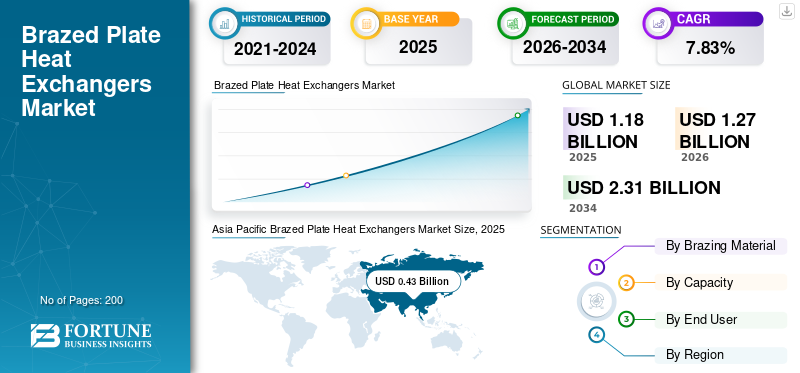
The global brazed plate heat exchangers market size was valued at USD 1.18 billion in 2025. The market is projected to grow from USD 1.27 billion in 2026 to USD 2.31 billion by 2034, exhibiting a CAGR of 7.83% during the forecast period.
The Brazed Plate Heat Exchangers (BPHEs) market is driven by increasing demand for compact and energy-efficient thermal systems across HVAC, refrigeration, industrial processing, and clean energy applications. According to the International Energy Agency, buildings accounted for nearly 30% of global final energy consumption in 2023, emphasizing the need for high-efficiency heating and cooling technologies. Moreover, IEA reported that heat pumps supply around 10% of global space heating demand, with global sales reaching record levels in 2022, reflecting the accelerated electrification of heating systems. Furthermore, in 2024, the IEA Global Energy Review highlighted continued growth in demand for energy efficient solutions, with thermal management systems accounting for a substantial share of operational energy use. BPHEs provide high heat transfer coefficients and a compact design compared to conventional shell-and-tube systems, making them ideal for space-constrained installations such as heat pumps, chillers, air conditioners, and district heating modules.
- For instance, in March 2024, Alfa Laval announced an expansion of its brazed plate heat exchanger production capacity at its San Bonifacio facility in Italy to meet rising demand from the heat pump and district heating sectors. The company stated that the investment was driven by accelerating European electrification and energy-efficiency initiatives. The expansion aims to support growing orders for compact BPHE units used in residential and commercial heat pump systems, reinforcing their role in low-carbon heating infrastructure.
Some of the leading companies operating in the industry include Alfa Laval, Danfoss, Kelvion Holding GmbH, SWEP International AB, and others. Alfa Laval is a global leader in heat transfer technology and a major supplier of BPHEs for HVAC, refrigeration, district energy, and industrial applications. The company offers a broad BPHE portfolio designed for high efficiency, compact footprint, and low refrigerant charge, supporting energy-efficient heating and cooling solutions worldwide.
Download Free sample to learn more about this report.
BRAZED PLATE HEAT EXCHANGERS MARKET KEY TAKEAWAYS
 Market Size & Forecast
- 2025 Market Size: USD 1.18 billion
- 2026 Market Size: USD 1.27 billion
- 2034 Forecast Market Size: USD 2.31 billion
- CAGR: 7.83% from 2026–2034
 Market Share
- The nickel segment is experiencing the highest growth and is expected to grow at a CAGR of 8.83% over the forecast period.
- The large capacity (>500 kW) segment is expected to grow at a CAGR of 7.28% during the forecast period.
- The chemical & petrochemical segment is expected to grow at a CAGR of 9.34% over the forecast period.
 Key Regional Highlights
North America
North America held the second-highest share in 2025, valued at USD 0.24 billion, and is expected to maintain its leading position in 2026 with a value of USD 0.26 billion.
Europe
Europe is projected to record a growth rate of 7.98% in the coming years.
Asia Pacific
Asia Pacific reached USD 0.43 billion in 2025 and secured the largest market share.
U.S.
The U.S. is witnessing strong adoption of high-efficiency HVAC systems.
Japan
The Japanese market in 2025 was valued at USD 0.03 billion, accounting for roughly 2.47% of global revenues.
Read More

BRAZED PLATE HEAT EXCHANGERS MARKET TRENDS
Rising Adoption of Heat Pumps and Electrified Heating Systems are the Key Market Trends
BPHEs are witnessing strong demand due to the rapid expansion of heat pumps and electrified heating infrastructure worldwide. Governments across Europe, North America, and parts of Asia are accelerating their building decarbonization programs and increasing the deployment of residential and commercial heat pumps. BPHEs are preferred in these systems due to their compact design, high thermal efficiency, and ability to operate under high-pressure refrigerants. The shift toward low-GWP refrigerants and natural refrigerants such as CO₂ and propane is further driving design innovations in brazed plate exchangers to withstand higher operating pressures and temperature variations.
Download Free sample to learn more about this report.
MARKET DYNAMICS
MARKET DRIVERS
Expansion of Industrial Heat Recovery and Process Optimization to Drive the Market Growth
The expansion of industrial heat recovery and process optimization is driving the brazed plate heat exchangers market share. Energy-intensive industries such as chemicals, refining, food processing, and power generation are increasingly focusing on improving thermal efficiency to reduce operating costs and meet emission targets. Many industrial processes generate substantial amounts of low- to medium-grade waste heat, which can be recovered and reused through compact heat exchange systems.
BPHEs are particularly suited for these applications due to their high heat transfer coefficients, compact design, and capability to operate under high-pressure and temperature conditions. In sectors such as pharmaceuticals and specialty chemicals, precise temperature control and hygienic design are critical, further supporting BPHE deployment. Their durability, low maintenance requirements, and ability to integrate into closed-loop systems make them a preferred solution for modern industrial process optimization strategies. These factors are expected to drive brazed plate heat exchangers market growth during the forecast period.
MARKET RESTRAINTS
Susceptibility to Fouling and Limited Serviceability to Hamper the Market Demand
One of the key restraints for BPHEs is their susceptibility to fouling in applications involving poor water quality, scaling fluids, or particulate contamination. Since BPHEs are fully brazed and not gasketed, they cannot be mechanically opened for cleaning, which makes maintenance more complex than with plate-and-frame heat exchangers. In industrial processes where fluids contain solids, oil residues, or high mineral content, fouling can reduce heat transfer efficiency and increase pressure drop, leading to performance degradation over time. Additionally, BPHEs have fixed plate configurations, limiting flexibility for capacity expansion or modification once installed. In highly corrosive environments, material compatibility becomes critical, and the use of specialized alloys can increase capital costs.
MARKET OPPORTUNITIES
Growing Adoption of Natural Refrigerants and Low-Carbon Technologies to Create Market Opportunities
The increasing transition toward natural refrigerants and low-carbon thermal systems presents a strong opportunity for BPHEs. Regulatory frameworks such as the EU F-Gas Regulation (revised 2024) are accelerating the phase-down of high-GWP refrigerants, encouraging the adoption of alternatives such as CO₂ (R744), ammonia, and propane.
These refrigerants operate at higher pressures, creating demand for compact heat exchangers capable of handling elevated stress conditions, an area where BPHEs demonstrate strong technical advantages. Additionally, the global push toward green hydrogen, district energy networks, and thermal energy storage systems is expanding new application areas for compact, high-efficiency heat exchangers. BPHEs are increasingly integrated into electrolyzer cooling systems, fuel cell thermal management, and waste-to-energy plants due to their high thermal performance and space efficiency.
MARKET CHALLENGES
Volatility in Raw Material Prices and High-Pressure Design Complexities to Pose Challenges for Market Growth
One of the major challenges in the brazed plate heat exchangers market is volatility in raw material prices, particularly stainless steel, copper, and nickel alloys used in plate construction and brazing. Fluctuations in global metal prices directly impact manufacturing costs and profit margins, making pricing strategies more complex for suppliers. Additionally, supply chain disruptions and geopolitical trade uncertainties can affect the availability of specialized alloys required for high-pressure and corrosive applications.
Another challenge is the increasing technical complexity of high-pressure refrigerants such as CO₂, which require enhanced mechanical strength, precise manufacturing tolerances, and rigorous testing standards. Designing BPHEs that can withstand elevated pressures while maintaining compactness and efficiency demands advanced engineering capabilities and higher R&D investment.
Segmentation Analysis
By Brazing Material
Copper Segment Dominates Due to Cost Efficiency
Based on brazing material, the market is classified into copper, nickel, and specialty alloys.
In 2025, the copper segment held the dominant market share. The growth of this segment is driven by its excellent thermal conductivity, cost-effectiveness, and reliable metallurgical bonding properties. Copper provides strong capillary action during brazing, ensuring uniform distribution between stainless steel plates and creating a robust, leak-tight seal. Its high thermal conductivity enhances overall heat transfer efficiency, supporting compact exchanger designs with improved performance.
The nickel segment is experiencing the highest growth and is expected to grow at a CAGR of 8.83% over the forecast period.
To know how our report can help streamline your business, Speak to Analyst
By Capacity
Expanding Commercial HVAC Applications Drive Medium Capacity Segment Growth
Based on capacity, the market is classified into small capacity (<50 kW), medium capacity (50–500 kW), and large capacity (>500 kW).
In 2025, the medium capacity (50–500 kW) segment dominated the global market. This capacity range is widely used in commercial HVAC units, district heating substations, heat pump systems, refrigeration units, and process cooling applications, making it the most versatile segment. Many commercial buildings, including offices, hospitals, retail centers, and hotels, require heating and cooling loads that fall within this range, driving consistent demand.
The large capacity (>500 kW) segment is expected to grow at a CAGR of 7.28% during the forecast period.
By End User
HVAC & Building Services Segment Dominates Due to the Rising Energy-Efficient HVAC Infrastructure Development Demand
On the basis of end user, the market is classified into HVAC & building services, food & beverage, chemical & petrochemical, oil & gas, power generation, and others.
In 2025, the HVAC & building services segment dominated the global market. This growth is driven by widespread demand for efficient heating, cooling, and hot water systems in residential and commercial infrastructure. Modern buildings increasingly require compact, energy-efficient thermal management solutions to meet regulatory efficiency standards and reduce operating costs. BPHEs are extensively used in chillers, heat pumps, boilers, district heating substations, and domestic hot water systems due to their high heat transfer efficiency and small footprint.
The chemical & petrochemical segment is expected to grow at a CAGR of 9.34% over the forecast period.
Brazed Plate Heat Exchangers Market Regional Outlook
By geography, the market is categorized into North America, Europe, Asia Pacific, Latin America, and the Middle East & Africa.
Asia Pacific
Asia Pacific reached USD 0.43 billion in 2025 and secured the largest market share. In the region, India and China reached the valuations of USD 0.08 billion and USD 0.24 billion, respectively, in 2025.
Asia Pacific Brazed Plate Heat Exchangers Market Size, 2025 (USD Billion)
To get more information on the regional analysis of this market, Download Free sample
The region’s fast-growing manufacturing sector, particularly in chemicals, food processing, and electronics, is driving adoption of compact heat exchangers for process cooling and heat recovery. Rising cold chain logistics investments, supported by expanding e-commerce and food exports, further boost demand for efficient thermal systems. Additionally, government initiatives promoting energy efficiency and industrial modernization are encouraging the replacement of conventional heat exchangers with high-performance brazed plate units across diverse applications in the region.
Japan Brazed Plate Heat Exchangers Market
The Japanese market in 2025 was valued at USD 0.03 billion, accounting for roughly 2.47% of global revenues. Japan’s strong focus on high-efficiency HVAC systems and advanced industrial process optimization drives steady demand for the product.
China Brazed Plate Heat Exchangers Market
China’s market is projected to be significant worldwide, with 2025 revenues valued at USD 0.24 billion, representing roughly 20.15% of the global market.
India Brazed Plate Heat Exchangers Market
The Indian market in 2025 was valued at USD 0.08 billion, accounting for roughly 6.69% of global revenues.
North America
North America held the second-highest share in 2025, valued at USD 0.24 billion, and is expected to maintain its leading position in 2026 with a value of USD 0.26 billion. Rising investments in energy-efficient buildings and industrial modernization are key drivers for BPHEs in North America. The U.S. and Canada are witnessing strong adoption of high-efficiency HVAC systems, particularly heat pumps, as part of electrification and decarbonization initiatives. Growing retrofit activity in commercial buildings, hospitals, and data centers is driving demand for compact, high-performance heat exchangers.
U.S. Brazed Plate Heat Exchangers Market
Based on North America’s strong contribution and the U.S. dominance within the region, the U.S. market was valued at USD 0.19 billion in 2025, accounting for roughly 16.39% of the global market size.
Europe
Europe is projected to record a growth rate of 7.98% in the coming years, which is the third-highest among all regions. It reached a valuation of USD 0.35 billion in 2025. Strong decarbonization policies and the rapid electrification of heating systems are major drivers of BPHE adoption in Europe. The region is aggressively expanding heat pump installations to reduce dependence on fossil fuels, increasing demand for compact and high-efficiency heat exchangers. District heating network modernization across countries such as Germany, France, and the Nordics further supports BPHE adoption in substations and energy transfer units.
Germany Brazed Plate Heat Exchangers Market
The Germany’s market in 2025 was valued at USD 0.10 billion and is estimated at around USD 0.11 billion in 2026, representing roughly 8.47% of the global revenues.
Latin America
Latin America is expected to witness moderate growth in this market during the forecast period. The Latin America market reached a valuation of USD 0.06 billion in 2025.
Growing commercial construction and industrial expansion are supporting demand for BPHEs in Latin America. Countries such as Brazil and Mexico are witnessing rising investments in food processing, cold storage, and HVAC infrastructure, increasing the need for compact and energy-efficient heat transfer systems. Additionally, the modernization of industrial facilities and the gradual adoption of energy-efficient technologies are contributing to steady BPHE market growth across the region.
Brazil Brazed Plate Heat Exchangers Market
Brazil's market was valued at USD 0.03 billion in 2025, representing roughly 2.60% of the global revenues.
Middle East & Africa
The Middle East & Africa are expected to witness significant growth in this market during the forecast period. The Middle East & Africa market reached about USD 0.10 billion in 2025.
Rising demand for district cooling, commercial HVAC systems, and large infrastructure projects is driving BPHE adoption in the Middle East & Africa. Gulf countries are investing heavily in high-efficiency cooling systems to address extreme climatic conditions and rising urban development. Additionally, expansion in oil & gas processing and industrial facilities across the region supports demand for compact and durable heat transfer solutions.
GCC Brazed Plate Heat Exchangers Market
The GCC market was valued at USD 0.06 billion in 2025, representing roughly 5.12% of the global market.
COMPETITIVE LANDSCAPE
Key Industry Players
Major players Focus on Boosting their Market Share Via Partnerships, Business Expansion, And Technological Advancements
The global brazed plate heat exchangers market is highly consolidated, with prominent players such as Alfa Laval, Danfoss, Kelvion Holding GmbH, SWEP International AB, and others. Companies operating in the industry are adopting targeted growth strategies focused on strengthening their product portfolio, technical capability, expanding manufacturing presence, and other areas.
- For instance, in March 2024, Alfa Laval announced the expansion of its brazed plate heat exchanger production capacity in Europe to address growing demand from the heat pump and district energy sectors. The investment focused on automation upgrades and improved brazing technologies to enhance efficiency and reduce lead times. The development supports the growing electrification trend and strengthens the company’s supply capabilities for residential and commercial HVAC markets.
Other key players in the global market include API Heat Transfer, Hisaka Works, Ltd., Chart Industries, Inc., and others. These companies are expected to prioritize new product launches and collaborations to increase their global market share during the forecast period.
LIST OF KEY BRAZED PLATE HEAT EXCHANGERS COMPANIES PROFILED
- Alfa Laval (Sweden)
- Danfoss (Denmark)
- Kelvion Holding GmbH (Germany)
- SWEP International AB (Sweden)
- Xylem Inc. (U.S.)
- API Heat Transfer (U.S.)
- Hisaka Works, Ltd. (Japan)
- Chart Industries, Inc. (U.S.)
- Johnson Controls Inc. (Ireland)
- GEA Group Aktiengesellschaft (Germany)
KEY INDUSTRY DEVELOPMENTS
- May 2024: Johnson Controls integrated advanced brazed plate heat exchangers into its next-generation chiller and heat pump platforms. The move improves overall system efficiency and reduces refrigerant usage in commercial buildings. This integration supports the company’s sustainability roadmap and aligns with stricter building energy performance regulations.
- April 2024: GEA introduced enhanced corrosion-resistant brazed plate heat exchangers for industrial and food processing applications. The new design incorporates improved plate geometry and optimized flow distribution to increase thermal efficiency. The development supports demand for hygienic and energy-efficient heat transfer equipment in regulated industries such as dairy, beverage, and pharmaceuticals.
- January 2024: Danfoss introduced an upgraded range of microchannel-compatible BPHEs designed for high-efficiency heat pump systems. The new series was engineered to support low-GWP refrigerants and operate under higher pressure conditions. This launch aligns with global decarbonization efforts and with the expanding demand for compact, energy-efficient thermal solutions for residential and commercial heating applications.
- September 2023: SWEP expanded its BPHE portfolio with a new model optimized for transcritical CO₂ applications. The development targeted supermarkets and industrial refrigeration systems requiring high-pressure durability and enhanced thermal performance. SWEP emphasized sustainability and reduced refrigerant charge in the product design, strengthening its position in natural refrigerant-based cooling systems across Europe and Asia.
- June 2023: Kelvion announced investments in digital monitoring solutions integrated with its compact BPHEs. The upgrade allows predictive maintenance and improved performance tracking in industrial and HVAC installations. This initiative enhances lifecycle management and supports customers seeking energy optimization and operational reliability in process industries.
REPORT COVERAGE
The global brazed plate heat exchangers market analysis provides an in-depth study of the market size and forecast for all the market segments included in the report. It includes details on the market dynamics and trends expected to drive the market over the forecast period. It offers information on the technological advancements, new product launches, key industry developments, and details on partnerships, mergers, and acquisitions. The market research report also encompasses a detailed competitive landscape with information on the market share and profiles of key operating players.
Request for Customization to gain extensive market insights.
Report Scope & Segmentation
| ATTRIBUTE | DETAILS |
| Study Period | 2021-2034 |
| Base Year | 2025 |
| Forecast Period | 2026-2034 |
| Historical Period | 2021-2024 |
| Growth Rate | CAGR of 7.83% from 2026-2034 |
| Unit | Value (USD Billion) |
| Segmentation | By Brazing Material, Capacity, End User, and Region |
| By Brazing Material |
|
| By Capacity |
|
| By End User |
|
| By Geography |
|
Frequently Asked Questions
Fortune Business Insights says that the global market value stood at USD 1.18 billion in 2025 and is projected to reach USD 2.31 billion by 2034.
In 2025, the North American market value stood at USD 0.24 billion.
The market is expected to exhibit a CAGR of 7.83% during the forecast period.
The copper segment led the market by brazing material in 2025.
Rising demand for energy-efficient HVAC systems, industrial heat recovery, and compact high-performance thermal solutions are the key factors driving the market.
Alfa Laval, Danfoss, Kelvion Holding GmbH, and others are some of the prominent players in the market.
Asia Pacific dominated the market in 2025 with the largest share.
Increasing electrification of heating systems, space-saving design advantages, and superior heat transfer efficiency are expected to favor BPHE adoption.



- 2021-2034
- 2025
- 2021-2024
- 200
Get 30-60 hrs Free Customization
Expand Regional and Country Coverage, Segments Analysis, Company Profiles, Competitive Benchmarking, and End-user Insights.



















Related Reports
-
US +1 833 909 2966 ( Toll Free )
-
Get In Touch With Us