Breast Enlargement Oil Market Size, Share & Industry Analysis, By Ingredient Type (Herbal/Natural, Synthetic/Conventional, and Organic/Clean Label), By Formulation (Oil-Based, Oil-Serum Blends, and Multi-Ingredient Massage Oils), By End-User (Women and Unisex), By Distribution Channel (Supermarkets & Hypermarkets, Pharmacies & Drug Stores, Online Retail, Specialty Beauty & Wellness Stores, and Others), and Regional Forecast, 2026-2034
 Download Free Sample
(Offer valid till 15th Oct 2026)

Breast Enlargement Oil Market Size and Future Outlook
 Listen to Audio Version
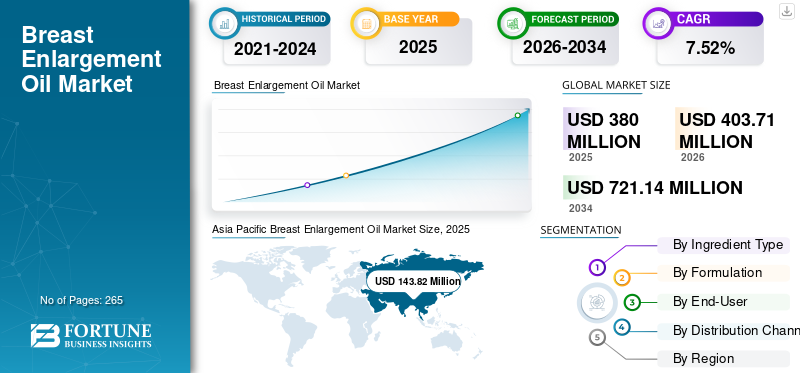
The global breast enlargement oil market size was valued at USD 380.00 million in 2025. The market is projected to grow from USD 403.71 million in 2026 to USD 721.14 million by 2034, exhibiting a CAGR of 7.52% during the forecast period. Asia Pacific dominated the breast enlargement oil market, with a market share of 37.84% in 2025.
The global market is in a nascent stage and falls within the broader cosmetic and personal care industry, where growth of the market is primarily led by a growing consumer shift toward topical and non-invasive methods as an alternative to cosmetic surgery. This consumer transition toward cosmetic procedures is further supplemented by increasing spending on cosmetic procedures, rising awareness of body aesthetics, the building influence of social media beauty trends, and the broader acceptance of natural and herbal formulations. Furthermore, market players strive to win consumer confidence by emphasizing organic, plant-based ingredients, massage-friendly textures, and skin-nourishing benefits through the product. Developing economies in Asia Pacific and South America are experiencing swift market penetration on the back of e-commerce penetration and rising affordability. Meanwhile, product efficacy concerns and regulatory scrutiny continue to influence product positioning and marketing strategies amongst key players.
According to the public health and safety organization’s consumer survey, revealed that around 74% consumers perceive organic ingredients to be far more effective and safe when opting for personal care products.
A few major players operating in the market include VLCC Health Care Ltd., Himalaya Wellness, Palmer’s (ET Browne Drug Co.), Forest Essentials, and Mamaearth. These companies primarily focus on natural and herbal formulations as a core of their competitiveness strategies, offering botanical ingredients, Ayurveda-inspired, and clean-label claims. This approach encourages consumer trust, aligns with the growing preference for less invasive beauty solutions, and helps products stand out in a market that is increasingly scrutinized for safety, efficacy, and chemical- free formulations in personal care products.
Download Free sample to learn more about this report.
BREAST ENLARGEMENT OIL MARKET KEY TAKEAWAYS
 Market Size & Forecast
- 2025 Market Size: USD 380.00 Million
- 2026 Market Size: USD 403.71 Million
- 2034 Forecast Market Size: USD 721.14 Million
- CAGR: 7.52% from 2026–2034
 Market Share
- Asia Pacific dominated the market with a 37.84% share in 2025.
- The herbal/natural segment held the largest share by ingredient type.
- The oil-based formulation segment dominated the market by formulation.
 Key Regional Highlights
Asia Pacific
Asia Pacific reached USD 143.82 million in 2025, accounting for the largest regional market share.
North America
North America is projected to reach USD 102.92 million in 2025, supported by rising demand for natural and non-invasive beauty products.
Europe
Europe reached USD 76.59 million in 2025, representing 20.16% of the global market.
U.S.
The market reached approximately USD 81.65 million in 2025, accounting for around 21.49% of global revenue.
Japan
The market reached approximately USD 22.08 million in 2025, representing around 5.81% of global revenue.
Read More

BREAST ENLARGEMENT OIL MARKET TRENDS
Rising Preference for Natural & Herbal Formulations Driven by Safety Concerns
Consumers' growing knowledge regarding ingredient safety and long-term skin health has been a key factor driving demand for breast enlargement oils formulated with plant and herbal-based ingredients. Concerns surrounding synthetic chemicals and invasive cosmetic procedures have raised several concerns, such as allergic reactions, skin irritability, potential hormonal imbalance, and long-term toxicity risks. The consumer has been turning to topical, naturally occurring solutions. As a result, manufacturers are increasingly introducing botanicals, essential oils, and Ayurveda-inspired blends into their formulations. This strategy strengthens clean-label positioning and enhances brand credibility across both online and offline retail channels.
MARKET DYNAMICS
MARKET DRIVERS
Download Free sample to learn more about this report.
Growing Demand for Breast Augmentation Via Non-Invasive Alternatives Boosts Market Development
Growing fear surrounding surgical breast enhancement procedure due to risks such as complications, recovery time, and high cost are major factors fueling demand for noninvasive alternatives, mainly breast enlargement oils. Users increasingly prefer products safe, aesthetically enhancing, affordable, painless, and easy to use. This trend is also supported by the expanding availability of breast enhancement creams and oils through online platforms and discreet purchasing. Increased marketing of natural formulations is speeding market growth momentum across developed and emerging economies. Moreover, evolving beauty standards are playing a crucial role in shaping R&D priorities, as manufacturers position breast enlargement oils as non-invasive alternatives to silicone breast implants, further strengthening market growth.
MARKET RESTRAINTS
Absence of Strong Clinical Proof Concerns Restricting Product Demand
One of the biggest market limitations of the breast enhancement products market is the absence of strong clinical proof supporting product effectiveness. As consumers become more informed and evidence-driven, manufacturers face increasing difficulty in substantiating marketing claims, which can result in fewer repeat purchases and less brand loyalty. As a consequence, stricter regulations and more cautious consumer habits, especially in highly regulated developed markets, have intensified around compliance, labeling accuracy, and efficacy substantiation, restricting market growth.
MARKET OPPORTUNITIES
Expansion of Digital Media Platforms to Unlock Market Opportunities
The rapid expansion of digital and social media platforms marketing is opening up a huge market opportunity for manufacturers of breast augmentation oils. Internet shopping allows discreet buying, thorough ingredient transparency, and influencer-led education, which collectively help lessen consumer hesitation. With rising digital penetration in developing economies, brands have greater opportunities to access new customer segments, tailor marketing strategies, and expand direct-to-consumer sales channels. This digital enhances brand visibility, strengthens consumer confidence, and supports overall market share.
MARKET CHALLENGES
Regulatory Scrutiny and Compliance Pressure Affecting Product Positioning
An increase in regulatory scrutiny of cosmetic and personal care products is a significant challenge for the breast enlargement oil market. Today, authorities have been very thorough in examining product claims, ingredient safety, and labeling accuracy in order to prevent misleading marketing. Due to this, manufacturers face extra compliance costs and tighter restrictions on promotional language. These constraints affect brand differentiation and delay product launches, especially in markets with strict regulations on cosmetics and consumer protection.
Segmentation Analysis
By Ingredient Type
Herbal/Natural Ingredients Dominate Revenue Due to Strong User Trust and Repeat Purchases
Based on ingredient type, the market is divided into herbal/natural, synthetic/conventional, and organic/clean label.
The herbal/natural segment dominated the market, as strong consumers associate plant-based ingredients with minimal side effects, enhanced safety, and long-term skin benefits. Growing issues regarding synthetic chemicals and inadequate scientific validation of invasive cosmetic methodologies have boosted the preference for herbal formulations as natural breast enhancement alternatives. Moreover, the prominent application of Ayurveda, botanical oils, and traditional medicine, particularly in the Asia Pacific region, has increased user trust and repeat purchases, enabling natural/herbal formulations to maintain the segment.
The synthetic/conventional segment is anticipated to grow at the fastest CAGR of 8.94% over the forecast period.
To know how our report can help streamline your business, Speak to Analyst
By Formulation
Oil-Based Formulations Led the Segment Due to Their Close Relevance With Traditional Massage Practices
Based on formulation, the market is divided into oil-based, oil serum blends, and multi-ingredient massage oils.
In 2025, the oil-based formulation segment dominated the global market, driven by its close relevance to traditional massage practices and long-standing consumer habits. These products are perceived as more effective for prolonged massage and topical absorption, which is typically encouraged for breast enlargement and firming advantages. Furthermore, oil-based variants are easier to formulate with natural and herbal components and are economical, broadly available through offline and online platforms, leading to higher adoption rates and repeat purchases.
The oil-serum blends segment is projected to grow at the second-fastest CAGR of 8.91% over the forecast period. Growing consumer awareness of ingredients such as hyaluronic acid is influencing product innovation, encouraging brands to incorporate skin-hydrating and firming actives into breast enlargement oil formulations.
By End-User
Women Segment Led due to Growing Awareness of Breast Firming
Based on end-user, the market is divided into women and unisex.
In 2025, the women segment dominated, driven by product formulation, branding, and marketing strategies primarily targeted at female end-users and focused on feminine aesthetics and body-care needs. Moreover, growing awareness of breast firming and enhancement products among women, together with long-term application routines and greater usage frequency, has directly boosted repeat purchases and segment growth.
The unisex segment is projected to grow at the second-fastest CAGR of 10.27% over the forecast period.
By Distribution Channel
Online Retail Dominates Revenue Due to Discreet Purchasing and Wider Product Accessibility
Based on distribution channel, the market is segmented into supermarkets & hypermarkets, pharmacies & drug stores, online retail, specialty beauty & wellness stores, and others.
The online retail segment dominated the global market, driven by growing consumer preference for secluded, discreet shopping of intimate beauty items. Online websites provide a wide product variety, user reviews, in-depth ingredient descriptions, along with competitive pricing, doorstep delivery, return & exchange options, and easy payment gateways, which enhance product purchases. Furthermore, influencer-led marketing, aggressive digital endorsements, and direct-to-consumer brand strategies have broadened consumer reach across developing and developed economies, significantly boosting product sales for online channels.
The specialty beauty & wellness stores segment is projected to grow at a CAGR of 6.61% during the study period.
Breast Enlargement Oil Market Regional Outlook
By geography, the market is categorized into Europe, North America, Asia Pacific, South America, and the Middle East & Africa.
North America
Asia Pacific Breast Enlargement Oil Market Size, 2025 (USD Million)
To get more information on the regional analysis of this market, Download Free sample
North America is projected to record a growth rate of 6.73% in the coming years and reach a valuation of USD 102.92 million in 2025. Topical beauty solutions backed by natural ingredients and clean-label claims, and consumer preference for non-invasive procedures drives market growth.
U.S Breast Enlargement Oil Market
Based on North America’s strong contribution and the U.S. dominating within the region, the U.S. market can be analytically approximated at around USD 81.65 million in 2025, accounting for roughly 21.49% of global product sales.
Europe
Europe held the third-dominant share in 2025, valued at USD 76.59 million with a market share of 20.16% in the global market. The region’s growth is led by increasing demand for natural and organic personal care products, supported by strong consumer awareness around ingredient safety and strict cosmetic regulations that favor clean-label formulations.
U.K Breast Enlargement Oil Market
The U.K. market in 2025 stood at around USD 9.10 million, representing roughly 2.39% of global revenues.
Germany Breast Enlargement Oil Market
Germany’s market stood to reach approximately USD 12.47 million in 2025, equivalent to around 3.28% of global revenues.
Asia Pacific
Asia Pacific reached USD 143.82 million in 2025 and secured the position of the largest region in the global market. In the region, India and China reached USD 37.74 million and USD 46.44million, respectively, in 2025.
Japan Breast Enlargement Oil Market
The Japanese market in 2025 stood at around USD 22.08 million, accounting for roughly 5.81% of global revenues. Strong consumer preference for gentle non-invasive beauty solutions, emphasis on skincare routines, and high trust in premium, well-formulated topical personal care products drives country’s market growth.
China Breast Enlargement Oil Market
China’s market in 2025 reached around USD 46.44 million in revenues, representing roughly 12.22% of global product sales.
India Breast Enlargement Oil Market
The Indian market in 2025 reached around USD 37.74 million, accounting for roughly 9.93% of global revenues.
South America and the Middle East & Africa
The South America and Middle East & Africa regions are expected to witness moderate growth in this market during the forecast period. The South American market reached a valuation of USD 34.14 million in 2025. Growing beauty consciousness among women, high cultural emphasis on body aesthetics, and growing adoption rates of affordable, non-invasive cosmetic and personal care products drive market growth. In the Middle East & Africa, the UAE reached a value of USD 4.29 million in 2025.
South Africa Breast Enlargement Oil Market
The market reached around USD 3.28 million in 2025, representing roughly 0.86% of global market revenues.
COMPETITIVE LANDSCAPE
Key Market Players
Key Players Focus on Direct-to-Consumer Channels to Gain Competitive Edge
Industry players compete by offering a uniquely differentiating their product offering through clean, herbal, and organic formulation claims to address rising safety and efficacy concerns. As consumer trust is a major factor for purchase, businesses are putting their money into explaining the ingredients to the customer, getting certifications, and having scientific studies to back up their claims. Besides that, brands are using digital marketing very strongly, getting influencers on board, and selling through D2C channels, thus giving the brand more chances to be witnessed, trusted, and maintained by customers in a highly segmented market.
LIST OF KEY BREAST ENLARGEMENT OIL COMPANIES PROFILED
- VLCC Health Care Ltd. (India)
- Himalaya Wellness Company (U.K.)
- Forest Essentials (Estée Lauder Companies – India operations) (India)
- Palmer’s (E.T. Browne Drug Company, Inc.) (U.S.)
- Dabur India Ltd. (India)
- Mamaearth (Honasa Consumer Pvt. Ltd.) (India)
- Bajaj Consumer Care Ltd. (India)
- Patanjali Ayurved Ltd. (India)
- Herbal Hills (Isha Agro Developers Pvt. Ltd.) (India)
- Biotique (Bio Veda Action Research Pvt. Ltd.) (India)
KEY INDUSTRY DEVELOPMENTS
- September 2025: The Himalaya Wellness Company widened its direct-to-consumer (D2C) presence through the launch of digital, first SKUs, and personalized e-commerce strategies based on real-time consumer insights and curated beauty journeys. This initiative also facilitates more online visibility of category products, such as body and herbal oils.
- July 2024: VLCC reinforced its online and omnichannel product distribution presence by integrating its personal care products line through various e-commerce platforms and retail partners, thereby making the products more accessible and strategically placing body enhancement/oil products next to the beauty range.
REPORT COVERAGE
Request for Customization to gain extensive market insights.
Report Scope & Segmentation
| ATTRIBUTE | DETAILS |
| Study Period | 2021-2034 |
| Base Year | 2025 |
| Estimated Year | 2026 |
| Forecast Period | 2026-2034 |
| Historical Period | 2021-2024 |
| Growth Rate | CAGR of 7.52% from 2026 to 2034 |
| Unit | Value (USD Million) |
| Segmentation | By Ingredient Type, Formulation, End-User, Distribution Channel, and Region |
| By Ingredient Type |
|
| By Formulation |
|
| By End-User |
|
| By Distribution Channel |
|
| By Region |
|
Frequently Asked Questions
According to Fortune Business Insights, the global market value stood at USD 380.00 million in 2025 and is projected to reach USD 721.14 million by 2034.
In 2025, the market value stood at USD 143.82 million.
The market is expected to grow to a CAGR of 7.52% during the forecast period (2026-2034).
By ingredient type, the herbal/natural segment led the market.
Growing consumer shift toward topical and non-invasive methods as an alternative to cosmetic surgery, along with the influence of social media trends are driving market expansion.
VLCC Health Care Ltd., Himalaya Wellness, Palmer’s (ET Browne Drug Co.), Forest Essentials, and Mamaearth are the major players in the global market.
Asia Pacific dominated the market in 2025.



- 2021-2034
- 2025
- 2021-2024
- 265
-
(Offer valid till 15th Oct 2026)
Get 30-60 hrs Free Customization
Expand Regional and Country Coverage, Segments Analysis, Company Profiles, Competitive Benchmarking, and End-user Insights.







-
US +1 833 909 2966 ( Toll Free )
-
Get In Touch With Us