Calcium Fortified Foods Market Size, Share & Industry Analysis, By Product Type (Bakery & Confectionery [Bread & Baked Products, Cookies & Biscuits, Cakes & Pastries, and Confectioneries], Dairy and Dairy Alternatives, Infant Formula, and Others), By Source (Calcium Carbonate, Calcium Citrate, Calcium Phosphates, and Others), By Distribution Channel (Supermarkets/Hypermarkets, Convenience Stores, Online Retail, and Others), and Regional Forecast, 2026-2034
 Download Free Sample
(Offer valid till 15th Oct 2026)

Calcium Fortified Foods Market Size And Future Outlook
 Listen to Audio Version
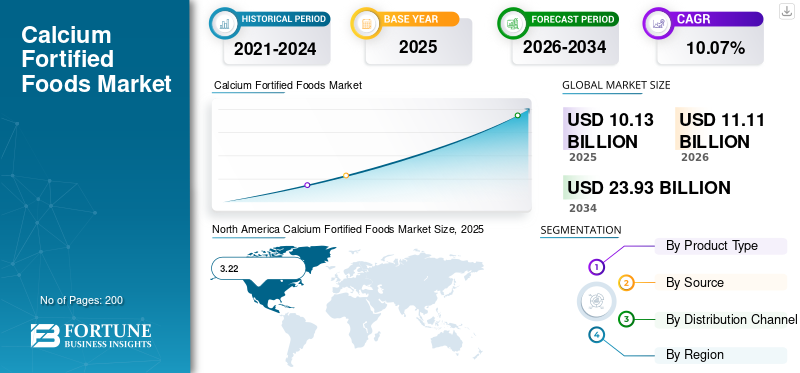
The global calcium fortified foods market size was valued at USD 10.13 billion in 2025. The market is projected to grow from USD 11.11 billion in 2026 to USD 23.93 billion by 2034, exhibiting a CAGR of 10.07% during the forecast period. North America dominated the global calcium fortified foods market with a market share of 34.75% in 2025.
The demand for calcium fortified foods continues to accelerate due to rising concerns over bone health, increasing cases of osteoporosis, declining dietary calcium intake, and a growing shift toward functional and fortified foods. Calcium fortification has become a key strategy in the food industry to address nutritional deficiencies, especially among aging populations, children, pregnant women, and individuals with dairy-free diets. Governments, health organizations, and food manufacturers are increasingly promoting the demand for calcium fortified products to combat micronutrient deficiency and enhance population health benefits.
The market for calcium fortified foods remains strongly supported by a rising demand for dairy alternatives, expanding applications of calcium salts in processed foods, advancements in microencapsulation technologies, and growing clean-label fortification trends.
The global market is dominated by major players, including Nestlé S.A., Danone S.A., General Mills Inc., Abbott Laboratories, and The Kraft Heinz Company. These top 5 companies represent the most influential constituents of the global value chain based on large-scale production capabilities, innovation leadership in fortification techniques, diversified product portfolios, and wide distribution networks across retail and online platforms.
Download Free sample to learn more about this report.
CALCIUM FORTIFIED FOODS MARKET KEY TAKEAWAYS
 Market Size & Forecast
- 2025 Market Size: USD 10.13 billion
- 2026 Market Size: USD 11.11 billion
- 2034 Forecast Market Size: USD 23.93 billion
- CAGR: 10.07% from 2026–2034
 Market Share
- North America dominated the global calcium fortified foods market with a market share of 34.75% in 2025.
- The dairy & dairy alternatives segment accounted for a major share of 35.78% in 2025.
- The calcium citrate segment is expected to grow significantly at a CAGR of 10.89% during the forecast period.
 Key Regional Highlights
North America
North America's calcium-fortified food market generated a revenue of about USD 3.52 billion in 2025 and is expected to grow at a CAGR of around 9.72% over the forecast period.
Europe
Europe is experiencing steady progress in the calcium fortified foods market with a CAGR of approximately 10.06% during the forecast period.
Asia Pacific
The region reached USD 2.18 billion in 2025 and is projected to reach USD 5.49 billion by 2034 at a CAGR of 10.83% over the forecast period.
U.S.
The U.S. market specifically leads within the region, supported by fortified dairy products, beverages, cereals, and government campaigns promoting bone health nutrition.
Japan
Japan's market is driven by its aging population, growing focus on osteoporosis prevention, and increasing consumption of calcium-fortified foods and beverages to support healthy aging and overall wellness.
Read More

MARKET DYNAMICS
Market Drivers
Growing Nutritional Deficiencies and Bone Health Awareness to Accelerate Market Expansion
The increase in calcium deficiencies, osteoporosis incidence, and poor dietary intake, especially in urban populations, continues to fuel growth for calcium fortified foods. Rising awareness campaigns by the World Health Organization, National Institutes of Health (NIH), and national health agencies emphasize the importance of meeting the recommended daily calcium intake. This global calcium fortified foods market demand surge is particularly visible across dairy alternatives, bakery, infant formula, and ready-to-eat products.
- According to the National Health and Nutrition Examination Survey, around 42% of Americans failed to reach their Estimated Average Requirements (EARs) for calcium in the U.S.
Market Restraints
Limited Bioavailability and Stability Challenges in Fortification Processes to Impede Market Growth
Although calcium fortification is widely adopted across food categories; however, bioavailability constraints and stability issues remain significant technical barriers that limit full commercial potential. These challenges affect nutrient absorption in consumers as well as the manufacturing process, product formulation, and shelf-life stability. Moreover, most widely used calcium supplementation agents, especially calcium carbonate, have low absorption efficiency under certain dietary and physiological conditions.
- According to the U.S. National Institutes of Health (NIH), calcium absorption efficiency ranges from only 25% to 35% for most adults consuming fortified foods.
Market Opportunities
Expansion of Functional Foods and Medical Nutrition Opens High-Value Growth Channels
Calcium fortified foods are increasingly positioned in preventive health, sports nutrition, geriatric nutrition, and prescription nutrition programs. The rise of personalized nutrition, clean-label foods, and fortified convenience foods is creating new high-margin avenues for manufacturers.
- For instance, in March 2025, Plenish, a plant-based alternatives brand, launched the U.K.’s only clean-label fortified oat milk called "Plenish Enriched Oat M*lk." This product is notable for having no oils or additives, using only three base ingredients such as oats, water, and salt. It is fortified with essential vitamins and minerals, including calcium, vitamin D, B12, riboflavin, and iodine, providing 30% of the daily calcium needs per 100ml, double the amount found in other fortified plant-based drinks in the U.K.
Calcium Fortified Foods Market Trends
Surge in Calcium-Fortified Snacks, Bakery, and On-the-Go Functional Foods is a Key Market Trend
The market for calcium-fortified snacks, bakery products, and on-the-go functional foods is witnessing strong growth, driven by increasing health awareness and demand from Millennial and Gen Z consumers. These demographics prefer fortified convenience foods as nutrient boosters and meal replacements, favoring snacks, bars, and bakery items enhanced with calcium and other functional nutrients.
- For instance, in December 2024, Nutrizoe launched "SnackEasy," a healthy snacking range specifically designed to support pregnancy nutrition. SnackEasy is a millet-based snack suitable for all trimesters, fortified with essential nutrients including calcium, DHA, folic acid, Vitamin D2, and plant-based proteins.
Download Free sample to learn more about this report.
SEGMENTATION ANALYSIS
By Product Type
Dairy & Dairy Alternatives Segment Led the Market with Increasing Awareness about the Importance of Calcium for Bone Health
By product type, the market is segmented into bakery & confectionery, dairy & dairy alternatives, infant formula, and others.
The dairy & dairy alternatives segment accounted for a major share of 35.78% in 2025 and is the fastest growing during the forecast period. The segment dominates primarily due to the widespread consumption and established consumer trust in dairy products as a natural source of calcium. Increasing health awareness about the importance of calcium for bone health and the prevention of osteoporosis has boosted the demand for fortified dairy foods such as milk, yogurt, and cheese. Similarly, the rise of plant-based diets, lactose intolerance, and veganism has driven growth in dairy alternatives such as fortified almond and soy milk, which provide comparable calcium content, catering to consumers with dietary restrictions or ethical preferences.
The others segment, which includes flour, fats & oils, and condiments, is expected to grow significantly with a CAGR of 10.27% over the forecast period.
To know how our report can help streamline your business, Speak to Analyst
By Source
Calcium Carbonate Segment Dominated Due to High Cost-Effectiveness
By source, the market is segmented into calcium carbonate, calcium citrate, calcium phosphates, and others.
The calcium carbonate segment held a major calcium fortified foods market share in 2025 with a value of 43.96%. Calcium carbonate remains the most widely used source due to its high elemental calcium content (40%), affordability, and suitability for bakery, confectionery, and dairy products.
The calcium citrate segment is expected to grow significantly at a CAGR of 10.89% during the forecast period.
By Distribution Channel
High Product Visibility and Consumer Trust Fuel Supermarkets/Hypermarkets Segment Leadership
The calcium fortified foods are sold through supermarkets/hypermarkets, convenience stores, online retail, and others.
The supermarkets/hypermarkets segment accounted for USD 4.53 billion in 2025 and remained the most preferred channel. Supermarkets typically have well-organized aisles, attractive product displays, and strategic shelf placements that maximize the visibility of fortified packaged foods. This visibility helps consumers easily find and select these products, boosting sales. Consumers generally trust supermarkets as reliable sources of quality and safe food products, including fortified items. This trust stems from supermarkets' regulatory compliance, consistent product availability, and brand reputation, which reassures consumers about the authenticity and nutritional benefits of fortified foods.
The online retail segment is anticipated to grow at a CAGR of 11.07% during the forecast period.
Calcium Fortified Foods Market Regional Outlook
Regionally, the report covers the global market analysis across North America, Europe, Asia Pacific, South America, and the Middle East & Africa.
North America
The North America market held the largest market share of 34.72% in 2025. The region's dominance is driven by rising health awareness, strong consumer preference for functional foods, and an increasing prevalence of bone-related health issues. North America's calcium-fortified food market generated a revenue of about USD 3.52 billion in 2025 and is expected to grow at a CAGR of around 9.72% over the forecast period. The U.S. market specifically leads within the region, supported by fortified dairy products, beverages, cereals, and government campaigns promoting bone health nutrition.
North America Calcium Fortified Foods Market Size, 2025 (USD Billion)
To get more information on the regional analysis of this market, Download Free sample
Europe
Europe is experiencing steady progress in the calcium fortified foods market with a CAGR of approximately 10.06% during the forecast period. This growth is driven by several key factors, including stringent regulatory standards that ensure product quality and safety, high consumer awareness of nutritional benefits, and expanding product offerings in fortified dairy alternatives, bakery goods, and medical nutrition segments.
Asia Pacific
The Asia Pacific market is rapidly growing, driven by increasing health awareness, especially concerning osteoporosis and calcium deficiency among aging populations in countries such as China, Japan, South Korea, and India. The rising adoption of Western dietary habits, urbanization, expanding middle-class incomes, and government nutrition programs also significantly boost demand. The region reached USD 2.18 billion in 2025 and is projected to reach USD 5.49 billion by 2034 at a CAGR of 10.83% over the forecast period.
South America
The market in South America is set to grow at a CAGR of 10.47% during the forecast period, driven by expanding middle-class health awareness and the increased incorporation of fortified foods into public health programs. These programs aim to address nutritional deficiencies and improve bone health outcomes across diverse populations in the region. The rise in consumer education about the benefits of calcium, combined with government initiatives promoting food fortification as a strategy to reduce malnutrition, supports steady market growth.
Middle East & Africa
The Middle East & Africa market is expected to grow at a CAGR of approximately 8.43% during the forecast period, propelled by the rising prevalence of micronutrient deficiencies in the population. This nutritional gap has driven an increased adoption of fortified staple foods as public health interventions to combat deficiencies, especially calcium. The market growth is also supported by rising health consciousness and government initiatives promoting food fortification to improve overall nutrition.
COMPETITIVE LANDSCAPE
Key Industry Players
Fortification Breakthroughs and Diverse Offerings Shape the Competitive Landscape
The competitive landscape of the market is characterized by key players spanning major food manufacturers, nutritional product companies, and ingredient formulators. The global calcium fortified foods market growth is strongly supported by technological innovations in fortification processes, which enhance calcium bioavailability, improve product stability, and enable incorporation into diverse food matrices. Companies compete through product differentiation, focusing on fortified dairy alternatives, cereals, beverages, and bakery products to cater to various consumer segments.
Key Players in the Calcium Fortified Foods Market
|
Rank |
Company Name |
|
1 |
Nestlé S.A. |
|
2 |
Danone S.A. |
|
3 |
General Mills Inc. |
|
4 |
Unilever PLC |
|
5 |
Kellanova |
List of Key Calcium Fortified Foods Companies Profiled:
- Nestlé S.A. (Switzerland)
- Danone S.A. (France)
- General Mills, Inc. (U.S.)
- Abbott Laboratories (U.S.)
- The Kraft Heinz Company (U.S.)
- Kellogg Company (Kellanova) (U.S.)
- Unilever PLC (U.K.)
- Arla Foods amba (Denmark)
- Mead Johnson Nutrition (Reckitt Benckiser Group) (U.S.)
- FrieslandCampina N.V. (Netherlands)
KEY INDUSTRY DEVELOPMENTS:
- December 2024: Aavin launched a new fortified milk variant called "Green Magic Plus," which is enriched with vitamins A and D. This milk variant contains 4.5% fat and 9% Solids-Not-Fat (SNF). It is aimed at providing added nutritional benefits, including higher protein content, making it particularly beneficial for children.
- August 2024: Shiny Meadow launched its fresh milk with higher protein and calcium content in Hong Kong to meet consumer demand for nutritional balance. The product offers 4.0g of protein and 130mg of calcium per 100ml, higher than the previous version's 3.6g of protein and 120mg of calcium per 100ml. This launch addresses increasing consumer focus on natural, additive-free fresh milk that supports bone health and immunity, aligning with lifestyle and nutritional concerns in Hong Kong.
- February 2024: Nestlé Health Science launched Resource Activ, a multi-benefit, high-protein nutritional supplement specifically designed to cater to the wellness needs of active millennials and adults above 30 years. It features a unique "New Edge Formula" with high-quality proteins for muscle health, enriched calcium and vitamin D for bone health, and hyaluronate for skin health.
- July 2023: Oriflame India launched two new health nutritional supplements under its Wellosophy range: Iron Complex, designed especially for women, and Calcium fortified with Vitamin D and Magnesium. These supplements are crafted to support busy lifestyles, promote active and healthy living, and meet the specific nutritional needs of Indian consumers.
- April 2022: Abbott launched Arachitol Gummies in India as a fruit-flavored, chewable dietary supplement to help bridge widespread vitamin D and calcium deficiency, especially in children and adults with limited sun exposure and fast-paced lifestyles.
REPORT COVERAGE
The global market industry report analyzes the market in depth and highlights crucial aspects such as market trends, market dynamics, prominent companies, investment in research and development, and end-use. Besides this, the report also provides insights into the market analysis and highlights significant industry developments.
Request for Customization to gain extensive market insights.
Report Scope & Segmentation
| ATTRIBUTE | DETAILS |
| Study Period | 2021-2034 |
| Base Year | 2025 |
| Forecast Period | 2026-2034 |
| Historical Period | 2021-2024 |
| Growth Rate | CAGR of 10.07% from 2026 to 2034 |
| Unit | Value (USD Billion) |
| Segmentations | By Product Type, Source, Distribution Channel, and Region |
| Segmentation |
By Product Type
|
|
By Source
|
|
|
By Distribution Channel
|
|
|
By Region
|
Frequently Asked Questions
Fortune Business Insights says that the global market was USD 10.13 billion in 2025 and is anticipated to reach USD 23.93 billion by 2034.
The global market will exhibit steady growth at a CAGR of 10.07% over the forecast period.
By product type, the dairy and dairy alternatives segment led the market in 2025.
North America held the largest market share in 2025.
Growing nutritional deficiencies and bone health awareness is the crucial factor driving the global market.
The global market is dominated by major players, including Nestlé S.A., Danone S.A., General Mills Inc., Abbott Laboratories, and The Kraft Heinz Company.
Surge in calcium-fortified snacks, bakery, and on-the-go functional foods is a key market trend.


- 2021-2034
- 2025
- 2021-2024
- 200
-
(Offer valid till 15th Oct 2026)
Get 30-60 hrs Free Customization
Expand Regional and Country Coverage, Segments Analysis, Company Profiles, Competitive Benchmarking, and End-user Insights.








-
US +1 833 909 2966 ( Toll Free )
-
Get In Touch With Us