Cancer Supportive Care Market Size, Share & Industry Analysis, By Offering (Products {Antiemetics & Nausea Management, Hematopoietic Growth Factors, Bone Health Management, and Cancer Pain Management} and Services {Palliative Care, Home-based Supportive Care, Oncology Nutrition, and Psycho-oncology & Counseling}), By Cancer Type (Lung Cancer, Breast Cancer, Colorectal Cancer, Prostate Cancer, and Hematological Malignancies), By Age Group (Adults and Pediatrics), By Care Setting (Hospitals & Cancer Centers, Specialty Oncology Clinics, and Homecare Settings), and Regional Forecast, 2026-2034
 Download Free Sample
Cancer Supportive Care Market Size and Future Outlook
 Listen to Audio Version
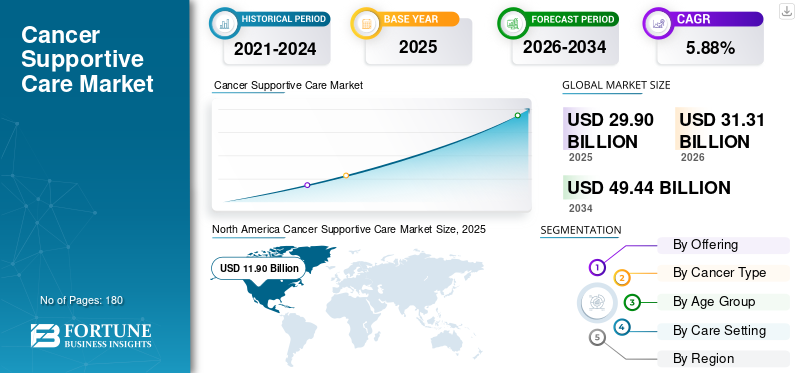
The global cancer supportive care market size was valued at USD 29.90 billion in 2025. The market is projected to grow from USD 31.31 billion in 2026 to USD 49.44 billion by 2034, exhibiting a CAGR of 5.88% during the forecast period. North America dominated the cancer supportive care market with a market share of 39.79% in 2025.
The global market comprises products and services aimed at addressing cancer-related symptoms, treatment side effects, and quality-of-life requirements throughout different cancer therapies. The market is expanding due to the increasing global cancer incidence, greater adoption of systemic cancer treatments, heightened need for symptom management, broader integration of palliative care, and the transition to home and outpatient supportive care.
Key players in the global market include Amgen Inc., Sandoz Inc., Pfizer Inc., and Teva Pharmaceutical Industries Ltd. Robust portfolios of cancer supportive care drugs, extensive geographic reach, and a focus on innovation are several factors underpinning the leadership of these companies in the worldwide market.
Download Free sample to learn more about this report.
Cancer Supportive Care Market Key Takeways
 Global Market Size & Forecast
- 2025 Market Size: USD 29.90 billion
- 2026 Market Size: USD 31.31 billion
- 2034 Forecast Market Size: USD 49.44 billion
- CAGR: 5.88% from 2026–2034
 Market Share
- North America dominated the cancer supportive care market with a 39.79% share in 2025.
- The lung cancer segment is projected to hold a 21.3% share in 2026.
- The adults segment is projected to account for a 96.9% share in 2026.
 Key Regional Highlights
North America
North America maintained its market leadership with a valuation of USD 11.90 billion in 2025.
Europe
Europe is projected to expand at a CAGR of 4.57% during the forecast period.
Asia Pacific
Asia Pacific is expected to reach a market valuation of USD 7.70 billion by 2026.
U.S.
U.S. The market is estimated to reach approximately USD 10.90 billion by 2026.
Japan
Japan The market is estimated to reach approximately USD 1.66 billion by 2026.
Read More

CANCER SUPPORTIVE CARE MARKET TRENDS
Rising Adoption of Personalized Oncology Care is a Remarkable Market Trend
The increasing acceptance of personalized oncology care is emerging as a significant trend in the global market. Supportive care is progressively being designed to align with each patient’s cancer type, treatment plan, symptom burden, age, existing health conditions, nutritional status, mental health requirements, and preferences for care. As oncology transitions from universal treatments to personalized cancer management, supportive care is also becoming more customized with patient-reported outcomes, digital symptom tracking, timely palliative care referral, nutrition assessment, and psychosocial evaluation. This enables clinicians to detect nausea, pain, fatigue, mucositis, distress, malnutrition, and infection risk sooner, facilitating prompt intervention and minimizing treatment delays. Individualized supportive care is crucial for patients undergoing intricate chemotherapy, immunotherapy, targeted therapy, and advanced cancer treatments, as the side-effect patterns vary based on the therapy and the patient's characteristics. Consequently, hospitals and cancer centers are progressively incorporating multidisciplinary supportive oncology teams to enhance quality of life, adherence, and overall care results. These factors are supporting the global cancer supportive care market growth during the forecast period.
- In November 2025, Oracle Health and Life Sciences announced a collaboration with the Cancer Center Informatics Society to advance AI in oncology care, EHR interoperability, next-generation clinical trials, and personalized medicine across cancer centers. This type of data-driven oncology infrastructure supports more personalized cancer care by helping providers connect treatment, patient data, and supportive-care workflows.
MARKET DYNAMICS
MARKET DRIVERS
Download Free sample to learn more about this report.
Increasing Prevalence of Cancer to Propel Market Growth
The rising occurrence of cancer significantly propels the global market for cancer supportive care, as a larger population of cancer patients directly heightens the demand for symptom management, treatment toxicity mitigation, palliative services, nutritional assistance, pain relief, and psychosocial support. With the increasing number of patients undergoing chemotherapy, radiation, immunotherapy, and advanced cancer treatments, the need for antiemetics, G-CSFs, anemia support, bone-support products, home care, and counseling services grows correspondingly. The burden is particularly heavy for older individuals and those with advanced cancers, who frequently need ongoing supportive care during their treatment process. Additionally, initiatives undertaken by operating players to manage the rising patient number is also propelling the global market growth.
- In April 2025, Cipla Foundation and CanSupport launched Maharashtra’s largest palliative home-care service in Pune, India, with nine home-care teams planned to support more than 900 cancer patients with medical, emotional, and psychosocial care at home.
MARKET RESTRAINTS
Limited Access to Supportive Care Services in Developing Regions to Hamper Market Growth
Limited availability of supportive care services in developing areas significantly hinders the global market, as numerous patients in low- and middle-income nations continue to be deprived of prompt access to palliative care, pain management, nutritional assistance, psycho-oncology, home care, and symptom alleviation services. This hinders market adoption despite a strong clinical need, since supportive care is typically focused in large hospitals and urban cancer facilities. In numerous developing areas, a lack of trained palliative-care providers, inadequate reimbursement, restricted opioid access, low public awareness, and insufficient homecare systems limit the use of services.
- In October 2025, the ATLANTES Global Observatory of Palliative Care at the University of Navarra reported that more than half of the world’s countries lack access to basic palliative care services, based on its World Map of Palliative Care covering 201 countries and territories. This highlights how limited service availability in many developing regions can restrain the expansion of cancer supportive care services despite rising patient needs.
MARKET OPPORTUNITIES
Growing Awareness Regarding Quality-Of-Life Management During Cancer Treatment to Offer Market Growth Opportunities
Growing awareness regarding quality-of-life management during cancer treatment is generating a significant market opportunity as patients and oncologists increasingly emphasize how well patients manage therapy, rather than solely how effectively the tumor reacts. Cancer therapies can lead to nausea, discomfort, fatigue, mucositis, loss of appetite, emotional distress, nerve pain, and sleep issues, potentially diminishing adherence and disrupting treatment plans. Consequently, cancer centers are broadening supportive oncology initiatives that integrate palliative care, symptom management, nutrition, counseling, home care, and patient-reported outcomes monitoring. This generates chances for firms providing supportive-care medications, cancer nutrition, home services, digital symptom monitoring, and collaborative care options. The potential is particularly significant in outpatient and homecare environments, where patients require ongoing assistance between treatment appointments. All these factors would drive the market growth in the coming years.
- In September 2024, Together for Supportive Cancer Care launched as a national coalition of more than 40 organizations to expand early and equitable access to whole-person supportive care for people with cancer.
MARKET CHALLENGES
Reimbursement Limitations to Emerge as a Prominent Challenge to Market Growth
Reimbursement limitations pose a significant obstacle for the worldwide market since numerous supportive-care services lack clear and consistent reimbursement compared to essential cancer therapies. Palliative care, psycho-oncology, nutrition counseling, home symptom management, rehabilitation, and patient navigation services usually need multidisciplinary teams, yet reimbursement might not adequately cover staff time, care coordination, remote monitoring, or home visits. This restricts providers' desire to grow supportive oncology initiatives, particularly in community oncology, hospice, and home care environments. In developed markets, payment reductions and unclear billing routes can shrink margins for oncology practices and complicate the sustainability of supportive services. The difficulty is greater in developing areas, where public funding is restricted and many patients bear the costs themselves. Consequently, gaps in reimbursement may hinder the adoption of services, even with significant clinical demand.
- According to an article published in January 2025, the CMS has finalized a 2.83% Medicare Physician Fee Schedule conversion factor cut for 2025, with an estimated 4% cut for medical oncology. Such reimbursement pressure can make it harder for oncology practices to support labor-intensive services such as symptom management, palliative care coordination, counseling, and nutrition support.
Segmentation Analysis
By Offering
Products Segment Dominated the Market Due to Higher Routine Use Across Cancer Treatment Pathways
In terms of offering, the market is divided into products and services. The products segment is further segmented into antiemetics & nausea management, hematopoietic growth factors/neutropenia support, bone health & skeletal complication management, cancer pain management, anemia & blood support, and others.
The products segment captured the largest global cancer supportive care market share in 2025. The segment’s dominance is due to the fact that supportive care drugs and consumables are required repeatedly across chemotherapy, radiation therapy, immunotherapy, metastatic disease management, and palliative treatment pathways. The segment’s dominance is also supported by the broad use of biologics and biosimilars for neutropenia support and bone complications, along with high-volume generic drugs for nausea, pain, anemia, and infection management. Additionally, regulatory support for new product launches also supports the market growth.
- In December 2025, Accord Healthcare launched Osvyrti and Jubereq, denosumab biosimilars to Prolia and Xgeva, following expiry of the reference medicine’s patent in Europe.
The services segment is anticipated to rise with a CAGR of 6.85% over the forecast period.
To know how our report can help streamline your business, Speak to Analyst
By Cancer Type
High Disease Burden and Intensive Supportive Care Needs Led to Lung Cancer Segment’s Dominance
On the basis of cancer type, the market is divided into lung cancer, breast cancer, colorectal cancer, prostate cancer, hematological malignancies, head & neck cancer, and others.
The lung cancer segment accounted for the largest global market share in 2025. It has one of the highest global incidence and mortality burdens, leading to strong demand for symptom control and treatment-toxicity management. The segment’s dominance is also supported by the high share of advanced-stage lung cancer cases, where supportive care is required alongside chemotherapy, immunotherapy, targeted therapy, and radiation therapy. This creates recurring demand across both product-based and service-based supportive care settings. Furthermore, the segment is set to hold a share of 21.3% in 2026.
- In June 2024, Mass General Cancer Center reported results from a multi-site randomized trial showing that a stepped palliative care model in patients with advanced lung cancer produced quality-of-life outcomes. These outcomes are similar to monthly palliative care visits, while offering a more scalable supportive-care approach.
The breast cancer segment is poised to grow at a CAGR of 5.01% over the forecast period.
By Age Group
Higher Cancer Burden and Greater Supportive Care Utilization Supported the Adults Segment’s Growth
In terms of age group, the market is segmented into adults and pediatrics.
The adults segment dominated the market in 2025. The segmental dominance is supported by higher cancer incidence among adults, especially older adults, leading to greater demand for symptom control, treatment-toxicity management, and palliative support. The segment also benefits from age-related complications such as frailty, comorbidities, polypharmacy, malnutrition, fatigue, and higher risk of treatment interruptions. Additionally, adult cancer care has a much larger patient pool and stronger commercial revenue capture across hospitals, oncology clinics, homecare, and palliative care settings. Furthermore, the segment is set to hold a share of 96.9% in 2026.
- In February 2026, Haryana, India launched 22 day-care cancer centers across 17 districts to provide chemotherapy, follow-up treatment, palliative care, supportive care, and symptom management services closer to patients. The program also includes regular screening for individuals aged above 30 years, highlighting how adult cancer-care needs are driving expansion of supportive oncology infrastructure.
The pediatrics segment is anticipated to rise with a CAGR of 7.69% over the forecast period.
By Care Setting
Hospitals & Cancer Centers Segment Led the Market Due to Centralized Delivery of Complex Supportive Oncology Care
On the basis of care setting, the market is segmented into hospitals & cancer centers, specialty oncology clinics, homecare settings, and others.
The hospitals & cancer centers segment dominated the market in 2025 as these facilities remain the primary point of care for patients receiving various cancer treatments. The segment’s dominance is further supported by the need for multidisciplinary care, emergency symptom management, infusion services, diagnostic monitoring, and management of severe treatment-related toxicities. Moreover, hospitals and cancer centers can manage high-acuity patients and provide product-based and service-based supportive care under one setting, leading to higher revenue generation. Furthermore, the segment is set to hold a share of 54.2% in 2026.
- In July 2025, Premier Health opened its new Cancer Prevention and Supportive Care Center at Miami Valley Hospital South to provide whole-person care across prevention, risk management, survivorship, and palliative care.
The homecare settings segment is anticipated to rise with a CAGR of 9.41% over the forecast period.
Cancer Supportive Care Market Regional Outlook
By region, the market is separated into North America, Europe, Asia Pacific, Latin America, and the Middle East & Africa.
North America
North America Cancer Supportive Care Market Size, 2025 (USD Billion)
To get more information on the regional analysis of this market, Download Free sample
North America accounted for the largest market share and was valued at USD 11.42 billion in 2024. In 2025, the region maintained its dominance, with USD 11.90 billion. The regional market growth is mainly driven by high cancer diagnosis and treatment rates, strong reimbursement for oncology products, advanced cancer-center infrastructure, and broader adoption of supportive oncology services.
U.S. Cancer Supportive Care Market
The U.S. market dominated the North American region and is analytically approximated at around USD 10.90 billion in 2026, accounting for roughly 34.8% of the global market.
Europe
The Europe market size is anticipated to grow at a CAGR of 4.57% during the forecast period. Europe’s growth is supported by mature public oncology systems, strong cancer screening and diagnosis infrastructure, increasing integration of palliative care, and wider use of biosimilars that improve access to supportive products.
U.K. Cancer Supportive Care Market
The U.K. market is estimated to reach around USD 1.43 billion in 2026, representing roughly 4.6% of global revenues.
Germany Cancer Supportive Care Market
The Germany market size is projected to reach approximately USD 1.73 billion in 2026, equivalent to around 5.5% of global sales.
Asia Pacific
The Asia Pacific market is expected to reach a valuation of USD 7.70 billion by 2026. Asia Pacific is expected to be the fastest-growing region due to its large and rising cancer patient pool, expanding oncology hospitals, increasing access to chemotherapy and biologics, improving biosimilar availability, and growing private healthcare investment.
Japan Cancer Supportive Care Market
The Japan market is estimated to reach a value of around USD 1.66 billion in 2026, accounting for roughly 5.3% of global revenues.
China Cancer Supportive Care Market
The China market is projected to reach revenues of around USD 2.77 billion in 2026, representing roughly 8.8% of global sales.
India Cancer Supportive Care Market
The Indian market size is estimated to reach around USD 0.90 billion in 2026, accounting for roughly 2.9% of global revenues.
Latin America and Middle East & Africa
The Middle East & Africa and Latin America regions are likely to witness a slower growth over the forecast period. Prominent factors such as improving cancer diagnosis, increasing private oncology care, gradual access to supportive-care drugs, and rising awareness of palliative care and symptom management are boosting the market growth in these regions. The market in Latin America is projected to hit a valuation of USD 1.75 billion by 2026.
GCC Cancer Supportive Care Market
In the Middle East & Africa region, the GCC market is projected to reach approximately USD 0.49 billion by 2026, representing about 1.6% of global revenues.
COMPETITIVE LANDSCAPE
Key Industry Players
Focus on Supportive Oncology Services, Home-based Care, and Integrated Symptom Management by Key Players to Propel Market Competition
The global cancer supportive care market is moderately fragmented, with companies such as Amgen Inc., Sandoz Inc., Pfizer Inc., and Teva Pharmaceutical Industries Ltd. holding notable positions. Strategic focus on biosimilars, patient support programs, home-based palliative care, and integrated supportive oncology services is helping companies strengthen their market presence.
- In June 2025, Sandoz launched WYOST/denosumab-bbdz and Jubbonti / denosumab-bbdz in the U.S., the first and only interchangeable U.S. FDA-approved denosumab biosimilars available at launch, including use for cancer-related skeletal events.
Additional key contributors include Fresenius Kabi AG, Baxter, Viatris Inc., Option Care Health Inc., VITAS Healthcare, and Heron Therapeutics, Inc., among others. These companies and care providers are expected to focus on supportive oncology access, home-based care delivery, specialty pharmacy support, digital symptom monitoring, palliative care integration, and patient-centered oncology service models to improve competitiveness during the forecast period.
LIST OF KEY CANCER SUPPORTIVE CARE COMPANIES PROFILED
- Amgen Inc. (U.S.)
- Sandoz Inc. (Switzerland)
- Pfizer Inc. (U.S.)
- Teva Pharmaceutical Industries Ltd. (Israel)
- Fresenius Kabi AG (Germany)
- Baxter (U.S.)
- Viatris Inc. (U.S.)
- Option Care Health Inc. (U.S.)
- VITAS Healthcare (U.S.)
- Heron Therapeutics, Inc. (U.S.)
KEY INDUSTRY DEVELOPMENTS
- March 2026: Thyme Care launched its Integrated Social Support model, placing licensed oncology social workers as early intervention points for emotional, financial, food, transportation, and practical barriers faced by cancer patients.
- February 2026: Accord BioPharma announced the U.S. FDA approval of FILKRI / filgrastim-laha, a biosimilar to Neupogen, for cancer patients receiving myelosuppressive chemotherapy and other neutropenia-related indications.
- December 2025: Lupin received the U.S. FDA approval for Armlupeg / pegfilgrastim-unne, a biosimilar to Neulasta, indicated to reduce infection incidence caused by febrile neutropenia in patients receiving myelosuppressive anti-cancer drugs.
- November 2025: Zydus and RK Pharma entered an exclusive licensing and commercialization agreement for a novel sterile injectable 505(b) (2) supportive oncology product for the U.S. market, with filing expected in 2026.
- September 2025: Henlius and Organon announced the U.S. FDA approval of BILDYOS/denosumab-nxxp and BILPREVDA/denosumab-nxxp, biosimilars to Prolia and Xgeva, respectively, for all reference-product indications.
REPORT COVERAGE
The global cancer supportive care market analysis encompasses an extensive examination of the market size and projections for all market segments featured in the report. It provides information on the market dynamics and trends that are anticipated to propel the market during the forecast period. It offers insights into crucial factors, such as innovations in products, the regulatory landscape, pipeline analysis, and the introduction of new products. Furthermore, the global market report outlines collaborations, mergers & acquisitions, along with significant advancements in the industry within the market. The global market forecast report additionally offers a comprehensive competitive landscape with details on market share and profiles of major active participants.
Request for Customization to gain extensive market insights.
Report Scope & Segmentation
| ATTRIBUTE | DETAILS |
| Study Period | 2021-2034 |
| Base Year | 2025 |
| Estimated Year | 2026 |
| Forecast Period | 2026-2034 |
| Historical Period | 2021-2024` |
| Growth Rate | CAGR of 5.88% from 2026-2034 |
| Unit | Value (USD Billion) |
| Segmentation | By Offering, Cancer Type, Age Group, Care Setting, and Region |
| By Offering |
|
| By Cancer Type |
|
| By Age Group |
|
| By Care Setting |
|
| By Region |
|
Frequently Asked Questions
According to Fortune Business Insights, the global market value stood at USD 29.90 billion in 2025 and is projected to reach USD 49.44 billion by 2034.
In 2025, the market value stood at USD 11.90 billion.
The market is expected to exhibit a CAGR of 5.88% during the forecast period.
By offering, the products segment is expected to lead the market.
Rising prevalence of cancer and coupled with increasing awareness regarding supportive care are primarily driving market expansion.
Amgen Inc., Sandoz Inc., Pfizer Inc., and Teva Pharmaceutical Industries Ltd. are some of the leading players in the global market.
North America dominated the market in 2025.



- 2021-2034
- 2025
- 2021-2024
- 180
Get 30-60 hrs Free Customization
Expand Regional and Country Coverage, Segments Analysis, Company Profiles, Competitive Benchmarking, and End-user Insights.













.webp)






Related Reports
-
US +1 833 909 2966 ( Toll Free )
-
Get In Touch With Us