Capillary Electrophoresis Market Size, Share & Industry Analysis, By Product (Instruments {Automatic Capillary Electrophoresis Systems and Semi-Automatic Capillary Electrophoresis Systems}, Consumables, & Software), By Mode (Capillary Zone Electrophoresis, Capillary Gel Electrophoresis, Capillary Electrochromatography, & Others), By Application (Nucleic Acid Analysis, Drug Discovery & Development, Protein & Peptide Analysis, Clinical Diagnostics), By End-user (Pharmaceutical & Biotechnology Companies, Academic & Research Institutes, Clinical Laboratories), & Regional Forecast, 2026-2034
 Download Free Sample
KEY MARKET INSIGHTS
 Listen to Audio Version
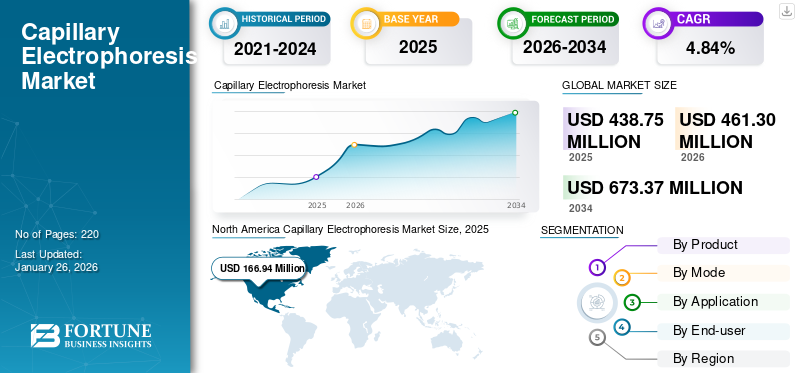
The global capillary electrophoresis market size was valued at USD 438.75 million in 2025 and is projected to grow from USD 461.3 million in 2026 to USD 673.37 million by 2034, exhibiting a CAGR of 4.84% during the forecast period. North America dominated the capillary electrophoresis market with a market share of 38.05% in 2025.
Capillary Electrophoresis (CE) is an analytical technique that divides molecules and ions based on their charge and size within a thin capillary tube, which is filled with a buffer solution. This process is done via a high-voltage electric field. As the electric field is applied, the charged particles move through the capillary toward electrodes of opposite charge. Small particles get highly charged and move faster, while large particles move more slowly due to a weakened charge. The process is used for nucleic acid analysis, protein analysis, and clinical diagnostics. The growth of the market is driven by rising research and development initiatives by pharmaceutical and biotechnology companies as well as research institutes.
Furthermore, the market is dominated by major players, including Thermo Fisher Scientific Inc., and Agilent Technologies, Inc., among others. These companies have a range of advanced products and a strong global presence, which are contributing factors to their leading positions in the market.
Download Free sample to learn more about this report.
Capillary Electrophoresis Market Key Takeaways
 Global Market Size & Forecast
- 2025 Market Size: USD 438.75 Million
- 2026 Market Size: USD 461.30 Million
- 2034 Forecast Market Size: USD 673.37 Million
- CAGR: 4.84% from 2026–2034
 Market Share
- North America dominated the capillary electrophoresis market with a 38.05% share in 2025.
- The consumables segment held a 58.53% market share in 2026.
- The protein & peptide analysis segment is projected to grow at a 5.8% CAGR during the forecast period.
 Key Regional Highlights
North America
Reached USD 166.94 million in 2025, accounting for 38.05% of the global market.
Europe
Recorded USD 129.91 million in 2025, representing 29.61% of the global market.
Asia Pacific
Generated USD 110.54 million in 2025, capturing 25.19% of the global market.
U.S
The market reached USD 166.85 million in 2025, driven by strong pharmaceutical R&D investments.
Japan
Market growth is supported by increasing life sciences research and adoption of advanced analytical technologies.
Read More

MARKET DYNAMICS
MARKET DRIVERS
Increasing Prevalence of Chronic Diseases and Demand for Precision Medicine to Propel the Market Growth
Over the past few years, there has been a growing burden of chronic diseases such as genetic disorders, cancer, and others globally. CE systems offer high-resolution and fast analytical capabilities needed for exact biomolecular analysis used in disease diagnosis and monitoring. As a result, their adoption is increasing among clinical laboratories. Moreover, the rising adoption of personalized or precision medicine, where treatments are made based on individual genetic, proteomic, or molecular profiles, also depends heavily on advanced analytical tools, such as CE, for correct sample characterization.
This is primarily important in oncology, genetic disorders, and infectious diseases. CE’s ability to handle difficult biological samples quickly has allowed clinicians and researchers to improve treatment plans and progress patient outcomes. Due to this, the demand for capillary electrophoresis (CE) is expanding mainly in North America, where chronic disease rates are rising alongside governmental funding for healthcare innovation. These factors are anticipated to impel the global capillary electrophoresis market growth in the upcoming years.
- For instance, according to data published by the American Cancer Society, Inc., as of January 1, 2025, approximately 18.6 million individuals in the U.S. were living with a history of cancer. This figure is expected to rise, projecting that by 2035, more than 22.0 million people will have survived cancer.
MARKET RESTRAINTS
High Initial Investment and Running Costs to Restrict Market Expansion
Despite the increasing demand for research activities and clinical diagnostics, the high initial cost of acquiring advanced CE systems is limiting their global demand. These instruments are based on innovative technology that requires large financial spending, which can especially hamper their adoption by smaller research laboratories and clinical facilities working with limited budgets.
- For instance, in September 2025, according to LabX, an independent marketplace for buying and selling new and used equipment, high-end capillary electrophoresis systems equipped with advanced detection technologies and designed for expert applications are highly priced, with a range from USD 20,000 to USD 150,000 for new systems.
Additionally, the initial purchase, operational costs, including consumables such as capillaries, reagents, buffers, and maintenance services, are adding ongoing financial burdens. This limits the adoption and widespread use, particularly in emerging markets, which is anticipated to hinder market expansion.
MARKET OPPORTUNITIES
Increasing Adoption of Capillary Electrophoresis in Emerging Markets and Academic Research to Offer Lucrative Growth Opportunities
Recently, emerging countries have been increasing investments in life sciences and biotech, which is generating a strong demand for cost-efficient, reliable analytical tools such as CE. Governments from countries such as those in the Asia Pacific, Latin America, and other African nations are supporting the growth of local pharmaceutical manufacturing, bioscience R&D facilities, and clinical testing infrastructure. Compact/benchtop CE systems provide an affordable entry point for labs, improving analytical capability without the expense or difficulty of large-tool HPLC-MS.
In academic institutions, CE is depicting a growing demand as an educational and research platform due to its advantages, including simplicity, speed, and interdisciplinary usability across chemistry, biology, pharmacology, and forensic sciences. As a result, suppliers who tailor their offerings to budget-conscious or first-time users are expected to witness significant growth potential across these regions.
CAPILLARY ELECTROPHORESIS MARKET TRENDS
Integration with Mass Spectrometry (CE-MS) to Emerge as a Key Market Trend
Currently, the integration with mass spectrometry (CE-MS) is one of the notable trends in the capillary electrophoresis (CE) market, fueled by the need for high-resolution and high-sensitivity analytical tools. The combination of CE with mass spectrometry provides quantitative and qualitative accuracy for the precise study of complex biomolecules, metabolites, and peptides, representing particular significance in proteomics, metabolomics, and biopharmaceutical research. Moreover, advances in interface technologies as well as miniaturized sources of ions have improved the strength and reproducibility of CE-MS tools, driving their wider adoption in clinical diagnostics and drug discovery workflows.
- For instance, in June 2024, CMP Scientific launched the BioSummit CVA system, a next-generation Capillary Electrophoresis-Mass Spectrometry (cIEF-MS) platform designed for high-precision charge variant analysis of protein therapeutics. The system features advanced EMASS-II CE-MS technology, efficient workflows, and proprietary data analysis software for better sensitivity and strength.
In addition, pharmaceutical & biotechnology companies are increasingly adopting CE-MS for the characterization of therapeutic proteins, charge variants, and post-translational modifications, thereby increasing the demand for the integration of mass spectrometry.
MARKET CHALLENGES
Shortage of Skilled Professionals to Create Challenges for Market Growth
Globally, there is a limited availability of personnel with the necessary technical skills to operate complex capillary electrophoresis instruments effectively and interpret the complex analytical data that they generate. Operators must be knowledgeable of sample preparation, instrument optimization, troubleshooting, and data analysis, including peak identification and quantification, which creates the need for specialized training.
- For instance, according to data from the Journal of Scientific & Technical Research in February 2023, there was a shortage of around 25,000 medical technologists in the U.S. in 2023.
As a result, the shortage of such skilled professionals is leading to the underuse of advanced systems in research and diagnostics. Moreover, recruiting and retaining qualified staff has also emerged as an operational challenge, particularly in low- and middle-income regions. This skills gap is expected to hamper productivity, limiting the expansion of capillary electrophoresis applications.
Download Free sample to learn more about this report.
Segmentation Analysis
By Product
Higher Utilization of Consumables Contributed to Segmental Growth
On the basis of segmentation by product, the market is classified into instruments, consumables, and software. Furthermore, the instrument segment is subclassified into automatic capillary electrophoresis systems and semi-automatic capillary electrophoresis systems.
To know how our report can help streamline your business, Speak to Analyst
The consumables segment dominated the global capillary electrophoresis market share 58.53% in 2026. Consumables, such as capillaries, buffers, reagents, sample vials, and cartridges, require regular replacement after limited runs due to contamination, degradation, or loss of efficiency, which drives continuous sales even after instrument installation. Moreover, the increasing number of CE instruments in academic, pharmaceutical, and biotechnology laboratories creates a steady demand for compatible consumables, which is expected to drive the segment’s growth.
- For instance, in May 2022, Promega launched the Spectrum CE System, a new capillary electrophoresis instrument that supports advanced 8-color STR analysis while remaining fully compatible with existing 5- and 6-color kits. The system offers flexible plate handling, simplified workflows, and user-friendly software to simplify forensic DNA analysis.
In addition, the instrument segment is projected to grow at a CAGR of 5.0% during the forecast period.
By Mode
High Significance of CGE in Nucleic Acid Analysis to Drive the Segment’s Growth
Based on mode, the market is segmented into capillary zone electrophoresis, capillary gel electrophoresis, capillary electrochromatography, and others.
By mode, the capillary gel electrophoresis segment accounted for the largest share 2025. Capillary Gel Electrophoresis (CGE) is primarily used for analyzing the size of nucleic acids and proteins, especially in genomics and biopharmaceutical quality control. It is crucial for DNA sequencing and purity testing, which is expected to contribute to the segment’s growth. Furthermore, the segment holds a 43.97% share in 2026.
In addition, the capillary electrochromatography segment is projected to grow at a CAGR of 5.4% during the forecast period.
By Application
Rapid Expansion of DNA and RNA Sequencing to Propel Nucleic Acid Segment Growth
Based on application, the market is segmented into nucleic acid analysis, drug discovery & development, protein & peptide analysis, clinical diagnostics, and others.
By application, the nucleic acid analysis segment accounted for the largest share 2025. The segment's growth is attributed to the rapid expansion of DNA and RNA sequencing, genotyping, and mutation analysis in research and clinical diagnostics. This has greatly enhanced the usage of capillary electrophoresis as it remains a gold-standard method for fragment size analysis and Sanger sequencing validation. Furthermore, the segment holds 30.4% share in 2026.
In addition, the protein & peptide analysis segment is projected to grow at a CAGR of 5.8% during the forecast period.
By End-user
Increasing Number of Academic & Research Institutes Globally to Drive the Segment Growth
Based on end-user, the market is segmented into pharmaceutical & biotechnology companies,
academic & research institutes, clinical laboratories, and others.
In 2025, the global market was dominated by academic & research institutes in terms of end-user. The growth is attributed to the rising number of academic & research institutes, as well as initiatives by these settings to conduct training programs in capillary electrophoresis, resulting in an increase in its demand worldwide. Moreover, the segment holds a 41.36% share in 2026.
- For instance, in July 2024, the Sun Lab at Michigan State University organized its first Summer School for Capillary Electrophoresis-Mass Spectrometry, offering hands-on experimental training for graduate researchers in CE-MS for biomedical applications.
In addition, the pharmaceutical & biotechnology companies segment is projected to grow at a CAGR of 5.3% during the forecast period.
Capillary Electrophoresis Market Regional Outlook
By geography, the market is categorized into North America, Europe, Asia Pacific, Latin America, and the Middle East & Africa.
North America
North America Capillary Electrophoresis Market Size, 2025 (USD Million) To get more information on the regional analysis of this market, Download Free sample
North America recorded a market size of USD 166.94 million in 2025, capturing 38.05% of the global market share, and is projected to reach USD 175.63 million in 2026. This growth is driven by rising investments in research and development by pharmaceutical & biotechnology companies in the U.S., which is driving the demand for various laboratory instruments such as the CE systems. In 2025, the U.S. market is projected to have reached USD 166.85 million.
- For instance, according to the data published by the Congressional Budget Office (CBO) in April 2021, the U.S. pharmaceutical industry allocated USD 83.0 billion to R&D expenditures in 2019.
Europe and Asia Pacific
In 2025, Europe represented USD 129.91 million, accounting for 29.61% of the worldwide market, and is projected to grow to USD 136.48 million in 2026.The Asia Pacific market generated USD 110.54 million in 2025, representing 25.19% of the global market landscape, and is expected to reach USD 116.63 million in 2026. During the forecast period, the Europe region is projected to record a growth rate of 5.0%, which is the second-highest among all regions, and reach a valuation of USD 121.1 million by 2025. This growth is primarily attributed to the numerous research institutes in the region, which contribute to many research studies and drive the utilization of CE systems. Due to such factors, countries including the U.K., Germany, and France are anticipated to have recorded the valuation of USD 34.03 million, USD 41.75 million, and USD 20.2 million respectively in 2025. After Europe, the market in Asia Pacific is estimated to have reached USD 104.5 million in 2025 and secure the position of the third-largest region in the market. In the region, India and China markets are estimated to have touched USD 10.49 million and USD 53.45 million respectively in 2026.
Latin America and the Middle East & Africa
In 2025, Latin America held 4.18% of the global market, reaching a valuation of USD 18.34 million, and is projected to grow to USD 19.09 million in 2026.Middle East & Africa accounted for USD 13.03 million in 2025, representing 2.97% of the global market share, and is projected to reach USD 13.46 million in 2026. the Latin America and Middle East & Africa regions are expected to showcase moderate growth in the market. The Latin America market, in 2025, is expected to reach a valuation of USD 18.3 million. The growth is attributed to the increasing rapid diagnostic studies, which involve CE systems. As a result, key players are expanding their presence in the region. In the Middle East & Africa, the GCC market is anticipated to have reached a value of USD 9.9 million by 2025.
COMPETITIVE LANDSCAPE
Key Industry Players
Diversified Product Offerings and Strong Market Reach Strengthened the Position of Key Players
In 2024, Thermo Fisher Scientific Inc., Agilent Technologies Inc., and Danaher accounted for the largest market share. These companies are developing advanced products for both research and clinical purposes, which is expected to strengthen their product offerings and enhance their brand reputation in the market.
Other prominent companies, including Helena Laboratories Corporation and Shimadzu Corporation, as well as other players, are expanding their product reach worldwide. This is expected to help them capture a significant market share in the upcoming years.
LIST OF KEY CAPILLARY ELECTROPHORESIS COMPANIES PROFILED
- Danaher (U.S.)
- Helena Laboratories Corporation (U.S.)
- QIAGEN (U.S.)
- Bio-Rad Laboratories Inc. (U.S.)
- Bio-Techne (U.S.)
- Thermo Fisher Scientific Inc. (U.S.)
- Agilent Technologies Inc. (U.S.)
- PerkinElmer Inc. (U.S.)
- Merck KGaA (U.S.)
- Shimadzu Corporation (U.S.)
KEY INDUSTRY DEVELOPMENTS
- March 2025: Thermo Fisher Scientific Inc., launched an IVDR-compliant capillary electrophoresis system called the SeqStudio Flex Dx Genetic Analyzer. The system has been designed for clinical and research applications, streamlining workflows in diagnostic laboratories.
- January 2024: Agilent announced a new automated parallel capillary electrophoresis system, the Agilent ProteoAnalyzer system for protein analysis, at the 23rd Annual PepTalk Conference in San Diego.
- May 2022: QIAGEN launched QIAxcel Connect, a high-sensitivity CE instrument for nucleic acid analysis, with plug-and-play simplicity and integration with their automation/remote-connectivity system QIA-sphere.
- September 2021: SCIEX (Danaher) launched the BioPhase 8800 System, a multi-capillary system for CE-SDS that can process 8 samples simultaneously, for high-throughput biologics QC/characterization.
- September 2020: Promega, in collaboration with Hitachi High-Tech, launched the Spectrum Compact CE System. The solution is a benchtop capillary electrophoresis instrument for DNA analysis that supports Sanger sequencing and fragment analysis.
REPORT COVERAGE
Request for Customization to gain extensive market insights.
Report Scope & Segmentation
| ATTRIBUTE | DETAILS |
| Study Period | 2021-2034 |
| Base Year | 2025 |
| Estimated Year | 2026 |
| Forecast Period | 2026-2034 |
| Historical Period | 2021-2024 |
| Growth Rate | CAGR of 4.84% from 2026-2034 |
| Unit | Value (USD Million) |
| Segmentation |
By Product · Instruments o Automatic Capillary Electrophoresis Systems o Semi-Automatic Capillary Electrophoresis Systems · Consumables · Software By Mode · Capillary Zone Electrophoresis · Capillary Gel Electrophoresis · Capillary Electrochromatography · Others By Application · Nucleic Acid Analysis · Drug Discovery & Development · Protein & Peptide Analysis · Clinical Diagnostics · Others By End-user · Pharmaceutical & Biotechnology Companies · Academic & Research Institutes · Clinical Laboratories · Others By Geography · North America (By Product, Mode, Application, End-user, and Country) o U.S. (Product) o Canada (Product) · Europe (By Product, Mode, Application, End-user, and Country/Sub-region) o Germany (Product) o U.K. (Product) o France (Product) o Spain (Product) o Italy (Product) o Scandinavia (Product) o Rest of Europe (Product) · Asia Pacific (By Product, Mode, Application, End-user, and Country/Sub-region) o China (Product) o Japan (Product) o India (Product) o Australia (Product) o Southeast Asia (Product) o Rest of Asia Pacific (Product) · Latin America (By Product, Mode, Application, End-user, and Country/Sub-region) o Brazil (Product) o Mexico (Product) o Rest of Latin America (Product) · Middle East & Africa (By Product, Mode, Application, End-user, and Country/Sub-region) o GCC (Product) o South Africa (Product) o Rest of the Middle East & Africa (Product) |
Frequently Asked Questions
The global capillary electrophoresis market size was valued at USD 438.75 million in 2025. The market is projected to grow from USD 461.3 million in 2026 to USD 673.37 million by 2034, exhibiting a CAGR of 4.84% during the forecast period.
In 2025, the market value stood at USD 166.94 million.
The market is expected to exhibit a CAGR of 4.84% during the forecast period of 2026-2034.
The consumables segment led the market by product in 2025.
The key factors driving market growth are the increasing prevalence of chronic diseases and the demand for precision medicine.
Thermo Fisher Scientific Inc., Agilent Technologies Inc., and Danaher are some of the prominent players in the market.
North America dominated the market in 2025.



- 2021-2034
- 2025
- 2021-2024
- 220
Get 30-60 hrs Free Customization
Expand Regional and Country Coverage, Segments Analysis, Company Profiles, Competitive Benchmarking, and End-user Insights.













.webp)






Related Reports
-
US +1 833 909 2966 ( Toll Free )
-
Get In Touch With Us