Caramel Ingredients Market Size, Share & Industry Analysis, By Form (Liquid, Powder, and Chip & Chunks), By Function (Color, Flavor, Fillings & Toppings, Inclusions, and Others), By Application (Bakery & Confectionery, Beverages, Dairy & Frozen Desserts, Snacks, and Others), By End-Use (Food Processing, Food Service, and Household/Retail), and Regional Forecast, 2026–2034
 Download Free Sample
(Offer valid till 15th Oct 2026)

Caramel Ingredients Market Size and Future Outlook
 Listen to Audio Version
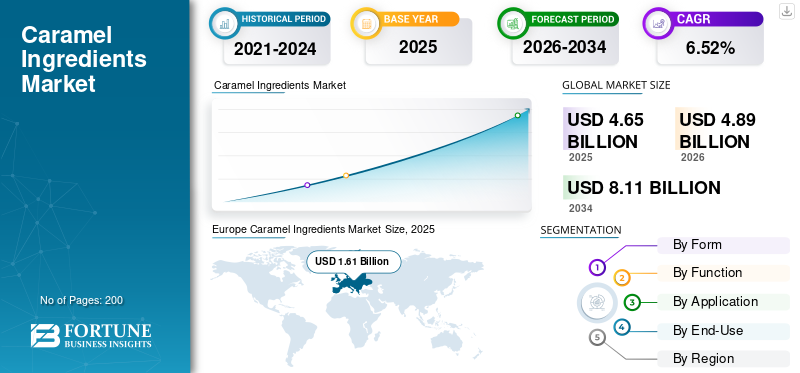
The global caramel ingredients market size was valued at USD 4.65 billion in 2025. The market is projected to grow from USD 4.89 billion in 2026 to USD 8.11 billion by 2034, exhibiting a CAGR of 6.52% during the forecast period. Europe dominated the caramel ingredients market with a market share of 34.62% in 2025.
Caramel ingredients are food ingredients made from heating sugars to high temperatures. The products include caramel color, caramel flavor, syrup, filling, and topping, and as an inclusion used in a wide range of food products, including bakery, confectionery, beverages, dairy desserts, snacks, and foodservice applications. Demand is associated with the rising popularity of premium sweets, flavored beverages, dessert sauces, and bakery products, where caramel is valued for its rich taste profile and broad formulation versatility. Increasing new product development and key player growth strategies, such as geographical expansion, R&D, and base expansion, are driving market growth. Furthermore, rising consumer disposable income, urbanization, and changing standards of living are contributing to industry growth.
The market is dominated by Cargill Incorporated, Kerry Group plc., Sethness Roquette, Puratos Group, Sensient Technologies Corporation, and others.
Download Free sample to learn more about this report.
Caramel Ingredients Market Key Takeaways
 Global Market Size & Forecast
- 2025 Market Size: USD 4.65 billion
- 2026 Market Size: USD 4.89 billion
- 2034 Forecast Market Size: USD 8.11 billion
- CAGR: 6.52% from 2026–2034
 Market Share
- Europe dominated the caramel ingredients market with a 34.62% share in 2025.
- The liquid form segment led the market with a value of USD 3.04 billion in 2025.
- The color segment dominated the market with a value of USD 1.73 billion in 2025.
 Key Regional Highlights
Europe
Europe generated USD 1.61 billion in 2025 and is projected to expand at a 6.18% CAGR.
North America
North America reached USD 1.33 billion in 2025 and is expected to grow at a 6.69% CAGR.
Asia Pacific
Asia Pacific generated USD 1.16 billion in 2025 and is projected to record the fastest regional CAGR of 7.47%.
U.S.
The market was valued at approximately USD 1.08 billion in 2025.
Japan
The market is expected to witness steady growth, supported by rising demand for processed food and beverage products.
Read More

Caramel Ingredients Market Trends
Growing Demand for Clean-Label and Natural Food Ingredients is Changing Industry Outlook
The growing demand for clean-label, natural food ingredients is reshaping the outlook for the market, especially in premium food, beverage, and dairy applications. Food manufacturers are increasingly under pressure to simplify ingredient lists, remove artificial-sounding additives, and improve label transparency. Manufacturers are therefore developing caramel solutions with cleaner positioning, reduced reliance on additives, and better compatibility with natural and premium product claims. The trend is also encouraging innovation in burnt sugar systems, caramel powders, and specialty syrups that deliver authentic taste while fitting evolving label expectations. The emerging trend of clean-label ingredients in the food industry to drive the global caramel ingredients market growth.
- In January 2025, GNT, an independent, family-owned company pioneering in plant-based color solutions, launched a new range of brown Exberry colours made from non-GMO caramelized carrots using a physical processing method.
MARKET DYNAMICS
Market Drivers
Download Free sample to learn more about this report.
Increasing Consumer Preference for Premium Indulgence is Driving Market Growth
Rising consumer interest in premium indulgence is driving strong demand for caramel ingredients across food and beverage products, particularly in dairy, frozen desserts, and ready-to-drink categories. As consumers' preferences are shifting toward richer flavors, smoother textures, and more complex sensory experiences, manufacturers are adding caramel-based fillings, sauces, inclusions, and flavor systems to boost product appeal. Caramel works particularly well in indulgent products as it provides sweetness, buttery notes, toasted flavors, and a rich visual appeal in a single ingredient.
The growth of affordable luxury products is also supporting market expansion, as brands use caramel ingredients to create a premium perception without completely redesigning the product base. In addition, salted caramel, dark caramel, buttery caramel, and textured caramel inclusions are helping brands launch more sophisticated variants that justify higher pricing. Foodservice chains and packaged food brands are further accelerating this trend by using caramel drizzles, centers, and toppings to create visually attractive and experience-driven offerings. As a result, the preference for indulgent and premium food experiences is not only increasing caramel ingredient consumption but also shifting demand toward higher-value specialty caramel systems.
- In December 2025, British Bakels Ltd., a U.K.-based company, launched a toppings and fillings portfolio with two new ready-to-use Billionaire’s Caramels: Sea Salted Billionaire’s Caramel and Real Chocolate Billionaire’s Caramel. The company developed these products to help bakers deliver premium indulgence, texture, and visual appeal across sweet bakery and patisserie.
Market Restraints
Strict Regulatory Restrictions and Rising Consumer Health Concerns Regarding High Sugar Consumption to Hamper Market Growth
Compliance requirements differ across regions, making formulation, approval, and cross-border commercialization more complex for manufacturers. This increases product development time and raises documentation, testing, and reformulation costs, especially for suppliers serving multinational food and beverage companies. As a result, regulatory scrutiny can slow new product launches and limit the adoption of certain caramel ingredient formats in sensitive end-use categories.
Furthermore, growing consumer health consciousness regarding high sugar intake is also restraining demand. As more consumers shift toward reduced-sugar, low-calorie, and better-for-you products, some manufacturers are limiting caramel-heavy formulations or reformulating them to avoid an overly sweet positioning. This is particularly relevant in markets where front-of-pack labeling, sugar taxes, and nutrition-conscious purchasing behavior are becoming more influential. According to the International Sugar Organisation, sugar consumption in the U.S. and Europe fell by 4.4% and 6.7%, respectively, in 2025, compared with the last two years. It will significantly affect the market growth during the forecast period.
Market Opportunities
Growing Demand for Product from Beverages Industry is Changing Future Landscape Of Market
Caramel has strong functionality in beverages as it can contribute color, flavor depth, sweetness perception, and product differentiation across carbonated drinks, ready-to-drink coffee, flavored milk, milkshakes, alcoholic beverages, and specialty café beverages. As consumers increasingly shift toward café-style and dessert-inspired drinks, beverage manufacturers are using caramel ingredients to create richer and more premium taste profiles. Furthermore, the growth of customization in foodservice and quick-service beverage chains is also supporting demand for caramel syrups, drizzles, and flavor bases, since these ingredients help create visual appeal and perceived indulgence. It will positively drive the industry to new heights in the coming years.
- In September 2025, OSF Flavors, a U.S. based flavors company, launched its new caramel miso latte flavor, a cross-category innovation for coffee, beverages, dairy, confections, and desserts.
SEGMENTATION ANALYSIS
By Form
Wide Industrial Application Led to Liquid Form Segmental Dominance
By form, the market is segmented into liquid, powder, and chips & chunks.
The liquid form segment dominated the market in 2025, valued at USD 3.04 billion due to its extensive use across beverages, bakery, confectionery, dairy desserts, sauces, and foodservice applications. Liquid caramel ingredients are widely preferred as they are easy to pump, blend, dose, and standardize in large-scale manufacturing systems, which makes them highly suitable for industrial food and beverage processing. The product demand is further supported by its utilization in both high-volume standard applications and premium ready-to-use systems. As a result, liquid remains the most commercially established and widely consumed form in the caramel ingredients industry.
The chips & chunks segment is projected to grow at the fastest CAGR of 9.33% during the forecast period. Chips & chunks are gaining momentum as they are increasingly used in premium bakery, cookies, brownies, snack bars, chocolates, ice cream, and frozen desserts, where visible texture and indulgent appeal directly improve product differentiation.
By Function
Carmel Ingredients’ High Preference is Led by its Ability to Achieve the Required Color Shade
By function, the market is segmented into color, flavor, fillings & toppings, inclusions, and others.
The color segment led the global market in 2025, valued at USD 1.73 billion due to its extensive use across beverages, bakery, confectionery, sauces, dairy products, and savory convenience food products, where visual consistency is a key product requirement. Caramel-based coloring ingredients are widely preferred as they help manufacturers achieve stable brown shades, enhance product appearance, and maintain brand-standard visual identity in large-scale production lines. The demand is particularly strong in beverage applications, where caramel color is used in high volumes and integrates efficiently into liquid processing systems. The segment also benefits from broad commercial acceptance and cost-effective functionality compared with more specialized uses of caramel ingredients. As a result, color remains the most widely applied and commercially dominant function in the market.
The inclusion segment is expected to grow at the fastest CAGR of 8.72% during the forecast period. Caramel inclusions such as chips, chunks, bits, and coated pieces help enhance bite, structure, and sensory richness, making them highly attractive in premium food formulations. The shift toward premium, texture-led, and visually differentiated products is driving the fastest growth in the inclusions segment.
To know how our report can help streamline your business, Speak to Analyst
By Application
High Volume Consumption of Product Led to Beverages Segmental Dominance
By application, the market is segmented into bakery & confectionery, beverages, dairy & frozen desserts, snacks, and others.
The beverages segment held the largest share of the market in 2025, valued at USD 1.46 billion. They are extensively used in carbonated soft drinks, ready-to-drink coffee, flavored milk, alcoholic beverages, and specialty café-style drinks. Caramel ingredients are highly preferred in beverage formulations as they provide color consistency, flavor depth, sweetness perception, and premium visual appeal in a format that is easy to process at an industrial scale. Furthermore, the expansion of indulgent and dessert-inspired drink offerings across both retail and foodservice channels. As a result, beverages remain the largest application segment in the market.
The snacks segment is projected to grow at the fastest CAGR of 8.09% during the forecast period. Manufacturers are using caramel inclusions, coatings, and drizzles more actively to support premium positioning and higher-value launches. Therefore, strong innovation and premiumization trends are expected to make snacks the fastest-growing application segment in the market.
By End-Use
Adoption of Product in Several Processed Food Boosted Food Processing Segment Demand
By end-use, the market is segmented into food processing, food service, and household/retail.
The food processing segment held the largest share of the market in 2025, valued at USD 3.26 billion. The caramel ingredients are used extensively in several packaged and processed foods and beverages at industrial scale. Manufacturers prefer caramel ingredients in this segment as they provide color, flavor, fillings, toppings, and texture in forms that are easy to standardize across high-volume production systems. The segment also benefits from the wide commercial use of liquid caramel ingredients and caramel colors, which are well-suited for automated processing, blending, dosing, and consistency control. In addition, processed and convenience food manufacturers rely on caramel ingredients to improve visual appeal, enhance indulgent taste profiles, and support premium product positioning across multiple categories. As a result, the large application base and high-volume industrial usage keep food processing as the dominant end-use segment in the market.
The food service segment is projected to grow at the fastest CAGR of 7.57% during the forecast period. Food service is gaining momentum as cafés, quick-service restaurants, dessert chains, bakeries, and ice cream outlets increasingly use caramel ingredients in beverages, drizzles, toppings, fillings, and dessert customization to create richer flavor and visual appeal. It will drive the product demand from the segment.
Caramel Ingredients Market Regional Outlook
Regionally, the report covers the global market analysis across North America, Europe, Asia Pacific, South America, and the Middle East & Africa.
North America
Europe Caramel Ingredients Market Size, 2025 (USD Billion)
To get more information on the regional analysis of this market, Download Free sample
North America accounted for USD 1.33 billion in 2025 and is projected to grow at a CAGR of 6.69% over the forecast period. The market growth is supported by the region’s strong premium dessert and flavored beverage consumption, which keeps demand high for caramel syrups, colors, fillings, and inclusions. A major driver is the region’s well-established indulgence-led packaged food market, where caramel is widely used to create richer taste and a darker appearance, and to position bakery, confectionery, and dairy products as café-style. Another important factor is the large-scale commercialization of foodservice beverage customization, which increases the use of caramel sauces and drizzles in coffee chains, dessert outlets, and quick-service formats. The manufacturers in the region focus heavily on product differentiation, caramel ingredients are used not only for sweetness, but also for premium sensory layering and visual appeal. This improves value realization, especially in fillings, toppings, and specialty inclusions. As a result, North America remains a high-value market with strong demand for both standard and premium caramel ingredient formats.
U.S. Caramel Ingredients Market
The U.S. market was valued at approximately USD 1.08 billion in 2025 and is expected to expand at a CAGR of 6.79% during the forecast period. The rapid expansion of ready-to-drink coffee, flavored milk, and dessert-inspired beverages, where caramel is used to create both taste richness and visual familiarity. Another key factor is the country’s strong innovation pipeline in snacks, cookies, brownies, ice cream, and premium bakery, which increases demand for caramel fillings, chips, chunks, and drizzles. The U.S. consumers respond strongly to limited-edition, café-style, and premium comfort flavors; caramel remains one of the most commercially reliable ingredient themes across categories. This supports high repeat use in both retail and foodservice applications. As a result, the U.S. remains the most commercially influential country market for caramel ingredients in the region.
Europe
Europe dominates the market in both value and volume consumption of the product, valued at USD 1.61 billion in 2025 and expanding at a CAGR of 6.18% over the projected period. The market is driven by the region’s deep bakery and confectionery heritage, which creates sustained demand for caramel flavors, fillings, powders, and inclusions across premium and everyday products. Additionally, the mature private-label and branded innovation environment, which encourages frequent launches of caramel-based seasonal and premium variants. European manufacturers compete strongly on quality, caramel ingredients are increasingly selected for both sensory depth and product refinement rather than only for bulk sweetness. This leads to stronger demand for specialized formats such as inclusions, fillings, and application-specific flavor systems. As a result, Europe remains one of the most diversified and value-driven markets for caramel ingredients.
Germany Caramel Ingredients Market
Germany accounted for approximately USD 0.39 billion in 2025, driven by its strong industrial bakery base and high preference for quality-driven confectionery and dessert products. One of the key drivers is Germany’s well-developed baked goods sector, where caramel is used in fillings, coatings, inclusions, and flavored dessert components to create richer taste and more premium positioning.
Asia Pacific
Asia Pacific’s market reached USD 1.16 billion in 2025 and is the fastest-growing region, with a 7.47% CAGR over the forecast period. The market is expanding rapidly due to rising urban food consumption and the fast growth of packaged indulgence categories across major economies. A key driver is the region’s growing café culture and adoption of western-style desserts, which are increasing the use of caramel in beverages, bakery items, ice cream, and dessert toppings. Furthermore, middle-income consumers are trading up toward more premium and flavor-rich foods, caramel is increasingly used to improve both taste familiarity and aspirational product appeal. This is also encouraging greater use of fillings, sauces, and inclusions rather than just standard color formats. As a result, the Asia Pacific is emerging as the fastest-expanding regional market with strong volume and value potential.
China Caramel Ingredients Market
China was valued at USD 0.73 billion in 2025. The Chinese market is one of the largest markets in the region, and it is emerging with a steady growth rate due to the rapid commercialization of modern beverages and western-style bakery products. One major driver is the expansion of ready-to-drink tea, coffee, and milk beverage categories, where caramel is used to deliver color depth, sweetness perception, and premium café-style flavor cues. Furthermore, Chinese consumers are increasingly attracted to internationally styled flavors with familiar sweetness; caramel performs well as a bridge between local taste acceptance and premium product positioning. This is encouraging broader adoption across both large-scale manufacturers and foodservice chains. As a result, China is becoming one of the most dynamic country markets for caramel ingredient consumption.
India Caramel Ingredients Market
The Indian market reached USD 0.17 billion in 2025. The market is being driven by the rapid growth of organized dairy desserts and western-style quick-service food formats. A key factor is the expansion of flavored milk, ice cream, dessert sauces, and bakery café products, where caramel is increasingly used to create richer taste and premium appeal.
South America and the Middle East & Africa
South America accounted for USD 0.36 billion in 2025, growing at a CAGR of 5.47% over the projected period. The widespread use of caramel in sweet baked goods, confectionery, dessert fillings, and flavored beverages, which keeps the ingredient relevant across mass-market categories. It is driving the market growth in the region. Furthermore, consumers in the region remain price-conscious, caramel ingredients are often used as an efficient way to improve flavor intensity and visual appeal without sharply increasing formulation cost. This supports demand across both retail food and foodservice channels. As a result, South America remains a steadily growing market where value is created through broad usage in mainstream indulgent applications.
The Middle East & Africa market was valued at USD 0.19 billion in 2025, expanding at a CAGR of 3.81%. The market is being driven by the expansion of modern foodservice and hospitality-led consumption, especially in urban centers and travel-linked retail environments. Furthermore, the region’s growing network of cafés, bakeries, and dessert outlets heavily uses caramel in syrups, sauces, toppings, and beverage customization. It will positively contribute to the industry’s growth.
South Africa Caramel Ingredients Market
The South Africa market was valued at approximately USD 0.06 billion in 2025 and is projected to grow at a CAGR of 4.08% during the forecast period. The market is growing due to the regional retail and food manufacturing hub, which supports the wider distribution of caramel-based products across organized channels. Furthermore, stable demand in food processing, while also creating opportunities in foodservice, desserts, and beverages. As a result, South Africa remains one of the most important country markets for caramel ingredients within MEA.
COMPETITIVE LANDSCAPE
Key Industry Players
Key Players are Focused on Innovation, Portfolio Expansion, and Strategic Partnerships
The global caramel ingredients market share is moderately fragmented, dominated by a limited number of large global manufacturers and several regional players. Key players such as Cargill Inc., Kerry Group plc, Sethness Roquette, Puratos Group, and Sensient Technologies Corporation are dominating the market. The industry has been shifting as key players pursue strategies to expand their market presence by launching new sustainable products within their categories, expanding their geographical reach, and focusing on R&D to develop novel products from plant-based ingredients. It is strongly contributing to changing the industry landscape.
Key Players in Caramel Ingredients Market
|
Rank |
Company Name |
|
1 |
Cargill Inc. |
|
2 |
Kerry Group plc |
|
3 |
Sethness Roquette |
|
4 |
Puratos Group |
|
5 |
Sensient Technologies Corporation |
List of Key Caramel Ingredients Companies Profiled in Report
- Cargill Inc. (U.S.)
- Kerry Group plc (Ireland)
- Sethness Roquette (France)
- Puratos Group (Belgium)
- Sensient Technologies Corporation (U.S.)
- Barry Callebaut AG (Switzerland)
- Metarom Group (France)
- Aarkay Food Products Ltd (India)
- Ingredion Inc (U.S.)
- Givaudan SA (Switzerland)
KEY INDUSTRY DEVELOPMENTS
- January 2026: Skjodt-Barrett Foods, a U.S.-based flavor manufacturer and seller of caramel and bakery fillings, launched its Signature Caramels & Fillings. The portfolio includes five caramel SKUs—spanning indulgent, premium, reduced-sugar, and functional profiles—along with eight bakery fillings ranging from fruit-forward classics to wide, modern signature-style varieties.
- November 2025: Werther's Original, one of America's popular caramel brands, introduced a new limited-edition flavor, Gingerbread Flavored Soft Caramels: NEW Gingerbread Flavored Soft Caramels and Cookie Butter Crème.
- October 2025: Sethness Roquette, a global flavors and colors manufacturing company, expanded its product offerings by launching dark Class I Powder Caramel Color 1360PW, a reddish-brown color developed for food and beverage manufacturers.
- October 2025: Mars Wrigley, one of the key confectionery manufacturers, launched the M&M'S brand by introducing M&M'S Pop'd Caramel, marking the company's first foray into freeze-dried candy.
- October 2025: Zevia, a zero-sugar beverages manufacturing company, introduced a limited edition salted caramel soda on its own website and the Amazon online retail platform.
REPORT COVERAGE
The caramel ingredients market report analyzes the market in depth and highlights key aspects, including global market trends, supply chain, market dynamics, prominent companies, investment in research and development, and end-use. In addition, the research report highlights significant industry developments.
Request for Customization to gain extensive market insights.
Report Scope & Segmentation
| ATTRIBUTE | DETAILS |
| Study Period | 2021-2034 |
| Base Year | 2025 |
| Estimated Year | 2026 |
| Forecast Period | 2026-2034 |
| Historical Period | 2021-2024 |
| Growth Rate | CAGR of 6.52% from 2026 to 2034 |
| Unit | Value (USD Billion) |
|
Segmentation |
By Form
|
|
By Function
|
|
|
By Application
|
|
|
By End-Use
|
|
|
By Region
|
Frequently Asked Questions
Fortune Business Insights says that the global market was USD 4.65 billion in 2025 and is anticipated to reach USD 8.11 billion by 2034.
At a CAGR of 6.52%, the global market will exhibit steady growth over the forecast period.
By form, the liquid segment led the market.
Europe held the largest market share in 2025.
Increasing consumer preference for premium indulgence is driving the market growth.
Cargill Inc., Kerry Group plc, Sethness Roquette, Puratos Group, Sensient Technologies Corporation are the leading companies in the market.
The growing demand for clean-label, natural food ingredients is changing the industry outlook.



- 2021-2034
- 2025
- 2021-2024
- 200
-
(Offer valid till 15th Oct 2026)
Get 30-60 hrs Free Customization
Expand Regional and Country Coverage, Segments Analysis, Company Profiles, Competitive Benchmarking, and End-user Insights.




















Related Reports
-
US +1 833 909 2966 ( Toll Free )
-
Get In Touch With Us