Carbon-Negative Building Materials Market Size, Share & Industry Analysis, By Material Type (Natural Fiber & Wood-Based Materials, CO₂-Mineralized Materials, Biochar-Enhanced Materials, and Others), By End-Use (Residential, Commercial, and Industrial), and Regional Forecast, 2026-2034
 Download Free Sample
Carbon-Negative Building Materials Market Size and Future Outlook
 Listen to Audio Version
The global carbon-negative building materials market size was valued at USD 18.00 billion in 2025 and is projected to grow from USD 19.61 billion in 2026 to USD 36.27 billion by 2034, exhibiting a CAGR of 8.0% during the forecast period. North America dominated the carbon negative building materials market with a market share of 34% in 2025.
The market comprises a range of construction materials designed to store, absorb, or permanently lock away more carbon dioxide than is released during their production and use. The market covers key material types such as CO₂-mineralized materials, natural fiber and wood-based materials, biochar-enhanced materials, and other low-carbon building solutions, which are valued for reducing embodied carbon while supporting durability, structural performance, insulation efficiency, and sustainable construction goals. These materials are increasingly used across residential, commercial, and industrial construction where developers, builders, and policymakers are placing greater emphasis on low-emission and climate-positive building practices. The rising demand for green buildings, stricter carbon-reduction targets, and growing interest in embodied-carbon measurement are driving the market growth.
Major players in the market include Plantd, Inc., Louisiana-Pacific Corporation, Blue Planet Systems, TimberHP, and ThermaCork. Their competitive position is supported by strong eco-friendly material portfolios, access to renewable or carbon-sequestering feedstocks, advanced manufacturing capabilities, and growing alignment with demand for low-carbon construction solutions across residential, commercial, and industrial buildings.
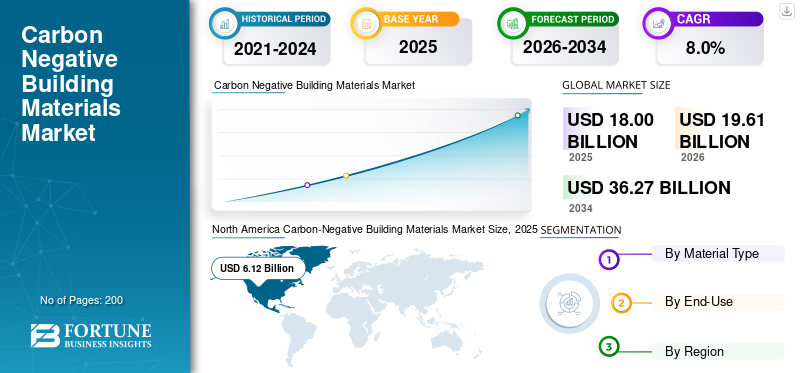
Download Free sample to learn more about this report.
CARBON-NEGATIVE BUILDING MATERIALS MARKET KEY TAKEAWAYS
 Global Market Size & Forecast
- 2025 Market Size: USD 18.00 billion
- 2026 Market Size: USD 19.61 billion
- 2034 Forecast Market Size: USD 36.27 billion
- CAGR: 8.0% from 2026–2034
 Market Share
- North America dominated the market with a 34% share in 2025.
- The Natural Fiber & Wood-Based Materials segment held the largest market share in 2025.
- The Residential segment held the largest market share in 2025.
 Key Regional Highlights
North America
Reached USD 6.12 billion in 2025, driven by strong green building adoption, wood-based construction, and embodied carbon reduction initiatives.
Europe
The market is projected to reach USD 6.25 billion by 2026, supported by rising demand for low-carbon construction materials and sustainable building practices.
Asia Pacific
Growth is driven by rapid urbanization, expanding infrastructure development, and increasing adoption of green building programs across major economies.
U.S.
The market is projected to reach USD 5.74 billion by 2026, supported by growing use of mass timber, bio-based materials, and carbon-storing building products.
Japan
Growth is supported by increasing investments in sustainable construction, green building initiatives, and the adoption of low-carbon building materials.
Read More

CARBON-NEGATIVE BUILDING MATERIALS MARKET TRENDS
Growing Focus on Embodied Carbon Reduction in Construction Materials
One of the key trends in the market is the growing focus on reducing embodied carbon across building and infrastructure projects. Developers, architects, and construction material producers are increasingly looking for recycled materials that can store carbon, use renewable feedstocks, or incorporate carbon-capture technologies while still meeting performance requirements for strength, durability, insulation, and design flexibility. As a result, suppliers are expanding carbon-negative material offerings such as CO₂-mineralized aggregates and concrete products, natural fiber and wood-based panels, biochar-enhanced materials, cork-based insulation, and other low-carbon construction solutions. The trend is becoming stronger as green building standards, corporate sustainability targets, and public-sector decarbonization goals push construction stakeholders to consider operational energy use and the carbon neutrality of the materials used in buildings.
- According to the World Green Building Council, materials and construction account for about 11% of the global energy-related carbon emissions, supporting the growing focus on embodied-carbon reduction in building materials.
MARKET DYNAMICS
MARKET DRIVERS
Download Free sample to learn more about this report.
Rising Residential Construction and Green Housing Demand to Support Market Growth
The primary driver of the carbon-negative building materials market growth is the rising demand for sustainable materials in residential construction. Homebuilders, developers, and homeowners are increasingly focusing on materials that can reduce embodied carbon while improving energy efficiency, indoor comfort, durability, and long-term building performance. An additional layer of support comes from the growing demand for green homes, energy-efficient housing, and climate-conscious residential developments. As residential buildings require large volumes of structural panels, insulation materials, flooring, wall systems, and exterior building products, the use of carbon-negative materials is becoming more important in reducing the overall carbon footprint of residential construction.
- According to the U.S. Department of Energy, reducing embodied carbon is important for low-carbon new construction as building materials such as concrete, steel, lumber, and glass are major sources of embodied carbon in buildings.
MARKET RESTRAINTS
High Production Costs and Limited Commercial Scale May Restrain Wider Market Growth
The market faces a key restraint due to the higher production cost and limited commercial scale of many carbon-negative material technologies. Products such as CO₂-mineralized materials, natural fiber and wood-based materials, biochar-enhanced materials, and other low-carbon construction solutions often require specialized feedstocks, advanced processing methods, certification support, and controlled manufacturing systems. Since these materials are used across residential, commercial, and industrial construction, cost competitiveness remains important for wider adoption.
- According to the Asian Development Bank, major challenges for green building implementation include access to construction materials and skilled labor, followed by the high cost of low-carbon construction.
MARKET OPPORTUNITIES
Expanding Green Building and Public Infrastructure Projects to Create Market Opportunities
One of the key opportunities in the market is the expanding use of low-carbon materials in green building and infrastructure projects. Carbon-negative materials such as carbon-negative concrete and aggregates, natural fiber and wood-based panels, biochar-enhanced materials, cork insulation, and other carbon-storing construction products are gaining relevance as builders look for ways to reduce greenhouse gas emissions while maintaining strength, insulation performance, durability, and design flexibility. As governments, developers, and construction companies continue investing in sustainable housing, commercial buildings, public infrastructure, and energy-efficient renovation projects, the demand for materials with lower lifecycle emissions is expected to increase.
- According to the World Green Building Council, by 2030, all new buildings, infrastructure, and renovations should achieve at least 40% lower embodied carbon, supporting opportunities for low-carbon and carbon-negative building materials.
MARKET CHALLENGES
Balancing Performance, Certification, and Cost May Create Challenges for Market Growth
The materials market faces a key challenge in balancing material performance, certification requirements, and cost efficiency across the large-scale construction sector. These materials are used in residential, commercial, and industrial buildings, where buyers require reliable strength, durability, insulation performance, fire resistance, moisture resistance, and long-term service life. The challenge becomes more significant in price-sensitive construction projects where builders and developers expect dependable supply, code-compliant performance, easy installation, and competitive pricing at commercial scale.
- According to Lendlease, barriers to carbon-negative construction materials include economic barriers, technical and performance barriers, standards, specifications, and the need to define low-carbon performance requirements for building products.
Segmentation Analysis
By Material Type
Broad Use in Structural and Insulation Applications to Support the Dominance of the Natural Fiber & Wood-Based Materials Segment
Based on material type, the market is segmented into natural fiber & wood-based materials, CO₂-mineralized materials, biochar-enhanced materials, and others.
The natural fiber & wood-based materials segment holds the largest carbon-negative building materials market share due to its wide availability, established use in construction, and strong carbon storage potential. Their use is especially strong in residential, commercial, and industrial construction, where builders require lower-carbon alternatives for panels, insulation, wall systems, flooring, roofing, and structural components. Strong demand for renewable, lightweight, and low-embodied-carbon materials continues to support the dominance of the segment.
- According to the American Wood Council, wood products are roughly 50% carbon by mass and the carbon absorbed during tree growth remains stored in the building material while it is in use. This supports the dominance of natural fiber and wood-based materials in carbon-negative construction.
The CO₂-mineralized materials segment is expected to grow at a CAGR of 9.7% over the forecast period.
By End-Use
To know how our report can help streamline your business, Speak to Analyst
Residential Segment Led the Market in 2025 with Extensive Sustainable Material Usage in Renovation and Housing
In terms of end-use, the market is categorized into residential, commercial, and industrial.
The residential segment held the largest share of the market in 2025, supported by the broad use of sustainable materials in housing, renovation, insulation, wall systems, roofing, flooring, and structural applications. Carbon-negative building materials are increasingly preferred in this segment given that residential construction requires materials that can reduce embodied carbon while supporting durability, comfort, thermal insulation, and long-term energy efficiency. Strong demand for sustainable homes, wider adoption of wood-based and natural fiber materials, and growing focus on low-carbon construction practices continue to support the dominance of the residential segment.
- According to the GlobalABC / IEA 2019 Global Status Report, residential buildings accounted for more than 70% of global final energy consumption in buildings, supporting the importance of residential construction in low-carbon and carbon-negative building material adoption.
The commercial segment is expected to grow at a CAGR of 8.2% over the forecast period.
Carbon-Negative Building Materials Market Regional Outlook
By geography, the market is categorized into North America, Europe, Asia Pacific, Latin America, and the Middle East and Africa.
North America
North America Carbon-Negative Building Materials Market Size, 2025 (USD Billion)
To get more information on the regional analysis of this market, Download Free sample
In 2024, North America accounted for the largest share of the market, valued at USD 5.55 billion, and continued to lead in 2025 with a valuation of USD 6.12 billion. The region benefits from strong green building adoption, advanced construction material innovation, established wood-based building product usage, and growing focus on reducing embodied carbon across residential, commercial, and industrial construction. Carbon-negative materials are increasingly used in structural panels, insulation materials, wall systems, flooring, roofing, concrete alternatives, and other low-carbon building applications, all of which are gaining importance as builders and developers shift toward sustainable construction practices.
U.S. Carbon-Negative Building Materials Market
The U.S. market is projected to reach USD 5.74 billion by 2026. The U.S. remains the region’s largest demand center, supported by strong residential construction activity, growing adoption of carbon-negative materials, and increasing use of sustainable materials in homes, commercial buildings, and infrastructure projects. The product demand is further supported by the country’s expanding focus on embodied-carbon reduction, energy-efficient housing, mass timber construction, bio-based materials, and carbon-storing building products.
To know how our report can help streamline your business, Speak to Analyst
Europe
The Europe market is expected to experience steady growth over the coming years. The regional market is projected to reach a market valuation of USD 6.25 billion by 2026 and expand at a stable rate during the forecast period. The market growth is supported by the increasing demand for low-carbon construction materials across residential, commercial, and industrial buildings, where developers and builders are placing greater emphasis on reducing embodied carbon, improving energy efficiency, and meeting sustainability targets.
U.K. Carbon-Negative Building Materials Market
The U.K. market is estimated to reach a value of around USD 1.31 billion in 2026, accounting for roughly 20.9% of regional revenues.
Germany Carbon-Negative Building Materials Market
The Germany market is estimated to hit a valuation of around USD 1.50 billion in 2026, accounting for roughly 24.0% of regional revenues.
Asia Pacific
Asia Pacific continues to be an emerging and high-potential market, supported by rising construction activity, rapid urban development, and increasing attention toward sustainable building practices. Countries such as China, India, Japan, South Korea, and Southeast Asian economies are expected to create steady opportunities as infrastructure development, housing demand, green building programs, and climate-focused construction policies continue to gain momentum.
China Carbon-Negative Building Materials Market
Given Asia Pacific's significant contribution and China's dominance in the region, the Chinese market is estimated to reach a value of around USD 1.72 billion in 2026, accounting for roughly 35.0% of regional sales.
Latin America and the Middle East & Africa
Latin America and the Middle East & Africa markets are relatively smaller in terms of valuation, yet continue to present considerable growth prospects. Growth in Latin America is supported by the rising interest in sustainable construction, green housing, and low-carbon building solutions across Brazil, Mexico, and other developing economies. The Middle East & Africa are also showing steady potential, supported by expanding construction activity, urban development, infrastructure investment, and rising demand for energy-efficient building materials. Countries in the GCC such as Saudi Arabia and the UAE are benefiting from large-scale real estate, smart city, and sustainability-focused construction projects.
Brazil Carbon-Negative Building Materials Market
The Brazilian market is estimated to reach a value of USD 0.45 billion in 2026, accounting for approximately 45.9% of regional revenues.
COMPETITIVE LANDSCAPE
Key Industry Players
Leading Companies Emphasize Material Innovation and Products with Carbon Benefits to differentiate themselves Against Competitors
The market is moderately fragmented, with competition shaped by companies that can combine scalable production, reliable access to renewable or carbon-sequestering feedstocks, strong product performance, and clear sustainability credentials. Competitive advantage depends on the ability to deliver materials that reduce embodied carbon while meeting construction requirements for strength, durability, insulation, fire performance, moisture resistance, and long service life.
Major participants such as Plantd, Inc., Louisiana-Pacific Corporation, Blue Planet Systems, TimberHP, and ThermaCork benefit from differentiated material technologies, sustainable product portfolios, and growing alignment with demand across residential, commercial, and industrial construction. As competition continues to evolve, the market is increasingly favoring suppliers that can provide verified carbon benefits, consistent material quality, and scalable supply solutions.
LIST OF KEY CARBON-NEGATIVE BUILDING MATERIALS COMPANIES PROFILED
- Partanna Global (U.S.)
- Prometheus Materials, Inc (U.S.)
- Plantd, Inc. (U.S.)
- Louisiana-Pacific Corporation (U.S.)
- Blue Planet Systems (U.S.)
- GreenJams(India)
- CarbonCraft (India)
- Hempitecture Inc. (U.S.)
- TimberHP (U.S.)
- ThermaCork (Portugal)
- Ricron Panels (India)
KEY INDUSTRY DEVELOPMENTS
- May 2026: Prometheus Materials announced a 10-year strategic partnership with Green Stream Algae to secure microalgae and biomineral supply for scaling its ProZERO low-carbon and carbon-negative cement technology.
REPORT COVERAGE
The global market analysis provides an in-depth study of market size and forecast by all the market segments included in the report. It includes details on market dynamics and trends expected to drive the market during the forecast period. It offers information on technological advancements, new product launches, key industry developments, and partnerships, mergers, and acquisitions. The market research report also encompasses a detailed competitive landscape with information on the market shares and profiles of key players.
Request for Customization to gain extensive market insights.
Report Scope & Segmentation
| ATTRIBUTE | DETAILS |
| Study Period | 2021-2034 |
| Base Year | 2025 |
| Estimated Year | 2026 |
| Forecast Period | 2026-2034 |
| Historical Period | 2021-2024 |
| Growth Rate | CAGR of 8.0% from 2026-2034 |
| Unit | Value (USD Billion) |
| Segmentation | By Material Type, End-Use, and Region |
| By Material Type |
|
| By End-Use |
|
| By Region |
|
Frequently Asked Questions
Fortune Business Insights says that the global market size was valued at USD 18.00 billion in 2025 and is projected to reach USD 36.27 billion by 2034.
The market is slated to exhibit steady growth at a CAGR of 8.0% during the forecast period.
The residential end-use segment led the market in 2025.
North America held the highest market share in 2025.
The rising demand for low-carbon and sustainable construction materials in residential, commercial, and industrial buildings is driving the market growth.



- 2021-2034
- 2025
- 2021-2024
- 200
Get 30-60 hrs Free Customization
Expand Regional and Country Coverage, Segments Analysis, Company Profiles, Competitive Benchmarking, and End-user Insights.


















Related Reports
-
US +1 833 909 2966 ( Toll Free )
-
Get In Touch With Us