Carbon Neutrality Market Size, Share & Industry Analysis, By Solution Type (Carbon Management, Carbon Neutrality Consulting, Voluntary Carbon Offsets, Carbon Removal Solutions, Verification & Certification, Renewable Energy Certificates, and Others), By Component (Software Platforms, Services, and Credits & Certificates), By Organization Size (Large Enterprises, SMEs, and Government or Public Organizations), By End-Use Industry (Manufacturing, Energy & Utilities, Transportation & Logistics, BFSI, IT & Telecom, Retail & Consumer Goods, Healthcare, and Others), Regional Forecast, 2026-2034
 Download Free Sample
Carbon Neutrality Market Size and Future Outlook
 Listen to Audio Version
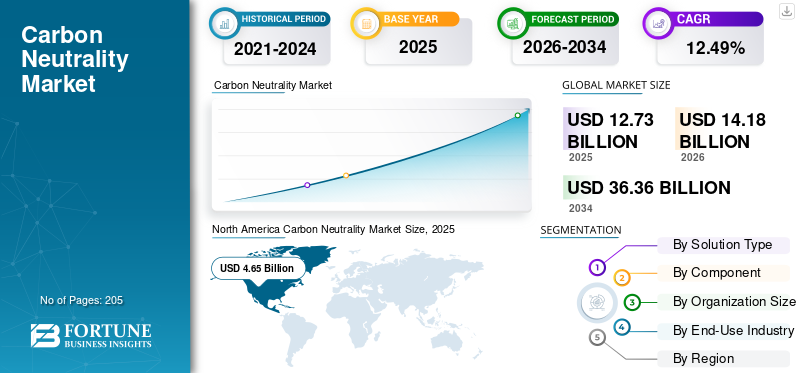
The global carbon neutrality market size was valued at USD 12.73 billion in 2025. The market is projected to grow from USD 14.18 billion in 2026 to USD 36.36 billion by 2034, exhibiting a CAGR of 12.49% during the forecast period. North America dominated the carbon neutrality market with a market share of 36.53% in 2025.
Carbon neutrality refers to the process of balancing greenhouse gas emissions generated by organizations, industries, or governments through a combination of direct emissions reduction, renewable energy adoption, carbon accounting, carbon offset procurement, and carbon dioxide removal activities. The market includes carbon management software, emissions measurement and verification (MRV) systems, carbon neutrality consulting, voluntary carbon credits, renewable energy certificates (RECs), and engineered carbon removal solutions.
The market is growing due to the rapid expansion of corporate net-zero commitments validated by organizations such as the Science Based Targets initiative (SBTi) and growing climate disclosure participation through CDP. Regulatory frameworks, including the European Union’s Corporate Sustainability Reporting Directive (CSRD), ISSB disclosure standards, and national net-zero targets, are accelerating enterprise investments in emissions tracking and sustainability compliance. In addition, reducing greenhouse emissions (Scope 3 emissions) reporting requirements across supply chains is driving adoption among manufacturing, transportation, global energy, and consumer goods industries.
- For instance, in March 2024, Microsoft signed a long-term agreement with carbon removal developer Vaulted Deep to purchase permanent carbon removal credits as part of its carbon negativity and neutrality strategy. The agreement supports the deployment of waste-based carbon sequestration technologies designed to permanently store carbon underground. This development highlights the growing corporate preference for high-integrity and durable carbon removal solutions over traditional avoidance offsets, reflecting the increasing commercialization of engineered carbon removal technologies within the global market.
Some of the leading companies operating in the global industry include Schneider Electric, Salesforce, SAP, Microsoft, and others. Salesforce is a leading U.S.-based cloud software company actively involved in the market through its sustainability and ESG solutions portfolio. The company offers Net Zero Cloud, a carbon management platform that helps organizations track, analyze, and reduce Scope 1, Scope 2, and Scope 3 emissions.
Download Free sample to learn more about this report.
Carbon Neutrality Market KEY TAKEAWAYS
 Global Market Size & Forecast
- 2025 Market Size: USD 12.73 Billion
- 2026 Market Size: USD 14.18 Billion
- 2034 Forecast Market Size: USD 36.36 Billion
- CAGR: 12.49% from 2026–2034
 Market Share
- North America held the dominant market share of 36.53% in 2025.
- Services accounted for the largest market share of 47.33% in 2025.
- Carbon Neutrality Consulting captured a 37.99% market share in 2025.
 Key Regional Highlights
Asia Pacific
Asia Pacific reached USD 3.16 billion in 2025, driven by industrial decarbonization and renewable energy investments.
North America
North America reached USD 4.65 billion in 2025 and is projected to reach USD 5.19 billion in 2026, supported by strong ESG adoption.
Europe
Europe is projected to reach USD 3.88 billion in 2025, driven by stringent sustainability regulations.
U.S.
The U.S. market reached USD 4.00 billion in 2025, supported by carbon management and sustainability investments.
Japan
Germany is projected to reach USD 1.02 billion by 2026, driven by industrial decarbonization and renewable energy integration.
Read More

CARBON NEUTRALITY MARKET TRENDS
Rising Adoption of Carbon Accounting Platforms and Permanent Carbon Removal Solutions is the Key Market Trend
The carbon neutrality market is driven by a significant transformation due to the rapid adoption of enterprise carbon accounting platforms, Scope 3 emissions management systems, and permanent carbon removal technologies. Organizations across manufacturing, transportation, BFSI, energy, and consumer goods sectors are increasingly investing in digital MRV (measurement, reporting, and verification) platforms to comply with evolving sustainability disclosure requirements such as the Corporate Sustainability Reporting Directive (CSRD), International Sustainability Standards Board (ISSB), and supply-chain emissions reporting frameworks. This trend is accelerating the deployment of AI-enabled carbon management software capable of real-time emissions tracking, sustainability analytics, and automated climate reporting.
In addition, the market is witnessing a shift from traditional avoidance-based carbon offsets toward durable carbon removal solutions, including direct air capture (DAC), biochar, and carbon mineralization. Large corporations are increasingly entering long-term carbon removal purchase agreements to achieve high-integrity net-zero targets and reduce dependence on lower-quality offset credits.
MARKET DYNAMICS
MARKET DRIVERS
Download Free sample to learn more about this report.
Increasing Corporate Net-Zero Commitments and Climate Disclosure Regulations to Support Market Expansion
The carbon neutrality market growth is being strongly driven by the rapid increase in corporate net-zero commitments and the expansion of climate disclosure regulations across global industries. Organizations are increasingly adopting carbon neutrality strategies to align with frameworks established by the Science Based Targets initiative (SBTi), CDP, and the United Nations Framework Convention on Climate Change (UNFCCC). Growing regulatory pressure from sustainability reporting standards such as the Corporate Sustainability Reporting Directive (CSRD) and International Sustainability Standards Board (ISSB) is accelerating investments in carbon accounting platforms, emissions monitoring systems, and sustainability reporting solutions.
In addition, rising Scope 3 emissions disclosure requirements are encouraging companies to implement supply-chain decarbonization programs, renewable energy procurement, and enterprise-wide carbon management systems. Large corporations across manufacturing, transportation, BFSI, retail, and technology sectors are increasingly investing in carbon neutrality consulting, renewable energy certificates, voluntary carbon offsets, and engineered carbon removal solutions to meet investor expectations and long-term climate targets.
MARKET RESTRAINTS
High Cost of Carbon Removal and Complexity in Scope 3 Emissions Measurement to Hamper Market Demand
One of the major restraints affecting the carbon neutrality market is the high cost associated with advanced decarbonization and carbon removal technologies. Engineered carbon removal solutions such as direct air capture (DAC), carbon mineralization, and bioenergy with carbon capture and storage (BECCS) remain expensive due to high energy consumption, infrastructure requirements, and limited commercial-scale deployment.
In addition, many organizations continue to face challenges in accurately measuring and managing Scope 3 emissions across complex global supply chains. Scope 3 reporting requires extensive supplier engagement, emissions data standardization, and integration of sustainability metrics across procurement, logistics, manufacturing, and distribution networks.
MARKET OPPORTUNITIES
Rising Climate-Focused Procurement Policies to Provide Several Growth Opportunities
An important opportunity in the market is the increasing integration of sustainability criteria into global procurement and supply-chain management practices. Large multinational corporations are expanding supplier decarbonization programs and requiring vendors to disclose emissions data, adopt renewable energy, and align with corporate net-zero targets. This trend is creating substantial demand for carbon neutrality solutions among suppliers, contract manufacturers, logistics providers, and small and medium-sized enterprises (SMEs) that were previously outside formal climate reporting ecosystems.
In addition, green public procurement initiatives and climate-linked purchasing standards introduced by governments and large enterprises are accelerating the adoption of low-carbon products, emissions tracking platforms, and sustainability certification services. Organizations are increasingly prioritizing suppliers with verified carbon reduction strategies, renewable energy usage, and transparent ESG reporting capabilities. This is generating new business opportunities for carbon accounting software providers, sustainability consulting firms, renewable certificate providers, and verification organizations.
MARKET CHALLENGES
Lack of Standardized Global Emissions to Deter Industry Expansion
One of the key challenges in the carbon neutrality industry is the lack of standardized global emissions reporting frameworks and the limited availability of reliable carbon data across complex supply chains. Organizations operating across multiple regions often face difficulties aligning disclosures with varying sustainability regulations, reporting methodologies, and carbon accounting standards. Differences between regional frameworks, emissions calculation methodologies, and supplier reporting practices create inconsistencies in Scope 1, Scope 2, and especially Scope 3 emissions measurement.
In addition, many companies continue to rely on estimated or incomplete supplier emissions data due to limited digital infrastructure and low sustainability maturity among upstream vendors. This affects the accuracy of carbon inventories, climate disclosures, and neutrality claims. The challenge is particularly significant in manufacturing, transportation, and retail sectors with highly fragmented global supply chains.
Segmentation Analysis
By Solution Type
Carbon Neutrality Consulting Dominated Due to Regulatory Compliance Management
Based on solution type, the market is classified into carbon management, carbon neutrality consulting, voluntary carbon offsets, carbon removal solutions, verification & certification, renewable energy certificates, and others.
In 2025, the carbon neutrality consulting segment accounted for 37.99% share as organizations require specialized expertise to develop and execute enterprise-wide decarbonization strategies. Companies across manufacturing, transportation, energy, BFSI, and retail sectors are increasingly seeking consulting support for emissions baseline assessment, Scope 1–3 reporting, sustainability roadmap development, renewable energy procurement, supplier decarbonization, and regulatory compliance management. Consulting firms also assist organizations in aligning climate targets with frameworks established by SBTi, CDP, ISSB, and regional disclosure regulations.
The carbon removal solutions segment is expected to grow at a CAGR of 14.95% during the forecast period.
To know how our report can help streamline your business, Speak to Analyst
By Component
Services Segment Dominated Owing to Rising Public Sectors' Reliance On External Service Providers
Based on component, the market is classified into software platforms, services, and credits & certificates.
In 2025, the services segment dominated the global market, accounting for 47.33% share. Organizations across industrial, commercial, and public sectors rely heavily on external service providers for carbon footprint assessment, Scope 1–3 emissions reporting, sustainability strategy development, renewable energy procurement, carbon offset sourcing, and ESG disclosure management. Service providers also assist enterprises in aligning with climate frameworks such as SBTi, CDP, ISSB, and regional sustainability reporting regulations.
The software platforms segment is expected to grow at a CAGR of 13.92% during the forecast period.
By Organization Size
Large Enterprises Led Due to Substantial Financial Resources
On the basis of organization size, the market is classified into large enterprises, SMEs, and government or public organizations.
In 2025, the large enterprises segment accounted for a leading carbon neutrality market share of 67.37%, driven by substantial financial resources, advanced sustainability infrastructure, and strong regulatory exposure across global operations. Multinational corporations in manufacturing, energy, transportation, BFSI, retail, and technology sectors are increasingly investing in carbon accounting platforms, net-zero consulting, renewable energy procurement, and supply-chain decarbonization programs to meet climate disclosure obligations and rising investor expectations. These organizations also face higher pressure to align with frameworks and standards established by SBTi, CDP, ISSB, and regional sustainability regulations such as CSRD.
The SMEs segment is expected to grow at a CAGR of 14.26% during the forecast period.
By End-Use Industry
Manufacturing Segment Dominated Owing to High Energy Consumption
On the basis of end-use industry, the market is classified into manufacturing, energy & utilities, transportation & logistics, BFSI, IT & telecom, retail & consumer goods, healthcare, and others.
In 2025, the manufacturing segment dominated the global market, accounting for 25.22% share, driven by high energy consumption, carbon-intensive operations, and increasing regulatory pressure to reduce industrial emissions. Industries such as steel, cement, chemicals, automotive, electronics, and industrial equipment manufacturing generate significant Scope 1, Scope 2, and Scope 3 emissions across production and supply-chain activities. As a result, manufacturers are investing heavily in carbon accounting platforms, renewable energy procurement, emissions monitoring systems, energy-efficiency technologies, and sustainability consulting services to achieve net-zero targets and comply with climate disclosure requirements.
The transportation & logistics segment is expected to grow at a CAGR of 14.83% during the forecast period.
Carbon Neutrality Market Regional Outlook
By geography, the market is categorized into North America, Europe, Asia Pacific, Latin America, and the Middle East & Africa.
North America
North America Carbon Neutrality Market Size, 2025 (USD Billion)
To get more information on the regional analysis of this market, Download Free sample
The North American market accounted for a dominant market share and was valued at USD 4.65 billion in 2025. The region is expected to maintain its dominant share by 2026 with USD 5.19 billion. The growth is due to strong enterprise adoption of carbon accounting platforms, advanced ESG reporting infrastructure, and large-scale investments in carbon removal technologies. The U.S. is a major hub for carbon management software providers, sustainability consulting firms, and engineered carbon removal companies such as Climeworks and Carbon Clean Partners.
U.S. Carbon Neutrality Market
Based on North America’s strong contribution and the U.S. dominance within the region, the U.S. market stood at around USD 4.00 billion in 2025, accounting for roughly 31.41% of the global market sales.
Europe
Europe is projected to record a growth rate of 11.77% in the coming years and reach a valuation of USD 3.88 billion in 2025. The regional market is driven by strict sustainability regulations, including the Corporate Sustainability Reporting Directive (CSRD), EU Taxonomy, and the European Green Deal. Germany, the U.K., France, and the Netherlands are investing heavily in industrial decarbonization, carbon accounting systems, renewable energy procurement, and carbon capture projects.
Germany Carbon Neutrality Market
Germany’s market stood at around USD 0.92 billion in 2025. The market is estimated to reach around USD 1.02 billion by 2026, representing roughly 7.25% of the global revenues. Germany leads the European market due to strong industrial decarbonization investments across automotive, chemicals, and manufacturing sectors, supported by advanced ESG reporting adoption and renewable energy integration.
Asia Pacific
Asia Pacific reached USD 3.16 billion in 2025. In the region, India and China are both estimated to reach USD 0.58 billion and USD 1.12 billion, respectively, by 2026. Asia Pacific is witnessing rapid growth in the market due to expanding industrial decarbonization initiatives, increasing ESG disclosure adoption, and large-scale renewable energy investments across China, Japan, India, South Korea, and Australia.
India Carbon Neutrality Market
The Indian market accounted for roughly 4.53% of global revenues. India is emerging as one of the fastest-growing markets due to increasing investments in renewable energy, green hydrogen, and industrial decarbonization initiatives across the manufacturing and energy sectors.
China Carbon Neutrality Market
China’s market represents roughly 8.82% of the global market.
Australia Carbon Neutrality Market
The market in Australia stood at around USD 2.72 billion in 2025, accounting for roughly 2.72% of global revenues.
Latin America
Latin America is expected to witness moderate growth in this market during the study period. The Latin American market reached a valuation of USD 0.66 billion in 2025. The region is experiencing growing demand for carbon neutrality solutions due to expanding nature-based carbon projects, renewable energy investments, and increasing participation in voluntary carbon markets across Brazil, Chile, Colombia, and Mexico.
Brazil Carbon Neutrality Market
Brazil's market reached around USD 0.35 billion in 2025, representing roughly 2.72% of the market.
Middle East & Africa
The Middle East & Africa region is expected to witness significant growth in this market during the forecast period. The Middle East & Africa market reached a valuation of USD 0.39 billion in 2025. The market is expanding due to increasing investments in green hydrogen, carbon capture and storage (CCUS), renewable energy projects, and national net-zero initiatives across the UAE, Saudi Arabia, and South Africa.
GCC Carbon Neutrality Market
The GCC market reached around USD 0.24 billion in 2025, representing roughly 1.88% of the global market.
COMPETITIVE LANDSCAPE
Key Industry Players
Major players are Integrating AI-Enabled Energy Management to Support Industrial Emissions Reduction
The global market holds a consolidated market structure, constituting prominent players such as Schneider Electric, Salesforce, SAP, and others. Companies operating in the market are adopting targeted growth strategies focused on strengthening their product portfolio, technical capability, and expanding manufacturing presence.
- For instance, in February 2024, Schneider Electric expanded its Sustainability Business division by strengthening advisory and digital decarbonization services focused on enterprise net-zero transformation. The company continued integrating AI-enabled energy management and carbon monitoring capabilities into its EcoStruxure platform to support industrial emissions reduction, renewable energy optimization, and Scope 1–3 reporting. This development reinforced Schneider Electric’s position in carbon neutrality consulting and sustainability infrastructure management across manufacturing, utilities, and commercial sectors.
Other key players in the global market include Microsoft, IBM, ENGIE, South Pole, Atos, and others. These companies are expected to prioritize new product launches and collaborations to increase their global market share during the forecast period.
LIST OF KEY CARBON NEUTRALITY COMPANIES PROFILED
- Schneider Electric (France)
- Salesforce (U.S.)
- SAP (Germany)
- Microsoft (U.S.)
- IBM (U.S.)
- ENGIE (France)
- South Pole (Switzerland)
- Atos (France)
- Watershed (U.S.)
- Persefoni (U.S.)
- Verra (U.S.)
- Gold Standard (Switzerland)
KEY INDUSTRY DEVELOPMENTS
- June 2024: ENGIE advanced several renewable energy and decarbonization projects focused on supporting industrial carbon neutrality and low-carbon energy transition initiatives. The company expanded renewable electricity procurement solutions and green energy partnerships designed to help corporate customers reduce operational emissions. ENGIE also strengthened investments in hydrogen and energy-efficiency projects supporting long-term climate neutrality strategies across Europe and other international markets.
- March 2024: Microsoft signed a long-term agreement with Vaulted Deep to procure permanent carbon removal credits as part of its carbon negativity strategy. The partnership supports waste-based carbon sequestration technologies designed for long-term underground carbon storage. The agreement highlighted Microsoft’s continued investment in engineered carbon removals and its focus on high-integrity carbon neutrality solutions beyond traditional avoidance-based offsets.
- February 2024: Schneider Electric expanded its Sustainability Business division by strengthening advisory and digital decarbonization services focused on enterprise net-zero transformation. The company continued integrating AI-enabled energy management and carbon monitoring capabilities into its EcoStruxure platform to support industrial emissions reduction, renewable energy optimization, and Scope 1–3 reporting.
- January 2024: SAP strengthened its sustainability portfolio by expanding SAP Sustainability Control Tower and carbon data integration solutions for enterprise emissions management. The company focused on helping organizations monitor operational emissions, automate ESG reporting, and integrate carbon accounting into enterprise resource planning systems.
- October 2023: IBM expanded its environmental intelligence and ESG software capabilities to help enterprises improve emissions monitoring, sustainability analytics, and climate-risk management. The company continued integrating AI and hybrid cloud technologies into sustainability reporting platforms to support Scope 1–3 emissions tracking and operational decarbonization initiatives. IBM’s solutions are increasingly being adopted across industrial and infrastructure-intensive sectors, pursuing carbon neutrality goals.
REPORT COVERAGE
The global carbon neutrality market analysis provides an in-depth study of the market size & forecast by all the market segments included in the report. It includes details on the market dynamics and the market trends expected to drive the market in the forecast period. It offers information on the technological advancements, new product launches, key industry developments, and details on partnerships, mergers & acquisitions. The market research report also encompasses a detailed competitive landscape with information on the market share and profiles of key operating players.
Request for Customization to gain extensive market insights.
Report Scope & Market Segmentation
| ATTRIBUTE | DETAILS |
| Study Period | 2021-2034 |
| Base Year | 2025 |
| Estimated Year | 2026 |
| Forecast Period | 2026-2034 |
| Historical Period | 2021-2024 |
| Growth Rate | CAGR of 12.49% from 2026 to 2034 |
| Unit | Value (USD Billion) |
| Segmentation | By Solution Type, Component, Organization Size, End-Use Industry, and Region |
| By Solution Type |
|
| By Component |
|
| By Organization Size |
|
| By End-Use Industry |
|
| By Geography |
|
Frequently Asked Questions
Fortune Business Insights says that the global market value stood at USD 12.73 billion in 2025 and is projected to reach USD 36.36 billion by 2034.
In 2025, the market value stood at USD 4.65 billion.
The market is expected to exhibit a CAGR of 12.49% during the forecast period.
The carbon neutrality consulting segment led the market by solution type.
Increasing corporate net-zero commitments, renewable energy procurement, and carbon removal solutions are the key factors driving the market.
Schneider Electric, Salesforce, SAP, and Microsoft are some of the top players in the market.
North America dominated the market in 2025.



- 2021-2034
- 2025
- 2021-2024
- 205
Get 30-60 hrs Free Customization
Expand Regional and Country Coverage, Segments Analysis, Company Profiles, Competitive Benchmarking, and End-user Insights.



















Related Reports
-
US +1 833 909 2966 ( Toll Free )
-
Get In Touch With Us