Cell Line Development Market Size, Share & Industry Analysis, By Offering (Instrument, Consumables, Services, and Software/Platforms), By Cell Line Type (Mammalian Cell Lines, and Non-Mammalian Cell Lines), By Application (Bioproduction, Diagnostics & Assay Development, Drug Discovery & Toxicity Testing, and Others), By End User (Pharmaceutical & Biotechnology Companies, CROs & CDMOs, Academic & Research Institutes, Cell Banks & Bioproduction Facilities, and Others), and Regional Forecast, 2026-2034
 Download Free Sample
Cell Line Development Market Size and Future Outlook
 Listen to Audio Version
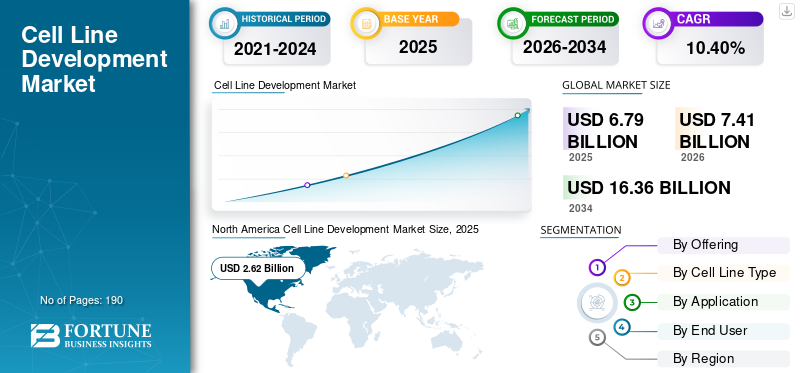
The global cell line development market size was valued at USD 6.79 billion in 2025. The market is projected to grow from USD 7.41 billion in 2026 to USD 16.36 billion by 2034, exhibiting a CAGR of 10.40% during the forecast period. North America dominated the cell line development market with a market share of 38.58% in 2025.
The global market comprises stable and high-performing cell lines used to produce various biologics, vaccines, monoclonal antibodies and recombinant proteins among other advanced therapies. These solutions help pharmaceutical and biotechnology companies improve productivity, reduce development timelines, and maintain consistency in biologics manufacturing. Also, the increased demand for complex biologics, biosimilars, and cell and gene therapies is encouraging companies to adopt advanced host cell systems. These factors are making cell line development an important part of upstream bioprocessing and supporting partnerships between technology providers, CDMOs, and drug developers.
- For instance, in August 2025, WuXi Biologics launched WuXia293 Stable, a HEK293 stable cell line platform for the development and manufacturing of difficult-to-express molecules. The platform was designed to support high titers, robust stability, and scalable manufacturing, which highlights how companies are investing in advanced cell line platforms to improve biologics development efficiency.
Furthermore, key players, such as Thermo Fisher Scientific Inc., Lonza Group AG, Sartorius AG, and WuXi Biologics, are actively participating in new product launches, strategic collaborations and acquisitions, as well as investment initiatives to expand their market presence.
Download Free sample to learn more about this report.
Cell Line Development Market KEY TAKEAWAYS
 Global Market Size & Forecast
- 2025 Market Size: USD 6.79 billion
- 2026 Market Size: USD 7.41 billion
- 2034 Forecast Market Size: USD 16.36 billion
- CAGR: 10.40% during 2026-2034
 Market Share
- North America dominated the global market with a 38.58% share in 2025.
- Mammalian Cell Lines dominated the cell line type segment in 2025.
- Bioproduction held the largest application segment share in 2025.
 Key Regional Highlights
North America
Dominated the market with a valuation of USD 2.62 billion in 2025.
Europe
It is projected to grow at an 8.48% CAGR and reach USD 2.17 billion in 2026.
Asia Pacific
Estimated to reach USD 1.94 billion in 2026, supported by rising biologics manufacturing capacity.
U.S.
The market is estimated at approximately USD 2.63 billion in 2026, accounting for roughly 35.52% of global sales.
Japan
The market is estimated at approximately USD 0.81 billion in 2026, accounting for around 10.87% of global sales.
Read More

CELL LINE DEVELOPMENT MARKET TRENDS
Rising Demand for Biologics is Strengthening Need for High-Performance Cell Lines
The global market is gaining strong importance as biologics continue to become a major part of the pharmaceutical pipeline. Biologics such as monoclonal antibodies, recombinant proteins, fusion proteins, and complex therapeutic proteins, require stable and high-yielding cell lines to support consistent production. As more companies develop complex biologics, the need for cell lines that can improve productivity, maintain product quality, and support scalable manufacturing is increasing. This is encouraging biopharmaceutical companies and CDMOs to invest in advanced and targeted integration-based platforms that can reduce development timelines and improve manufacturing reliability. As a result, the rising demand for biologics and biosimilars is strengthening the adoption of high-performance cell line development solutions in various commercial workflows.
- For instance, in September 2025, WuXi Biologics launched TrueSite TI, a targeted integration-based CHO cell line platform under its WuXia 4.0 platform family. The platform is designed to accelerate biologics development by improving titer, product quality, cell line stability, and scalability for antibody and complex protein therapies, showing how biologics demand is pushing companies to develop stronger cell line platforms.
MARKET DYNAMICS
MARKET DRIVERS
Download Free sample to learn more about this report.
Rising Investment in Biopharmaceutical Manufacturing is Supporting Market Growth
The global market is growing as pharmaceutical and biotechnology companies continue to increase investment in biologics manufacturing capacity. As companies expand biologics facilities and expand their advanced biomanufacturing technologies, the need for reliable production cell lines increases. This creates stronger demand for market. Therefore, rising investment in biopharmaceutical manufacturing directly supports market growth by increasing the number of biologics programs moving from development to clinical and commercial production.
- For instance, in September 2025, Amgen Inc invested USD 650.0 million for expansion of its U.S. manufacturing network to support increased drug production at its biologics manufacturing facility in Juncos. The investment integrated advanced technologies across operations and strengthen its U.S. biomanufacturing and global supply chain, highlighting the need for strong upstream development capabilities, including cell line development.
MARKET RESTRAINTS
Strict Cell Substrate Characterization Requirements May Slow Market Adoption
Strict regulatory requirements for cell substrate characterization are a major factor restraining market growth. Developers need to prove the identity, purity, stability, safety, and suitability of cell banks before they can be used in regulated production. This increases testing needs, documentation burden, development cost, and approval timelines, especially for small biotechnology companies with limited regulatory and analytical capabilities. As regulators expect detailed evidence on cell line origin, cell bank characterization, genetic stability, adventitious agent testing, and manufacturing consistency, companies may face longer development cycles and higher regulatory compliance costs. Therefore, while demand for advanced cell line platforms is rising, the regulatory burden linked to cell substrate qualification can slow commercialization and limit faster adoption across early-stage developers.
- For instance, in January 2025, BioProcess International reported that the FDA cited contamination concerns at Sanofi’s Framingham biologics facility. The article noted that around 20% of bioreactor runs over 30 months were rejected due to contamination issues. The instance highlights contamination risk in biologics manufacturing, leading to rejected production runs, higher costs, quality investigations, and operational delays.
MARKET OPPORTUNITIES
Expansion of Cell and Gene Therapy Manufacturing is Opening New Growth Avenues
The global cell line development market growth is expected to gain strong momentum through opportunities from the rapid expansion of cell and gene therapy manufacturing. These therapies need reliable production systems for viral vectors, plasmids, engineered cells, recombinant proteins, and other complex biological materials. As many gene therapy programs use HEK293 and other specialized cell lines for AAV and lentiviral vector production, the demand for high-yield, scalable, and stable cell line platforms is increasing. This creates opportunities for cell line developers, media suppliers, technology providers, and CDMOs to offer integrated solutions that reduce production bottlenecks, improve vector yield, and support commercial-scale manufacturing. As a result, the shift from research-scale advanced therapies to clinical and commercial production is creating new demand for specialized cell line development solutions.
- For instance, in May 2025, NewBiologix granted ReciBioPharm, a non-exclusive license to its Xcell-Eng-HEK293 cell lines for the development and manufacture of AAV therapeutics. The development provided company access to engineered HEK293 cell lines for advanced therapies, highlighting how cell and gene therapy manufacturing is creating opportunities for specialized cell line platforms. Such developments are expected to rise market
MARKET CHALLENGES
Long Development Timelines for Stable Clone Selection Create Commercialization Delays and Remain a Significant Challenge
One of the key challenges for the market is long development timelines for stable clone selection. The process involves several time-consuming steps, including host cell selection, vector design, transfection, selection pressure, single-cell cloning, productivity screening, stability testing, and cell banking. Each step requires repeated testing to confirm that the selected clone can deliver consistent yield, quality, and genetic stability. As a result, companies may face delays in moving biologic candidates from discovery to clinical manufacturing, which increases project cost and affects speed-to-market.
- For instance, in February 2024, Springer Nature Link published an article titled ‘From Efficiency to Yield: Exploring Recent Advances in CHO Cell Line Development for Monoclonal Antibodies’ that stated that existing platforms for developing stable high-producing cell lines have shown inefficiencies, leading to inconsistencies in yield, growth characteristics, and final product quality attributes. These challenges create pressure on manufacturers to adopt faster and more reliable screening platforms.
Segmentation Analysis
By Offering
Services Segment Dominate as Biopharma Companies Prefer Faster Outsourced Cell Line Development
Based on offering, the market is categorized into instruments {cell counters, isolation systems, clone screening platforms, cell analysis platforms, centrifuges, bioreactors, and others}, consumables {reagent and kits, cell culture media, functional additives, feeds and supplements, expression vectors, and others}, services, and software/platforms.
The services segment dominates the market as many pharmaceutical and biotechnology companies outsource cell line development to CROs and CDMOs. As stable clone generation, productivity screening, cell banking, media optimization, analytical testing, and regulatory documentation need specialized infrastructure and experienced teams. Outsourcing helps companies reduce development timelines, manage technical risk, and access advanced platforms for complex biologics. As a result, service providers account for a major share of market revenue, especially as early-stage biotech firms and mid-sized biopharma companies prefer integrated development support.
- For instance, in December 2025, AGC Biologics partnered with ATUM to integrate ATUM’s Leap-In Transposase expression platform into AGC Biologics’ Cell Line Development Center of Excellence. The company stated that the offering was designed to give drug developers flexible cell line development options for monoclonal antibodies, multispecifics, and complex molecules, showing how outsourced service models are strengthening the market.
The software/platforms segment is expected to grow at a CAGR of 17.51% over the forecast period.
To know how our report can help streamline your business, Speak to Analyst
By Cell Line Type
Mammalian Cell Lines Segment Led Due to their Strong Use in Complex Biologics Production
Based on cell line type, the market is segmented into mammalian cell lines {CHO cell lines, HEK293 cell lines, vero cell lines, hybridoma cell lines, and others} and non-mammalian cell lines {microbial cell lines, insect cell lines, and others}.
In 2025, the mammalian cell lines segment dominated the global cell line development market share as most high-value biologics require human-like protein folding, glycosylation, and post-translational modification. CHO and HEK293 cells are widely used for monoclonal antibodies, recombinant proteins, fusion proteins, enzymes, viral vectors, and other complex therapeutic molecules. As biologics pipelines continue to expand, companies are investing in improved CHO and HEK293 systems to increase yield, stability, scalability, and product quality. Therefore, mammalian cell lines hold the leading share due to their direct fit with commercial biologics manufacturing requirements.
- For instance, in September 2025, WuXi Biologics launched TrueSite TI, a targeted integration-based CHO cell line platform under its WuXia 4.0 platform family. The company stated that the platform was designed to improve titer, product quality, stability, and scalability for antibody and complex protein therapies, highlighting why mammalian cells remain central to biologics development.
The non-mammalian cell lines segment is projected to grow at a 9.42% CAGR during the forecast period.
By Application
Bioproduction Segment Dominated as Cell Lines are Core to Biologics Manufacturing
Based on application, the market is segmented into bioproduction {monoclonal antibody production, recombinant protein production, vaccine production, gene therapy & viral vector production, tissue engineering & regenerative medicine, and others}, diagnostics & assay development, drug discovery & toxicity testing, and others.
The bioproduction segment captured the largest share in the market. Cell line development is primarily used to generate stable production systems for commercial biologics and biosimilars. Bioproduction requires cell lines that can deliver high productivity, consistent product quality, genetic stability, and scalable performance from research batches to GMP manufacturing. The increasing number of monoclonal antibodies, recombinant proteins, fusion proteins, and cell and gene therapy products is therefore pushing companies to invest in stronger production cell lines.
- For instance, in January 2026, Aragen Biologics launched CHOMax, a new cell line development and early manufacturing platform. The new platform supports an integrated path from DNA to IND-enabling clinical supply for suitable standard IgG monoclonal antibodies.
The diagnostics & assay development segment is projected to grow at a CAGR of 10.05% during the forecast period.
By End User
Pharmaceutical & Biotechnology Companies Led Due to Strong Biologics Pipeline Ownership
Based on end user, the market is segmented into pharmaceutical & biotechnology companies, CROs & CDMOs, academic & research institutes, cell banks & bioproduction facilities, and others.
The pharmaceutical & biotechnology companies segment held the largest share in 2025. They are the primary decision-makers for selecting host cell systems, cell line platforms, development partners, and upstream bioprocessing workflows. Their projects require GMP readiness, scalability, and regulatory-compliant cell banking. This keeps them as the leading end user segment.
- For instance, in January 2025, Samsung Biologics highlighted its position as a fully integrated, end-to-end CDMO offering development and manufacturing solutions from cell line development to final aseptic fill-finish. This reflects how pharma and biotech companies increasingly rely on integrated development partners to move biologic assets from cell line development into clinical and commercial manufacturing.
The CROs & CDMOs segment is projected to grow at a CAGR of 12.54% over the forecast period.
Cell Line Development Market Regional Outlook
By geography, the market is categorized into Europe, North America, Asia Pacific, Latin America, and the Middle East & Africa.
North America
North America Cell Line Development Market Size, 2025 (USD Billion)
To get more information on the regional analysis of this market, Download Free sample
North America held the dominant share in 2024 at USD 2.42 billion and maintained its leading position in 2025 at USD 2.62 billion. The North America market is growing due to strong biologics R&D, a high presence of pharmaceutical and biotechnology companies, and wider outsourcing to CDMOs for faster cell line development. The region also benefits from advanced biomanufacturing infrastructure and early adoption of CHO, HEK293, automation, and high-throughput screening platforms.
U.S. Cell Line Development Market
Given North America's substantial contribution and the U.S. dominance in the region, the U.S. market is estimated at around USD 2.63 billion in 2026, accounting for roughly 35.52% of the global market.
Europe
Europe is projected to grow at 8.48% over the coming years, the second-highest among all regions, and reach a valuation of USD 2.17 billion by 2026. Growth in European countries is supported by strong biosimilar development, expanding biologics manufacturing, and increasing regulatory focus on consistent and well-characterized production cell lines.
U.K. Cell Line Development Market
The U.K. market is estimated at USD 0.49 billion in 2026, accounting for roughly 6.61% of the global market.
Germany Cell Line Development Market
Germany's market is projected to reach approximately USD 0.46 billion in 2026, equivalent to around 6.18% of the global market.
Asia Pacific
Asia Pacific is estimated to reach USD 1.94 billion in 2026 and secure third place in the market. The region is growing faster due to rising biologics manufacturing capacity, increasing biotech investments, and cost-efficient CDMO expansion in China, India, South Korea, and Japan.
Japan Cell Line Development Market
The Japanese market is estimated at around USD 0.81 billion in 2026, accounting for approximately 10.87% of the global market.
China's Cell Line Development Market
China's market is projected to be among the largest globally, with 2026 revenues estimated at around USD 0.56 billion, accounting for approximately 7.54% of global sales.
India Cell Line Development Market
The Indian market is estimated at around USD 0.22 billion in 2026, accounting for roughly 3.03% of global revenue.
Latin America and Middle East & Africa
The Latin America and Middle East & Africa regions are expected to witness growth in this market during the forecast period and are estimated to reach a valuation of USD 0.27 billion and USD 0.20 billion respectively. The growth in Latin America and the Middle East is driven by improving biopharmaceutical manufacturing capabilities, rising demand for affordable biologics and biosimilars, and gradual expansion of local research and diagnostic infrastructure.
GCC Cell Line Development Market
The GCC market is set to reach USD 0.13 billion in 2026.
South Africa Cell Line Development Market
The South African market is projected to reach approximately USD 0.05 billion by 2026, accounting for roughly 0.65% of global revenue.
COMPETITIVE LANDSCAPE
Key Industry Players
New Product Launches and Strategic Platform Development to Strengthen Market Progress
The presence of large life science companies, biologics CDMOs, cell culture technology providers, and specialized expression platform developers characterizes the global market. Key companies are focusing on improving stable cell line generation, strengthening CHO and HEK293 expression systems, reducing clone selection timelines, and supporting scalable biologics manufacturing. The market is also witnessing rising investment in targeted integration platforms, automated clone screening, high-yield expression systems, and integrated development services as biologics, biosimilars, recombinant proteins, and advanced therapies continue to expand globally.
- For instance, in April 2026, Thermo Fisher Scientific Inc. launched a next-generation integrated cell line development platform, including the Gibco CHOvantage GS Cell Line Development Kit. The platform is designed to help biologics developers accelerate time to clinic while maintaining regulatory confidence and commercial scalability, highlighting how product innovation is supporting faster biologics development.
Major players such as Thermo Fisher Scientific Inc., Lonza Group AG, Sartorius AG, WuXi Biologics, Merck KGaA, Samsung Biologics Co., Ltd., Catalent, Inc., KBI Biopharma, AGC Biologics, are actively competing based on platform strength, service depth, host cell expertise, technology integration, and global development capacity. Companies with strong CHO platforms, validated cell culture workflows, scalable biomanufacturing support, regulatory experience, and end-to-end CDMO capabilities are expected to maintain a leading position in the market. Also, growing demand for complex biologics and difficult-to-express molecules is encouraging key players to develop specialized cell line development technologies that improve productivity, reduce development risk, and support commercial manufacturing readiness.
LIST OF KEY CELL LINE DEVELOPMENT MARKET COMPANIES PROFILED IN REPORT
- Thermo Fisher Scientific Inc. (U.S.)
- Lonza Group AG (Switzerland)
- Sartorius AG (Germany)
- WuXi Biologics (China)
- Merck KGaA (Germany)
- Danaher Corporation (U.S.)
- Samsung Biologics Co., Ltd. (South Korea)
- Catalent, Inc. (U.S.)
- KBI Biopharma, Inc. (U.S.)
- AGC Biologics (U.S.)
KEY INDUSTRY DEVELOPMENTS
- April 2026: OneCyte partnered with Kemp Proteins to deliver high-performance cell line development services for next-generation biologics, combining high-throughput single-cell analysis with protein engineering and expression solutions.
- December 2025: CHITOSE, in collaboration with FUJIFILM Corporation, combined CHITOSE’s CHO-MK cell line development expertise with FUJIFILM Biosciences’ GMP-manufactured culture media capabilities. CHITOSE’s expertise in cell line development using the established CHO-MK cells aligns with FUJIFILM Biosciences' advanced culture media development and manufacturing capabilities.
- December 2025: AGC Biologics expanded its Cell Line Development Center of Excellence by partnering with ATUM to integrate the Leap-In Transposase expression platform within its offerings. The partnership provided drug developers with technology designed to increase yields and significantly shorten the path to clinical trials, addressing the need for speed and efficiency.
- October 2025: INITS collaborated with FyoniBio to provide biotech companies with an integrated path from R&D to GMP-compliant clinical production, combining FyoniBio’s cell line and process development expertise with INITS’ GMP production capabilities.
- October 2025: Rentschler Biopharma announced that it would introduce the Rentschler Expression Platform for accelerated timelines in cell line development while expanding its services in Japan and South Korea
REPORT COVERAGE
The report provides a detailed global cell line development market analysis. It focuses on key aspects, including major offerings, cell line types, applications, end users, and regional market performance. The report further evaluates market trends, drivers, restraints, opportunities, challenges, and the competitive landscape across major regions. It also highlights key industry developments, technology advancements, strategic partnerships, and company initiatives that are expected to shape the growth of the global market during the forecast period.
Request for Customization to gain extensive market insights.
Report Scope & Segmentation
| ATTRIBUTE | DETAILS |
| Study Period | 2021-2034 |
| Base Year | 2025 |
| Estimated Year | 2026 |
| Forecast Period | 2026-2034 |
| Historical Period | 2021-2024 |
| Growth Rate | CAGR of 10.40% from 2026 to 2034 |
| Unit | Value (USD Billion) |
| Segmentation | By Offering, Cell Line Type, Application, End User, and Region |
| By Offering |
|
| By Cell Line Type |
|
| By Application |
|
| By End User |
|
| By Region |
|
Frequently Asked Questions
According to Fortune Business Insights, the global market value stood at USD 6.79 billion in 2025 and is projected to reach USD 16.36 billion by 2034.
In 2025, the North America’s market value stood at USD 2.62 billion.
The market is expected to grow at a CAGR of 10.40% over the forecast period.
The services segment leads the market.
Rising biologics pipeline is driving demand for advanced cell line development.
Thermo Fisher Scientific Inc., Lonza Group AG, Sartorius AG, and WuXi Biologics are the top players in the market.
North America accounted for the largest market share in 2025.



- 2021-2034
- 2025
- 2021-2024
- 190
Get 30-60 hrs Free Customization
Expand Regional and Country Coverage, Segments Analysis, Company Profiles, Competitive Benchmarking, and End-user Insights.













.webp)






Related Reports
-
US +1 833 909 2966 ( Toll Free )
-
Get In Touch With Us