Chickpea Protein Market Size, Share & Industry Analysis, By Type (Chickpea Protein Isolate, Chickpea Protein Concentrate, and Flour), By Form (Powder and Liquid), By Nature (Organic and Conventional), By Application (Food & beverages {Dairy alternatives, Meat alternatives, Bakery & Snacks, Beverages, and Others}, Nutraceuticals & Dietary Supplements, Animal Feed & Pet Food, and Others), and Regional Forecast, 2026-2034
 Download Free Sample
(Offer valid till 15th Oct 2026)

KEY MARKET INSIGHTS
 Listen to Audio Version
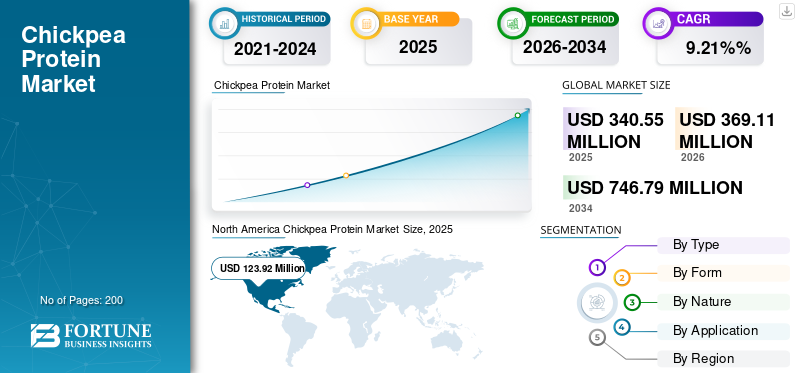
The global chickpea protein market size was valued at USD 340.55 million in 2025. The market is projected to grow from USD 369.11 million in 2026 to USD 746.79 million by 2034, exhibiting a CAGR of 9.21% during the forecast period. North America dominated the global chickpea protein market with a market share of 36.39% in 2025.
Chickpea protein is one of the emerging protein options within the plant-based proteins. Chickpea protein is a high-quality, plant-based protein from garbanzo beans. It is a versatile ingredient, offering benefits such as muscle support, fiber, iron, and B vitamins, and is often used in vegan food products, powders, and baked goods due to its mild taste and excellent emulsifying properties. Rising vegan diets among adults, coupled with the emerging popularity of plant-derived protein alternatives to animal products such as whey and meat, increasing health-conscious consumers and changing consumer preferences, to drive the market growth in the upcoming years. Additionally, key players are focusing on product development, raising funds for investments, and geographical market expansion to drive the market in the near future.
Key players are accelerating innovation and expanding their channel reach to capitalize on this momentum. Leading companies such as Ingredion Inc., Roquette Freres, Archer Daniels Midland, STDM FOOD and Beverages Pvt.Ltd, and VW-Ingredients are focusing on developing new products to meet the product demand.
Download Free sample to learn more about this report.
Chickpea Protein Market Key Takeaways
 Market Size & Forecast
- 2025 Market Size: USD 340.55 million
- 2026 Market Size: USD 369.11 million
- 2034 Forecast Market Size: USD 746.79 million
- CAGR: 9.21% from 2026-2034
 Market Share
- North America dominated the chickpea protein market with a 36.39% share in 2025.
- The chickpea protein isolate segment is projected to register a CAGR of 11.44% during the forecast period.
- The liquid segment is expected to grow at a CAGR of 11.60% from 2026 to 2034.
 Key Regional Highlights
North America
North America was valued at USD 123.92 million in 2025 and is expected to grow at a CAGR of 9.24% during the forecast period.
Europe
Europe accounted for USD 99.00 million in 2025 and is projected to expand at a CAGR of 8.78%.
Asia Pacific
Asia Pacific reached USD 80.45 million in 2025 and is anticipated to grow at the fastest CAGR of 10.18%.
U.S.
Strong demand for high-protein vegan supplements is driving market growth.
Japan
Rising consumer preference for plant-based nutrition is supporting market expansion.
Read More

MARKET DYNAMICS
Market Drivers
Increasing Plant-based Protein Consumption to Drive Market Growth
Over the past decade, a significant shift toward a plant-based diet has emerged across key markets, including the U.S., Europe, and Australia. It is also emerging rapidly in developing markets, such as India and Brazil, among others. Chickpea protein offers superior digestibility, a neutral flavor, and a favorable amino acid balance compared to many alternative pulses, making it increasingly preferred in dairy alternatives, meat substitute, bakery products, beverages, and nutritional supplements. Manufacturers are leveraging chickpea protein to enhance the texture, emulsification, foaming, and moisture retention properties, thereby improving sensory performance across multiple applications.
- According to the Good Food Institute, the plant-based proteins powder and liquid sales in the U.S. retail market have increased 9% from 2022 to 2023 and 11% from 2023 to 2024. Additionally, sales of plant-based proteins have increased by more than 21% over the past two years, from 2022 to 2024, and reached USD 450 million in 2024.
Market Restraints
Poor Infrastructure and High Cost to Hamper Market Growth
Unlike soy and pea protein production, chickpea protein production is not significantly standardized in key producing countries such as India, Australia, and Russia. Despite India being the world's largest chickpea producer, there is a shortage of large-scale domestic facilities dedicated to advanced processing, such as protein extraction. The existing infrastructure is often designed for traditional uses, such as flour and split pulses, rather than high-value protein isolates required for the alternative protein market. To develop advanced infrastructure, higher investments will be required. Only a handful of commercial manufacturers produce chickpea proteins, resulting in higher processing costs, limited availability, and slower supply chain scalability. This constraint restricts adoption in large-volume applications such as beverages, dairy alternatives, and functional foods.
Market Opportunities
Increasing Research & Developments is Positively Driving Market
Over the last decade, industry players have invested substantial funds in various plant-based protein products, as demand for the plant-based food category is emerging globally. Along with the key manufacturers, several agriculture associations and farmers' development organizations are actively involved in research & development activities to bring more value to their agriculture products. Chickpea is one of the emerging ingredients in the plant-based protein supplements sector. Thus, organizations are developing new technologies and extraction methods to obtain the maximum protein content from available raw materials. It will create a new opportunity for the industry.
- In July 2024, the Brazilian Agricultural Research Corporation (EMBRAPA), one of Brazil's renowned agricultural research institutions, recently launched its latest advancements: lentil and chickpea protein concentrates. The recently developed chickpea protein concentrates contain 73% chickpea concentrate. They are designed to enhance the protein content in foods such as burgers and plant-based beverages.
Chickpea Protein Market Trends
Emerging Startups to Develop New Products to Shape Industry
The global market is being significantly reshaped by a new wave of startups that are accelerating innovation across ingredient technology, product formulation, and application diversification. Additionally, plant-based food manufacturers are utilizing chickpeas to produce protein-rich products, including tofu and meat alternatives. Overall, emerging startups are transitioning chickpea protein from a niche pulse ingredient to a mainstream functional protein category, driving product innovation, accelerating technology advancements, and expanding commercial adoption across regions. The adoption of innovative processing techniques and new product developments is expected to drive the chickpea protein market growth sales in the upcoming years.
- In September 2025, THIS, a U.K.-based vegan food manufacturer, collaborated with a German-based startup, Omami, to launch a new range of vegan tofu made from chickpea protein.
Download Free sample to learn more about this report.
SEGMENTATION ANALYSIS
By Type
Versatile Applications and Easy Availability to Drive Flour Segment Growth
By type, the market is segmented into chickpea protein isolate, chickpea protein concentrate, and flour.
In 2025, the flour segment accounted for USD 203.06 million, representing 59.63% of global sales. Chickpea protein flour maintains the largest market share due to its cost-efficiency, broad functional versatility, mature supply chain, and strong integration into mainstream food applications. It is used significantly in bakery mixes, snacks, and gluten-free products.
The chickpea protein isolate segment is projected to be the fastest-growing segment during the forecast period, with a CAGR of 11.44% in 2026.
To know how our report can help streamline your business, Speak to Analyst
By Form
Convenience and Wide Availability to Drive Powder Segment Growth
On the basis of form, the market is segmented into powder and liquid.
The powder segment generated approximately USD 323.79 million in 2025, accounting for around 95.08% of total sales. The powder segment dominates the market with a significant share. A larger proportion of commercial chickpea proteins, such as isolates, concentrates, flours, and textured forms, are supplied in a dry form for bakery, snacks, meat substitutes, and mixes. Furthermore, this form can be easily stored for a longer period and is more convenient for use in multiple end-use applications, such as bakery, meat alternatives, and supplements.
The liquid segment is expected to grow at a CAGR of 11.60% during the forecast period for the global market, from 2026 to 2034.
By Nature
Low Price and High Availability of Raw Materials to Drive Conventional Category
On the basis of nature, the market is segmented into conventional and organic.
The conventional segment generated approximately USD 310.91 million in 2025, accounting for around 91.30% of total sales. The powder segment dominates the market with a significant share. Conventional chickpea protein is significantly more cost-effective to produce due to the wider availability of conventionally grown chickpeas, lower input costs and higher crop yields compared with organic farming. As a result, manufacturers prefer conventional chickpea to produce the protein product.
The organic segment is expected to grow at a CAGR of 11.06% during the forecast period for the global market, from 2026 to 2034.
By Application
Functional Properties making Product Popular in Food & Beverages Industry
On the basis of the application, the market is segmented into food & beverages, nutraceuticals & dietary supplements, animal feed & pet food, and others. The food and beverages segment is further categorized into dairy alternatives, meat alternatives, bakery & snacks, beverages, and others.
The food & beverages segment represented the largest market share in 2025, valued at USD 256.26 million, capturing more than 75% of the global market share. Chickpea protein offers strong functional benefits, such as emulsification, foaming, binding, and a naturally mild flavor, making it suitable for dairy alternatives, plant-based meat, bakery products, snacks, and protein-fortified beverages. As consumer demand rises for clean-label, allergen-free, and plant-based products, food manufacturers increasingly prefer chickpea protein over other substitutes. It will further drive the product demand in the industry.
The nutraceuticals & dietary supplements segment is anticipated to grow at a CAGR of 10.81% during the forecast period.
Chickpea Protein Market Regional Outlook
Regionally, the report covers the global market analysis across North America, Europe, Asia Pacific, South America, and the Middle East & Africa.
North America
North America Chickpea Protein Market Size, 2025 (USD Million) To get more information on the regional analysis of this market, Download Free sample
North America was the largest regional market in 2025, valued at around USD 123.92 million, or roughly 36.39% of global chickpea protein sales, and is expected to grow at a 9.24% CAGR. The strong adoption of plant-based diets, advanced product innovations in dairy and meat alternatives, and high penetration of clean-label, allergen-free foods are key factors driving the market in the region. Additionally, the widespread use of consumers and the presence of ingredient suppliers for high-protein vegan supplements in the U.S., Canada, and Mexico drive the industry growth.
Europe
Europe, at approximately USD 99.00 million in 2025, is projected to expand at a 8.78% CAGR. The rising demand for sustainable food and allergen-free proteins, coupled with regulatory pressure to reduce reliance on soy and animal-based proteins, supports the accelerated growth in product demand. Additionally, the adoption of plant-based dairy and bakery products, driven by increasing interest in organic, non-GMO, and minimally processed proteins.
Asia Pacific
Asia Pacific accounted for close to USD 80.45 million in 2025 and will be the fastest-growing region with a 10.18% CAGR. Rapid urbanization, rising disposable incomes, and increasing demand for healthier and plant-forward foods are driving robust growth. The region benefits from high chickpea consumption in South Asia and expanding R&D investment for new plant-based formats in East and Southeast Asia.
South America
South America generated approximately USD 25.03 million in 2025 and is projected to grow at an 8.26% CAGR. Increasing awareness of plant-based nutrition, expanding snack and bakery industries, and growing interest in lactose-free and gluten-free foods contribute to rising demand, particularly in Brazil and Argentina
Middle East & Africa
The Middle East & Africa, while accounting for a smaller share at approximately USD 12.14 million in 2025, is projected to grow at a 7.33% CAGR. The high prevalence of vegetarian diets in specific markets, rising health consciousness, and the growing application of chickpea ingredients in traditional foods support steady market expansion. GCC countries are emerging as early adopters of clean-label and protein-enriched food innovations, providing new commercial opportunities for ingredient suppliers
COMPETITIVE LANDSCAPE
Key Industry Players
New Product Development and Base Expansion Assist to Achieve Strong Industry Dominance
The global chickpea protein market share is moderately fragmented, with the presence of a few leading players and numerous emerging players. As the industry demographic shifts toward vegan supplements, multiple new entrants are entering the industry with innovative product options. Furthermore, these new entrants are securing investments from multiple investors globally, creating more competitive challenges for the leading players. Thus, the leading players are focusing on expanding their geographical presence and acquiring small-scale producers to procure a strong market share in the upcoming years. Ingredion Inc., Roquette Frères, Archer Daniels Midland, STDM FOOD and Beverages Pvt. Ltd, and VW-Ingredients are a few leading players emphasizing geographical expansion, new product development, and merger & acquisition activities globally.
- For instance, in February 2022, Ingredion Inc. invested in an Israeli company, InnovoPro, to develop chickpea protein products. Additionally, the company expanded its plant-based protein production facility to New Jersey, investing USD 75 million in November 2024 to increase chickpea protein production.
Key Players in the Chickpea Protein Market
|
Rank |
Company Name |
|
1 |
Ingredion Inc. |
|
2 |
Roquette Freres |
|
3 |
Archer Daniels Midland |
|
4 |
STDM FOOD and Beverages Pvt.Ltd |
|
5 |
VW-Ingredients. |
List of Key Chickpea Protein Companies Profiled:
- Ingredion Inc. (U.S.)
- Archer Daniels Midland (U.S.)
- STDM FOOD and Beverages Pvt.Ltd (India)
- VW-Ingredients (Netherlands)
- ChickP Protein Ltd. (Israel)
- PLT Health Solutions (U.S.)
- Chickplease (U.S.)
- Relsus Pte Ltd. (Singapore)
- Roquette Frères. (France)
- AGT Food & Ingredients Inc (Canada)
KEY INDUSTRY DEVELOPMENTS
- September 2025: Shandi Global, a Singapore-based food-tech company, launched Chanza, a plant-based protein made from whole chickpeas, in India. The new product, designed to replicate the texture of meat or paneer, is free from soy, gluten, and artificial binders.
- September 2025: Chickapea, an emerging manufacturer of organic dried pasta made from chickpea and yellow pea, raised CAD 4.25 million (approximately USD 3 million) from the investors' funding led by FCC Capital, InvestEco, and AGT Foods. The funding will enable the company to expand its product offerings and increase its geographical presence in North America.
- November 2023: ChickP Ltd., a chickpea protein manufacturing company, launched 90% chickpea protein isolate for active nutrition consumers at Fi Europe in Frankfurt, Germany.
- September 2023: Symrise AG, one of the leading food ingredients manufacturers in the world, enhanced its product offerings by launching a range of diana foodTM chickpea and aquafaba ingredients with multiple benefits. All these newly launched products are developed for plant-based food products with clean label options.
- November 2022: Ingredion Incorporated, a leading global provider of ingredient solutions to the food manufacturing industry, signed an exclusive commercial distribution partnership with InnovoPro, a leading Foodtech chickpea solutions company, to distribute a chickpea protein concentrate in the U.S. and Canada.
REPORT COVERAGE
The global chickpea protein industry report provides in-depth analysis of the market, highlighting key aspects such as global market trends, market dynamics, prominent companies, research and development investments, and end-use applications. Besides this, the report also provides insights into the global market growth analysis and highlights significant industry developments.
Request for Customization to gain extensive market insights.
Report Scope & Segmentation
|
ATTRIBUTE |
DETAILS |
|
Study Period |
2021-2034 |
|
Base Year |
2025 |
|
Estimated Year |
2026 |
|
Forecast Period |
2026-2034 |
|
Historical Period |
2021-2024 |
|
Growth Rate |
CAGR of 9.21% from 2026 to 2034 |
|
Unit |
Value (USD Million) |
|
Segmentation |
By Type
|
|
By Form · Powder · Liquid |
|
|
By Nature · Conventional · Organic |
|
|
By Application · Food & beverages o Dairy alternatives o Meat alternatives o Bakery & snacks o Beverages o Others · Nutraceuticals & dietary supplements · Animal Feed & Pet Food · Others |
|
|
By Region · North America (By Type, Form, Nature, Application, and Country) • U.S. (By Type) • Canada (By Type) • Mexico (By Type) · Europe (By Type, Form, Nature, Application, and Country) • Germany (By Type) • Spain (By Type) • Italy (By Type) • France (By Type) • U.K. (By Type) • Rest of Europe (By Type) · Asia Pacific (By Type, Form, Nature, Application, and Country) • China (By Type) • Japan (By Type) • India (By Type) • Australia (By Type) • Rest of Asia Pacific (By Type) · South America (By Type, Form, Nature, Application, and Country) • Brazil (By Type) • Argentina (By Type) • Rest of South America (By Type) · Middle East & Africa (By Type, Form, Nature, Application, and Country) • South Africa (By Type) • UAE (By Type) • Rest of the Middle East & Africa (By Type) |
Frequently Asked Questions
Fortune Business Insights says that the global market was USD 340.55 million in 2025 and is anticipated to reach USD 746.79 million by 2034.
At a CAGR of 9.21% , the global market will exhibit steady growth over the forecast period.
By type, the flour segment leads the market.
North America held the largest market share in 2025.
The increasing plant-based protein consumption to drive the market growth.
Ingredion Inc., Roquette Freres, Archer Daniels Midland, STDM FOOD and Beverages Pvt. Ltd, and VW-Ingredients are the leading companies in the market.
Emerging startups to develop new products to shape the industry.



- 2021-2034
- 2025
- 2021-2024
- 200
-
(Offer valid till 15th Oct 2026)
Get 30-60 hrs Free Customization
Expand Regional and Country Coverage, Segments Analysis, Company Profiles, Competitive Benchmarking, and End-user Insights.



















-
US +1 833 909 2966 ( Toll Free )
-
Get In Touch With Us