Clean Label Mold Inhibitors Market Size, Share & Industry Analysis, By Active Inhibitory System (Organic Acidification {Acetic Acid, Citric Acid, and Others}, Bio-Fermentation {Cultured Wheat Flour, and Others}, Plant-Based Antimicrobial Extracts {Rosemary Extract, Green Tea Extract, and Others}), By Form (Dry, Liquid, and Encapsulated), By End-Use (Bakery & Confectionery, Dairy & Dairy-Alternative Products, Processed & Ready-to-Eat Foods, Beverage, and Others), and Regional Forecast, 2026-2034
 Download Free Sample
(Offer valid till 30th Sep 2026)

KEY MARKET INSIGHTS
 Listen to Audio Version
The global clean label mold inhibitors market size was valued at USD 1.49 billion in 2025. The market is projected to grow from USD 1.60 billion in 2026 to USD 2.87 billion by 2034, exhibiting a CAGR of 7.58% during the forecast period. Europe dominated the global market with a market share of 36.91% in 2025.
Clean label mold inhibitors are natural ingredients, such as fermented flours, vinegar, cultured dextrose, and plant extracts, that act as substitutes for synthetic preservatives. These are widely incorporated in bakery, beverages, RTE foods, and various food applications to prevent mold growth. The product is popular in the food & beverages industry and is also used in the animal feed and cosmetics industries. The increasing consumer demand for clean label products, coupled with consumer preference for minimally processed products, is significantly driving the market globally. Additionally, the increased focus of industry players on developing clean label products, the adoption of emerging technologies in the sector, and wide market acceptance are driving industry growth during the forecast period.
Corbion N.V., Kerry Group, DSM-Firmenich, International Flavors & Fragrances Inc., and Kemin Industries, Inc. are key players in the global market. They are deploying diversified strategies such as product launches, base expansions, mergers and acquisitions, and marketing activities to strengthen their market positions.
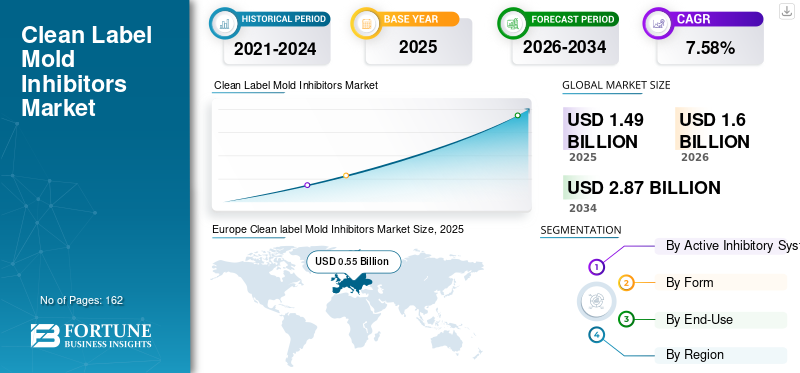
Download Free sample to learn more about this report.
Clean Label Mold Inhibitors Market Takeaways
 Global Market Size & Forecast
- 2025 Market Size: USD 1.49 billion
- 2026 Market Size: USD 1.60 billion
- 2034 Forecast Market Size: USD 2.87 billion
- CAGR: 7.58% from 2026–2034
 Market Share
- Europe dominated the clean label mold inhibitors market with a market share of 36.91% in 2025.
- Organic acidification segment dominated the market with a 44.18% share in 2025.
- Dry form segment dominated the clean label mold inhibitors market share, holding 58.61% in 2025.
 Key Regional Highlights
Europe
The European market held the dominant share in 2025, valued at USD 0.55 billion, and is also anticipated to maintain the leading share of 32.99% in 2026.
North America
The North America clean label mold inhibitors market was valued at USD 0.49 billion in 2025 and is expected to grow at a CAGR of 6.76% during the forecast period.
U.S.
The U.S. market was valued at USD 0.39 billion in 2025, representing roughly 26.13% of global clean label mold inhibitors revenues.
Asia Pacific
The Asia Pacific clean label mold inhibitors market was valued at USD 0.31 billion in 2025 and secured the position of the third-largest region in the market. China, India, and Japan collectively held a 69.88% share of the Asia Pacific market in 2025.
Japan
In 2026, the Japan market is estimated to be around USD 0.06 billion and is anticipated to grow at a CAGR of 7.24% during the forecast period.
Read More

CLEAN LABEL MOLD INHIBITORS MARKET TRENDS
Expanding Popularity for Clean label and Natural Food Products
Consumers are increasingly seeking products without artificial additives, thereby heightening the demand for clean label mold inhibitors. Synthetic preservatives are extensively used in bakery, dairy, beverages, sauces, and other processed foods applications and may potentially cause serious health issues, including allergies, asthma, hyperactivity in children, and neurological damage. As awareness of the risks associated with synthetic ingredients used in food products increases, individuals are seeking natural, organic, and clean label food products. This has led to a drive in the demand for clean label food preservation ingredients such as mold inhibitors. Thus, the use of the product in processed foods, fermented beverages, dairy products, and bakery applications is increasing. These factors are anticipated to propel the global clean label mold inhibitors market growth at a lucrative CAGR during the forecast period.
- According to the Castle Group, one of the key food ingredients manufacturing companies in Europe, 46% of millennials and 45% of Gen Z are willing to pay extra for clean label food products. These claims are based on the consumer survey conducted by the International Journal of Creative Research Thoughts in 2024.
Download Free sample to learn more about this report.
MARKET DYNAMICS
MARKET DRIVERS
Digital Transparency and Social Media Popularity to Drive the Market Growth
Digital platforms, such as Instagram and Facebook, among others, are playing a vital role in shaping the consumer buying behavior. These platforms are key tools for promoting and spreading awareness about clean label food products. Several studies show that social media influencers can have a substantial impact on consumer attitudes toward natural, clean label, organic, and plant-based products. Furthermore, the rising digital transparency has fundamentally altered the relationship between food companies and consumers. Through digital transparency, consumers can easily access detailed information about the product quality and check the ingredients used in it. Nowadays, more than one-third of consumers prefer to check the ingredient details before purchasing a product. Thus, key market players in the food industry are shifting to adopt healthy ingredients in their products, driving the global clean label mold inhibitors market growth.
- According to CBI Europe, in 2024, more than 47% of European shoppers are looking for labels that feel "closer to nature" such as natural, organic and clean label, and scan products to check ingredient details.
MARKET RESTRAINTS
Functional Challenges and Cost of the Products to Hamper the Market Growth
Despite strong demand, the market faces several structural and technical challenges. In comparison to synthetic substitutes, natural inhibitors such as vinegar, cultured wheat, or fermented flours contain higher moisture and have a limited shelf life. To maintain similar functional benefits, clean label mold inhibitors often require higher dosage levels, which can negatively impact taste, aroma, or texture, especially in bakery and dairy products.
Furthermore, natural and fermentation-based ingredients involve higher raw material, processing, and quality control costs, making it more expensive in the market. The higher costs are particularly challenging for price-sensitive markets and small to mid-scale food manufacturers. Thus, the technical challenges and higher price of the product are likely to restrict the market growth.
MARKET OPPORTUNITIES
Emerging Ready-to-Eat Product Demand to Push the Market Growth
In the post-COVID-19 era, consumers are significantly looking for the RTE foods and RTD beverages globally. Since then, companies have made significant investments in the innovation and development of ready-to-eat meals and convenience food products. Compared to home-cooked meals, ready-to-eat meals and convenience food products contain more food additives with functional properties. Natural inhibitors enhance the food functionality and help to preserve the product for a longer period. As clean label positioning becomes a mainstream requirement rather than a premium feature, food manufacturers are increasingly reformulating legacy products to eliminate synthetic preservatives, creating sustained demand for natural mold inhibitors.
- According to a consumer research survey conducted by Ingredion Inc. in Europe in 2024, 99% of European manufacturers consider clean label products essential to their business strategy, with 87% already introducing them to the market. These products are anticipated to make up over 70% of portfolios in 2025 and 2026, up from 52% in 2021.
Segmentation Analysis
By Active Inhibitory System
Affordability and Accessibility to Drive the Organic Acidification Segment Growth
By active inhibitory system, the market is segmented into organic acidification, bio-fermentation, and plant-based antimicrobial extracts.
The organic acidification segment dominated the market, accounting for a 44.18% share in 2025. The dominance is driven by the use of naturally derived acids such as acetic, lactic, citric, and propionic acids. This segment benefits from cost-effectiveness, simplicity, and broad regulatory approval, especially in bread, sauces, and beverages. Furthermore, it is widely available in the market and offers more technical flexibility to food manufacturers.
The bio-fermentation segment is anticipated to rise with a CAGR of 8.02% over the forecast period.
By Form
Wide Industrial Application and Higher Shelf Life to Drive the Dry Segment Growth
Based on form, the market is segmented into dry, liquid, and encapsulated.
The dry form segment dominated the clean label mold inhibitors market share, holding 58.61% in 2025. Dry mold inhibitors, including powdered fermented flours, cultured wheat, starch-based inhibitors, and dried organic acids, are extensively used in multiple food applications such as bakery, RTE foods, sauces, and others. Additionally, with reduced sensitivity to temperature and moisture, it has a higher shelf life. It offers consistent dosing accuracy and minimal impact on product texture or water activity, leading to the dominance of the segment.
The encapsulated segment is projected to grow at a CAGR of 8.44% over the forecast period.
By End-Use
To know how our report can help streamline your business, Speak to Analyst
Extensive Adoption in Baked Goods Production to Propel Bakery & Confectionery Segment Growth
Based on end-use, the market is segmented into bakery & confectionery, dairy & dairy-alternative products, processed & ready-to-eat foods, beverage, and others.
The bakery & confectionery segment dominated the global market in 2025, with a share of 55.71%. Clean label mold inhibitors contain high moisture and exhibit high water activity, as well as a neutral pH, creating ideal conditions for mold development. Furthermore, it provides consistent shelf-life extension without altering the taste, crumb structure, or aroma. Hence, it is widely used in the production of bread, buns, cakes, pastries, tortillas, and other sweet baked goods.
The beverages segment is expected to grow at a CAGR of 9.27% over the forecast period, driven by the rising demand for fermented beverages and functional beverages in the global space.
Clean Label Mold Inhibitors Market Regional Outlook
By geography, the market is categorized into North America, Europe, Asia Pacific, South America, and the Middle East & Africa.
Europe
Europe Clean label Mold Inhibitors Market Size, 2025 (USD Billion)
To get more information on the regional analysis of this market, Download Free sample
The European market held the dominant share in 2025, valued at USD 0.55 billion, and is also anticipated to maintain the leading share of 32.99% in 2026. The escalating acceptance of bakery products and the emerging popularity of clean label food products are expected to drive the Europe clean label mold inhibitors market growth. Furthermore, increasing product launches in prepared and RTE food products under clean label claims are estimated to drive the market growth.
- According to the European Court of Auditors (ECA), more than 12% of new product launches in the food category feature sustainability claims, such as organic, clean label, natural, and halal.
U.K. Clean Label Mold Inhibitors Market
The U.K. market is anticipated to reach a value of USD 0.12 billion in 2026. The market expansion is driven by changing dietary habits and strong exposure to global cuisines, particularly American-style bakery products such as cheesecakes, bagels, and desserts that require mold control. Clean label mold inhibitors have expanded beyond traditional usage. They are now widely applied in home baking, desserts, sauces, and savory foods. The rapid growth of quick-service restaurants, cafés, and bakery chains has significantly increased foodservice demand. Moreover, U.K. retailers actively promote “free-from” and clean label products, accelerating reformulation across both branded and private-label food categories.
Germany Clean Label Mold Inhibitors Market
The Germany market is poised to touch a valuation of USD 0.12 billion in 2026. Traditional diet practices and deep-rooted bread and bakery consumption habits are used to maintain freshness in packaged bread and baked goods. Clean label solutions are increasingly integrated into ready-to-eat meals, baking mixes, and processed foods, reflecting evolving consumer preferences. Additionally, German consumers are highly receptive to natural and organic food claims, making clean label preservation a preferred choice among manufacturers.
- According to the Central Association of the German Bakery Trade, the German bakery trade is expected to record a 2% growth in 2025, accounting for USD 19.39 billion.
North America
The North America clean label mold inhibitors market was valued at USD 0.49 billion in 2025 and is expected to grow at a CAGR of 6.76% during the forecast period. Clean label mold inhibitors are widely used in cheese, bakery, dairy-based spreads, and ready-to-eat foods, where extending shelf life without synthetic preservatives is crucial. The increasing consumption of fermented foods and beverages, as well as dairy products, is likely to push the growth of the clean label & natural preservatives.
- According to the U.S. Department of Agriculture, the cheese consumption increased from 6.15 million MT in 2024 to 6.22 million MT in 2025.
U.S. Clean Label Mold Inhibitors Market
The U.S. market was valued at USD 0.39 billion in 2025, representing roughly 26.13% of global clean label mold inhibitors revenues. Emerging plant-based processed and packed food sales in the country are significantly contributing to the industry's growth. Clean label mold inhibitors are widely used in vegan meat and vegan dairy products to meet consumer demand for natural, transparent ingredients, while ensuring product safety and shelf life.
- According to the Good Food Institute, the U.S. plant-based food industry, including vegan dairy, meat alternatives, and other processed vegan foods, reached USD 8.1 billion in 2024, up from USD 3.9 billion in 2017.
Asia Pacific
The Asia Pacific clean label mold inhibitors market was valued at USD 0.31 billion in 2025 and secured the position of the third-largest region in the market. China, India, and Japan collectively held a 69.88% share of the Asia Pacific market in 2025. The industry's growth has been driven by urbanization, the westernization of diets, and the rapid expansion of the bakery and foodservice industries. The rising disposable incomes and increasing acceptance of clean label food concepts are driving the adoption of clean label products across both retail and foodservice channels.
Japan Clean Label Mold Inhibitors Market
In 2026, the Japan market is estimated to be around USD 0.06 billion and is anticipated to grow at a CAGR of 7.24% during the forecast period. The increasing adoption of Western lifestyles and bakery products is likely to drive industry growth in the country. According to the USDA, the bakery and confectionery product sales in Japan reached approximately USD 50 billion in 2024. The increasing bakery industry in the country is expected to positively influence the use of natural ingredients, such as mold inhibitors, in the upcoming years.
China Clean Label Mold Inhibitors Market
The China market is projected to reach USD 0.27 billion by the end of 2026. Clean label mold inhibitors are increasingly used in convenience foods, premium desserts, and ready-to-bake products, driven by café culture and international bakery chains. The expansion of fusion cuisine and premium foodservice outlets has further strengthened the product demand from both households and commercial users.
India Clean Label Mold Inhibitors Market
The India market was valued to be around USD 0.05 billion in 2025, accounting for roughly 3.58% of the global market share.
South America and the Middle East & Africa
The South America and Middle East & Africa regions are expected to witness moderate growth in this market during the forecast period. The South America market was valued at USD 0.08 billion in 2025 and is expected to grow at a CAGR of 8.46% during the forecast period (2026-2034). The Middle East & Africa market was valued at USD 0.04 billion in 2025 and is expected to reach USD 0.08 billion by 2034, registering a CAGR of 6.39% during the forecast period.
UAE Clean Label Mold Inhibitors Market
The UAE market was valued at USD 0.01 billion in 2025. The market is driven primarily by the rapid expansion of the foodservice, bakery, and hospitality sectors, supported by strong tourism inflows and a highly urbanized population. The country shows a high dependence on packaged, imported, and premium bakery and dairy products, which require effective mold control to maintain freshness under hot climatic conditions.
COMPETITIVE LANDSCAPE
Key Industry Players
New Product Launches and Expanding R&D to Secure Strong Market Presence
The global clean label mold inhibitors market exhibits a moderately consolidated nature with the presence of a few dominant players. Corbion N.V., Kerry Group, DSM-Firmenich, International Flavors & Fragrances Inc., Kemin Industries, Inc., and Tate Lyle plc are key players holding a considerable market share in 2025. The leading companies in the global market are focusing on advancements in product development, new product launches, expanding distribution channels, acquisitions, and collaborations to meet the growing clean label trends in the market.
LIST OF KEY CLEAN LABEL MOLD INHIBITORS COMPANIES PROFILED
- Corbion N.V (Netherlands)
- Kerry Group PLC (Ireland)
- DSM-Firmenich (Netherlands)
- IFF (U.S.)
- Kemin Industries, Inc. (U.S.)
- Ara Partners (U.S.)
- BioVeritas (U.S.)
- Ribus, Inc. (U.S.)
- Lesaffre Corporation (France)
- Puratos Group (Belgium)
KEY INDUSTRY DEVELOPMENTS
- September 2025: Cain Food Industries, an American food ingredients manufacturer, showcased its clean label mold inhibitor, AlphaFresh, derived from cultured wheat, at the International Baking Industry Expo (IBIE).
- April 2025: Corbion N.V, a leading food solutions manufacturer, launched a cultured wheat solution, Verdad Essence WH100. The newly launched product enhances the quality and shelf life of bakery products without compromising taste, texture, or shelf stability.
- July 2023: BioVeritas, LLC, a food technology startup, launched a clean label mold inhibitor at IFT FIRST, the Institute of Food Technologists’ annual meeting. The newly launched cultured vegetable oil extract is created through a proprietary upcycling process. It replaces calcium propionate in baked food applications.
- May 2023: Lallemand Inc., one of the key food ingredient manufacturers, introduced a new solution to control mold growth in dairy products - LALCULT® Protect MC1.
- April 2023: Corbion N.V., a Dutch food and biotechnology company, developed a new system to help bakers. The newly developed PLA (polylactic acid), a bioplastic made from renewable resources such as corn starch and sugarcane, helps reduce the risk of mold spoilage in bakery applications.
REPORT COVERAGE
Request for Customization to gain extensive market insights.
Report Scope & Segmentation
|
ATTRIBUTE |
DETAILS |
|
Study Period |
2021-2034 |
|
Base Year |
2025 |
|
Estimated Year |
2026 |
|
Forecast Period |
2026-2034 |
|
Historical Period |
2021-2024 |
|
Growth Rate |
CAGR of 7.58% from 2026-2034 |
|
Unit |
Value (USD Billion) |
|
Segmentation |
By Active Inhibitory System, Form, End-Use, and Region |
|
By Active Inhibitory System |
· Organic Acidification o Acetic acid o Citric acid o Others · Bio-Fermentation o Cultured Wheat Flour o Others · Plant-Based Antimicrobial Extracts o Rosemary extract o Green tea extract o Others |
|
By Form |
· Dry · Liquid · Encapsulated |
|
By End-Use |
· Bakery & Confectionery · Dairy & Dairy-Alternative Products · Processed & Ready-to-Eat Foods · Beverage · Others |
|
By Region |
· North America (By Active Inhibitory System, Form, End-Use, and Country) o U.S. (By End-Use) o Canada (By End-Use) o Mexico (By End-Use) · Europe (By Active Inhibitory System, Form, End-Use, and Country/Sub-region) o Germany (By End-Use) o U.K. (By End-Use) o France (By End-Use) o Spain (By End-Use) o Italy (By End-Use) o Rest of Europe (By End-Use) · Asia Pacific (By Active Inhibitory System, Form, End-Use, and Country/Sub-region) o China (By End-Use) o Japan (By End-Use) o India (By End-Use) o Australia (By End-Use) o Rest of Asia Pacific (By End-Use) · South America (By Active Inhibitory System, Form, End-Use, and Country/Sub-region) o Brazil (By End-Use) o Argentina (By End-Use) o Rest of Latin America (By End-Use) · Middle East & Africa (By Active Inhibitory System, Form, End-Use, and Country/Sub-region) o UAE (By End-Use) o South Africa (By End-Use) o Rest of Middle East & Africa (By End-Use) |
Frequently Asked Questions
According to Fortune Business Insights, the global market value stood at USD 1.49 billion in 2025 and is projected to reach USD 2.87 billion by 2034.
In 2025, the North America market value stood at USD 0.55 billion.
The market is expected to exhibit a CAGR of 7.58% during the forecast period of 2026-2034.
By active inhibitory system, the organic acidification segment led the market in 2025.
Digital transparency and social media popularity are key factors expected to drive market growth.
Corbion N.V., Kerry Group, DSM-Firmenich, International Flavors & Fragrances Inc., and Kemin Industries, Inc. are the major players in the global market.
North America dominated the market in 2025.
The expanding popularity of clean label and natural food products is a key trend in the market.



- 2021-2034
- 2025
- 2021-2024
- 162
-
(Offer valid till 30th Sep 2026)
Get 30-60 hrs Free Customization
Expand Regional and Country Coverage, Segments Analysis, Company Profiles, Competitive Benchmarking, and End-user Insights.




















Related Reports
-
US +1 833 909 2966 ( Toll Free )
-
Get In Touch With Us