Cleaning Robot Market Size, Share, and Industry Analysis By Product (Floor Cleaning Robots, Lawn Cleaning Robots, Pool Cleaning Robots, Window Cleaning Robots, and Others), By Operation Mode (Self-driven and Remote Controlled), By Type (Personal Cleaning Robots and Professional Cleaning Robots), By Sales Channel (Online and Offline), By Application (Residential, Commercial, Industrial, and Others), and Regional Forecast, 2026 - 2034
 Download Free Sample
Cleaning Robots Market Size and Future Outlook
 Listen to Audio Version
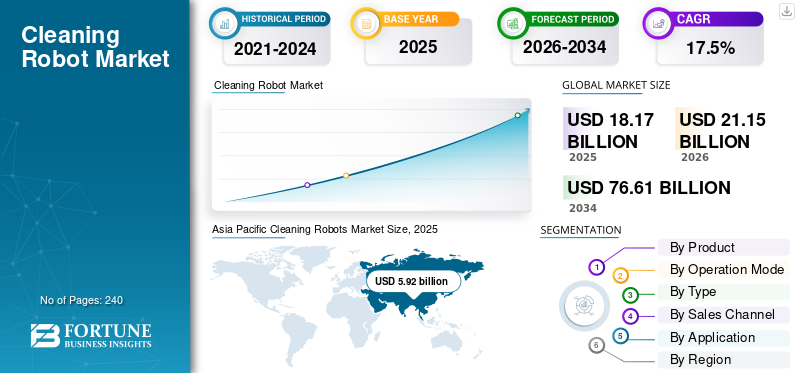
The global cleaning robots market size was valued at USD 18.17 billion in 2025. The market is projected to grow from USD 21.15 billion in 2026 to USD 76.61 billion by 2034, exhibiting a CAGR of 17.5% during the forecast period. Asia Pacific dominated the global cleaning robot market with a market share of 32.58% in 2025.
Cleaning robots are autonomous or semi-autonomous devices equipped with sensors, intelligent navigation systems and suction or mopping mechanisms designed to perform routine cleaning tasks with minimal human intervention. These systems are increasingly adopted across residential, commercial and industrial environments as households and businesses shift toward smart and automated maintenance practices. The market represents a rapidly advancing segment of the consumer and service robotics industry, driven by increasing demand for automated solutions that improves convenience, hygiene and daily efficiency.
The market is supported by the presence of several leading manufacturers known for technological innovation, including iRobot, Ecovacs, Roborock and Samsung, who are continuously enhancing product performance through AI driven navigation, multi function cleaning capabilities and smart home integration. With ongoing advancements in robotics, connectivity and automation, the market continues to evolve as one of the most dynamic categories in the modern smart home and facility management landscape.
Download Free sample to learn more about this report.
Cleaning Robot MARKET KEY TAKEAWAYS
 Market Size & Forecast
- 2025 Market Size: USD 18.17 billion
- 2026 Market Size: USD 21.15 billion
- 2034 Forecast Market Size: USD 76.61 billion
- CAGR: 17.5% from 2026–2034
 Market Share
- Asia Pacific dominated the cleaning robots market with a 32.58% share in 2025.
- The residential segment accounted for 62.8% of the market share in 2026.
- The floor cleaning robots segment held a 59.4% market share in 2026.
 Key Regional Highlights
North American
North America is projected to reach USD 6.20 billion in 2026, supported by high consumer spending and advanced robotics adoption.
Europe
Europe is projected to reach USD 4.88 billion in 2026, fueled by increasing household automation and supportive technology policies.
Asia Pacific
Asia Pacific is projected to reach USD 7.03 billion in 2026, driven by rapid urbanization and strong smart home adoption.
U.S.
The market is projected to reach USD 5.22 billion in 2026, driven by strong demand for smart home and robotic cleaning solutions.
Japan
The market is supported by high adoption of smart home technologies and continued advancements in robotics.
Read More

IMPACT OF GENERATIVE AI
Generative AI is Driving Next Wave of Advancement in Cleaning Robot
Generative AI is emerging as a significant accelerator in the market, driving advancements in autonomy, precision and operational efficiency. By enabling robots to learn from diverse data and adapt to complex real world environments, generative AI improves navigation, object recognition and decision making capabilities. This progress supports stronger cleaning robots market growth as systems deliver more reliable performance across residential, commercial and industrial settings. The technology also enhances predictive maintenance, user interaction and continuous performance optimization, strengthening the value proposition for consumers and enterprises. As manufacturers integrate generative AI into next generation cleaning systems, the market is expected to experience faster innovation cycles, stronger competitive differentiation and greater adoption worldwide.
MARKET DYNAMICS
CLEANING ROBOTS MARKET TRENDS:
Emerging Intelligent and and Autonomous Cleaning Solutions is Reshaping Future of the Market
The industry is experiencing a strong shift toward intelligent and autonomous cleaning solutions as advancements in sensors, connectivity and generative AI reshape user expectations. Demand for robots capable of self learning, adaptive navigation and efficient energy management is rising, driven by its expanding applications in residential and commercial environments.
- According to the International Federation of Robotics, service robot sales have recorded double digit annual growth in recent years, reflecting increasing global adoption of automated assistance.
The integration of AI enabled mapping and real time decision making is further strengthening product performance and operational reliability. As manufacturers prioritize smarter software driven capabilities, the sector is witnessing rapid innovation and a steady transition from basic robotic devices to highly capable autonomous cleaning systems.
Download Free sample to learn more about this report.
MARKET DRIVERS:
Rising Efficiency Needs is Powering Shift Toward Automated Cleaning Solutions
The market is growing as both consumers and businesses are highly focused on convenience, saving time, and maintaining higher hygiene standards. With rapid urbanization, households with dual incomes and a growing adoption of smart home setups, there is a surge in use of automated cleaning solutions. Due to ongoing advancements in battery life, suction power, and the ability to clean multiple surfaces, these modern cleaning systems are becoming more attractive for everyday use. According to the International Federation of Robotics, there is a notable rise in demand for professional service robots, especially for tasks including floor cleaning, as companies aim to streamline their operations and keep their facilities intact. With an increasing focus on productivity and cleanliness, the market is evolving at a fast pace.
MARKET RESTRAINTS:
Cost Pressures and Performance Constraints Limits Market Expansion
The market expansion is hampered by several challenges that limit the widespread adoption of automated cleaning solutions. High upfront costs remain a major concern for households and small enterprises, especially when compared to conventional cleaning equipment. Performance constraints in crowded or irregular environments and inconsistent results on varying floor surfaces also limits the product usage in certain settings. Additionally, issues such as short battery life, ongoing maintenance requirements and the need for regular software upgrades can discourage long term adoption of cleaning robots. Many advanced cleaning systems still struggle to achieve full autonomy in highly dynamic environments, reducing their effectiveness in complex commercial spaces. These constraints collectively slow the pace of large scale market penetration.
MARKET OPPORTUNITIES:
Expanding Applications Creating New Avenues for Intelligent Cleaning Solutions
The sector presents substantial growth opportunities as technological innovation expands the capabilities and potential applications of automated cleaning solutions. Increasing integration of AI assisted vision systems, advanced mapping and cloud based performance analytics is enabling manufacturers to design more versatile and intelligent products. Emerging demand from sectors such as hospitality, healthcare facilities, logistics and large commercial facilities offers strong prospects for specialized, high capacity cleaning systems tailored to professional use. Additionally, increasing consumer interest in premium smart home devices creates room for product diversification and value added service models.
Segmentation Analysis
By Application
Residential Segment Dominates Market as Home Automation is Prioritized Rapidly
Based on application segmentation, the market is classified into Residential, Commercial, and Industrial.
To know how our report can help streamline your business, Speak to Analyst
In 2025, the residential segment secured the highest share within the application category. In 2026, the segment is anticipated to dominate with a 62.8% share. This segmental growth is driven by increasing household adoption of automated cleaning solutions that support convenience focused lifestyles. Rising awareness of home hygiene, coupled with expanding smart home integration, has strengthened demand for robotic cleaning systems. These devices offer benefits including saving time, efficient operation and improved cleaning consistency, making them well suited for daily use. As technology advances and affordability improves, residential adoption continues to lead over commercial and industrial applications.
The commercial segment is expected to grow at a CAGR of 18.3% over the forecast period.
By Product
Strong Demand for Floor Cleaning Robots Drives Product Segment Leadership
Based on product segmentation, the market is classified into floor cleaning robots, lawn cleaning robots, pool cleaning robots, window cleaning robots, and others.
In 2025, the floor cleaning robots segment held the highest cleaning robots market share within the product category. In 2026, the segment is anticipated to dominate with a 59.4% share. This leadership is driven by rising global demand for automated floor care solutions that offer time saving benefits and consistent cleaning quality. Advancements in suction efficiency, smart navigation and surface adaptability have made these robots a preferred choice for both homes and commercial settings. As consumers increasingly prioritize convenience and hygiene, floor cleaning robots continue to outperform other specialized categories such as pool, lawn and window cleaning systems.
The window cleaning robots is expected to grow at a CAGR of 20.1% over the forecast period.
By Operation Mode
Self Driven Functionality Enhances Convenience and Leads to Segment Dominance
In terms of operation mode, the market is categorized into self-driven and remote controlled.
In 2025, the self driven segment captured the highest share among operation modes. In 2026, the segment is anticipated to dominate with a 82.2% share. Its strong position is supported by increasing adoption of fully autonomous cleaning systems that require minimal user involvement. Enhanced mapping technologies, obstacle detection and real time route optimization have improved performance across varied environments. As smart homes gain higher momentum and customers prefer hands free operation, self driven robots are becoming the standard choice over remote controlled models. Their ability to deliver efficient and continuous cleaning further reinforces their dominance in this category.
Remote controlled segment is expected to grow at a CAGR of 16.3% over the forecast period.
By Type
Personal Cleaning Robots Gain Momentum Due to Growing Household Adoption
In terms of type, the market is categorized into personal cleaning robots and professional cleaning robots.
In 2025, personal cleaning robots hold the largest market share within the type category. In 2026, the segment is anticipated to dominate with a 57.8% share. This growth is propelled by rising household dependency on smart devices that simplify everyday routines. These robots are designed for user friendly operation, compact storage and effective cleaning across common residential surfaces, making them suitable for urban families. Increasing awareness of hygiene and time management needs further boosts its adoption. As personal robots becomes more affordable and technologically advanced, they maintain a clear lead over professional grade cleaning systems.
Professional cleaning robots segment is expected to grow at a CAGR of 17.0% over the forecast period.
By Sales Channel
Online Distribution Leads Due to Wider Access and Competitive Pricing
In terms of sales channel, the market is categorized into online and offline.
In 2025, online channels held the highest share in the market. In 2026, the segment is anticipated to dominate with a 85.7% share. This strong presence is driven by shifting consumer behaviour toward digital purchasing and the convenience offered by e-commerce platforms. Customers benefit from wide product availability, transparent pricing, quick delivery and access to reviews that influence purchase decisions. Online platforms also support frequent promotional campaigns, attracting price conscious buyers. As digital retail ecosystems strengthen globally, online sales continue to outperform offline channels, solidifying their position as the primary route for product distribution.
Offline segment is expected to grow at a CAGR of 16.1% over the forecast period.
Cleaning Robots Market Regional Outlook
By geography, the market is categorized into North America, Europe, Asia Pacific, South America, and Middle East & Africa.
Asia Pacific Cleaning Robots Market Size, 2025 (USD billion)
To get more information on the regional analysis of this market, Download Free sample
North America
North America holds the second largest share, supported by strong technological adoption, high consumer spending and widespread acceptance of automated cleaning solutions. The market is projected to reach USD 6.20 billion by 2026, with the U.S. contributing USD 5.22 billion, due to continued demand for smart home devices and advanced robotic technologies across residential and commercial settings.
Europe
Europe ranks third and is projected to reach USD 4.88 billion by 2026. This growth is driven by increasing household automation, strong regulatory support for advanced technologies and steady adoption of robots across major countries. The U.K. (USD 0.96 billion in 2026), Germany (USD 1.14 billion in 2026), and France (USD 0.60 billion in 2026) remains key contributors as consumers prioritize efficiency and energy saving home devices.
Asia Pacific
Asia Pacific holds the highest market share and is expected to maintain its position, reaching USD 7.03 billion by 2026. Rapid urbanization, strong manufacturing capabilities and widespread acceptance of smart home technologies drive this dominance. Countries such as China (USD 3.08 billion in 2026) and India (USD 0.91 billion in 2026) remain major contributors, supported by large tech driven consumer bases, expanding robotics manufacturing clusters and national initiatives promoting digital transformation. Their combined influence accelerates innovation and strengthens long term regional leadership.
South America
South America is projected to reach USD 1.34 billion by 2026, supported by growing digital engagement, expanding middle class populations and rising demand for convenient home cleaning solutions. Brazil and Mexico lead the region as consumers gradually shift toward time saving automated devices.
Middle East & Africa
The Middle East & Africa market is set to reach USD 1.71 billion by 2026, driven by expanding internet penetration, national digitalization programs and increasing interest in smart home technologies. GCC countries, contributing USD 0.87 billion by 2026, remain central to growth due to strong investments in modern infrastructure and innovation initiatives.
COMPETITIVE LANDSCAPE
Key Industry Players:
Rising Innovation Pressures Drive Leading Cleaning Robot Brands to Intensify AI-Focused Strategies
Major brands including iRobot, Ecovacs, Roborock, Samsung and LG lead the market, each competing on the improvements they can make in AI navigation of their robots, enhancements to cleaning performance, and other smart home integrations. iRobot aims for a premium positioning with AI-integrated iterations of Roomba. Rapid market expansion of Ecovacs and Roborock driven largely through high R&D and all-in-one anti-infection cleaning stations. Samsung and LG build on their other smart appliance platforms and integration to enhance product connectivity and improve user experience. Overall, leading companies remain focused on improving upgrading AI capabilities, levels of autonomous performance and penetrating regional markets to remain competitive.
LIST OF KEY CLEANING ROBOTS COMPANIES PROFILED:
- Dyson (Singapore)
- Ecovacs Robotics (China)
- iRobot Corporation (U.S.)
- Kärcher (Germany)
- LG Electronics Inc. (South Korea)
- Neato Robotics (U.S.)
- Roborock (China)
- Samsung Electronics Co., Ltd. (South Korea)
- SharkNinja (U.S.)
- Xiaomi Corporation (China)
KEY INDUSTRY DEVELOPMENTS:
- November 2025: OCTOPUS Robots formed a strategic alliance with APROLLIANCE to promote robotic cleaning solutions within industrial and logistics environments. The initiative aims to automate a significant portion of routine cleaning work in high traffic facilities, supporting improved operational efficiency across professional cleaning networks.
- October 2025: Primech AI partnered with Savills subsidiary Swan Hygiene Solutions to introduce the HYTRON autonomous cleaning unit in Hong Kong and Macau. The collaboration focuses on enhancing restroom and facility cleaning operations, with large scale production planned to support growing regional demand for automated hygiene management.
- September 2025: Ecovacs announced a strategic partnership with BSH Home Appliances Group to collaborate on the development of next generation robotic cleaning solutions. The agreement combines Ecovacs expertise in intelligent robotics with BSHs strong appliance ecosystem, aiming to accelerate product innovation and expand global market reach.
- September 2025: Ecovacs presented new products at the IFA event, including the DEEBOT X11 series and the ULTRAMARINE pool cleaning unit. This expansion demonstrates the companys effort to broaden its product portfolio from indoor floor care to a wider range of home and outdoor cleaning applications.
- July 2025: iRobot unveiled the Roomba Max 705 Combo, a model designed with an advanced roller and mop system, enhanced carpet protection and an upgraded docking station with washing and drying functions. The introduction highlights iRobots continued investment in combined robotic vacuum cleaners and mopping technologies for improved residential cleaning performance.
REPORT COVERAGE
The cleaning robots market report provides an in-depth study of market size & forecast by all the market segments. It includes details on the market dynamics and market trends expected to drive the market in the forecast period. It offers information on the technological advancements, new product launches, key industry developments, and details on partnerships, mergers & acquisitions. The research report also includes a detailed competitive landscape, providing information on market share and profiles of key players.
Request for Customization to gain extensive market insights.
Report Scope & Segmentation
|
ATTRIBUTE |
DETAILS |
|
Study Period |
2021-2034 |
|
Base Year |
2025 |
|
Forecast Period |
2026-2034 |
|
Historical Period |
2021-2024 |
|
Growth Rate |
CAGR of 17.5% from 2026-2034 |
|
Unit |
Value (USD Billion) |
|
Segmentation
|
By Product · Floor Cleaning Robots · Lawn Cleaning Robots · Pool Cleaning Robots · Window Cleaning Robots · Others |
|
By Operation Mode · Self-driven · Remote Controlled |
|
|
By Type · Personal Cleaning Robots · Professional Cleaning Robots |
|
|
By Sales Channel · Online · Offline |
|
|
By Application · Residential · Commercial · Industrial |
|
|
By Geography · North America (By Product, By Operation Mode, By Type, By Sales Channel, By Application, and By Country) o U.S. (By Application) o Canada (By Application) o Mexico (By Application) · Europe (By Product, By Operation Mode, By Type, By Sales Channel, By Application, and By Country) o U.K. (By Application) o Germany (By Application) o France (By Application) o Italy (By Application) o Rest of Europe · Asia Pacific (By Product, By Operation Mode, By Type, By Sales Channel, By Application, and By Country) o China (By Application) o India (By Application) o Japan (By Application) o South Korea (By Application) o Rest of Asia Pacific · South America (By Product, By Operation Mode, By Type, By Sales Channel, By Application, and By Country) o Brazil (By Application) o Argentina (By Application) o Rest of South America · Middle East & Africa (By Product, By Operation Mode, By Type, By Sales Channel, By Application, and By Country) o GCC (By Application) o South Africa (By Application) o Rest of Middle East & Africa |
Frequently Asked Questions
Fortune Business Insights says that the global market value stood at USD 18.17 billion in 2025 and is projected to reach USD 76.61 billion by 2034.
In 2025, the market value stood at USD 5.92 billion.
The market is expected to exhibit a CAGR of 17.5% during the forecast period of 2026-2034.
The residential segment led the market by Application.
Growing demand for efficiency is driving the adoption of automated cleaning solutions and fueling market growth.
iRobot, Ecovacs, Roborock, Samsung and LG are some of the prominent players in the market.
Asia Pacific dominated the market in 2025.
The commercial segment is expected to grow with the highest CAGR.



- 2021-2034
- 2025
- 2021-2024
- 240
Get 30-60 hrs Free Customization
Expand Regional and Country Coverage, Segments Analysis, Company Profiles, Competitive Benchmarking, and End-user Insights.














Related Reports
-
US +1 833 909 2966 ( Toll Free )
-
Get In Touch With Us