Protein Supplements Market Size, Share & Industry Analysis, By Source (Animal-Derived Protein [Egg and Collagen Protein], Plant-Derived Protein [Soy, Pea, and Rice Protein], and Dairy Protein [Whey and Casein Protein]), By Product (Protein Powder, RTD, Protein Bars, Gummies, and Capsules & Tablets), By Functionality (Performance & Recovery, Weight Management, Healthy Aging, Beauty & Skin Health, and Medical Nutrition), By Distribution Channel (Supermarkets/Hypermarkets, Pharmacies/Drug Stores, Health & Wellness Stores, Online Retail, and Fitness Centers), and Regional Forecast, 2026-2034
 Download Free Sample
(Offer valid till 15th Sep 2026)

Protein Supplements Market Size
 Listen to Audio Version
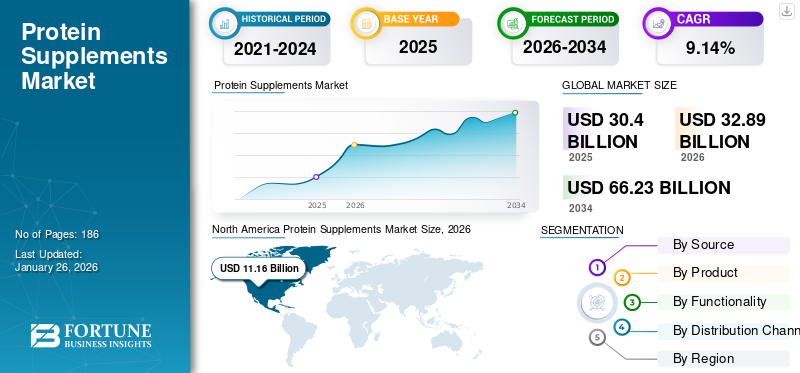
The global protein supplements market size was valued at USD 30.14 billion in 2025. The market is projected to grow from USD 32.41 billion in 2026 to USD 64.97 billion by 2034, exhibiting a CAGR of 9.08% during the forecast period. North America dominated the protein supplements market with a market share of 36.73% in 2025.
Protein supplements are nutritional products that are consumed by people to fulfill their protein needs and support weight management and muscle recovery. These products are sold in both dry and liquid form and are popular among sportsmen, athletes, and other people. Moreover, with respect to composition, it is made from plant or animal-derived materials such as hemp, rice, whey, milk, and soybean. Furthermore, surging demand for protein bars, ready to drink, and powders among bodybuilders, elite athletes, and casual exercisers and the presence of a large number of brands is expected to boost the global market share.
Companies such as Glanbia Plc, RSP Nutrition, and Abbott are prominent players in the market. New product launches are a pivotal strategy adopted by key players to improve their positions.
Download Free sample to learn more about this report.
PROTEIN SUPPLEMENTS MARKET TRENDS
Increasing Popularity of Plant-based Protein Products to be a Significant Market Trend
In recent years, the popularity of veganism has been on the rise globally, driven by growing concerns about environmental sustainability and animal welfare. This increasing interest in plant-based lifestyles has significantly impacted the demand for plant-based protein products. Notably, plant-based protein powders have gained traction due to their fiber content, which promotes smoother digestion and supports a healthy gut microbiome. As a result, plant-based protein powders are often considered a preferable substitute for animal-based protein.
The demand for plant-based protein products derived from ingredients such as soy, pea, and rice has increased substantially. Companies are focusing on developing innovative plant-based supplements to meet this growing demand.
For example, in October 2022, Glanbia’s flagship sports nutrition brand, Optimum Nutrition, launched a new offering in the plant-based category - Gold Standard 100% Plant Protein powder, made with 100% vegan ingredients. The new formula is crafted with 24 grams of premium plant-based protein to fuel various fitness activities.
In addition, personalized nutrition is becoming popular among consumers, and nutritionists may recommend nutrient consumption specifically catering to the consumer's needs. Hence, manufacturers have the opportunity to develop specifically tailored customized solutions and programs that meet individual needs.
MARKET DYNAMICS
MARKET DRIVERS
Download Free sample to learn more about this report.
Augmented Demand for Sports Nutrition Supplements to Drive Market Growth
Sports nutrition involves the consumption of nutrients, such as vitamins, protein supplements, fats, carbohydrates, minerals, and organic substances. Sports nutritional products consist of beverages, protein supplements, and food targeted at strength & endurance athletes and bodybuilders to increase their overall performance, enhance stamina, promote muscle growth, and improve health. Protein is essential for supporting muscle repair, growth, muscle recovery during intense training sessions, and enhancing the overall performance of the athletes. Furthermore, the growing popularity of naturally-derived dairy-based ingredients due to increasing health concerns related to synthetic ingredients is expected to act as a factor driving the protein supplements market growth in the sports nutrition sector.
|
Rank |
Market Drivers |
Expected impact on market growth |
Estimated CAGR contribution |
2026–2028 |
2029–2031 |
2032–2034 |
|
1 |
Augmented Demand for Sports Nutrition Supplements to Drive Market Growth |
High |
3.20% |
High |
High |
High |
|
2 |
Rising Focus on Healthy Aging and Maintenance of Muscle Health Expands Protein Supplement Consumption |
High |
2.65% |
Medium |
High |
High |
|
3 |
Increasing Adoption of Plant-Based and Specialized Protein Formulations Supports Market Expansion |
High |
2.35% |
High |
High |
High |
|
4 |
Expansion of Convenient Product Formats and Functional Protein Innovations Improves Consumer Adoption |
Medium–High |
2.05% |
Medium |
High |
High |
|
5 |
Growing E-commerce Penetration and Direct-to-Consumer Distribution Increase Product Accessibility |
Medium |
1.85% |
High |
High |
Medium |
|
6 |
Others, including rising disposable income, gym-network expansion, medical-nutrition demand, protein fortification, and increasing participation of women in fitness |
Low |
1.30% |
Low |
Low–Medium |
Medium |
|
Total positive contribution |
13.40% |
MARKET RESTRAINTS
High Cost of Production Due to Volatile Raw Material Prices Could Hamper Market Growth
Volatility in the prices of raw materials, including soybean and milk, due to demand and supply constraints, is projected to result in fluctuations in the prices of final products. Milk is the major raw material used for manufacturing whey and casein proteins. Milk can be compared to crude oil as it goes into refineries and emerges in the form of various products (whey concentrates, isolates, casein concentrates/isolates, cheese, yogurt, and milk powder), which are traded across the globe. Milk prices are expected to boom or crash depending on political and economic factors. Furthermore, the milk supply is subject to seasonal patterns. Specifically, the milk supply is greater during spring owing to the calving patterns of cows. Consumers also tend to have a seasonal pattern in terms of their consumption. For instance, the demand for fluid milk is maximum in the fall when the schools are back in session. The political scenario also has a considerable impact on price volatility.
|
Rank |
Market Restraints |
Expected negative impact |
Estimated negative CAGR contribution |
2026–2028 |
2029–2031 |
2032–2034 |
|
1 |
High Cost of Production Due to Volatile Raw Material Prices Could Hamper Market Growth |
High |
−1.45% |
High |
High |
Medium |
|
2 |
Increasing Regulatory Scrutiny, Product-Quality Concerns, and Misleading Claims Restrict Market Development |
High |
−1.15% |
Medium |
High |
High |
|
3 |
Digestive Intolerance, Allergen Risks, and Consumer Skepticism May Limit Product Adoption |
Medium–High |
−1.02% |
Medium |
Medium |
High |
|
4 |
Others, including intense price competition, counterfeit products, market saturation, packaging concerns, and competition from naturally protein-rich foods |
Low |
−0.70% |
Low |
Low–Medium |
Medium |
|
Total negative contribution |
−4.32% |
MARKET OPPORTUNITIES
Growing Demand for Natural Ingredients in Products to Create Market Expansion Opportunity
Several studies have shown that the consumption of food products that contain harmful additives or colorants is harmful to the body. Therefore, products that are made of natural ingredients are gaining popularity among consumers. New natural ingredient-based packaged products can create an opportunity for manufacturers to attract such consumers.
Among various consumer groups, supplement consumption is gaining momentum among teenagers. As protein is a necessary ingredient required in the early growth period, the consumption of plant-based protein supplements to boost muscle growth and achieve a balanced meal has increased rapidly. Therefore, manufacturers have the opportunity to launch new products that are specifically targeted toward a particular consumer group and address the health requirements of that particular group.
Segmentation Analysis
By Source
Dairy-Derived Protein Segment Dominated Market Due to Superior Amino Acid Profile
Depending on source, the market is segmented into animal-derived protein, plant-derived protein, dairy-derived protein, and others.
Dairy-derived protein segment led the market in 2025. In comparison to plant-derived proteins, dairy proteins have high bioavailability and digestibility, which allows the body to easily utilize and absorb amino acids. These protein sources have improved consumer familiarity as they have been used in the sports nutrition industry for ages. Moreover, minimal requirement for protein blending and wider product availability than animal or plant-sourced proteins further fuels the segment’s potential.
The plant-derived protein segment is projected to grow at a CAGR of 11.42% over the forecast period.
By Product
Protein Powder Segment Held Largest Market Share Owing to Convenient Consumption
By product, the market is segmented into protein powder, RTD, protein bars, gummies, capsules and tablets, soft gels, and others.
Protein powder emerged as the dominant product segment in 2025. Strong online sales and mass distribution channels by various companies, including Glanbia, Nature's Bounty Co., and Iovate Health Sciences International Inc., are expected to fuel the demand for protein powders. Furthermore, increasing demand for these powders from bodybuilders, elite athletes, and casual exercisers is anticipated to boost the protein powder segment growth. Moreover, lower cost per serving as compared to protein bars and RTD shakes and prolonged shelf life can enhance the segment’s growth. In addition, easy dosage customization further fuels the popularity of powders. As a result, such factors boost the global market growth.
The gummies segment is projected to grow at a high CAGR of 14.88% over the forecast period.
To know how our report can help streamline your business, Speak to Analyst
By Functionality
Performance and Recovery Segment Leads Due to Increased Popularity of Such Products among Athletes and Fitness Enthusiasts
On the basis of functionality, the market is segmented into performance and recovery, weight management, healthy aging, beauty and skin health, medical nutrition, general daily protein supplementation, and others.
Among these, the performance and recovery segment accounts for the highest protein supplements market share, owing to the increased demand for such products among athletes and fitness enthusiasts. These products support muscle repair and growth, reduce soreness, and enhance strength and endurance. Weight management is set to be another major segment during the forecast period. These products are available in convenient packaging solutions for consumers. They help consumers satiate their body's nutrition requirements while maintaining muscle mass and metabolism.
The healthy aging segment is projected to grow at a high CAGR of 13.54% over the forecast period.
By Distribution Channel
Supermarkets and Hypermarkets Led Due to Convenience of Shopping and Availability of Multiple Brands
By distribution channel, the market is classified into supermarkets/hypermarkets, pharmacies/drug stores, health & wellness stores, online retail, direct selling/MLM, practitioner/clinic dispensing, fitness centers & gyms, subscription services, and others.
Supermarkets/hypermarkets emerged as the dominant product segment in 2025. Major retailers in the U.S., including Walmart, are investing in private label varieties to promote the sale of protein products. Moreover, the sale of protein products through the retail channel is anticipated to grow slowly over the forecast period due to strong competition from other distribution channels, such as online stores and DTC channels.
Online retail segment is projected to grow at a high CAGR of 11.80% over the forecast period.
Protein Supplements Market Regional Outlook
By geography, the market is categorized into Europe, North America, Asia Pacific, South America, and the Middle East & Africa.
North America
North America Protein Supplements Market Size, 2025 (USD Billion)
To get more information on the regional analysis of this market, Download Free sample
North America dominates the market and reached a valuation of USD 11.07 billion in 2025. Functional foods and sports nutrition are the major distribution channel segments of the North American market. This can be attributed to the rising fitness awareness among consumers in the U.S., Canada, and Mexico, which is expected to drive the demand for functional food and beverages. Moreover, the growing health benefits of protein bars and shakes, coupled with millennials' increasing adoption of protein bars and cookies as a healthy snacking option, are expected to further propel the demand in the region.
U.S. Protein Supplements Market
Based on North America's strong contribution and the U.S. dominance within the region, the U.S. market was valued at USD 8.70 billion in 2025, accounting for roughly 28.87% of global sales. In the U.S., the demand for protein supplement products is high owing to the presence of well-established manufacturers with aggressive marketing strategies to boost the products among consumers. Physicians also recommend protein supplements, as protein is essential for strength and immunity. As products are available in convenient packages such as powder, ready-to-drink beverages, and bars, the popularity is growing among young consumers.
Europe
Europe reached USD 8.54 billion in 2025, recording a growth rate of 9.35% over the forecast period. Rising health awareness in Europe is also anticipated to augment the demand for functional foods over the next few years. The presence of major manufacturers, such as Glanbia plc, Bulk Powders Co., Ultimate Nutrition, Inc., and PowerBar Europe GmbH, in the region is expected to drive demand for products.
Germany Protein Supplements Market
The German market was valued at USD 1.83 billion in 2025, representing roughly 6.06% of the global market revenues.
U.K. Protein Supplements Market
The U.K. market reached USD 1.60 billion in 2025, equivalent to around 5.30% of the global market sales.
Asia Pacific
Asia Pacific reached USD 6.71 billion in 2025 and ranked third in the market. The trend for on-the-go snacking options across developing economies, such as India and China, will fuel the demand for protein & nutrition supplements in Asia Pacific. Besides, a notable shift in consumer lifestyle could further foster the protein and nutrition supplement products market in the region over the forecast period.
India Protein Supplements Market
The Indian market was valued at USD 0.85 billion in 2025, accounting for roughly 2.82% of the global market revenues.
China Protein Supplements Market
China's market is projected to be one of the largest globally, with revenues valued at USD 2.04 billion in 2025, accounting for roughly 6.76% of global market sales. Rising disposable incomes, a flourishing sports nutrition and dietary supplements industry, and increasing consumer awareness for high quality protein bolster the growth.
Japan Protein Supplements Market
The Japanese market was valued at USD 1.42 billion in 2025, accounting for approximately 4.72% of the global market revenues.
South America and Middle East & Africa
The South America and Middle East & Africa regions are expected to witness moderate growth in this market during the forecast period. The South America market reached a valuation of USD 2.56 billion in 2025. The market in South America is witnessing substantial growth, primarily fueled by the rising awareness of health and fitness trends. One notable trend in the region is the increasing demand for plant-based protein products. As consumers prioritize their well-being, they are actively seeking nutritional options to support their fitness goals. The Middle East & Africa market reached USD 1.27 billion in 2025. In the Middle East & Africa, consumers are displaying a growing inclination toward maintaining a healthy lifestyle and are actively seeking out nutritional products to enhance their fitness endeavors. Whey protein, renowned for its popularity among athletes and fitness enthusiasts, currently dominates the market in this region.
South Africa Protein Supplements Market
The South African protein market reached USD 0.89 billion in 2025, representing roughly 2.95% of global revenues.
COMPETITIVE LANDSCAPE
Key Industry Players
New Product Launches Help the Firms to Strengthen Market Penetration
The global protein supplements market is consolidated owing to the presence of a limited number of established and regional players. Key companies, such as Glanbia Plc, RSP Nutrition, and Abbott, are competing in the global space via extensive distribution network, and wide product portfolio. Moreover, to enhance their position in the market, the enterprises are focusing on launching new products.
LIST OF KEY PROTEIN SUPPLEMENTS COMPANIES PROFILED IN REPORT
- Glanbia Plc (Ireland)
- MusclePharm (U.S.)
- Abbott (U.S.)
- CytoSport, Inc. (U.S.)
- Quest Nutrition (U.S.)
- The Bountiful Company (U.S.)
- The Himalaya Drug Company (India)
- NOW Foods (U.S.)
- RSP Nutrition (U.S.)
- BPI Sports LLC (U.S.)
KEY INDUSTRY DEVELOPMENTS
- June 2026: Optimum Nutrition, a nutrition company based in the U.S., introduced clear whey protein across the U.K.
- July 2024: Alpino Health Food, a leading company in India, launched 100% peanut-based protein powder in the market. The product is lactose-free and caters to health-conscious consumers.
- June 2024: Steadfast Nutrition launched new protein supplements in the Asian market. The new product categories include Whey Protein and LIV Raw, which provide the necessary protein and nutrition to fitness enthusiasts.
- December 2023: Centrum launched Multivitamin & Protein Powders in the Indian market, which are available in powder and gummy form.
- May 2023: Arla Foods Ingredients launched a product that increases the protein content of juice-style Oral Nutrition Supplements (ONS) for medical nutrition to 7% without compromising mouthfeel or taste.
- April 2023: The U.K.'s premium sports supplement brand, Genetic Nutrition, launched its high-quality health and wellness segment in India. The brand's range of supplements includes protein powders, amino acids, and vitamins formulated using best-in-class ingredients for maximum effectiveness and is now available in the Indian market.
- September 2022: Tata Consumer Products entered the health supplements segment by launching a plant-based protein powder. Tata GoFit, a health supplement range for women, is a plant-based, easy-to-mix product formulated with the goodness of gut-friendly probiotics.
REPORT COVERAGE
The global protein supplements market provides an in-depth study of the market size & forecast by all the market segments included in the market report. The global market forecast analysis includes details on the market dynamics and global market trends expected to drive the market during the forecast period. The global market analysis offers information on new product launches, key industry developments, and details on partnerships, mergers & acquisitions. The global market report forecast also encompasses a detailed competitive landscape with information on the market segmentation, market share, and profiles of key operating players.
Request for Customization to gain extensive market insights.
Report Scope & Segmentation
| ATTRIBUTE | DETAILS |
| Study Period | 2021-2034 |
| Base Year | 2025 |
| Estimated Year | 2026 |
| Forecast Period | 2026-2034 |
| Historical Period | 2021-2024 |
| Growth Rate | CAGR of 9.08% from 2026-2034 |
| Unit | Value (USD Billion) |
| Segmentation | By Source, Product, Functionality, Distribution Channel, and Region |
| By Source |
|
| By Product |
|
| By Functionality |
|
| By Distribution Channel |
|
| By Region |
|
Frequently Asked Questions
Fortune Business Insights says that the global market value stood at USD 30.14 billion in 2025 and is projected to reach USD 64.97 billion by 2034.
In 2025, the North America’s market value stood at USD 11.07 billion.
The market is expected to exhibit a CAGR of 9.08% during the forecast period of 2026-2034.
By product, the protein powder segment led the global market in 2025.
Augmented demand for sports nutrition supplements to drive market growth.
Glanbia Plc, RSP Nutrition, and Abbott are the key players in the market.
North America held the largest market share in 2025.
Increasing popularity of plant-based protein products to be a significant market trend.



- 2021-2034
- 2025
- 2021-2024
- 180
-
(Offer valid till 15th Sep 2026)
Get 30-60 hrs Free Customization
Expand Regional and Country Coverage, Segments Analysis, Company Profiles, Competitive Benchmarking, and End-user Insights.




















Related Reports
-
US +1 833 909 2966 ( Toll Free )
-
Get In Touch With Us