Consumer Drone Market Size, Share & Industry Analysis, By Product Type (Multi-rotor, Nano, and Others), By Weight (Less than 250 g, 250 g to 2 kg, and 2 to 25 kg), By Price Range (Entry-level (Less than USD 100), Mid-tier (USD 100-500), and High-end (More than USD 500)), By Application (Hobby/Toy, Photography/Videography, Racing/Sports, Educational, and Others), By Technology (Manual/Remote Control and Autonomous), and Regional Forecast, 2026-2034
 Download Free Sample
Consumer Drone Market Size and Future Outlook
 Listen to Audio Version
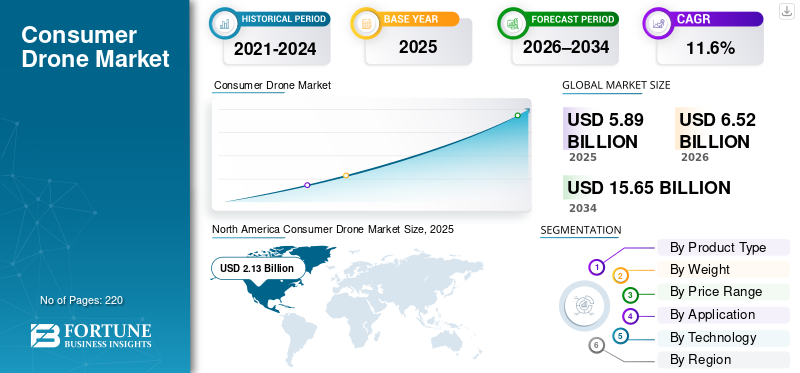
The global consumer drone market size was valued at USD 5.89 billion in 2025. The market is projected to grow from USD 6.52 million in 2026 to USD 15.65 billion by 2034, exhibiting a CAGR of 11.6% during the forecast period. North America dominated the global consumer drone market with a market share of 36.16% in 2025.
The global consumer drone market is expected to grow significantly due to rising adoption in aerial photography, recreational flying, and commercial applications. Commercial drones equipped with high-quality, high-resolution cameras, GPS navigation, and extended battery life enable seamless content creation, real-time mapping, and precision monitoring for hobbyists and enterprises. Moreover, the integration of 5G connectivity, obstacle avoidance sensors, and eco-friendly propulsion systems during surging e-commerce and remote sensing needs is accelerating market expansion.
- For instance, in September 2025, DJI launched the Mavic 4 Pro series, featuring a 100MP Hasselblad camera and 45-minute flight time, targeting creators and professionals with deliveries ramping up through 2026 to enhance imaging and filmmaking workflows.
Key players such as DJI, Skydio, Parrot SA, and Ryze Tech are focusing on technological innovations, including foldable designs with 8K video, swarm intelligence for coordinated flights, and app-integrated AI editing tools for diverse consumer and commercial platforms.
Download Free sample to learn more about this report.
CONSUMER DRONE MARKET TRENDS
Shift Toward Lightweight Carbon Fiber Frames and AI-Powered Autonomous Navigation is a Prominent Trend Observed in the Market
The shift toward lightweight carbon fiber airframes and AI-driven autonomous navigation is gaining traction in consumer drones, driven by demands for extended range, agility, and hands-free operation in photography, racing, and delivery applications. Carbon fiber construction reduces weight as compared to traditional plastics, enabling longer flights and higher speeds. At the same time, AI navigation uses computer vision for precise subject tracking, no-GPS indoor flying, and real-time environmental adaptation. These innovations enhance user experience in crowded airspace and remote areas, supporting trends such as FPV racing and social media content creation without constant manual input.
- For instance, in February 2025, Autel Robotics unveiled the Evo Nano+ with a whole carbon fiber body weighing under 200g and AI ActiveTrack 360°, delivering 46-minute flights and zero-collision autonomy for hobbyists and creators.
Download Free sample to learn more about this report.
MARKET DYNAMICS
MARKET DRIVERS
Rise in Consumer Adoption and Investment in Drone Technology is Expected to Drive Market Growth
A primary driver for the consumer drone industry is the global surge in consumer spending on recreational tech and accelerated investment in drone hardware and software for photography, videography, and delivery services.
Such consumer demand and investment propel growth for advanced drones featuring 8K cameras, extended 50-minute battery life, and AI autonomy. As users embrace FPV racing, aerial mapping, and social media content creation, there's an escalating need for lightweight, foldable drone models.
MARKET RESTRAINTS
Stringent Aviation Regulations and Privacy Concerns to Limit Market Expansion
Stringent aviation regulations and privacy concerns act as key restraints for the market. These restrictions, including Federal Aviation Administration FAA and EASA rules on no-fly zones, registration mandates, and beyond-visual-line-of-sight (BVLOS) limitations, hinder widespread recreational and commercial adoption by increasing compliance costs and limiting operational flexibility for hobbyists and small businesses. Privacy issues from unauthorized surveillance further fuel public backlash and local bans, slowing market penetration and hampering the consumer drone market growth during the forecast period.
MARKET OPPORTUNITIES
Integration of AR/VR with Drones Presents Growth Opportunities for the Market Growth
Augmented reality (AR) overlays and virtual reality (VR) goggles paired with FPV racing drones within the racing/sports segment offer immersive, spectator-friendly experiences that bridge gaming and real-world competitions. Educational tie-ins allow schools to simulate drone races for STEM training, while hobby/toy users access beginner AR flight trainers. Moreover, drone manufacturers such as DJI are collaborating with AR specialists to integrate augmented reality gaming into consumer drones via SDK access. Such factors are expected to present lucrative opportunities for the growth of the market.
MARKET CHALLENGES
Regulatory Compliance and the High Competition Act as A Challenge for the Market
Stringent aviation rules from the FAA, EASA, law enforcement, and local authorities impose no-fly zones, registration requirements, and altitude limits, complicating operations for hobby/toy users and restricting photography/videography shoots in urban areas. Market saturation from low-cost Chinese imports undercuts premium brands in hobby/toy and educational segments, presenting significant challenges for the consumer drone sector's growth.
Segmentation Analysis
By Product Type
Superior Stability, Ease of Use, And Battery Advancements to Propel Multi-Rotor Segmental Growth
Based on the product type, the market is divided into multi-rotor, nano, and others.
The multi-rotor segment is anticipated to account for the largest consumer drone market share. Multirotor drones have seen rising adoption in the industry due to their superior stability, ease of use, and versatility for applications such as aerial photography and recreation. In addition, continuous advancement in design, aerodynamics, and battery technology is propelling the development of multi-rotor drones with improved speed and high performance.
- For instance, in January 2026, South African drone engineer Luke Bell and a collaborator established a new benchmark for battery-powered remote-controlled multirotor UAS, attaining a verified average ground speed of 408 mph (657 km/h) through iterative optimization of propulsion systems.
The other segment is anticipated to grow steadily, with a CAGR of 10.0% over the forecast period.
To know how our report can help streamline your business, Speak to Analyst
By Weight
Optimal Balance of Regulatory Compliance and Urban Usability to Propel 250 g to 2 kg Segmental Growth
By weight, the market is segmented into less than 250 g, 250 g to 2 kg, and 2 to 25 kg.
The 250 g to 2 kg segment is anticipated to account for the largest market share, as they are increasingly preferred in the consumer drone industry for striking an optimal balance between regulatory compliance, drone capabilities, and practical usability. This range aligns with global rules allowing hobbyists and content creators to fly legally in populated areas with minimal hurdles. These drones support payloads such as high-res 4K/60fps cameras gimbals, and obstacle avoidance, which increases their demand significantly in the market during the forecast period.
The less than 250g segment is projected to grow at a steady annual growth rate (CAGR) of 12.5% over the forecast period.
By Price Range
Advanced App Controls and Autonomous Boosts Mid-Tier (USD 100-500) Segmental Growth
Based on price range, the market is segmented into entry-level (less than USD 100), mid-tier (USD 100-500), and high-end (more than USD 500).
The mid-tier segment acquires the largest share in the market in 2025. Consumer drones within the price range of USD 100 and 500 are used increasingly by hobbyists, aspiring creators, and casual pilots. These drones are suitable for vlogging, travel, and family events. The drones are equipped with app controls, return-to-home, and autonomous modes, boosting confidence for intermediate flyers, which is expected to drive the growth of the segment during the forecast period.
The high-end (more than USD 500) segment is expected to grow with the fastest growth rate of CAGR of 11.4% over the forecast period.
By Application
Increase in Demand for Drones with Advanced Camera Tech Fuels Photography/Videography Segmental Growth
Based on application, the market is segmented into hobby/toy, photography/videography, racing/sports, educational, and others.
The photography/videography segment held the largest share of the market in 2025. The photography and videography drone segment growth is surging due to an increase in the use of drones with advanced camera tech delivering cinematic 4K/8K footage at low cost, replacing expensive traditional methods such as helicopters. Growing social media demand, accessible pricing (USD 400-1500), and versatile uses drive the growth of the segment.
The racing/sports segment is projected to emerge as the fastest-growing at a CAGR of 13.4% over the forecast period.
By Technology
Standardized Tactical Equipment Compatibility Fuels Autonomous Segment’s Growth
Based on technology, the market is segmented into manual/remote control and autonomous.
The autonomous segment held the highest market share in 2025. The autonomous segment is growing significantly due to AI-driven features including obstacle avoidance, GPS return-to-home, and automated flight paths that make flying effortless and safe for beginners. Advancements in sensors and software enable hands-free operations for photography, delivery trials, and other applications, propelling the segment growth.
The manual/remote control segment is projected to grow with a steady growth rate at a CAGR of 10.8% over the forecast period.
Consumer Drone Market Regional Outlook
By region, the market is segmented into North America, Europe, Asia Pacific, Latin America, and Middle East & Africa.
North America
North America Consumer Drone Market Size, 2025 (USD Billion)
To get more information on the regional analysis of this market, Download Free sample
North America dominated the consumer drone market in 2025 with a valuation of USD 2.13 billion, growing to USD 2.35 billion in 2026. Tech-savvy consumers in the region drive the growth of the market through demand for advanced drones and autonomous features tailored for photography/videography.
U.S Consumer Drone Market
Based on North America’s substantial contribution and the U.S. dominance within the region, the U.S. market can be approximated at around USD 1.79 billion in 2025. Regulatory frameworks such as FAA guidelines support safe operations, boosting consumer confidence. Moreover, the demand for drones for compact, camera-equipped models has increased due to the rise in e-commerce delivery trials. However, data security risks from Chinese tech from the American Security Drone Act and NDAA provisions are hampering the market growth in the U.S.
- For instance, in 2025, the U.S. National Security Directive added DJI and certain Chinese manufacturers to the FCC's "Covered List," blocking FCC authorization.
Europe
Europe is projected to record a growth rate of 12.1% from 2026 to 2034, which is the second highest among all regions. The region's market expands due to rising adoption of compact multirotor drones, smartphone-integrated controls, and autonomous features for hobbyists, alongside investments in high-capacity batteries extending flight times for casual videography and events.
Countries such as the U.K, France, and Germany see strong uptake of mid-tier (USD 100-500) camera-equipped models under 2kg, supported by EASA regulations allowing safe urban flights and low-altitude recreation.
- For instance, in September 2025, Zero Zero Robotics showcased the HOVERAir AQUA at IFA 2025 in Berlin, positioning it as a land-and-water consumer drone built for action and outdoor filming.
U.K Consumer Drone market
The U.K. market in 2025 is estimated at around USD 0.46 billion, representing roughly 7.8% of global revenues.
France Consumer Drone market
The France market is projected to reach approximately USD 0.38 billion in 2025, equivalent to around 6.5% of global sales.
Asia Pacific
The Asia Pacific market is estimated to reach USD 0.58 billion in 2025 and is expected to grow at the fastest rate. The market in the Asia Pacific is growing rapidly owing to rapid urbanization, booming e-commerce, and a massive young consumer base in countries such as China, India, and Japan. Market expansion stems from high adoption of affordable entry-level (<USD 100) and mid-tier (USD 100-500) multirotor drones for recreational flying, social media videography, and agricultural hobby use in densely populated areas. Major players in China are designing drones for hobbyists, aerial photographers, and casual creators, driving market growth in the region.
- For instance, in September 2025, DJI unveiled the Mini 5 Pro, the world's first mini camera drone with a 1-inch CMOS sensor, enabling pro-level 50MP imaging and 4K/60fps HDR video in a sub-250g body.
Japan Consumer Drone Market
Japan in 2025 is estimated at around USD 0.15 billion, accounting for roughly 2.5% of global revenues.
China Consumer Drone Market
China’s market is projected to be one of the largest worldwide, with 2025 revenues estimated at around USD 0.58 billion, representing roughly 9.9% of global market sales.
India Consumer Drone Market
Indian market in 2025 is estimated at around USD 0.22 billion, accounting for roughly 3.8% of global revenues.
Latin America and the Middle East & Africa
Latin America exhibits steady market growth during 2026-2034, supported by defense modernization efforts and peacekeeping operations across Brazil, Colombia, and Chile. The Latin America market is set to reach a valuation of USD 0.43 billion in 2025. Latin America experiences strong adoption driven by urban hobbyists in Brazil, Mexico, and Colombia who use multirotor drones for social media videography and recreational flying.
The Middle East & Africa experience steady growth as affluent consumers in the UAE and Saudi Arabia adopt compact drones for luxury filming and tourism content. Tourism recovery and smartphone integration fuel recreational use in Dubai events and South African communities, supported by portable autonomous features.
Saudi Arabia Consumer Drone Market
The Saudi Arabia market is projected to reach around USD 0.12 billion in 2025, representing roughly 1.96% of global revenues.
COMPETITIVE LANDSCAPE
Key Industry Players
Focus on Battery Innovation and Autonomous Features by Key Players to Propel Market Progress
The global consumer drone market remains competitive, dominated by leaders such as DJI, Autel Robotics, Skydio, Parrot, and others, capturing significant shares through innovations in batteries and emerging features for extended flight times and compact designs. These companies drive adoption via smartphone app integration and modular power systems tailored for aerial photography, recreational racing, and autonomous hobby flights across urban and travel scenarios. Players emphasize fast-charging packs with high cycle life to support 30-45 minute sessions for vlogging and social media content, alongside thermal management for reliable performance in diverse climates.
Other prominent players, such as Potensic and FIMI, focus on scalable production of fast-charging LiPo modules, app-enhanced battery management systems, and lightweight solutions for everyday recreational flying.
LIST OF KEY CONSUMER DRONE COMPANIES PROFILED
- DJI (China)
- Parrot SA (France)
- Skydio (U.S.)
- Yuneec (China)
- Holy Stone (China)
- Potensic (China)
- FIMI (China)
- Eachine (China)
- iFlight (China)
- Syma (Switzerland)
KEY INDUSTRY DEVELOPMENTS
- January 2026: BAE Systems plc announced the expansion of its Digital GPS Anti-Jam Receiver (DIGAR™) software-enabled navigation capabilities for defense applications, supporting enhanced positioning resilience in contested environments. The strategic objective/purpose was to improve secure military navigation operations. Capabilities involved/Technologies involved included anti-jamming algorithms, GPS signal processing, electronic warfare protection, secure communications, and military software-based navigation management.
- November 2025: Lockheed Martin Corporation announced the integration of advanced software updates into its Aegis Combat System® platform to support enhanced naval defense mission capabilities. The strategic objective/purpose was to improve command and control effectiveness. Capabilities involved/Technologies involved included combat management software, sensor data integration, threat tracking, mission planning, and military software-enabled defense operations.
- September 2025: RTX Corporation announced software enhancements for its Collins Aerospace mission computing solutions, supporting upgraded avionics and defense system interoperability. The strategic objective/purpose was to strengthen digital defense system integration. Capabilities involved/Technologies involved included mission computing, data fusion, secure communications, embedded software, and military software architecture for defense platforms.
- July 2025: Northrop Grumman Corporation announced updates to its Integrated Battle Command System (IBCS)® software capabilities through continued deployment activities with defense customers. The strategic objective/purpose was to enhance integrated air and missile defense coordination. Capabilities involved/Technologies involved included command-and-control software, sensor networking, real-time data processing, battlefield awareness, and military software-driven defense coordination.
- October 2025: DJI launched DJI Air 3S, a dual-camera upgrade designed for travel photography with a 1-inch CMOS primary camera and a medium-tele camera to widen creative framing options.
- May 2025: DJI introduced the DJI Mavic 4 Pro, upgrading its flagship consumer camera-drone line with a 100MP Hasselblad primary camera and a 360° rotating gimbal to expand creator shooting angles.
- January 2025: DJI launched the DJI Flip, its first all-in-one vlog camera drone under 249g with foldable full-coverage propeller guards for ultra-safe flights. It features a 1/1.3-inch CMOS sensor for 48MP photos and 4K video, AI subject tracking, and intelligent modes. It targets beginners and pros alike for easy aerial photography.
- August 2024: Zero Zero Robotics launched the HOVERAir X1 Pro and X1 ProMax via an Indiegogo campaign, targeting hands-free action capture with upgraded performance and an 8K tier on ProMax.
- July 2023: DJI launched DJI Air 3, adding dual primary cameras (wide plus medium-tele) to push “prosumer-looking” results into a more accessible consumer price band. The release sharpened DJI’s mid-premium ladder between the Mini and Mavic families.
Request for Customization to gain extensive market insights.
Report Scope & Segmentation
|
ATTRIBUTE |
DETAILS |
|
Study Period |
2021-2034 |
|
Base Year |
2025 |
|
Estimated Year |
2026 |
|
Forecast Period |
2026-2034 |
|
Historical Period |
2021-2024 |
|
Growth Rate |
CAGR of 11.6% from 2026-2034 |
|
Unit |
Value (USD Billion) |
|
Segmentation |
By Product Type, By Weight, By Price Range, By Application, By Technology, and Region |
|
By Product Type |
· Multi-rotor · Nano · Others |
|
By Weight |
· Less than 250 g · 250 g to 2 kg · 2 to 25 kg |
|
By Price Range |
· Entry-level (Less than USD 100) · Mid-tier (USD 100-500) · High-end (More than USD 500) |
|
By Application |
· Hobby/Toy · Photography/Videography · Racing/Sports · Educational · Others |
|
By Technology |
· Manual/Remote Control · Autonomous |
|
By Region |
· North America (By Product Type, By Weight, By Price Range, By Application, By Technology, and Country) o U.S. (By Product Type) o Canada (By Product Type) · Europe (By Product Type, By Weight, By Price Range, By Application, By Technology, and Country) o U.K. (By Product Type) o Germany (By Product Type) o France (By Product Type) o Russia (By Product Type) o Rest of Europe (By Product Type) · Asia Pacific (By Product Type, By Weight, By Price Range, By Application, By Technology, and Country) o China (By Product Type) o Japan (By Product Type) o India (By Product Type) o South Korea (By Product Type) o Rest of Asia Pacific (By Product Type) · Latin America (By Product Type, By Weight, By Price Range, By Application, By Technology, and Country) o Brazil (By Product Type) o Mexico (By Product Type) o Rest of Latin America (By Aircraft Type) · Middle East & Africa (By Product Type, By Weight, By Price Range, By Application, By Technology, and Country) o UAE (By Product Type) o Saudi Arabia (By Product Type) o Rest of Middle East & Africa (By Product Type) |
Frequently Asked Questions
According to Fortune Business Insights, the global market value stood at USD 5.89 billion in 2025 and is projected to reach USD 15.65 billion by 2034.
In 2025, the market value stood at USD 2.13 billion.
The market is expected to exhibit a CAGR of 11.6% during the forecast period of 2026-2034.
By product type, the multi-rotor segment is expected to lead the market.
The rise in consumer adoption and investment in drone technology is driving market expansion.
DJI (China), Parrot SA (France), Skydio (U.S.), and others are some of the major players in the global market.
North America dominated the market in 2025.



- 2021-2034
- 2025
- 2021-2024
- 220
Get 30-60 hrs Free Customization
Expand Regional and Country Coverage, Segments Analysis, Company Profiles, Competitive Benchmarking, and End-user Insights.




















Related Reports
-
US +1 833 909 2966 ( Toll Free )
-
Get In Touch With Us