 Download Free Sample



Get a Quote
Receive a tailored pricing based on your needs.
- Choose license type
- Multiple user options
- Custom scope & coverage
- Fast turnaround
"Smart Strategies, Giving Speed to your Growth Trajectory"
 Listen to Audio Version
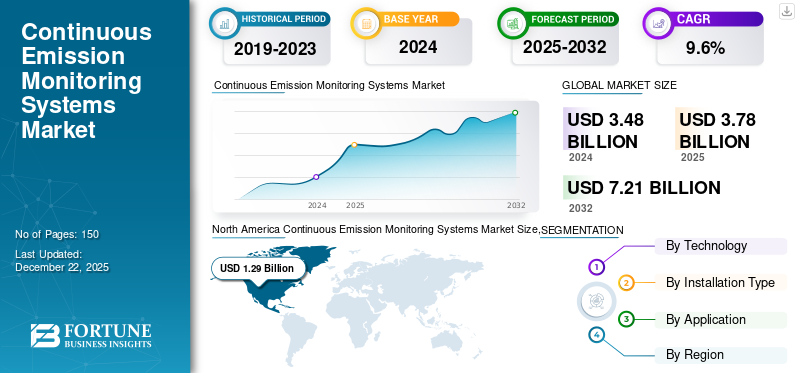
The global continuous emission monitoring systems market size was valued at USD 3.78 billion in 2025 and is projected to grow from USD 4.12 billion in 2026 to USD 8.45 billion by 2034, exhibiting a CAGR of 9.40% during the forecast period. North America dominated the global market with a share of 37.00% in 2025.
Continuous Emission Monitoring Systems (CEMS) comprise integrated systems designed to collect, continuously analyze, and record data on pollutant concentrations released from industrial exhaust stacks and flue gas sources. These systems are essential for regulatory compliance, providing the real time monitoring of gases such as SO₂, NOx, CO₂, CO, and O₂, to ensure adherence to environmental standards. It is crucial in emission control strategies across industries such as power generation, oil & gas, chemicals & petrochemicals, cement, pulp & paper, waste incineration, metals & mining, pharmaceutical, food & beverage, and wastewater treatment, supporting environmental transparency and operational efficiency. ABB, Siemens, Emerson Electric Co., Teledyne Technologies, Horiba, Thermo Fisher Scientific Inc., AMETEK Inc., Fuji Electric Co., Ltd., IMR Environmental Equipment, Inc., and SICK AG are key players.
The COVID-19 pandemic disrupted the CEMS market by slowing down manufacturing, installations, and retrofitting activities due to operational shutdowns. However, the shift toward stricter environmental regulations and the rising demand for remote monitoring solutions led to a resurgence in CEMS adoption, particularly in digital and real-time monitoring technologies.
Download Free sample to learn more about this report.
 Global Market Size & Forecast
 Market Share
 Key Regional Highlights
North America
The market reached USD 1.40 billion in 2025 and is projected to grow to USD 1.52 billion in 2026.
Europe
The market reached USD 1.20 billion in 2025 and is projected to grow to USD 1.32 billion in 2026
Asia Pacific
The market reached USD 0.84 billion in 2025 and is projected to grow to USD 0.92 billion in 2026.
U.S.
The market is projected to reach USD 0.90 billion by 2026.
Japan
The market is projected to reach USD 0.22 billion by 2026.
Read More

The implementation of reciprocal tariffs has the potential to significantly impact the market by increasing the cost of raw materials and finished products. Manufacturers in regions impacted by tariffs may experience higher production costs, which could lead to increased prices for continuous emission monitoring systems units. These cost hikes are likely to be transferred to end-users, raising the overall expenditure on emission monitoring systems. Additionally, supply chain disruptions caused by trade barriers may delay the delivery of critical components, further hindering market growth. These tariff-induced cost pressures could result in delayed project timelines and affect the adoption rate of continuous emission monitoring systems in price-sensitive markets, particularly in developing regions. For instance,
Advancements in the continuous emission monitoring system market, including machine learning and deep learning, are significantly enhancing the capabilities of continuous emission monitoring systems through real time data processing, anomaly detection, and predictive maintenance. For instance,
AI also plays a crucial role in detecting sensor calibration issues and errors, ensuring the accuracy of emission measurements. At the same time, predictive maintenance models help forecast potential equipment failures, reducing downtime. Additionally, AI optimizes system performance by adjusting sampling rates and calibration schedules, minimizing energy consumption and wear on equipment. Moreover, AI-driven predictive modeling and anomaly detection support emission forecasting and regulatory compliance, streamlining operational processes and mitigating the risk of regulatory violations.
Hybrid Monitoring Solutions Emerge as a Key Driver for Market Expansion
A growing trend in the market is the adoption of hybrid monitoring approaches, where industries combine continuous systems with occasional, manual, or portable monitoring options. This strategy helps facilities comply with regulations while reducing operational costs, particularly in sectors where full-time monitoring is financially burdensome or not mandated by law. Hybrid systems are commonly used in facilities with diverse process needs, smaller emission sources, or irregular operations where a permanent continuous emission monitoring system may not be necessary. For example,
Therefore, companies can maintain compliance, reduce costs, and enhance flexibility by using portable or semi-continuous devices at specific emission points and retaining automated continuous emission monitoring systems on essential stacks.
Download Free sample to learn more about this report.
Stringent Environmental Regulations and Sustainability Initiatives to Propel the Market Expansion
Governments worldwide are strengthening environmental standards, making regulatory compliance a critical factor for the continuous emission monitoring systems market growth. In regions such as the U.S., Europe, China, and India, air quality regulations have shifted from occasional inspections to continuous, automated monitoring of industrial emissions.
Non-compliance with these regulations can result in severe penalties, including substantial fines, production reductions, and even operational shutdowns. As a result, industries are increasingly adopting certified continuous emission monitoring systems that meet rigorous standards of accuracy and reliability to ensure compliance with environmental regulations and mitigate the risks of legal consequences.
Competitions from New and Alternative Monitoring Technologies May Hinder the Market Growth
The rise of cutting edge remote monitoring technologies, such as satellite-based sensing, is influencing the expansion of the market. These systems use specialized satellite tools to measure atmospheric pollutants across large regions in near real-time, enabling more efficient emissions tracking. For example,
Additionally, drone-mounted sensors are gaining traction, offering precise emissions assessments in hard-to-reach areas and for short-term monitoring needs.
Municipal and Urban Transformation Initiatives to Drive the Market Growth
Municipalities and urban administrations are increasingly prioritizing air pollution management due to public health concerns, growing population densities, and pressure to meet environmental standards. This shift is driving investments in both fixed and mobile emission monitoring systems. For example,
These systems provide continuous, real-time data, enabling city authorities to implement effective pollution control measures and ensure compliance with national and international air quality standards.
Direct Extractive CEMS Leads Driven by High Adoption in Heavy Industries
The market is divided into direct extractive CEMS, dilution extractive CEMS, and in-situ CEMS based on technology.
The direct extractive CEMS segment is anticipated to hold a dominant market share of 52.87% in 2026, primarily due to its widespread adoption in heavy industries that require accurate and continuous monitoring of multiple gas parameters under extreme operating conditions. These systems can handle high temperatures, complex flue gas compositions, and elevated particulate concentrations, making them the preferred solution for regulatory-grade emission monitoring. For instance,
The in-situ CEMS segment is expected to record the highest CAGR over the forecast period, driven by its low maintenance needs, faster response times, and compatibility with modern, decentralized, and space-constrained industrial configurations. These systems eliminate sample extraction and conditioning, making them ideal for dynamic and space-constrained environments. For instance,
New Installations Capture the Largest Market Share Owing to the Expanding Industrial Infrastructure
Based on installation type, the market is divided into new installations, retrofit installations/upgrades, and replacement installations.
The new installations segment accounts for the largest continuous emission monitoring systems market share, driven by the rapid expansion of industrial infrastructure in emerging economies. New facilities in sectors such as power generation, cement, and petrochemicals are being established under increasingly stringent environmental regulations. These projects incorporate advanced CEMS technologies from the design stage to ensure long-term regulatory compliance and operational efficiency. For instance,
The retrofit installations/upgrades segment is register the highest share of 39.55% in 2026. This trend is marked in developed regions where mature industrial sectors prioritize the modernization of legacy emission monitoring systems. Key growth drivers include the accelerating shift toward digital transformation, the need for higher measurement accuracy, and the adoption of remote monitoring technologies to enhance regulatory compliance and operational efficiency. For instance,
To know how our report can help streamline your business, Speak to Analyst
Power Generation Segment Dominates with Continuous Emission Monitoring Needs
By application, the market is segmented into power generation, oil & gas, chemicals & petrochemicals, cement, pulp & paper, waste incineration, metals & mining, pharmaceutical, food & beverage, and others.
The power generation segment is anticipated to hold a dominant market share of 29.41% in 2026, driven by high pollutant output and stringent emissions regulations. Utilities must ensure ongoing compliance with SOx, NOx, and CO₂ emission standards, making these solutions essential for operational and regulatory frameworks.
The others segment is projected to experience the highest CAGR, fueled by urbanization and the broadening of environmental regulations to include smaller and municipal-scale facilities. Additionally, the growing adoption of IoT and automation technologies in these facilities is driving operational efficiency and ensuring better compliance with environmental standards.
By region, the market has been studied across North America, Europe, Asia Pacific, South America, and the Middle East & Africa.
In 2025, the North America market stood at USD 1.4 billion, representing 37.00% of global demand, and is projected to grow to USD 1.52 billion in 2026, continues to lead the market, owing to early regulatory enforcement, especially by the U.S. Environmental Protection Agency (EPA) under the Clean Air Act (40 CFR Part 60 and 75). The region has a well-developed industrial base spanning sectors such as power generation, oil & gas, and chemicals, all subject to stringent continuous emissions monitoring requirements. This leadership position is further reinforced by continued investments in retrofitting and upgrading aging infrastructure. The U.S. market is projected to reach USD 0.9 billion by 2026. For instance,
North America Continuous Emission Monitoring Systems Market Size, 2025 (USD Billion)
To get more information on the regional analysis of this market, Download Free sample
Asia Pacific maintained a strong presence in the global market, reaching USD 0.84 billion in 2025, accounting for 22.10% share, and is expected to reach USD 0.92 billion in 2026, driven by rapid industrialization, increasing urbanization, and progressively stricter environmental regulations. Countries such as China, India, Japan, and Indonesia are implementing nationwide programs aimed at air pollution reduction, thereby mandating real-time emissions monitoring in new and existing facilities. The Japan market is projected to reach USD 0.22 billion by 2026, the China market is projected to reach USD 0.26 billion by 2026, and the India market is projected to reach USD 0.17 billion by 2026. For instance,
Europe holds the second-largest market share due to its mature regulatory landscape and rigorous enforcement of environmental protection laws. The EU's Industrial Emissions Directive (IED) and national frameworks mandate continuous air pollutant monitoring across key industrial sectors. The UK market is projected to reach USD 0.36 billion by 2026, and the Germany market is projected to reach USD 0.3 billion by 2026. The Europe region captured 31.80% of the global market in 2025, generating USD 1.2 billion in revenue, and is projected to reach USD 1.32 billion in 2026. For instance,
The market in these regions is projected to grow steadily, primarily due to limited regulatory enforcement and fragmented environmental compliance frameworks across the region. Although several countries have introduced emission control regulations, the inconsistent implementation and weak institutional monitoring capabilities have significantly reduced the urgency for industrial operators to adopt continuous emissions monitoring systems. The Middle East & Africa market accounted for USD 0.2 billion in 2025, representing 5.40% of the global industry, and is expected to reach USD 0.21 billion in 2026.
In 2025, Latin America represented USD 0.14 billion, accounting for 3.70% of the worldwide market, and is projected to grow to USD 0.15 billion in 2026.
Key Players Launch New Products to Strengthen their Market Positions
Prominent players enhance their product portfolios to enhance their market positions by offering advancements in sensor technologies, addressing diverse consumer needs, and staying ahead of competitors. They prioritize portfolio enhancement and strategic collaborations, acquisitions, and partnerships to strengthen their product offerings. Such strategic product launches help companies maintain and enhance their market share in a rapidly evolving landscape.
The market report focuses on key aspects such as leading companies, product/service types, and product applications. Besides, the report offers insights into the market trend analysis and highlights vital developments. In addition to the factors above, the report encompasses several factors that contributed to the market growth in recent years.
Request for Customization to gain extensive market insights.
|
ATTRIBUTE |
DETAILS |
|
|
Study Period |
2021-2034 |
|
|
Base Year |
2025 |
|
|
Estimated Year |
2026 |
|
|
Forecast Period |
2026-2034 |
|
|
Historical Period |
2021-2024 |
|
|
Unit |
Value (USD Billion) |
|
|
Growth Rate |
CAGR of 9.40% from 2026 to 2034 |
|
|
Segmentation |
By Technology
By Installation Type
By Application
By Region
|
|
|
Companies Profiled in the Report |
|
|
According to Fortune Business Insights, the market is projected to reach USD 8.45 billion by 2034.
In 2025, the market size stood at USD 3.78 billion.
The market is projected to grow at a CAGR of 9.40% during the forecast period.
By application, the power generation segment is leading the market.
Stringent environmental regulations and sustainability initiatives are key factors propelling market growth.
Thermo Fisher Scientific, Siemens AG, Emerson Electric Co., ABB Ltd., and AMETEK Inc. are the top players in the continuous emission monitoring systems market.
North America dominated the global market with a share of 37.00% in 2025.
Asia Pacific is expected to grow at the highest CAGR during the forecast period.

Get 30-60 hrs Free Customization
Expand Regional and Country Coverage, Segments Analysis, Company Profiles, Competitive Benchmarking, and End-user Insights.




















Related Reports
Get In Touch With Us
US +1 833 909 2966 ( Toll Free )
Receive a tailored pricing based on your needs.
Discuss your questions with our industry experts.
Have questions? Get quick answers before you purchase.

