Cord Blood Banking Services Market Size, Share & Industry Analysis, By Services (Collection & Transportation, Processing, Analysis, Storage, and Others), By Bank Type (Private, Public, and Hybrid), By Component (Cord Blood and Cord Tissue), By Application (Cancer, Genetic Disorders, Blood Disorders, Immune Disorders, Metabolic Disorders, and Others), By Service Provider (Private Banks, Public Banks, Hospital-Affiliated Banks, Hybrid Banks, and Others), and Regional Forecast, 2026-2034
 Download Free Sample
Cord Blood Banking Services Market Size and Future Outlook
 Listen to Audio Version
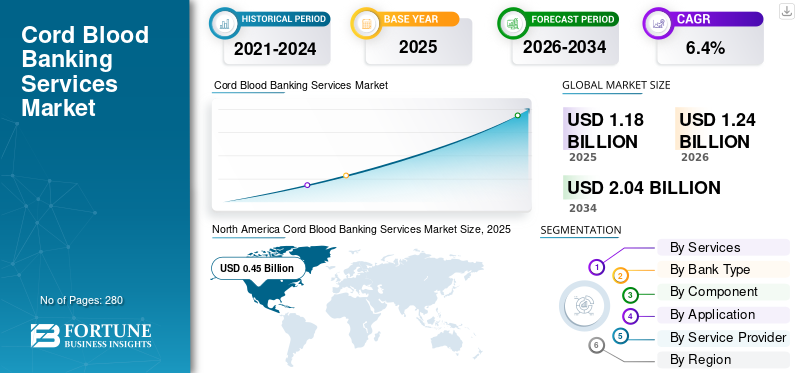
The global cord blood banking services market size was valued at USD 1.18 billion in 2025 and is projected to grow from USD 1.24 billion in 2026 to USD 2.04 billion by 2034, exhibiting a CAGR of 6.4% during the forecast period. North America dominated the cord blood banking services market with a market share of 38.14% in 2025.
The global market covers the collection, transportation, processing, testing, cryogenic preservation, storage, and release of stem-cell-rich blood obtained from the umbilical cord and placenta after childbirth. Services are offered through private banks that reserve units for families, public banks that make qualified units available to unrelated patients, and hybrid models combining both approaches. Market growth is supported by the established role of cord blood in hematopoietic stem cell transplantation, rising awareness among expectant parents, greater participation by maternity hospitals, and the expansion of long-term storage plans. Cord blood is used in treating selected blood cancers, inherited metabolic conditions, immune disorders, and other diseases affecting the blood-forming system. The market also benefits from recurring storage revenue, improved processing methods, stronger chain-of-custody systems, and efforts to build ethnically diverse public inventories. Growing interest in cell therapy research is further encouraging banks to strengthen sample quality, traceability, and clinical-release capabilities.
Furthermore, Cord Blood Registry (CBR), FamiCord AG, Shandong Cord Blood Bank, and ViaCord held the largest market share, driven by increased investments and strategic initiatives, including new service launches, collaborations, and partnerships.
Download Free sample to learn more about this report.
CORD BLOOD BANKING SERVICES MARKET KEY TAKEAWAYS
 Global Market Size & Forecast
- 2025 Market Size: USD 1.18 billion
- 2026 Market Size: USD 1.24 billion
- 2034 Forecast Market Size: USD 2.04 billion
- CAGR: 6.4% from 2026–2034
 Market Share
- North America dominated the market with a 38.14% share in 2025.
- The Private Banking segment held the largest market share, projected at 65.4% in 2026.
- The Cord Blood segment held the largest market share, projected at 76.2% in 2026.
 Key Regional Highlights
North America
North America reached USD 0.45 billion in 2025, supported by a large installed base of privately stored cord blood units, recurring storage payments, and established commercial banking networks.
Europe
Europe projected to reach USD 0.21 billion by 2026, growing at a 6.2% CAGR, driven by recurring storage revenue, contract renewals, and expansion into broader perinatal tissue services.
Asia Pacific
Asia Pacific projected to reach USD 0.46 billion by 2026, ranking as the third-largest region and emerging as the fastest-growing market due to its large birth population and increasing awareness of stem-cell preservation.
U.S.
The market is projected to reach USD 0.43 billion by 2026, accounting for 34.9% of global revenue.
Japan
The market is projected to generate approximately USD 0.03 billion by 2026, contributing nearly 2.1% to global revenue.
Read More

CORD BLOOD BANKING SERVICES MARKET TRENDS
Subscription-Based Storage and Broader Service Packages are Reshaping the Market Trends
Cord blood banks are increasingly moving away from a simple one-time processing transaction toward long-term, recurring service relationships. Annual subscription plans, multi-year contracts, renewal programs, digital account management, and bundled family-banking packages are becoming more important as they provide customers with payment flexibility and give service providers a steadier revenue base.
Storage is consequently gaining importance within the overall service mix. Every newly banked unit is added to an existing inventory that must be preserved, monitored, documented, and protected for many years. FamiCord reported that its cumulative stored biological materials increased to approximately 1.134 million in 2025, while 68,000 new materials were added during the year. The company also reported a rising proportion of subscription models, price adjustments, high renewal rates, and stronger demand for more comprehensive service packages. Cryo-Cell similarly generated USD 31.4 million from processing and storage fees during fiscal 2025, representing nearly all its reported revenue.
Alongside changes in payment structures, providers are strengthening electronic chain-of-custody records, sample tracking, customer portals, and quality-monitoring systems. Larger banks are also using hospital partnerships and centralized laboratories to manage collections across wider geographic areas. This trend favors providers with scalable cryogenic infrastructure, dependable information systems, and low customer churn, while smaller standalone banks may face pressure to consolidate, form partnerships, or specialize in selected geographic markets.
MARKET DYNAMICS
MARKET DRIVERS
Download Free sample to learn more about this report.
Rising Need for Transplant-Ready Stem Cell Sources to Support Market Expansion
The growing clinical need for readily available blood-forming stem cells is a central driver of the market. Cord blood can be collected without an invasive donor procedure, cryopreserved in advance, and released when a suitable patient requires transplantation. It may also tolerate a less exact human leukocyte antigen match than bone marrow or peripheral blood stem cells, widening donor options for patients who struggle to find a closely matched adult donor. This advantage is particularly important for ethnically diverse patients, who remain underrepresented in many donor registries.
NMDP states that blood stem cell transplantation can treat more than 75 blood cancers and diseases, while approximately 12,000 patients each year are diagnosed with life-threatening conditions for which an unrelated donor transplant may be their best or only curative option. The growing burden of leukemia, lymphoma, sickle cell disease, immune deficiencies, and inherited metabolic disorders therefore supports demand for high-quality cord blood collection, testing, storage, matching, and release services.
Public inventory-building programs reinforce this demand. In the U.S., more than 247,900 cord blood units are available through the national registry, including more than 3,900 National Cord Blood Inventory units added during fiscal 2025. As transplant centers seek faster access to qualified units, banks with broad inventories, validated processing, and reliable logistics are positioned to benefit.
|
Rank |
Market Drivers |
Overall Impact Rank |
CAGR Contribution (2026-2034) |
Impact 2026-2028 |
Impact 2029-2031 |
Impact 2032-2034 |
|
1 |
Expansion of recurring storage revenue from the growing cumulative base of banked cord blood and cord tissue units |
High |
2.20% |
High |
High |
High |
|
2 |
Growing demand for transplant-ready stem cell sources for hematologic cancers, blood disorders, immune disorders, and inherited diseases |
High |
1.90% |
Medium |
High |
High |
|
3 |
Expansion of private, hybrid, and hospital-partner cord blood banking networks across emerging markets |
Medium-High |
1.70% |
Medium |
High |
High |
|
4 |
Increasing parental awareness, flexible payment plans, and adoption of bundled cord blood and cord tissue banking services |
Medium |
1.40% |
Medium |
Medium |
High |
|
5 |
Advancements in processing, testing, cryopreservation, quality assurance, and digital chain-of-custody systems |
Medium |
1.00% |
Medium |
Medium |
Medium |
|
6 |
Others (expansion of public and directed-donation programs, maternity hospital partnerships, research demand, provider consolidation, and improved registry participation) |
Low |
0.60% |
Low |
Low |
Medium |
|
Total Positive Growth Contribution |
8.80% |
MARKET RESTRAINTS
High Private-Banking Costs and Uncertain Personal Use to Restrict Adoption
The high cost of private cord blood banking remains a major restraint, particularly in price-sensitive households and emerging markets. Families generally pay an initial fee covering collection kits, transportation, processing, testing, and cryopreservation, followed by annual storage charges or a larger prepaid amount for multi-year preservation. Since these expenses are commonly paid out of pocket, the decision competes with other childbirth, medical, and household costs.
More importantly, storing a newborn’s cord blood does not guarantee that the unit will eventually be suitable or recommended for that child or another family member. ACOG notes that private collection and storage involve costs and that there is no assurance the stored unit will prove useful for future treatment. For certain inherited conditions, the child’s own cord blood may carry the same genetic abnormality and may therefore be unsuitable for autologous use. Professional guidance has consequently emphasized balanced counseling and generally favors public donation for families without a known medical indication.
These considerations can reduce conversion rates even where parental awareness is high. The restraint becomes more pronounced when promotional claims create expectations beyond currently established clinical uses, prompting physicians and parents to question the value of long-term private storage. Banks must therefore communicate realistic benefits, provide flexible payment structures, and demonstrate strong quality standards. Without improved affordability and clearer evidence of likely family benefit, private banking penetration may remain concentrated among higher-income consumers.
|
Rank |
Market Restraints |
Overall Impact Rank |
Negative CAGR Contribution (2026-2034) |
Impact 2026-2028 |
Impact 2029-2031 |
Impact 2032-2034 |
|
1 |
High upfront and recurring private-banking costs, combined with uncertainty regarding future personal or family use |
High |
−1.0% |
High |
High |
Medium |
|
2 |
Declining fertility rates and live-birth volumes across Europe, East Asia, and other mature markets |
Medium |
−0.7% |
Medium |
Medium |
High |
|
3 |
Stringent regulatory, accreditation, sample-quality, cold-chain, and long-term storage compliance requirements |
Medium |
−0.5% |
High |
Medium |
Medium |
|
4 |
Others (limited public-bank funding, low awareness in underserved markets, competition from alternative stem cell sources, collection failures, currency volatility, and reputational risks) |
Low |
−0.2% |
Low |
Low |
Low |
|
Total Negative Growth Impact |
−2.4% |
MARKET OPPORTUNITIES
Expansion of Diverse Public and Hybrid Inventories to Create New Growth Opportunities
A significant opportunity lies in expanding public, community, and hybrid cord blood banking networks that serve both individual families and the wider transplant system. Public banks can improve access for patients who cannot find a suitable adult donor, while hybrid models can combine commercially funded family storage with public donation, directed donation, research use, or community-sharing arrangements. This approach can improve the utilization of collection infrastructure and create multiple revenue streams from processing, storage, registry services, confirmatory testing, and clinical release.
The need is especially strong among ethnically diverse populations as HLA markers are inherited and patients are more likely to match donors with similar ancestry. NMDP notes that ethnically diverse donors remain underrepresented, meaning that patients do not have an equal probability of finding a suitable match. Hospitals and maternity centers can support market expansion by identifying eligible mothers during prenatal care, standardizing consent procedures, training delivery staff, and arranging rapid transportation to accredited processing laboratories.
The U.S. registry already contains more than 247,900 available cord blood units, demonstrating the scale achievable through coordinated collection and funding programs. Similar networks could be expanded across Asia, Latin America, the Middle East, and underserved parts of Europe. Banks combining digital enrollment, multilingual education, transparent consent, and efficient qualification protocols may secure more usable donations while reducing collection failures. Over time, broader and more representative inventories can support transplantation, scientific research, and more equitable access to cell-based therapies.
MARKET CHALLENGES
Maintaining Sample Quality Amid Regulatory and Demographic Pressures Remains Challenging
Cord blood banking depends on a tightly controlled process that begins in the delivery room and continues through transportation, testing, processing, cryopreservation, storage, and eventual clinical release. A delay, labeling error, temperature excursion, low collected volume, contamination event, or incomplete maternal screening can make a unit unsuitable for transplantation. Banks must therefore coordinate obstetric teams, couriers, laboratories, registries, and transplant centers while maintaining traceability over contracts that may continue for several decades.
Regulatory requirements add further complexity. In the U.S., private banks must comply with establishment registration, donor screening, infectious-disease testing, labeling, reporting, and current good tissue practice requirements. Public units intended for unrelated recipients face additional biologics licensing or investigational requirements, while registered facilities are subject to regulatory inspection. Licensing and accreditation frameworks also differ between countries, increasing compliance and administrative costs for international providers.
Demographic change creates another structural challenge. Birth volumes are declining in several mature markets, particularly across Europe and East Asia, reducing the pool of potential new collections and intensifying competition for maternity-hospital partnerships. United Nations population projections reflect continuing fertility declines across many countries, meaning that providers cannot rely exclusively on birth growth. Banks must instead improve enrollment conversion, contract renewal, pricing, and service breadth without overstating unproven clinical benefits. Maintaining financial viability while funding redundant storage systems, backup power, cybersecurity, audits, insurance, and long-term sample stewardship will remain demanding.
Segmentation Analysis
By Services
Expanding Stored-Unit Inventories to Sustain Storage Segment Leadership
Based on services, the market is segmented into collection & transportation, processing, analysis, storage, and others.
The storage segment accounted for the largest service share as it generates revenue throughout the life of a banking contract, whereas collection, transportation, processing, and initial analysis are mainly one-time activities. Every accepted unit enlarges the inventory requiring cryogenic preservation, monitoring, documentation, backup systems, and customer account management. Long-duration prepaid plans and annual subscriptions also make storage revenue more predictable than new-enrollment revenue.
Additionally, the analysis segment is projected to grow at a CAGR of 5.2% during the forecast period.
To know how our report can help streamline your business, Speak to Analyst
By Bank Type
Family-Paid Preservation Keeps Private Banking Segment in the Leading Position
By bank type, the market is classified into private, public, and hybrid.
The private banking segment held the largest share as families directly pay for collection, processing, testing, and exclusive long-term storage of their newborn’s cord blood. This model generates higher revenue per unit than public banking, which is usually supported by government, charitable, or institutional funding and accepts donations meeting defined quality thresholds. Moreover, the segment is projected to hold a 65.4% share in 2026.
Additionally, the hybrid segment is estimated to grow at a CAGR of 10.6% during the forecast period.
By Component
Established Transplant Use Enables Cord Blood Segment to Retain Dominance
By component, the market is classified into cord blood and cord tissue.
The cord blood segment accounted for the larger share as it contains blood-forming stem cells with established applications in hematopoietic transplantation. Regulators and transplant organizations recognize its use for selected blood cancers, blood disorders, immune deficiencies, and inherited metabolic diseases. Moreover, the segment is projected to hold a 76.2% share in 2026.
Additionally, the cord tissue segment is estimated to grow at a CAGR of 9.3% during the forecast period.
By Application
Frequent Transplant Use in Hematologic Malignancies Supports Cancer Segment Leadership
By application, the market is classified into cancer, genetic disorders, blood disorders, immune disorders, metabolic disorders, and others.
The cancer segment represented the largest application share as cord blood transplantation is used in hematologic malignancies such as leukemia and lymphoma when a suitable stem cell source is required. These diseases account for a significant portion of transplant searches and public-unit releases, creating demand for HLA typing, confirmatory testing, registry matching, retrieval, and clinical shipment. Moreover, the segment is projected to hold a 40.1% share in 2026.
Additionally, the immune disorders segment is estimated to grow at a CAGR of 7.7% during the forecast period.
By Service Provider
Direct Consumer Revenue and Broad Collection Networks Favor Private Banks Segment Growth
On the basis of service provider, the market is classified into private banks, public banks, hospital-affiliated banks, hybrid banks, and others.
The private banks segment held the leading cord blood banking services market share as they manage the complete customer journey, from prenatal enrollment and collection-kit delivery to processing and recurring storage. Their direct-to-family model produces processing fees, prepaid contracts, annual renewals, and ancillary revenue, creating greater commercial value per stored unit. Furthermore, the segment is set to hold a 55.7% share in 2026.
In addition, the hybrid banks segment is projected to grow at a CAGR of 10.4% during the forecast period.
Cord Blood Banking Services Market Regional Outlook
Based on region, the market is classified into North America, Europe, Asia Pacific, Latin America, and the Middle East & Africa.
North America
North America Cord Blood Banking Services Market Size, 2025 (USD Billion)
To get more information on the regional analysis of this market, Download Free sample
North America held the largest revenue share in 2024, valued at USD 0.44 billion, and further reached USD 0.45 billion in 2025. Further, the region is expected to record a steady, moderate growth over the forecast period, primarily supported by its large installed base of privately stored cord blood units and recurring annual storage payments. North America already has well-established commercial banks, extensive maternity-hospital collection networks, relatively high service prices, and strong adoption of combined cord blood and cord tissue packages. Growth is therefore likely to be driven more by contract renewals, storage-fee adjustments, prepaid plans, digital customer management, and premium service packages than by a sharp increase in new births.
U.S. Cord Blood Banking Services Market
In 2026, the U.S. market is estimated to represent a valuation of USD 0.43 billion, capturing 34.9% of total global revenue.
Europe
Europe is expected to achieve a growth rate of 6.2% over the forecast period, the second-highest globally, reaching USD 0.21 billion by 2026. The region’s growth is expected to be driven by recurring storage revenue, contract renewals, price revisions, consolidation among banking providers, and the introduction of broader perinatal tissue services. FamiCord reported positive operational development in 2025 despite challenging economic conditions and attributed its performance to product innovation, optimized contract and pricing structures, and expansion beyond conventional cord blood storage. Larger provider networks can improve laboratory utilization, centralize processing, reduce operating costs, and offer collection services across multiple countries.
U.K. Cord Blood Banking Services Market
The U.K. market is projected to reach USD 0.03 billion by 2026, accounting for 2.6% of the global market revenue.
Germany Cord Blood Banking Services Market
Germany's market is projected to reach about USD 0.05 billion by 2026, representing roughly 4.2% of global revenue.
Asia Pacific
In 2026, the Asia Pacific market is predicted to value at USD 0.46 billion, ranking as the third-largest region globally. Asia Pacific is projected to be the fastest-growing regional market due to its large addressable birth population, comparatively low private-banking penetration in several countries, expanding hospital partnerships, and growing awareness of stem-cell preservation among urban families. The region has established banking markets in China, Japan, Australia, Singapore, and Hong Kong, while India, Indonesia, Malaysia, and the Philippines offer greater room for incremental adoption.
Japan Cord Blood Banking Services Market
Japan is projected to generate approximately USD 0.03 billion in revenue by 2026, contributing nearly 2.1% to the global market.
China Cord Blood Banking Services Market
China’s market size is expected to reach approximately USD 0.23 billion by 2026, contributing about 18.8% to global revenues.
India Cord Blood Banking Services Market
India is projected to contribute approximately USD 0.07 billion to the market by 2026, corresponding to about 6.0% of global revenues.
Latin America and Middle East & Africa
Both Latin America and the Middle East & Africa regions are anticipated to witness moderate cord blood banking services market growth. Further, Latin America is expected to reach a valuation of around USD 0.06 billion by 2026. Latin America is expected to grow from a relatively low penetration base as private cord blood banking becomes more accessible across major urban centers. Brazil and Mexico have established family-banking providers, processing laboratories, and public cord blood infrastructure, providing a foundation for wider market development. Growth in the Middle East & Africa market will be led predominantly by GCC countries, particularly the UAE and Saudi Arabia. The GCC benefits from premium private maternity services, high healthcare spending among citizens and expatriate families, growing awareness of newborn stem-cell preservation, and increasing availability of local processing and cryogenic-storage infrastructure.
GCC Cord Blood Banking Services Market
By 2026, the GCC is expected to generate a valuation of approximately USD 0.03 billion in the market, accounting for nearly 2.4% of global revenues.
COMPETITIVE LANDSCAPE
Key Industry Players
Strong Regional Presence and Service Expansion to Drive Market Competition
The global cord blood banking services market is moderately fragmented but regionally concentrated. Large private operators such as Cord Blood Registry in North America and FamiCord in Europe benefit from extensive stored-sample inventories, maternity-hospital networks, recurring storage fees and bundled cord blood, tissue and perinatal banking services. Competition is based mainly on regulatory compliance, accreditation, sample-processing quality, cryogenic-storage reliability, geographic collection coverage, pricing flexibility, and clinical-release experience. Public and hospital-affiliated banks also remain important, particularly in developed markets.
Overall, leading companies maintain strong regional positions, while differences in national regulations and public-versus-private banking structures preserve a sizable long tail of local providers. Consolidation, hospital partnerships, and expansion into cord tissue and other perinatal materials are expected to remain key competitive strategies.
LIST OF KEY CORD BLOOD BANKING SERVICES COMPANIES PROFILED
- Cord Blood Registry (CBR) (CooperSurgical) (U.S.)
- FamiCord AG (Germany)
- Shandong Cord Blood Bank (China)
- ViaCord (Revvity) (U.S.)
- Beijing Cord Blood Bank (China)
- LifeCell International Pvt. Ltd. (India)
- Guangdong Cord Blood Bank (China)
- Cryo-Cell International, Inc. (U.S.)
- Shanghai Cord Blood Bank (China)
- Cordlife Group Limited (Singapore)
KEY INDUSTRY DEVELOPMENTS
- June 2026: FamiCord, through PBKM, signed a framework agreement with ArThec covering the development of tissue-engineering technologies for regenerative medicine.
- January 2026: The FDA cleared an Expanded Access program for StemCyte’s REGENECYTE in eligible patients with serious Long COVID symptoms who had exhausted standard treatment options, while further clinical development continued.
- November 2025: Following the Cord Blood Association’s dissolution in October 2025, AABB welcomed its members and formed a new Cord Blood Committee to continue work relating to cord blood banking, education, and birth-tissue therapies.
- February 2025: Vita 34 AG changed its corporate name to FamiCord AG, aligning the publicly listed parent company with its established international FamiCord banking network and creating a more unified global brand.
- January 2025: Singapore Ministry of Health renewed Cordlife’s cord blood and human-tissue banking licenses for one year and permitted the company to resume operations without the earlier monthly collection limit.
REPORT COVERAGE
The cord blood banking services market report provides an in-depth analysis of all market segments, highlighting key drivers, trends, opportunities, restraints, and challenges. It also provides insights into technological advancements, key industry developments, company market share analysis, and profiles of leading companies.
Request for Customization to gain extensive market insights.
Report Scope & Segmentation
| ATTRIBUTE | DETAILS |
| Study Period | 2021-2034 |
| Base Year | 2025 |
| Estimated Year | 2026 |
| Forecast Period | 2026-2034 |
| Historical Period | 2021-2024 |
| Growth Rate | CAGR of 6.4% from 2026-2034 |
| Unit | Value (USD Billion) |
| Segmentation | By Services, Bank Type, Component, Application, Service Provider, and Region |
| By Services |
|
| By Bank Type |
|
| By Component |
|
| By Application |
|
| By Service Provider |
|
| By Region |
|
Frequently Asked Questions
Fortune Business Insights says that the global market value stood at USD 1.18 billion in 2025 and is projected to reach USD 2.04 billion by 2034.
In 2025, the market value stood at USD 0.45 billion.
The market is expected to exhibit a CAGR of 6.4% during the forecast period.
The storage segment led the market by services.
The key factor driving the market is the rising need for transplant-ready stem cell sources.
Cord Blood Registry (CBR), FamiCord AG, Shandong Cord Blood Bank, and ViaCord are some of the major players in the market.
North America dominated the market in 2025.



- 2021-2034
- 2025
- 2021-2024
- 280
Get 30-60 hrs Free Customization
Expand Regional and Country Coverage, Segments Analysis, Company Profiles, Competitive Benchmarking, and End-user Insights.













.webp)






Related Reports
-
US +1 833 909 2966 ( Toll Free )
-
Get In Touch With Us