Corrugated Pallets Market Size, Share & Industry Analysis, By Pallet Type (Block Pallets, Stringer Pallets, Custom Pallets, and Others), By Wall Type (Single-wall, Double-wall, and Triple-wall), By End Use (Food & Beverages, Pharmaceuticals, Consumer Goods, Electronics, Automotive, and Others), and Regional Forecast, 2026-2034
 Download Free Sample
(Offer valid till 15th Oct 2026)

Corrugated Pallets Market Size and Future Outlook
 Listen to Audio Version
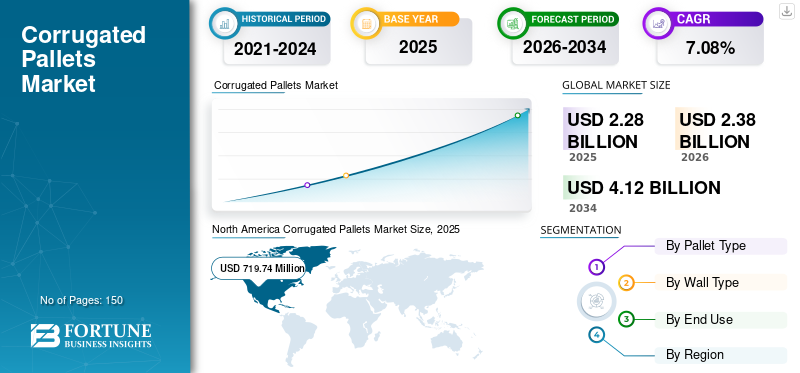
The global corrugated pallets market size was valued at USD 2,238.00 million in 2025. The market is projected to grow from USD 2,383.53 million in 2026 to USD 4,119.17 million by 2034, exhibiting a CAGR of 7.08% during the forecast period. North America dominated the corrugated pallets market with a market share of 32.16% in 2025.
The global market pertains to the sector dedicated to the manufacturing, distribution, and utilization of pallets constructed from corrugated paperboard materials. The increasing demand for corrugated pallets that are eco-friendly and lightweight packaging options is propelling the adoption. Their ability to be recycled, adherence to international shipping standards, and cost benefits compared to wooden pallets render them more favored in global commerce and e-commerce logistics.
Furthermore, many key industry players, such as DS Smith, Smurfit Kappa, and Mondi, operating in the market, are focusing on developing innovative products and conducting R&D.
Download Free sample to learn more about this report.
CORRUGATED PALLETS MARKET Key Takeaways
 Global Market Size & Forecast
- 2025 Market Size: USD 2,238.00 million
- 2026 Market Size: USD 2,383.53 million
- 2034 Forecast Market Size: USD 4,119.17 million
- CAGR: 7.08% from 2026–2034
 Market Share
- North America dominated the corrugated pallets market with a market share of 32.16% in 2025.
- The stringer pallets segment is expected to grow at a CAGR of 7.12% over the forecast period.
- The triple-wall segment is projected to grow at a CAGR of 6.85% over the forecast period.
 Key Regional Highlights
North America
The region generated USD 719.74 million in 2025 and maintained its leading position, supported by strong sustainability initiatives, advanced logistics infrastructure, warehouse automation, and expanding e-commerce activities.
Asia Pacific
Valued at USD 637.83 million in 2025, the region ranked second globally, driven by rapid industrialization, expanding manufacturing hubs, and increasing demand for cost-effective logistics solutions.
Europe
The market reached USD 382.70 million in 2025 and is projected to grow at a 6.79% CAGR, supported by stringent environmental regulations and rising adoption of recyclable packaging solutions.
U.S.
The market was valued at approximately USD 624.38 million in 2025, benefiting from a strong e-commerce ecosystem, export-oriented supply chains, and growing preference for sustainable shipping materials.
Japan
The market was valued at approximately USD 122.59 million in 2025, with demand supported by precision logistics, strict quality standards, and increasing adoption of sustainable packaging across electronics and food industries.
Read More

CORRUGATED PALLETS MARKET TRENDS
Shift Toward Sustainable and Circular Packaging Solutions is a Prominent Trend Observed in the Market
A significant trend in the global market is the rapid transition toward sustainable and circular packaging methods. Businesses across various sectors are increasingly aligning with environmental, social, and governance (ESG) objectives, which is boosting the demand for fully recyclable corrugated and biodegradable pallet options. Corrugated pallets, primarily constructed from paperboard, integrate seamlessly into closed-loop recycling systems and lessen dependence on wood and plastic. Furthermore, innovations in design and structural integrity have enhanced their load-bearing capabilities, broadening their use beyond light-duty applications. Major retailers and e-commerce firms are also emphasizing eco-friendly logistics solutions, further solidifying this trend as sustainability emerges as a crucial purchasing factor.
MARKET DYNAMICS
MARKET DRIVERS
Download Free sample to learn more about this report.
Growth in E-commerce and Export-Oriented Logistics is Driving Market Growth
The swift growth of global e-commerce and export-oriented supply chains significantly drives the corrugated pallets market growth. The rise in cross-border trade has generated a substantial demand for lightweight, compliant, and cost-effective pallet solutions. Such pallets remove the necessity for phytosanitary treatments that wooden pallets require, thereby streamlining international shipping procedures. Their lightweight characteristics also lead to reduced freight expenses, making them particularly appealing for air cargo and large-volume shipments. As online retail continues to expand and businesses enhance logistics for efficiency and cost-effectiveness, the demand for disposable, hygienic, and easy-to-manage pallet solutions is anticipated to increase consistently.
MARKET RESTRAINTS
Limited Load-Bearing Capacity Compared to Traditional Pallets Hampers Market Growth
Although corrugated pallets offer certain benefits, they have limitations in terms of load-bearing capacity and durability when compared to wooden or plastic options. Generally, they are not as suitable for heavy-duty applications or long-term reuse, particularly in environments that are subject to moisture or extreme handling conditions. This limits their use in sectors such as heavy manufacturing, automotive, and bulk material transport. Despite technological advancements that have improved their strength, concerns about reliability and performance under stress continue to exist among end users. These limitations may result in reluctance to replace traditional pallets, consequently hindering market penetration in specific industrial sectors.
MARKET OPPORTUNITIES
Increasing Adoption in Pharmaceutical and Food Industries Offers Potential Growth Opportunities
A considerable opportunity exists for the market due to their increasing utilization in the pharmaceutical and food sectors. These industries require elevated standards of hygiene, contamination management, and adherence to stringent regulatory requirements. Corrugated pallets, which are designed for single use and are devoid of pests or contaminants, provide a hygienic and secure alternative to wooden pallets. Their disposable characteristic minimizes the risk of cross-contamination, rendering them suitable for the handling of sensitive products. Furthermore, the growing global demand for packaged food and pharmaceutical items is opening new pathways for the application of such pallets, especially in temperature-sensitive and export logistics settings.
MARKET CHALLENGES
Moisture Sensitivity and Environmental Exposure Risks Pose a Critical Challenge to Market Growth
One of the primary challenges restraining the market is their vulnerability to moisture and environmental factors. Exposure to humidity, water, or damp storage conditions can undermine the structural integrity of paper-based pallets, resulting in diminished strength and possible product damage. This restricts their applicability in specific logistics situations, such as cold chain management or outdoor storage. While manufacturers are working on water-resistant coatings and treatments, these options may lead to higher costs and decreased recyclability. Striking a balance between performance improvement, sustainability, and cost-effectiveness continues to be a significant challenge for widespread adoption.
Segmentation Analysis
By Pallet Type
Structural Strength, Load Stability, and Handling Efficiency Drive the Dominance of Block Pallets
Based on the pallet type, the market is divided into block pallets, stringer pallets, custom pallets, and others.
The block pallets segment is expected to account for the largest corrugated pallets market share. The growth of this segment is mainly due to their enhanced structural integrity and effective load distribution features. Their design allows for four-way entry, facilitating easy access from all sides with forklifts and pallet jacks, which enhances operational efficiency in warehouses and logistics facilities. Moreover, block pallets offer improved weight distribution, which minimizes the likelihood of product damage during transportation. These benefits render them particularly favored in organized retail, export logistics, and automated material handling systems.
The stringer pallets segment is expected to grow at a CAGR of 7.12% over the forecast period.
By Wall Type
Enhanced Strength, Durability, and Load-Bearing Capacity Drive the Dominance of Double Wall Segment
Based on wall type, the market is segmented into single-wall, double-wall, and triple-wall.
In 2025, the double-wall segment dominated the global market owing to its enhanced strength and durability when compared to single wall options. Made from two layers of fluted corrugated board, it delivers greater compression resistance and an improved load-bearing capacity, rendering it appropriate for medium to relatively heavy applications. This additional structural integrity guarantees superior protection of goods during stacking, storage, and transit, thereby minimizing the risk of deformation or damage. Furthermore, double-wall pallets present a well-balanced mix of performance and cost-effectiveness, establishing them as a favored choice in various industries such as e-commerce, food & beverages, and pharmaceuticals, where both strength and sustainability are essential.
The triple-wall segment is projected to grow at a CAGR of 6.85% over the forecast period.
By End Use
To know how our report can help streamline your business, Speak to Analyst
Hygiene Requirements, High Shipment Volumes, and Sustainability Needs to Drive the Dominance of Food & Beverages Segment
Based on the end use, the market is segmented into food & beverages, pharmaceuticals, consumer goods, electronics, automotive, and others.
The food & beverages segment is expected to hold a dominant market share over the forecast period owing to its stringent hygiene standards and substantial distribution needs. Corrugated pallets are designed for single use, are recyclable, and are devoid of contaminants such as pests, which renders them exceptionally suitable for compliance with food safety and export regulations. The industry's swift turnover and extensive shipments favor the use of lightweight pallets that help lower transportation expenses while ensuring sufficient strength. Moreover, the growing demand for sustainable packaging solutions from food brands and retailers further propels the adoption of these pallets. Their ease of disposal and compatibility with automated handling systems render corrugated pallets an effective and dependable option in this industry.
The pharmaceuticals segment is projected to grow at a CAGR of 7.46% over the forecast period.
Corrugated Pallets Market Regional Outlook
By region, the market is categorized into Europe, North America, Asia Pacific, Latin America, and the Middle East & Africa.
North America
North America Corrugated Pallets Market Size, 2025 (USD Million)
To get more information on the regional analysis of this market, Download Free sample
North America held the dominant share in 2024, valued at USD 674.68 million, and maintained its leading position in 2025, with a value of USD 719.74 million. In North America, the market is propelled by robust sustainability mandates and well-established logistics networks. Companies are proactively substituting wood pallets with recyclable alternatives to fulfill ESG targets. The significant adoption of automation in warehousing, along with the existence of organized retail and e-commerce, further boosts the demand for lightweight pallets.
U.S. Corrugated Pallets Market
Based on North America's strong contribution and the U.S. dominance within the region, the U.S. market was analytically approximated at around USD 624.38 million in 2025, accounting for roughly 27.90% of global sales. The U.S. stimulates demand via its extensive e-commerce ecosystem and export-focused supply chains. Such pallets are favored due to their lightweight characteristics and adherence to international shipping regulations, which removes the need for phytosanitary measures. Moreover, leading retailers prioritize sustainable packaging, enhancing its adoption in both domestic and international logistics operations.
Asia Pacific
Asia Pacific reached USD 637.83 million in 2025 and secured the position of the second-largest region in the market. In the Asia Pacific region, swift industrialization and the growth of manufacturing centers are significant factors driving expansion. Nations such as China and India focus on cost-effective logistics solutions, rendering lightweight pallets appealing. The rise in exports and the increasing penetration of e-commerce further enhance the demand for disposable and affordable pallet options.
Japan Corrugated Pallets Market
The Japanese market in 2025 was valued at around USD 122.59 million, accounting for roughly 5.48% of global revenues. Japan's market is propelled by its emphasis on precision logistics, quality assurance, and hygiene standards. Such pallets are being utilized more frequently in industries such as electronics and food, where cleanliness and uniformity are essential. There is a growing concern for sustainability and rising carbon footprint amongst the environmental protection agencies and government authorities, which also boosts the market growth.
China Corrugated Pallets Market
China's market is projected to be one of the largest worldwide, with 2025 revenues recorded at around USD 204.74 million, representing roughly 9.15% of global sales.
India Corrugated Pallets Market
The Indian market size in 2025 was valued at around USD 168.32 million, accounting for roughly 7.52% of global high-revenue markets.
Europe
Europe is projected to grow at 6.79% over the coming years, the third-highest among regions, and reached a valuation of USD 382.70 million by 2025. The growth of the market in Europe is significantly shaped by rigorous environmental regulations and initiatives aimed at promoting a circular economy. Both governments and corporations emphasize the importance of using recyclable and biodegradable packaging materials, which in turn fosters the adoption of such pallets. Additionally, heightened consumer awareness and stringent waste management policies further facilitate the shift from plastic and wood-based pallet options.
U.K. Corrugated Pallets Market
The U.K. market in 2025 was valued at USD 69.12 million, representing approximately 3.09% of global revenues.
Germany Corrugated Pallets Market
Germany's market reached approximately USD 81.06 million in 2025, equivalent to around 3.62% of global sales.
Latin America
The Latin America region is expected to witness moderate growth in this market space during the forecast period. The Latin America market reached a valuation of USD 318.24 million in 2025. In Latin America, the rising demand for agricultural and food exports is creating a necessity for compliant and cost-effective pallet solutions. Such pallets contribute to lowering shipping expenses due to their reduced weight. Nevertheless, the price sensitivity prevalent among businesses promotes a gradual implementation, especially within sectors that emphasize international trade and perishable products.
Middle East & Africa
In the Middle East & Africa, South Africa reached USD 51.24 million in 2025. The Middle East & Africa region is experiencing growth driven by the expansion of trade activities and investments in logistics infrastructure. These pallets are becoming increasingly popular as companies modernize their supply chains and pursue cost-effective, export-friendly packaging solutions. The growing awareness of sustainable practices further enhances their acceptance in major industries.
Saudi Arabia Corrugated Pallets Market
The Saudi Arabian market reached approximately USD 57.78 million in 2025, accounting for roughly 2.58% of global revenues.
COMPETITIVE LANDSCAPE
Key Industry Players
Market Progress Driven by Key Players’ Focus on Expanding Product Launch and Partnerships
The global market has a semi-consolidated structure, with prominent players including DS Smith, Smurfit Kappa, and Mondi. The significant market shares of these packaging companies are due to numerous strategic initiatives, including collaborations among operating entities to advance research.
- In February 2026, DS Smith declared the expansion of its sustainable packaging offerings, featuring improved corrugated pallet solutions tailored for heavy-duty logistics and e-commerce uses. The company has incorporated advanced fiber engineering methods to enhance load-bearing capacity while ensuring recyclability. This initiative is in line with DS Smith's circular economy strategy, which seeks to substitute conventional wooden pallets in high-volume supply chains.
Other notable players in the global market include International Paper Company, Stora Enso, and Ficus Pax. These companies are expected to prioritize new product launches, strategic partnerships, and collaborations to increase their global market shares during the forecast period.
LIST OF KEY CORRUGATED PALLETS COMPANIES PROFILED
- DS Smith (U.K.)
- Smurfit Kappa (Ireland)
- Mondi (U.K.)
- International Paper Company (U.S.)
- Stora Enso (Finland)
- Ficus Pax (Mexico)
- Millwood, Inc. (U.S.)
- VPK Group (Belgium)
- Rengo Co., Ltd. (Japan)
- Oji Holdings Corporation (Japan)
- Signode (U.S.)
- Tri-Wall Limited (China)
- GreenOx (U.K.)
- ProtoPack, LLC (U.S.)
- Klaipėdos Kartono Tara (Lithuania)
KEY INDUSTRY DEVELOPMENTS
- November 2025: Smurfit Kappa launched a new series of high-performance corrugated pallets specifically designed for automated warehouses and export logistics. These pallets are constructed to provide enhanced durability and moisture resistance, effectively tackling significant challenges within the industry. The company has highlighted its commitment to minimizing carbon emissions and improving supply chain efficiency.
- August 2025: Mondi has broadened its corrugated packaging operations in Eastern Europe, which includes an increase in production capacity for corrugated pallet solutions. This expansion is intended to meet the rising regional demand fueled by e-commerce and industrial exports. Additionally, Mondi has launched innovative pallet designs that enhance material efficiency while preserving structural integrity.
- May 2025: International Paper Company has introduced a new series of reinforced corrugated pallets specifically designed for industries that are heavily involved in exports. These pallets offer improved compression strength and adhere to international shipping standards, thereby removing the necessity for fumigation. This initiative is aimed at sectors including food, pharmaceuticals, and consumer goods.
- January 2025: Stora Enso has launched enhanced corrugated pallet solutions within its renewable packaging range. The company has prioritized lightweight but durable pallet designs that minimize transportation emissions. This product improvement utilizes Stora Enso's knowledge in renewable corrugated materials and aids customers in shifting toward sustainable logistics systems.
- October 2024: Rengo Co., Ltd. has increased its production capacity for corrugated packaging in Japan, which includes facilities specifically for the manufacturing of corrugated pallets. This expansion is intended to address the growing demand from the electronics and food industries that require lightweight and hygienic logistics solutions.
REPORT COVERAGE
The market analysis includes a comprehensive study of market size & forecast across all market segments included in the report. It includes details on the market dynamics and market trends expected to drive the market over the forecast period. It provides information on key aspects, including technological advancements, pipeline candidates, the regulatory environment, and product launches. Additionally, it details partnerships, mergers & acquisitions, and key industry developments, as well as their prevalence by key regions. The global market research report also provides a detailed competitive landscape, including market share and profiles of key operating players.
Request for Customization to gain extensive market insights.
Report Scope & Segmentation
| ATTRIBUTE | DETAILS |
| Study Period | 2021-2034 |
| Base Year | 2025 |
| Estimated Year | 2026 |
| Forecast Period | 2026-2034 |
| Historical Period | 2021-2024 |
| Growth Rate | CAGR of 7.08% from 2026-2034 |
| Unit | Value (USD Million) |
| Segmentation | By Pallet Type, Wall Type, End Use, and Region |
| By Pallet Type |
|
| By Wall Type |
|
| By End Use |
|
| By Region |
|
Frequently Asked Questions
According to Fortune Business Insights, the global market value stood at USD 2,238.00 million in 2025 and is projected to reach USD 4,119.17 million by 2034.
In 2025, the market value stood at USD 719.74 million.
The market is expected to grow at a CAGR of 7.08% over the forecast period.
By pallet type, the block pallets segment is expected to lead the market.
Growth in e-commerce and export-oriented logistics is driving market growth.
DS Smith, Smurfit Kappa, and Mondi are the major players in the global market.
North America dominated the market in 2025.



- 2021-2034
- 2025
- 2021-2024
- 150
-
(Offer valid till 15th Oct 2026)
Get 30-60 hrs Free Customization
Expand Regional and Country Coverage, Segments Analysis, Company Profiles, Competitive Benchmarking, and End-user Insights.








Related Reports
-
US +1 833 909 2966 ( Toll Free )
-
Get In Touch With Us