Crab Market Size, Share & Industry Analysis, By Species (Blue Crab, Snow Crab, King Crab, Dungeness Crab, and Others), By Type (Frozen, Fresh, and Canned), By Application (Whole Cooked, Meat and Canned), By End-Use (Household and Food Service), and Regional Forecast, 2026-2034
 Download Free Sample
(Offer valid till 15th Oct 2026)

KEY MARKET INSIGHTS
 Listen to Audio Version
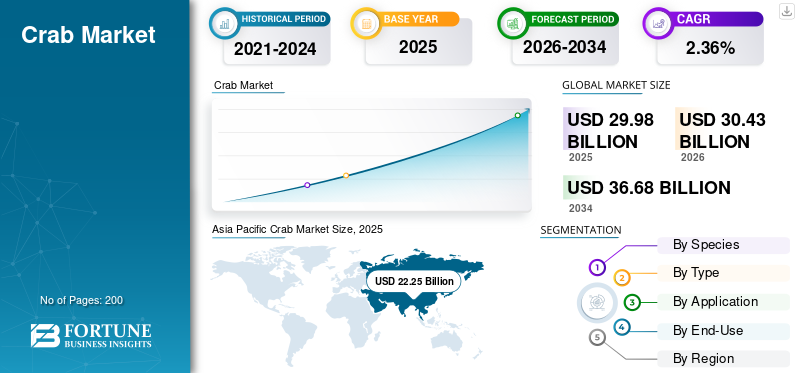
The global crab market size was valued at USD 29.98 billion in 2025 and is projected to grow from USD 30.43 billion in 2026 to USD 36.68 billion by 2034, exhibiting a CAGR of 2.36% during the forecast period. Asia Pacific dominated the global crab market with a market share of 74.22% in 2025.
The market growth is driven by rising consumer demand for premium seafood and demand for enhanced dining experience featuring delicacies such as king crab, snow crab, and dungeness crab. Increasing disposable income and shifting consumer preferences toward sustainably sourced seafood options have made crab a popular choice in North America and the Asia Pacific. Growth is supported by rising seafood protein consumption, premiumization of crustaceans, expanding cold-chain infrastructure, and increasing global trade of frozen and processed crab products.
According to the Food and Agriculture Organization (FAO), Global fisheries and aquaculture production in 2022 surged to 223.2 million tonnes, a 4.4% increase from the year 2020, with crabs accounting for a significant and fast-growing share due to strong demand from Asia, North America, and Europe. The global market continues to benefit from shifting consumer preferences toward high-protein, low-fat animal proteins, as well as the growing penetration of seafood in restaurant chains, hospitality, and premium retail. The global market is led by a group of large, vertically integrated seafood companies, including Thai Union Group, Maruha Nichiro Corporation, Nippon Suisan Kaisha (Nissui), Clearwater Seafoods, and Trident Seafoods, which collectively influence a significant share of global crab trade through scale, sourcing control, and downstream integration.
However, fluctuations in crab populations and challenges in the supply chain continue to influence market size and pricing dynamics. Overall, ongoing expansion in crab fishing activities and the growth of the market globally reflect increasing demand for crab and diversification within the global industry.
Download Free sample to learn more about this report.
Crab Market Takeaways
 Market Size & Forecast
- 2025 Market Size: USD 29.98 billion
- 2026 Market Size: USD 30.43 billion
- 2034 Forecast Market Size: USD 36.68 billion
- CAGR: 2.36% from 2026–2034
 Market Share
- Asia Pacific dominated the global crab market with a 74.22% share in 2025.
- Blue crab accounted for 37.10% of the global market in 2025.
- Fresh crab remained the leading type segment with a 49.81% market share in 2025.
 Key Regional Highlights
North America
North America represented a stable regional market, valued at USD 3.92 billion in 2025 and forecast to reach USD 4.56 billion by 2034.
Europe
Europe accounted for USD 1.90 billion in 2025 and is expected to reach USD 2.44 billion by 2034, registering a CAGR of 2.92%, the fastest among developed regions.
Asia Pacific
Asia Pacific led the global market with a valuation of USD 22.25 billion in 2025 and is projected to reach USD 27.54 billion by 2034, supported by strong seafood consumption across major economies.
U.S.
The U.S. crab market was valued at USD 3.37 billion in 2025.
Japan
Japan remains a key market within Asia Pacific, benefiting from strong cultural preferences for crab consumption and premium seafood products.
Read More

Crab Market Trends
Premiumization and Rising Demand for Value-Added Crab Products are Shaping the Industry
Premiumization has become a defining structural trend in the global market, driven by rising disposable incomes, evolving dining preferences, and shift toward convenience-oriented seafood consumption. Consumers and foodservice operators are increasingly favoring value-added crab products, including pasteurized crab meat, cooked and frozen crab clusters, portion-controlled packs, and seasoned ready-to-eat formats, over whole or live crabs due to consistency, food safety, and ease of preparation.
- For instance, in August 2023, Aquamar launched its Seafood Tenders line as a fully cooked, refrigerated, ready-to-eat seafood product. Seafood Tenders come in four varieties: smoked salmon, cod, crab, and smoked haddock. All products use 100 percent wild-caught seafood sourced sustainably.
Download Free sample to learn more about this report.
MARKET DYNAMICS
Market Drivers
Rising Global Seafood Consumption and Protein Diversification is Supporting Market Expansion
Rising global seafood consumption and the ongoing diversification of dietary protein sources have emerged as fundamental drivers supporting the expansion of the global crab market growth. As consumers increasingly seek high-quality, nutrient-dense proteins with lower saturated fat content and favorable health profiles, seafood, particularly crustaceans such as crab, has gained prominence across both developed and emerging economies.
- According to the Food and Agriculture Organization (FAO) reports, global per capita fish and seafood consumption rose from about 9.9 kg in the 1960s to over 20 kg in recent years, reaching a record 20.7 kg in 2022, driven by increased aquaculture and demand.
Market Restraints
Volatility in Wild Catch Supply and Regulatory Fishing Restrictions is Restraining Market Growth
The global market faces structural supply constraints due to seasonality, overfishing risks, and stringent fishery management regulations. Many high-value crab species are subject to quotas, size restrictions, and seasonal bans. In major producing regions such as Alaska and Russia, harvest quotas for snow crab and king crab have been periodically reduced, directly impacting global supply availability and price stability.
- According to 2025 FAO fisheries assessments, 35.5% of global fish stocks are classified as biologically overfished, a slight increase from 35.4% in 2019.
Market Opportunities
Expansion of Crab Aquaculture and Export-Oriented Processing are Unlocking Growth Aspects for Market
The rising use of crabs in industrial food processing and bio-manufacturing is unlocking substantial new growth opportunities for the global market, as manufacturers increasingly prioritize process efficiency, yield optimization, cost reduction, and sustainability compliance. Crabs enable controlled enzymatic breakdown of starches, fibers, and complex carbohydrates into fermentable or functional sugars, making them indispensable in large-scale food manufacturing, fermentation-based production, and emerging bio-industrial applications. This shift is not incremental but structural, driven by scale expansion in processed foods, renewable materials, and bio-based chemicals.
- According to the Vietnam Fisheries Magazine, Vietnam’s crab and crustacean exports totaled more than USD 113 million in the January-April period, marking a 51% year-on-year rise and almost threefold growth compared to early 2023.
SEGMENTATION ANALYSIS
By Species
Blue Crab Leads Due to Its Broad Availability and Cross-Regional Consumption
By species, the market is segmented into blue crab, snow crab, king crab, dungeness crab, and others.
Blue crab dominated the global market with a size of USD 11.12 billion in 2025, accounting for nearly 37.10% of the total market value. Its leadership is driven by wide geographic availability, adaptable culinary usage, and strong demand across Asia Pacific and North America, enabling consistent supply and pricing stability.
The others category, comprising mud crab and swimming crab, are some of the fastest-growing species, projected to expand at a CAGR of 2.96% in the forecast period.
To know how our report can help streamline your business, Speak to Analyst
Fresh Crab Dominates Due to Cultural Consumption and Foodservice Preference
Based on type, the market is segmented into frozen, fresh, and canned.
Fresh crab remained the largest type segment, valued at USD 14.93 billion in 2025, representing 49.81% of global crab market share. This dominance is caused by strong traditional consumption patterns, preference for live and fresh seafood in Asian cuisine, and premium foodservice usage, particularly in China, Japan, and Southeast Asia.
The canned crab segment is the fastest-growing by type, projected to expand at a CAGR of 3.45%, increasing from USD 3.33 billion in 2025 to USD 4.49 billion by 2034.
By Application
Whole Cooked Crab Leads Due to Its Usage in Traditional Dining and Visual Appeal
Based on application, the market is segmented into whole cooked, meat, and canned.
Whole cooked crab dominated the application type, with a market size of USD 14.93 billion in 2025, accounting for 49.79% of global consumption. This leadership is caused by consumer preference for intact presentation, cultural dining traditions, and premium restaurant offerings, particularly in the Asia Pacific. The segment is expected to grow at a CAGR of 1.67%.
Crab meat represents the fastest-growing application, projected to grow at a CAGR of 3.26%, increasing from USD 10.83 billion in 2025 to USD 14.35 billion by 2034.
By End-Use
Household Consumption Leads Due to Home-based Cooking Traditions and Rising Retail Access
On the basis of the end-use, the market is segmented into household and food service.
The household segment accounted for the largest share of global crab consumption, valued at USD 15.94 billion in 2025. This dominance is driven by home-based cooking traditions, rising disposable incomes, and improved access to fresh and frozen crab through modern retail and wet markets, particularly in the Asia Pacific.
The foodservice segment is the fastest-growing end-use, projected to expand at a CAGR of 2.73%, increasing from USD 14.04 billion in 2025 to USD 17.74 billion by 2034.
Crab Market Regional Outlook
Regionally, the report covers the global market analysis across North America, Europe, Asia Pacific, South America, and the Middle East & Africa.
Asia Pacific
Asia Pacific Crab Market Size, 2025 (USD Billion)
To get more information on the regional analysis of this market, Download Free sample
Asia Pacific dominates the global market by a wide margin, valued at USD 22.25 billion in 2025, and projected to reach USD 27.54 billion by 2034, expanding at a CAGR of 2.49%. The region accounts for the largest share of global production, consumption, and aquaculture output, supported by a strong cultural affinity for crab and rising middle-class incomes.
China Crab Market
China accounted for USD 16.66 billion in 2025, driven by large-scale crab aquaculture (particularly mitten and mud crab), strong domestic consumption, and premium gifting demand.
Japan and South Korea Crab Market
Japan and South Korea contribute high-value consumption, particularly for snow crab and king crab, while Southeast Asian countries such as Vietnam, Indonesia, and the Philippines play a critical role as export-oriented processing and aquaculture hubs. Asia Pacific market growth is underpinned by both volume expansion and gradual premiumization.
North America
North America represents a mature yet stable regional market, valued at USD 3.92 billion in 2025 and projected to reach USD 4.56 billion by 2034, growing at a CAGR of 1.78%. Regional market growth is primarily volume-stable and value-driven, supported by premium pricing of snow crab and king crab, strong foodservice demand, and high per-capita seafood consumption.
U.S. Crab Market
The U.S. market was valued at USD 3.37 billion in 2025, driven by domestic harvesting, imports, and high foodservice penetration.
Europe
Europe accounted for USD 1.90 billion in 2025 and is projected to reach USD 2.44 billion by 2034, registering a CAGR of 2.92%, the fastest among developed regions. Growth is driven by rising imports of frozen and processed crab, increasing premium seafood consumption, and strong regulatory alignment favoring traceable and sustainable seafood.
Germany Crab Market
Germany represents a major inland consumption market for crab within Europe, despite having no significant domestic crab harvesting. The Germany market was valued at approximately USD 0.22 billion in 2025, accounting for about 11.69% of the total European market, reflecting Germany’s large population base, high purchasing power, and strong reliance on imported seafood.
U.K. Crab Market
The U.K. is one of the most strategically important markets in Europe, combining domestic production, processing, consumption, and export activities. The U.K. market was valued at approximately USD 0.26 billion in 2025, representing around 13.86% of the European market.
South America, and Middle East & Africa
South America reached USD 1.18 billion in 2025 and is projected to grow to USD 1.35 billion by 2034, at a CAGR of 1.55%. The regional market is primarily export-oriented, supported by wild catch fisheries and growing processing capacity.
The Middle East & Africa market was valued at USD 0.72 billion in 2025 and is projected to reach USD 0.79 billion by 2034, growing at a CAGR of 1.04%, the slowest among regions. Growth is driven by seafood imports rather than domestic production, supported by hospitality expansion, tourism, and premium foodservice demand.
Brazil Crab Market
Brazil represents the largest market in South America, supported by its extensive coastline, rich marine biodiversity, and expanding seafood processing and export infrastructure. The Brazil market was valued at approximately USD 0.54 billion in 2025, accounting for nearly 45.31% of the total South American market.
COMPETITIVE LANDSCAPE
Key Industry Players
Scale, Processing Capabilities, and Export Networks are Driving the Competitive Advantage
The global crab market is moderately fragmented, with competition driven by access to raw material, processing scale, export certifications, and cold-chain integration. Leading players focus on vertical integration, sustainability compliance, and long-term buyer contracts. Sustainability compliance and traceability systems have become critical differentiators, as access to the U.S., EU, and Japanese markets increasingly depends on adherence to FAO-aligned fisheries management, IUU regulations, and third-party certifications.
Key Players in the Market
|
Rank |
Company Name |
|
1 |
Thai Union Group |
|
2 |
Maruha Nichiro Corporation |
|
3 |
Nippon Suisan Kaisha (Nissui) |
|
4 |
Clearwater Seafoods |
|
5 |
Trident Seafoods |
List of Key Crab Companies Profiled
- Thai Union Group (Thailand)
- Maruha Nichiro Corporation (Japan)
- Nippon Suisan Kaisha (Nissui) (Japan)
- Pacific Andes Group (Hong Kong)
- Bumble Bee Foods (U.S.)
- Clearwater Seafoods (Canada)
- Dongwon Industries (South Korea)
- High Liner Foods (Canada)
- Ocean Garden Products (U.S.)
- Trident Seafoods (U.S.)
KEY INDUSTRY DEVELOPMENTS
- October 2025: Trident Seafoods planned to resume crab processing at its massive Akutan facility in 2026 after completing technical upgrades. This move aligns with recovering Bering Sea crab stocks, prompting higher catch limits. The Akutan plant, North America's largest seafood processor, primarily handles pollock but also processes crab species like snow and king crab.
- February 2025: Supreme Crab & Seafood launched the Signature Catch Crab Meat Combo Stack, a new product featuring a blend of four meat sizes in one can. This innovation targets chefs seeking consistent mixes for crab cakes and seafood dishes.
- October 2024: Coupang launched its Autumn Crab Promotion through Rocket Fresh from August 26th to September 1st, targeting the peak autumn crab season in South Korea. The promotion offers fresh live crabs sourced from areas like Sinjin Island and Taean, alongside frozen prepared crabs and crab soup, delivered via Rocket Fresh's direct system.
- September 2024: North Seafood Ltd. opened a new crab processing facility at Steveston Harbour in Richmond, British Columbia. The state-of-the-art plant supports the local seafood industry by handling live crabs from northern B.C. The facility, built over about a year for USD 800,000 and fully funded by North Seafood, holds up to 50,000 pounds of crab and processes around 2 million pounds annually.
- September 2023: Handy Seafood launched Old Bay Crab Cake Minis to meet rising consumer demand for convenient, quick-prep seafood snacks. These bite-sized, frozen crab cakes cook in the microwave in just 1.5 minutes, offering restaurant-quality Maryland-style flavor.
REPORT COVERAGE
The global crab market industry report analyzes the market in depth and highlights crucial aspects such as global crab market trends, market dynamics, prominent companies, investment in research and development, and end-use. Besides this, the report also provides insights into the global crab market analysis and highlights significant industry developments.
Request for Customization to gain extensive market insights.
Report Scope & Segmentation
|
ATTRIBUTE |
DETAILS |
|
Study Period |
2021-2034 |
|
Base Year |
2025 |
|
Estimated Year |
2026 |
|
Forecast Period |
2026-2034 |
|
Historical Period |
2021-2024 |
|
Growth Rate |
CAGR of 2.36% from 2026 to 2034 |
|
Unit |
Value (USD Billion) |
|
Segmentation |
By Species
|
|
By Type
|
|
|
By Application
|
|
|
By End-Use
|
|
|
By Region
|
Frequently Asked Questions
Fortune Business Insights says that the global market was USD 29.98 billion in 2025 and is anticipated to reach USD 36.68 billion by 2034.
At a CAGR of 2.36%, the global market will exhibit steady growth over the forecast period.
By type, the fresh segment leads the market.
Asia Pacific held the largest market share in 2025.
Rising global seafood consumption and protein diversification drive the market growth.
Thai Union Group, Maruha Nichiro Corporation, Nippon Suisan Kaisha (Nissui), Clearwater Seafoods, and Trident Seafoods are the leading companies in the market.
Premiumization and rising demand for value-added crab products are shaping the industry.



- 2021-2034
- 2025
- 2021-2024
- 200
-
(Offer valid till 15th Oct 2026)
Get 30-60 hrs Free Customization
Expand Regional and Country Coverage, Segments Analysis, Company Profiles, Competitive Benchmarking, and End-user Insights.

















Related Reports
-
US +1 833 909 2966 ( Toll Free )
-
Get In Touch With Us