CRISPR Market Size, Share & Industry Analysis, By Offering (Products {Kits & Reagents, CRISPR Libraries, Enzymes/Cas Proteins/Nucleases, Vectors/Plasmids/Delivery Tools, & Others}, Software & Bioinformatics Tools, & Services), By Technology (CRISPR-Cas9, CRISPR-Cas12, CRISPR-Cas13) By Application (Basic & Translational Research, Drug Discovery & Target Identification, Preclinical Model Development, Therapeutic Development, Diagnostics), By End User (Pharmaceutical & Biotechnology Companies, Academic & Research Institutes, CROs/CDMOs, Diagnostic Laboratories), & Regional Forecast, 2026-2034
 Download Free Sample
CRISPR Market Size and Future Outlook
 Listen to Audio Version
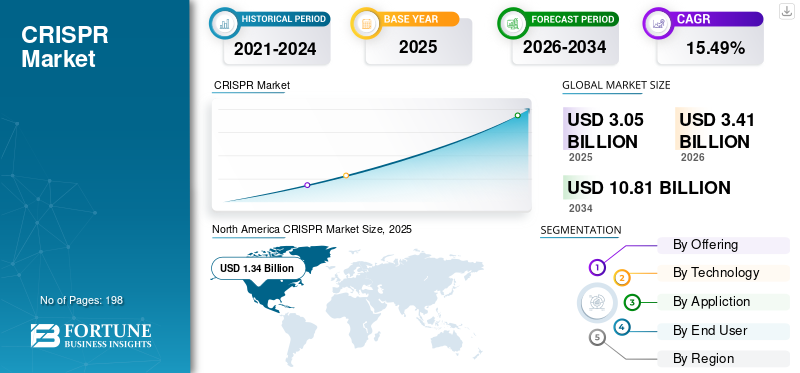
The global CRISPR market size was valued at USD 3.05 billion in 2025 and is projected to grow from USD 3.41 billion in 2026 to USD 10.81 billion by 2034, exhibiting a CAGR of 15.49% during the forecast period. North America dominated the crispr market with a market share of 43.93% in 2025.
The global CRISPR market encompasses products, software, bioinformatics tools, and services based on CRISPR, utilized in various application including basic and translational research, drug discovery and target identification, among others. The market is growing as CRISPR has emerged as a crucial tool for accurate genome editing, functional genomics, cell engineering, and translational research. The market’s expansion is further fueled by the increasing adoption of CRISPR in biopharmaceutical studies and the escalating demand for superior, workflow-focused solutions that can aid the transition from discovery to clinical application.
Furthermore, many key industry players, including Thermo Fisher Scientific Inc., Danaher Corporation (IDT and Aldevron), Merck KGaA, GenScript, and others are actively strengthening their CRISPR-related offerings through investments in gene-editing reagents, engineered nucleases, bioinformatics support, translational workflow solutions, and manufacturing capabilities.
Download Free sample to learn more about this report.
CRISPR Market Key Takeaways
 Market Size & Forecast
- 2025 Market Size: USD 3.05 billion
- 2026 Market Size: USD 3.41 billion
- 2034 Forecast Market Size: USD 10.81 billion
- CAGR: 15.49% from 2026-2034
 Market Share
- North America dominated the CRISPR market with a 43.93% share in 2025.
- CRISPR-Cas9 segment is expected to hold 58.2% share in 2026.
- Software & bioinformatics tools segment is projected to grow at a CAGR of 21.48%.
 Key Regional Highlights
North America
North America maintained market leadership with USD 1.34 billion in 2025, driven by strong R&D and gene-editing investments.
Europe
Europe is expanding steadily with a CAGR of 13.91%, supported by rising genomic research activities.
Asia Pacific
Asia Pacific is expected to reach USD 0.67 billion in 2026, fueled by increasing biotech adoption and research funding.
U.S.
The market is projected to reach USD 1.30 billion in 2026, accounting for about 38.0% of global revenue share.
Japan
Estimated at USD 0.14 billion in 2026, supported by advancements in biotechnology and precision medicine research.
Read More

CRISPR MARKET TRENDS
Advancements in Genome Engineering and Development of CRISPR based Therapies is a Significant Trend Observed
Progress in genome engineering and the creation of CRISPR-based treatments are becoming a significant trend in the global market as they transition the technology from fundamental lab usage to practical clinical and translational applications. Recent genome engineering methods are enhancing editing accuracy, minimizing off-target effects, and facilitating quicker transitions from discovery to therapy creation. There is a growing need for high-quality guide RNAs, engineered nucleases, off-target analysis tools, delivery methods, and translational assistance services. Concurrently, successful advancements in CRISPR-related treatments are bolstering the confidence of researchers and biotech firms to invest in next-generation gene-editing technologies. With an increasing number of programs moving into preclinical and clinical phases, the market is evolving toward more valuable products and services instead of just standard research reagents. This trend is promoting collaborations among reagent providers, therapy creators, and manufacturing companies to reduce development timelines. In general, ongoing advancements in genome engineering are enhancing the commercial significance of CRISPR in drug discovery, preclinical model development, and workflows that support therapy. These factors are supporting the overall global CRISPR market growth.
- For instance, in May 2025, Aldevron and Integrated DNA Technologies (IDT) announced that they had manufactured the world’s first mRNA-based personalized CRISPR therapy for an infant with urea cycle disorder, completing the gene-editing drug product in six months.
MARKET DYNAMICS
MARKET DRIVERS
Download Free sample to learn more about this report.
Increasing Adoption of Gene Editing Technologies in Biotechnology to Boost Market Growth
The rising use of gene editing technologies in biotechnology significantly fuels the global market, as biotech firms are increasingly utilizing these tools for target identification, cell engineering, functional genomics, and therapy development. With the increasing significance of gene editing in initial research and translational processes, there is a growing need for CRISPR reagents, guide RNAs, nucleases, delivery tools, and analytical support services. Biotech companies are seeking quicker and more accurate editing systems that can shorten development schedules and enhance research productivity. This is encouraging suppliers to broaden their offerings beyond fundamental research items into translational and clinical-level solutions. The trend is additionally backed by the increasing application of CRISPR in personalized medicine and rare disease initiatives, where biotech firms require highly tailored editing processes. With increased adoption, the market is developing more substantial commercial depth in both products and services. In general, broader application of gene editing in biotechnology is directly enhancing revenue prospects for CRISPR platform and solution provider. All these factors cumulatively drive the overall market growth.
- For instance, in July 2025, Integrated DNA Technologies (IDT) announced an expansion of its translational CRISPR portfolio, adding new purity offerings, off-target analysis services, and additional workflow solutions to help biotech researchers accelerate the development of CRISPR-based therapies.
MARKET RESTRAINTS
Ethical Concerns Related to Gene Editing to Hamper Market Growth
Ethical issues surrounding gene editing serve as a limitation on the global market since they heighten regulatory caution and hinder the speed of widespread commercial use, particularly in human applications. Issues related to human germline editing, embryo modification, social disparity, consent, and possible abuse for non-therapeutic trait selection persist in generating discussions within the scientific and policy spheres. The World Health Organization observes that human genome editing presents ethical challenges demanding strong regulation, especially when alterations might impact society in ways that extend beyond national boundaries. Such issues may hinder product development, restrict clinical acceptance, and elevate compliance demands for firms engaged in advanced genome engineering. The ethical discussion influences investor trust in certain higher-risk ventures, particularly when there is a chance of public or regulatory pushback. Consequently, the expansion of the market is more robust in research and somatic uses, whereas the more contentious fields encounter slower commercialization.
- For instance, in November 2025, Nature journal reported renewed controversy after a company-backed push to consider CRISPR-edited embryos, which worried many researchers and showed that ethical concerns around heritable genome editing are still a major barrier to broader acceptance of gene-editing technologies.
MARKET OPPORTUNITIES
Rising Investments in Genetic Research to Offer Market Growth Opportunities
Increasing investments in genetic research are creating a strong market opportunity for the global market as higher funding levels are helping research institutes, biotechnology companies, and translational medicine programs expand their genome-editing work. As more capital flows into genetic research, organizations are able to increase spending on CRISPR reagents, libraries, nucleases, delivery tools, software platforms, and outsourced engineering services. This also supports the development of more advanced workflows in functional genomics, target identification, cell engineering, and therapy-enabling research. Increased investment is further improving access to specialized infrastructure, which helps move CRISPR projects from early discovery into preclinical and translational stages more quickly. In addition, stronger funding activity gives solution providers more room to expand manufacturing, launch new products, and improve service capabilities. This creates a wider commercial opportunity not only for technology developers, but also for suppliers supporting research and clinical translation. Overall, rising investments in genetic research are strengthening the long term demand base for CRISPR products and services across global markets.
- For instance, in July 2025, Synthego announced the successful closing of its acquisition by Perceptive Advisors, an event that provided fresh backing for the company’s CRISPR business and reflected continued investor interest in gene-editing and molecular biology research platforms.
MARKET CHALLENGES
High Research & Development Costs Pose a Prominent Challenge to Market Growth
Elevated research and development expenses pose a significant obstacle for the global market as gene-editing initiatives demand substantial investment in platform enhancement, delivery mechanisms, preclinical testing, production, regulatory processes, and extended clinical periods. These expenses are particularly elevated in sophisticated applications such as in vivo editing and cell therapy, where firms need to finance multiple studies prior to market launch. Consequently, numerous players must focus on pipelines, postpone certain initiatives, or cut operating costs to maintain cash flow. This may delay product introductions, restrict the number of programs advancing to trials, and diminish short-term revenue growth throughout the market. Elevated R&D expenses also increase the obstacle for smaller firms that might possess robust science but have weak financial resources. Even with strong clinical advancements, companies frequently require substantial capital reserves merely to sustain their development pace. In general, the necessity for ongoing and costly R&D funding continues to pose a major obstacle to wider and quicker market growth. All the factors cumulatively affect the market growth.
- For instance, in March 2026, Caribou Biosciences reported full-year 2025 R&D expenses of USD 109.4 million.
Segmentation Analysis
By Offering
Wide Use of Kits & Reagents and CRISPR Libraries along with Other Products Allowed Products Segment to Dominate
In terms of offering, the market is divided into products, software & bioinformatics tools, and services. The products segment is further divided into kits & reagents, CRISPR libraries, enzymes/Cas proteins/nucleases, vectors/plasmids/delivery tools, and others.
The products segment led the global CRISPR market share in 2025. This is since CRISPR workflows require recurring purchases of various products for routine research and translational work. The dominance of this segment is also supported by the high repeat usage of these consumable and workflow-critical items across various applications. Moreover, suppliers are launching more advanced nuclease and reagent offerings to support higher editing precision, better scalability, and clinical translation, in turn boosting segment growth.
- For instance, in May 2025, Synthego introduced GMP SpCas9 to accelerate gene editing for therapeutic advancement.
The software & bioinformatics tools segment is anticipated to rise with a CAGR of 21.48% over the forecast period.
To know how our report can help streamline your business, Speak to Analyst
By Technology
Wide Usage of CRISPR-Cas9 in Therapeutic Applications Supported Segmental Dominance
Based on technology, the market is classified into CRISPR-Cas9, CRISPR-Cas12, CRISPR-Cas13, and others.
The CRISPR-Cas9 segment accounted for the dominant market share over the forecast period. CRISPR-Cas9 is the most widely used and commercially established gene-editing system across basic research, target identification, preclinical model development, and therapeutic workflows. The dominance of this segment is mainly supported by its high editing efficiency, simpler workflow design, broad product availability, and strong familiarity among researchers and biotechnology companies. In addition, many suppliers have built their core CRISPR product portfolios around Cas9, which has strengthened its adoption across both routine and advanced applications. Furthermore, the segment is set to hold 58.2% share in 2026.
- For instance, in July 2025, Integrated DNA Technologies (IDT) announced an expansion of its translational CRISPR portfolio, including new purity offerings and off-target analysis services to help advance CRISPR-based therapies.
The CRISPR-Cas13 segment is anticipated to rise with a CAGR of 19.03% over the forecast period.
By Application
Critical Need for Final Quality Verification Before Commercial Release Allowed Basic & Translational Research Segment to Dominate
On the basis of application, the market is divided into basic & translational research, drug discovery & target identification, preclinical model development, therapeutic development, diagnostics, and others.
In 2025, the market share was primarily led by the basic & translational research segment. This is owing to the fact that CRISPR is still used most widely in gene function studies, pathway analysis, disease mechanism research, and early-stage experimental validation. The growth of this segment is primarily bolstered by the extensive quantity of academic institutions, research facilities, and biotechnology laboratories that frequently utilize CRISPR tools in their daily research processes. Furthermore, this application field necessitates regular utilization of reagents, libraries, nucleases, plasmids, and analytical tools, maintaining elevated product demand. It also serves as the basis for future applications including drug discovery and therapy development, which is why investment begins here initially. With the growth of genomics and cell-engineering research in various institutions, the need for CRISPR products and support for workflows in initial research is steadily increasing. Furthermore, the segment is set to hold 32.0% share in 2026.
- For instance, in January 2025, Synthego announced its entry into the molecular biology and clinical diagnostic reagents market, expanding its portfolio with high-quality reagents designed to support researchers, clinicians, and diagnostic laboratories.
The therapeutic development segment is anticipated to rise with a CAGR of 17.39% over the forecast period.
By End User
Pharmaceutical & Biotechnology Companies Led Demand Due to High Investments in CRISPR Therapeutics
Based on end user, the market is segmented into pharmaceutical & biotechnology companies, academic & research institutes, CROs & CDMOs, diagnostic laboratories, and others.
The pharmaceutical & biotechnology companies segment dominated the market share in 2025. This segment's dominance is primarily driven by their increased spending ability and greater demand for premium reagents, nucleases, delivery tools, software, and outsourced genome-editing services. Moreover, biotech and pharmaceutical firms are concentrating on transitioning CRISPR from research to commercially viable uses, thereby boosting their consumption of products and services. They also need translational-grade and GMP-compliant solutions, which increases market value even more compared to standard academic application. With the expansion of pipelines in gene editing and precision medicine, more companies are increasingly reliant on CRISPR workflow solutions. Furthermore, the segment is set to hold a 42.3% share in 2026.
- For instance, in January 2025, Synthego signed a strategic agreement with AstraZeneca to license its CRISPR gene-editing enzyme eSpOT-ON.
In addition, CROs/CDMOs are projected to witness 18.24% growth rate during the forecast period.
CRISPR Market Regional Outlook
By geography, the market is divided into Latin America, Asia Pacific, Europe, North America, and the Middle East & Africa.
North America
North America CRISPR Market Size, 2025 (USD Billion)
To get more information on the regional analysis of this market, Download Free sample
The North America region dominated the global market and attained USD 1.20 billion in 2024. In 2025, the region maintained its dominance, with USD 1.34 billion. North America is growing strongly since it has a well-developed biotechnology and pharmaceutical industry, a high number of gene-editing research programs, and strong funding support for genomic medicine. The region also benefits from the presence of leading CRISPR technology developers, reagent suppliers, and service providers.
U.S. CRISPR Market
The U.S. market led the North American region and is projected reach approximately USD 1.30 billion in 2026, representing about 38.0% of the global market.
Europe
Europe’s market is growing at a CAGR of 13.91% during the forecast period. Europe's expansion is bolstered by its robust academic and public research foundation, heightened emphasis on genetic investigations, and growing application of CRISPR in drug development and translational medicine. The area gains from joint research initiatives, government-supported innovation financing, and the existence of well-established biotech and pharmaceutical firms.
U.K. CRISPR Market
The U.K. market is estimated at around USD 0.15 billion in 2026, representing roughly 4.4% of global revenues.
Germany CRISPR Market
Germany’s market size is projected to reach approximately USD 0.16 billion in 2026, equivalent to around 4.7% of global sales.
Asia Pacific
Asia Pacific’s market size is expected to reach a valuation of USD 0.67 billion by 2026. Asia Pacific is expected to grow at the fastest rate due to rising biotechnology investments, expanding genomics research, and increasing adoption of gene-editing tools across China, Japan, India, South Korea, Singapore, and Australia. The region is also benefiting from a growing number of research institutes, improving biotech infrastructure, and expanding CRO/CDMO capabilities.
Japan CRISPR Market
The Japanese market is estimated at around USD 0.14 billion in 2026, accounting for roughly 4.0% of global revenues.
China CRISPR Market
China’s market is projected to reach revenues of around USD 0.24 billion in 2026, representing roughly 7.1% of global sales.
India CRISPR Market
The Indian market is estimated at around USD 0.08 billion in 2026, accounting for roughly 2.3% of global revenues.
Latin America and Middle East & Africa
The growth in the Latin America and Middle East & Africa regions is anticipated to be moderate in the coming years. The growth of the market is driven by increasing investment in life sciences research, improving research capabilities, gradual expansion of biotechnology activities, and rising focus on molecular biology and genetic research. The Latin America market in 2026 is estimated at around USD 0.24 billion.
GCC CRISPR Market
The GCC market is projected to reach approximately USD 0.06 billion by 2026, representing about 1.9% of global revenues.
COMPETITIVE LANDSCAPE
Key Industry Players
Broad Portfolios and Specialized Services of Key Players Supported their Leading Market Positions
The global CRISPR market reflects a semi-fragmented competitive landscape, with the presence of major companies Thermo Fisher Scientific Inc., Danaher Corporation (IDT and Aldevron), Merck KGaA, and GenScript, among others. The considerable market presence of these companies is owing to their broad portfolios and strong geographic presence. Additionally, these companies are also focusing on portfolio expansion and strategic collaborations to address rising demand from drug discovery, preclinical model development, and therapeutic research.
Other significant participants include Synthego, Takara Bio Inc., OriGene Technologies, Inc., and Twist Biosciences. These firms are anticipated to focus on product improvement, and integrated product, and new product launches to elevate their market position throughout the forecast period.
- For instance, in April 2025, Synthego and Vita Therapeutics announced a strategic licensing agreement for hfCas12Max CRISPR nuclease to support the advancement of cell therapies.
LIST OF KEY CRISPR COMPANIES PROFILED IN REPORT
- Revvity Discovery Limited (U.S.)
- GenScript (U.S.)
- Merck KGaA (Germany)
- Thermo Fisher Scientific Inc. (U.S.)
- Danaher Corporation (Integrated DNA Technologies, Inc.) (U.S.)
- Synthego (U.S.)
- Takara Bio Inc. (Japan)
- OriGene Technologies, Inc. (U.S.)
- Twist Biosciences (U.S.)
- BPS Bioscience, Inc. (U.S.)
KEY INDUSTRY DEVELOPMENTS
- September 2025: IDT launched Alt-R HDR Enhancer Protein. The new protein is introduced to improve homology-directed repair efficiency in difficult-to-edit cells such as iPSCs and HSPCs, expanding IDT’s CRISPR toolkit for more precise genome modification and cell/gene therapy
- September 2025: Revvity and Profluent announced a strategic collaboration to launch AI-enhanced adenine deaminase Pin-point base editing systems. The collaboration combines Profluent’s AI-engineered enzes with Revvity’s Pin-point base-editing platform to provide a more therapeutically relevant base-editing toolkit.
- July 2025: Synthego announced the successful close of its acquisition by Perceptive Advisors. The transaction marked a significant ownership change for one of the key CRISPR solutions providers.
- May 2024: Merck signed a definitive agreement to acquire Mirus Bio. This will strengthen its integrated offering for viral vector manufacturing and novel modalities such as cell and gene therapies, which are important enabling areas for CRISPR therapeutic
- March 2024: EditCo Bio launched with the acquisition of Synthego’s engineered cell solutions business. The new company said it will provide edited cells and optimized guide RNA designs for the expanding CRISPR market.
REPORT COVERAGE
The global CRISPR market analysis includes a thorough evaluation of the market size and forecasts for every segment highlighted in the report. It offers insights into the market dynamics and trends expected to drive the market throughout the forecast period. It provides understanding of essential factors, including technological progress, product innovations, the regulatory environment, and the launch of new products. Additionally, it details partnerships, mergers & acquisitions, as well as key developments in the industry. The global market report also provides an in-depth competitive landscape, including information on market share and profiles of key active players.
Request for Customization to gain extensive market insights.
Report Scope & Segmentation
| ATTRIBUTE | DETAILS |
| Study Period | 2021-2034 |
| Base Year | 2025 |
| Estimated Year | 2026 |
| Forecast Period | 2026-2034 |
| Historical Period | 2021-2024 |
| Growth Rate | CAGR of 15.49% from 2026-2034 |
| Unit | Value (USD Billion) |
| Segmentation | By Offering, Technology, Application, End User, and Region |
| By Offering |
|
| By Technology |
|
| By Application |
|
| By End User |
|
| By Region |
|
Frequently Asked Questions
According to Fortune Business Insights, the global market value stood at USD 3.05 billion in 2025 and is projected to reach USD 10.81 billion by 2034.
In 2025, North Americas market value stood at USD 1.34 billion.
The market is expected to exhibit a CAGR of 15.49% during the forecast period.
By offering, the products segment is expected to lead the market.
Increasing adoption of gene editing technologies in biotechnology along with advancements in genome engineering and the development of CRISPR-based therapies are key factors driving the market.
Thermo Fisher Scientific Inc., Revvity Discovery Limited, GenScript, Merck KGaA, and Danaher Corporation are some of the top players in the market.
North America held the largest market share in 2025.



- 2021-2034
- 2025
- 2021-2024
- 198
Get 30-60 hrs Free Customization
Expand Regional and Country Coverage, Segments Analysis, Company Profiles, Competitive Benchmarking, and End-user Insights.













.webp)






Related Reports
-
US +1 833 909 2966 ( Toll Free )
-
Get In Touch With Us