Custom Fit Footwear Market Size, Share & Industry Analysis, By Product Type (Athletic/Sports Footwear, Casual Footwear, Formal Footwear, and Orthopedic/Medical Footwear), By Technology (3D Foot Scanning, 3D Printing, AI-Based Fit Analysis, and Traditional Manual Measurement), By End User (Men, Women, and Children), By Distribution Channel (Online/E-Commerce and Offline), and Regional Forecast, 2026-2034
 Download Free Sample
(Offer valid till 31st Oct 2026)

Custom Fit Footwear Market Size and Future Outlook
 Listen to Audio Version
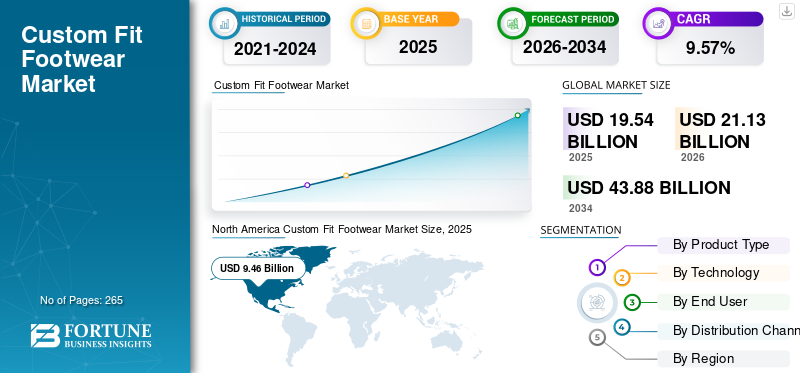
The global custom fit footwear market size was valued at USD 19.54 billion in 2025. The market is projected to grow from USD 21.13 billion in 2026 to USD 43.88 billion by 2034, exhibiting a CAGR of 9.57% during the forecast period. North America dominated the custom fit footwear market with a market share of 48.41% in 2025.
The custom fit footwear market is showing increasing potential as consumers increasingly prefer comfort and biomechanics. There has been an increase in the number of people who suffer from foot problems such as plantar fasciitis and diabetes, which affect about 20–25% of people globally. Technologies such as 3D scanning and printing enable accurate foot mapping, reducing manufacturing time by about 30–40%. People are becoming more aware of the benefits of customized shoes in sports for enhancing performance. Customized footwear can be easily purchased online using digital customization techniques. North America and Europe lead in the use of customized shoes. The Asia Pacific region is catching up rapidly owing to higher income levels and increasing demand for personalized footwear.
Some key players in the market, such as Nike, Adidas, New Balance, Aetrex, and Dr. Scholl's, are driving market growth. These companies emphasize the use of advanced customization techniques, including 3D foot scanning and AI-powered fit analysis, to achieve greater accuracy and an improved customer experience. Partnering with experts from the sports world and healthcare sectors is improving product acceptability and creating new niche markets, such as performance and orthopedic shoes. Moreover, leveraging DTC digital design and mass customization options enables scalable personalization and expands geographic coverage into emerging regions and the retail industry.
Download Free sample to learn more about this report.
Custom Fit Footwear Market Key Takeaways
 Global Market Size & Forecast
- 2025 Market Size: USD 19.54 Billion
- 2026 Market Size: USD 21.13 Billion
- 2034 Forecast Market Size: USD 43.88 Billion
- CAGR: 9.57% from 2026–2034
 Market Share
- North America dominated the custom fit footwear market with a 48.41% share in 2025.
- The orthopedic/medical footwear segment is projected to grow at a CAGR of 9.78% during the forecast period.
- The AI-based fit analysis segment is expected to register the fastest CAGR of 10.71% through 2034.
 Key Regional Highlights
North America
North America led the global market with a value of USD 9.46 billion in 2025 and is projected to grow at a CAGR of 8.92%.
Europe
Europe accounted for 23.89% of the global market and was valued at USD 4.67 billion in 2025.
Asia Pacific
Asia Pacific reached USD 3.80 billion in 2025 and is expected to expand at the fastest regional CAGR of 11.87%.
U.S.
The market was valued at USD 4.22 billion in 2025, accounting for approximately 48.40% of global market sales.
Japan
The market stood at USD 0.44 billion in 2025, representing around 2.24% of global market revenues.
Read More

CUSTOM FIT FOOTWEAR MARKET TRENDS
Rising Integration of Digital Foot Scanning and 3D Printing Technology Driving Mass Customization
As more brands adopt features such as digital foot scanning and 3D printing, the custom fit footwear industry is undergoing a revolution. With brands including Nike and Adidas are developing tools to improve fit, individuals now have access to personalized, highly precise footwear products. In this way, production time is reduced and fitting mistakes are fewer. Thus, a business has the opportunity to provide a wide range of affordable customized shoes.
MARKET DYNAMICS
MARKET DRIVERS
Download Free sample to learn more about this report.
Increasing Prevalence of Foot Health Issues Driving Demand for Custom Fit Footwear
There are many foot-related health concerns, such as plantar fasciitis, flat feet, and diabetes-related issues that have led an increasing number of people to require customized shoes. With increased awareness of health issues, more consumers are seeking prevention and treatment solutions that offer greater comfort. Companies such as Aetrex and Dr. Scholl's have capitalized on this trend by introducing orthotic technology in their shoes, driving market expansion.
MARKET RESTRAINTS
High Cost of Customization Limiting Mass Market Adoption
The high cost of personalized shoes is a critical barrier preventing the custom fit footwear market growth. High-end, cutting-edge technologies such as biomechanical evaluations, 3D scans, and customized manufacturing processes raise the final prices of products compared to standard footwear. This results in people's resistance to paying such high prices for products, particularly in emerging economies. Market players, including New Balance and Nike, are struggling with this issue, limiting the market to premium products.
MARKET OPPORTUNITIES
Expansion into Emerging Regions Market Through Digital Customization Platforms Creates Opportunities for Market Growth
With the rapid development of internet infrastructure and e-commerce markets in developing countries, an increasing number of business opportunities are emerging for custom fit shoes. On account of the growing prevalence of smartphones and the booming growth of online retailing, consumers have greater access to foot-scanning software and customization services from brands such as Adidas and Nike without physically visiting stores. Thus, firms can reach new large customer segments in the Asia Pacific and South America.
MARKET CHALLENGES
Complex Supply Chain and Production Scalability Challenges Market Growth
Producing customized footwear is challenging due to the complexity of its design and manufacturing processes. Unlike, regular shoes, customized footwear requires a fundamentally different production approach. Both Nike and New Balance struggle to balance customization with large-scale production, making it difficult to achieve economies of scale.
Segmentation Analysis
By Product Type
High Demand for Performance Optimization to Lead Growth of Athletic/Sports Footwear Segment
The market is segmented by product type into athletic/sports footwear, casual footwear, formal footwear, and orthopedic/medical footwear.
The athletic/sports footwear segment holds the largest custom fit footwear market share, accounting for nearly half of the market. The growing demand for sports and everyday performance enhancement, as well as injury prevention, primarily drives market growth. With an increasing focus on biomechanics in shoe design, major sports brands such as Nike and Adidas have invested in advanced customization technologies, including gait analysis and 3D foot scanners, making sports footwear more popular than other types of footwear. Moreover, rapid replacement rates make this product category the most profitable in the custom fit footwear market.
The orthopedic/medical footwear segment is anticipated to rise at the second fastest CAGR of 9.78% over the forecast period.
To know how our report can help streamline your business, Speak to Analyst
By Technology
Ability to Provide Real-Time and Highly Accurate Foot Measurements Leads to Dominance of 3D Foot-Scanning Segment
Based on technology, the segment is divided into 3D foot scanning, 3D printing, AI-based fit analysis, and traditional manual measurement.
The 3D foot-scanning segment leads the global market in terms of market size, owing to its ability to provide real-time, highly accurate foot measurements. Well-established brands, including Adidas and Nike, have integrated app-based and in-store foot-scanning solutions that offer customers improved fit and comfort, thereby lowering overall return rates. Consequently, the adoption of 3D foot-scanning technology across both clinical settings and retail industries is higher, driving the segment’s growth.
The AI-based fit analysis segment is anticipated to grow at the fastest CAGR of 10.71% over the forecast period.
By End User
Higher Sports Participation and Spending Power Boosted Dominance of Men's Segment
Based on end user, the market is segmented into men, women, and children.
The men end-user segment dominated overall market growth. Men have a higher participation rate across sports and other fitness-based activities. Moreover, demand for ergonomically optimized and performance-oriented footwear is leading brands to invest heavily in a male-centric product portfolio. This results in greater adoption of customized footwear among men. Additionally, higher average spending on premium and performance footwear further collectively positions men as the leading end-user segment.
The women end-user segment is projected to grow at the fastest CAGR of 10.19% during the forecast period.
By Distribution Channel
Need for Physical Fit Assessment Fueled Dominance of Offline Distribution Channel
Based on distribution channel, the market is segmented into online/e-commerce and offline.
The offline segment dominated the market in 2025. This high market share was driven by the need to ensure that one receives a precise measurement of feet and an appropriate match. The demand for personal experience when purchasing unique designs requires companies to focus on developing their flagship and specialty stores. In contrast to online channels, offline options have higher conversion rates and fewer product returns.
Online/e-commerce segment is projected to grow at the fastest compound annual growth rate of 10.48% during the forecast period.
Custom Fit Footwear Market Regional Outlook
By geography, the market is categorized into Europe, North America, Asia Pacific, South America, and the Middle East & Africa.
North America
North America Custom Fit Footwear Market Size, 2025 (USD Billion)
To get more information on the regional analysis of this market, Download Free sample
The North America’s market dominated globally and is projected to grow at a CAGR of 8.92% in the coming years, reaching a valuation of USD 9.46 billion in 2025. High consumer awareness of preventive care and foot health drives increased adoption of customized footwear solutions. Moreover, the strong presence of well-established players, including Nike and New Balance, fuels innovation in AI-driven and 3D-scanning fit technologies.
U.S. Custom Fit Footwear Market
Given North America’s strong contribution and the U.S. dominance in the region, the U.S. market reached USD 4.22 billion in 2025, accounting for roughly 48.40% of global market sales. High participation in sports and fitness activities, stronger consumer spending power on personal care items, including customized footwear, and well-established retail industry infrastructure support market expansion.
Europe
Europe ranked second in the global custom fit footwear market, accounting for 23.89% of the market and valued at USD 4.67 billion in 2025. With consumers placing increasing emphasis on quality and sustainability, and given the advanced state of health care in Europe and the rising incidence of podiatric problems, more attention is being directed toward customized footwear. Moreover, global brands such as Adidas are constantly pushing the boundaries of innovation in this niche.
U.K. Custom Fit Footwear Market
The U.K. market reached USD 0.81 billion in 2025, representing roughly 4.16% of global market revenues.
Germany Custom Fit Footwear Market
Germany’s market reached USD 1.03 billion in 2025, equivalent to around 5.26% of global market sales.
Asia Pacific
The Asia Pacific market is growing at a CAGR of 11.87% over the forecast period and reached USD 3.80 billion in 2025. Rising disposable incomes in emerging economies are enabling consumers to spend on personal care solutions, driving large-scale market growth. Individuals are increasingly spending on premium and personalized footwear. Moreover, growing internet penetration and expanding digital adoption and e-commerce penetration further augment product adoption.
Japan Custom Fit Footwear Market
The Japanese market was valued at USD 0.44 billion in 2025, accounting for roughly 2.24% of global market revenues. The country’s market growth is led by its rapidly aging population, which drives demand for orthopedic and custom-designed footwear that prioritizes comfort and performance. Furthermore, a higher consumer inclination toward superior quality, precision, and technologically curated products accelerates the adoption of customized footwear.
China Custom Fit Footwear Market
China’s market was valued at USD 1.51 billion in revenues in 2025, representing roughly 7.78% of global market sales.
India Custom Fit Footwear Market
The Indian market was valued at USD 0.74 billion in 2025, accounting for roughly 3.80% of global market revenues.
South America and the Middle East & Africa
The South America and the Middle East & Africa regions are expected to witness moderate growth in this market during the forecast period. The South America market reached USD 0.99 billion in 2025. The market in South America is influenced by an expanding middle-class population and improving financial conditions, which are encouraging increased spending on personalized and premium footwear.
UAE Custom Fit Footwear Market
The UAE reached USD 0.20 billion in 2025.
South Africa Custom Fit Footwear Market
The South African market reached USD 0.15 billion in 2025, representing roughly 0.79% of global market revenues.
COMPETITIVE LANDSCAPE
Key Industry Players
Competitive Pricing and Product Innovation Increases Competition Among Players
In the custom fitted shoes industry, competition is extremely high, as firms such as Nike, Adidas, and New Balance use innovation and aggressive growth tactics. It is evident in the focus on developing innovative technologies, including 3D foot scanners, artificial intelligence, and additive manufacturing. Collaboration with medical experts and sports organizations is contributing to increasing the legitimacy of their products and expanding their applications. Furthermore, firms are investing in expanding their consumer base through digital channels and venturing into new regions.
LIST OF KEY CUSTOM FIT FOOTWEAR COMPANIES PROFILED IN REPORT
- Nike (U.S.)
- Adidas (Germany)
- New Balance (U.S.)
- Skechers (U.S.)
- ASICS (Japan)
- Puma (Germany)
- Under Armor (U.S.)
- Aetrex (U.S.)
- Scholl's (U.S)
- AliveShoes (Italy)
KEY INDUSTRY DEVELOPMENTS
- October 2025: Nike announced “Project Amplify,” a motorized footwear system developed with Dephy, aimed at enhancing mobility and expanding customization into functional performance tech.
- July 2025: Nike, under its sustainability & innovation initiative, ran advanced circular footwear innovations incorporating recyclable materials and 3D printing, supporting long-term sustainable customization strategies.
- May 2024: Adidas collaborated with Google to develop AI-powered smart running shoes featuring real-time gait analysis and personalized coaching.
- March 2024: New Balance secured investment from Shapeways to expand 3D printing capabilities, strengthening its position in customized and on-demand footwear manufacturing.
- January 2024: Adidas partnered with Carbon3D to scale 3D-printed footwear production, enabling faster, more precise customization.
REPORT COVERAGE
The global custom fit footwear market analysis includes a comprehensive study of the market & forecast by all the market segmentations included in the report. This qualitative and quantitative report includes details on the market dynamics and key market trends expected to drive the market over the forecast period. It provides information on key aspects, including technologically advanced products and new launches. Additionally, it details partnerships, mergers & acquisitions, and key industry developments. The global market research report also provides a detailed competitive landscape, including market share and profiles of key players.
Request for Customization to gain extensive market insights.
Report Scope & Segmentation
| ATTRIBUTE | DETAILS |
| Study Period | 2021-2034 |
| Base Year | 2025 |
| Estimated Year | 2026 |
| Forecast Period | 2026-2034 |
| Historical Period | 2021-2024 |
| Growth Rate | CAGR of 9.57% from 2026 to 2034 |
| Unit | Value (USD Billion) |
| Segmentation | By Product Type, Technology, End User, Distribution Channel, and Region |
| By Product Type |
|
| By Technology |
|
| By End User |
|
| By Distribution Channel |
|
| By Region |
|
Frequently Asked Questions
According to Fortune Business Insights, the global market value stood at USD 19.54 billion in 2025 and is projected to reach USD 43.88 billion by 2034.
In 2025, the market value stood at USD 9.46 billion.
The market is expected to grow at a CAGR of 9.57% over the forecast period.
By product type, the athletic/sports footwear segment leads the market.
Increasing consumer focus on comfort, personalization, and foot health, particularly amid rising cases of orthopedic issues and lifestyle-related conditions drives global market growth.
Nike, Adidas, New Balance, Aetrex, and Dr. Scholl's are the top players in the market.
North America held the largest market share in 2025.



- 2021-2034
- 2025
- 2021-2024
- 265
-
(Offer valid till 31st Oct 2026)
Get 30-60 hrs Free Customization
Expand Regional and Country Coverage, Segments Analysis, Company Profiles, Competitive Benchmarking, and End-user Insights.



















-
US +1 833 909 2966 ( Toll Free )
-
Get In Touch With Us