Decentralized Clinical Trials Market Size, Share & Industry Analysis, By Type (Solutions and Services), By Design (Fully Decentralized Trials and Hybrid Decentralized Trials), By Phase (Phase I, Phase II, Phase III, and Phase IV), By Therapeutic Area (Oncology, Infectious Diseases, Neurology, Cardiology, and Others), By End User (Pharmaceutical & Biotechnology Companies, Medical Device Companies, CROs, and Others), and Regional Forecast, 2026-2034
 Download Free Sample
Decentralized Clinical Trials Market Size and Future Outlook
 Listen to Audio Version
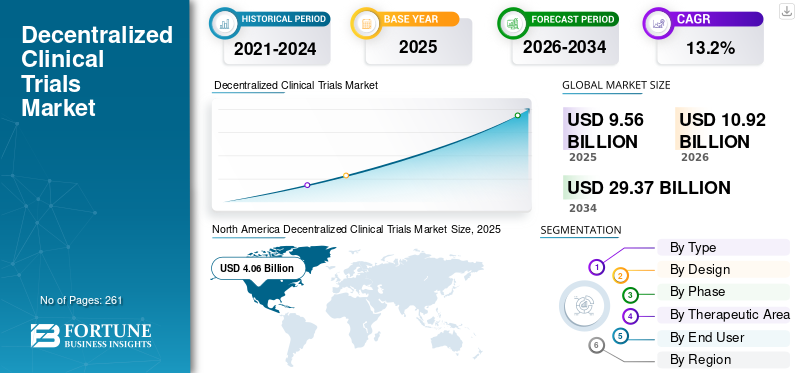
The global decentralized clinical trials market size was valued at USD 9.56 billion in 2025. The market is projected to grow from USD 10.92 billion in 2026 to USD 29.37 billion by 2034, exhibiting a CAGR of 13.2% during the forecast period. North America dominated the decentralized clinical trials market with a market share of 42.46% in 2025.
Decentralized clinical trials (DCTs) refer to clinical studies in which some or all of the study-related activities occur at a location separate from the investigator’s location. The rising number of clinical trials, increasing adoption of digital health technologies and telemedicine, and the expansion of decentralized trials are resulting in a growing adoption of these solutions and services in the market. The increasing number of chronic diseases, oncology, and specialty drug pipelines is further fueling the clinical trial adoption.
- For instance, according to 2025 data published by the World Health Organization (WHO), approximately 50,768 clinical trials were conducted in France.
Furthermore, the rising focus toward offering innovative services, including Thermo Fisher Scientific Inc., and Labcorp, among others, is further contributing to the demand for these solutions and services in the market.
Download Free sample to learn more about this report.
DECENTRALIZED CLINICAL TRIALS MARKET KEY TAKEAWAYS
 Market Size & Forecast
- 2025 Market Size: USD 9.56 billion
- 2026 Market Size: USD 10.92 billion
- 2034 Forecast Market Size: USD 29.37 billion
- CAGR: 13.2% from 2026–2034
 Market Share
- North America dominated the decentralized clinical trials market with a market share of 42.46% in 2025.
- The solutions segment is expected to grow at a CAGR of 13.3% over the forecast period.
- The fully decentralized trials segment is set to flourish at a growth rate of 13.5% during the forecast period.
 Key Regional Highlights
North America
The North America market held the dominant share in 2024, valued at USD 3.64 billion, and also accounted for the leading share in 2025 with USD 4.06 billion.
Europe
The Europe market is projected to record a CAGR of 12.6% over the forecast period, which is the second highest among all regions, and reach a valuation of USD 2.97 billion by 2026.
Asia Pacific
The Asia Pacific market is estimated to reach USD 2.25 billion in 2026.
U.S.
The U.S. market can be analytically approximated at around USD 4.22 billion in 2026, accounting for roughly 38.6% of global sales.
Japan
The Japan market is estimated to reach around USD 0.43 billion in 2026, accounting for roughly 4.0% of global revenues.
Read More

Decentralized Clinical Trials Market Trends
Adoption of Artificial Intelligence to Drive Decentralized Trial Demand
There is an increasing adoption of AI-enabled analytics to enhance patient identification, remote monitoring, trial matching, and participant retention. The sponsors and contract research organizations are increasingly adopting artificial intelligence and digital tools to screen electronic health records, claims data, registries, real-world data sources, and genomic datasets to identify eligible individuals faster and match them with suitable studies. Decentralized clinical trials leverage telemedicine, wearable devices, remote patient monitoring, and digital data collection platforms to reduce patient burden and accelerate trial timelines. This is especially important in rare diseases, oncology, neurology, and chronic disease trial designs, where recruitment pools are fragmented, and patient eligibility criteria are complex.
Additionally, artificial intelligence is increasingly being used to improve clinical sites selection, predictive enrollment planning, patient-risk scoring, adherence monitoring, and dropout prediction. In decentralized trials, where patient interactions occur across telehealth platforms, ePRO/eCOA tools, analytics platforms help sponsors monitor operational risks in real time.
- For instance, according to 2025 data published by Tufts University School of Medicine, it was reported that use of artificial intelligence to support clinical trial activity yields time savings of 18%.
Market Dynamics
Market Drivers
Download Free sample to learn more about this report.
Growth in Chronic Disease, Oncology, and Rare Disease Pipelines to Boost Market Expansion
The growing prevalence of chronic conditions, including cancer, rare diseases, and complex specialty diseases, is fueling the demand for decentralized clinical trials. These therapeutic indications often require long-term monitoring, increased patient access, frequent follow-ups, real-world outcome tracking, and the recruitment of hard-to-reach patient groups.
- For instance, according to 2026 data published by the National Center for Biotechnology Information (NCBI), it was reported that about 586,665 clinical trial studies were registered globally.
These aspects, along with growing healthcare expenditure, expansion of healthcare infrastructure, rising demand for tailored medicine, and growing need to improve clinical trial efficiency and accessibility, are further driving the penetration rate of these solutions and services in the market. Therefore, the factors above, along with the growing number of key companies offering novel decentralized services, are anticipated to contribute to the global decentralized clinical trials market growth.
Market Restraints
High Implementation Cost to Hamper the Market Growth
DCTs enhance patient access, recruitment, retention, and long-term trial efficiency. However, their initial deployment requires huge costs in system validation, digital platforms, cybersecurity, telehealth workflows, eConsent, eCOA/ePRO tools, direct-to-patient logistics, and others.
Furthermore, DCT systems require staff training, IT support, reimbursement coordination, workflow redesign, and management of various platforms across different trials, which creates implementation challenges. Along with this, the improper integration of digital platforms is leading to delayed start-up, higher operational burden, inconsistent data flows, and added costs for vendor oversight and troubleshooting, thereby hindering the market growth.
- For instance, according to the 2024 statistics published by Thermo Fisher Scientific Inc., about 52.7% respondents reported using technologies provided by multiple vendors in decentralized clinical trials, contributing to the growing costs.
Market Opportunities
Expansion of Clinical Trials in Emerging Countries to Create Market Opportunities
The expansion of clinical trial activity in developing countries presents a lucrative opportunity in the market. The clinical trial sponsors are expanding trial studies beyond traditional clinical trial settings. Additionally, increasing patient population, development of clinical research infrastructure, rising patient recruitment potential, and growing awareness about decentralization of clinical trials across developing nations, including China, Mexico, and others, are fueling the adoption of these services. Furthermore, increasing healthcare expenditure, among others, is resulting in the growing demand for decentralized clinical trial solutions and services.
- According to 2025 statistics published by the International Trade Administration, the healthcare expenditure is approximately USD 135.0 billion in Brazil.
Market Challenges
Limited Clinical Trials in Emerging Countries to Hamper the Market Growth
There is a growing demand for novel decentralized clinical trials among the patient population. However, limited healthcare access in emerging countries remains a key challenge in the global market. The lack of developed clinical trials infrastructure and logistics networks, trained professionals, challenges in regulatory compliance, and a limited number of sponsors are resulting in reduced conduction of decentralized trials among the companies and sponsors, thereby hindering the market growth.
- For instance, according to 2025 data published by the World Health Organization (WHO), only 22,832 clinical trials were conducted in Brazil.
SEGMENTATION ANALYSIS
By Type
Increasing Utilization of Decentralized Trials Pushed the Dominance of the Services Segment
Based on type, the market is classified into solutions and services.
The services segment held the largest share in 2025. The segment growth is owing to the escalating DCT adoption, resulting in growing demand for these services, including patient recruitment and engagement, eConsent implementation, telehealth coordination, and others. Additionally, a rising number of companies and sponsors providing innovative hybrid clinical trial services is further expected to contribute to the global market growth.
- For instance, according to 2024 data published by Thermo Fisher Scientific Inc., 87.3% of respondents answered that their site hosted at least 1 clinical trial that utilized decentralized elements during the past 12 months.
The solutions segment is expected to grow at a CAGR of 13.3% over the forecast period.
To know how our report can help streamline your business, Speak to Analyst
By Design
Growing Adoption of Hybrid Decentralized Trials Led to the Dominance of the Segment
On the basis of design, the market is bifurcated into fully decentralized trials and hybrid decentralized trials.
The hybrid decentralized trials segment dominated the global market in 2025. The segment growth is due to the increasing prevalence of chronic diseases and awareness of decentralized clinical trials, resulting in an increasing trial conduction, thereby contributing to the segmental growth.
- For instance, according to 2025 statistics published by the World Health Organization (WHO), about 17,360 phase III clinical trials were conducted in India.
The fully decentralized trials segment is set to flourish at a growth rate of 13.5% during the forecast period.
By Phase
Rising Number of Phase III Clinical Trials Led to the Dominance of the Segment
By phase, the market is subdivided into phase I, phase II, phase III, and phase IV.
The phase III segment dominated the global decentralized clinical trials market share in 2025 with a share of 46.7%. The segment growth is due to the increasing number of phase III clinical trials, resulting in an increasing service demand.
- For instance, according to 2025 data published by the World Health Organization (WHO), approximately 7,305 phase III clinical trials were conducted in Japan.
The phase IV segment is set to expand at a growth rate of 12.1% over the forecast period.
By Therapeutic Area
Growing Prevalence of Various Types of Cancer Led to the Oncology Segment Dominance
Based on therapeutic area, the market is divided into oncology, infectious diseases, neurology, cardiology, and others.
The oncology segment dominated the market in 2025. The rising prevalence of various types of cancer, including prostate cancer and others, the rising demand for decentralized clinical trials, and growing number of companies offering hybrid services, among others, are some of the crucial factors contributing to the growth of the segment. Furthermore, the segment is set to hold a share of 31.4% in 2026.
- For instance, according to 2026 data published by the National Cancer Institute (NCI), it was reported that about 333,830 new cases of prostate cancer were estimated to occur in the U.S.
In addition, the cardiology segment is projected to grow at a CAGR of 12.8% during the forecast period.
By End User
Increasing Number of Pharmaceutical & Biotechnological Companies Bolstered Segmental Dominance
Based on end user, the market is divided into pharmaceutical & biotechnological companies, medical device companies, CROs, and others.
The pharmaceutical & biotechnological companies segment dominated the market in 2025. The increasing number of hybrid clinical trials, growing awareness of decentralized clinical trials, and the increasing number of pharmaceutical and biotechnology firms, among others, are some of the key factors contributing to the growth of the segment. Furthermore, the segment is set to hold a share of 50.3% in 2026.
- For instance, according to 2026 data published by Cross River Therapy, it was reported that there are about 5,000 companies in the U.S.
In addition, the medical device companies segment is projected to grow at a CAGR of 14.8% during the forecast period.
Decentralized Clinical Trials Market Regional Outlook
Based on region, the market has been studied across North America, Europe, Asia Pacific, Latin America, and the Middle East & Africa.
North America
North America Decentralized Clinical Trials Market Size, 2025 (USD Billion)
To get more information on the regional analysis of this market, Download Free sample
The North America market held the dominant share in 2024, valued at USD 3.64 billion, and also accounted for the leading share in 2025 with USD 4.06 billion. The increasing number of clinical trials, rising adoption of decentralized clinical solutions and services, growing number of medical device companies, among others, are some of the key factors contributing to the growth of the segment.
- For instance, according to 2025 statistics published by the World Health Organization (WHO), about 41,351 phase II clinical trials were conducted in the U.S.
U.S. Decentralized Clinical Trials Market
Based on North America’s strong contribution and the U.S. dominance within the region, the U.S. market can be analytically approximated at around USD 4.22 billion in 2026, accounting for roughly 38.6% of global sales.
Europe
The Europe market is projected to record a CAGR of 12.6% over the forecast period, which is the second highest among all regions, and reach a valuation of USD 2.97 billion by 2026. The increasing prevalence of chronic conditions and interventional trials is expected to support the regional market growth.
U.K. Decentralized Clinical Trials Market
The U.K. market is estimated to touch around USD 0.61 billion in 2026, representing roughly 5.6% of global revenues.
Germany Decentralized Clinical Trials Market
The Germany market is projected to reach approximately USD 0.53 billion in 2026, equivalent to around 4.9% of global sales.
Asia Pacific
The Asia Pacific market is estimated to reach USD 2.25 billion in 2026 and secure the position of the third-largest region in the global market. The increasing healthcare expenditure and rising demand for innovative decentralized trial platforms are likely to support the regional market growth.
Japan Decentralized Clinical Trials Market
The Japan market is estimated to reach around USD 0.43 billion in 2026, accounting for roughly 4.0% of global revenues. The market is expected to grow due to the increasing emphasis of key companies on the provision of innovative patient centric study designs.
China Decentralized Clinical Trials Market
The China market is projected to be one of the largest worldwide, with 2026 revenues estimated to reach around USD 0.97 billion, representing roughly 8.9% of global sales.
India Decentralized Clinical Trials Market
The India market is estimated to touch around USD 0.22 billion in 2026, accounting for roughly 2.0% of global revenues.
Latin America and Middle East & Africa
The Latin America and Middle East & Africa regions are expected to witness moderate growth during the forecast period. The Latin America market is set to reach a valuation of USD 0.59 billion in 2026. The growth is due to the rising healthcare access and improving decentralized models in the region. The Middle East & Africa are also expected to grow due to the rising number of key companies focusing on improving their solutions and services channel in the market. In the Middle East & Africa, the GCC market is set to reach a value of USD 0.25 billion in 2026.
South Africa Decentralized Clinical Trials Market
The South Africa market is projected to reach around USD 0.14 billion in 2026, representing roughly 1.2% of global revenues.
Competitive Landscape
Key Industry Players
Leading Players’ Expansion of Clinical Trial Technologies to Support their Dominance
A strong product and services portfolio, along with a significant emphasis on strategic initiatives, is one of the key factors contributing to the dominance of these key companies globally. Thermo Fisher Scientific Inc., and Labcorp were key participants in the market in 2025. Furthermore, the growing focus of major companies on the expansion of clinical trial technology is likely to bolster their presence, further contributing to their market share.
- For instance, in May 2020, LabCorp, a global life sciences company, announced that Covance, its drug development business, is expanding its technology ecosystem to accelerate the adoption of decentralized clinical trials.
Other key players, including ICON plc and others, are also growing in the market. This is primarily due to their escalating emphasis on acquisitions and mergers among other companies to consolidate their presence in the market.
List of Key Decentralized Clinical Trials Companies Profiled
- IQVIA (U.S.)
- ICON plc (Ireland)
- Thermo Fisher Scientific Inc. (U.S.)
- Parexel International (MA) Corporation (U.S.)
- Medpace (U.S.)
- Labcorp (U.S.)
- Oracle (U.S.)
- Signant Health (U.S.)
- Fortrea (U.S.)
- Tecex Medical (Luxembourg)
KEY INDUSTRY DEVELOPMENTS
- November 2025: Cenmed, a company in laboratory distribution and supply chain solutions, collaborated with Curavit Clinical Research, a virtual contract research organization (VCRO) specializing in decentralized clinical trials (DCTs), to enhance the efficiency and scalability of kitting and logistics services for clinical research.
- September 2024: Signant Health, collaborated with IQVIA, a global provider of advanced analytics, technology solutions, and clinical research services. The move aimed at expanding the availability of its eClinical Solutions by joining IQVIA One Home for Sites initiative.
- February 2024: PCM Trials, the largest independent mobile research nurse visit provider for decentralized clinical trials (DCTs), acquired EmVenio Research based in Durham, North Carolina.
- January 2024: Labcorp, a global company of innovative and comprehensive laboratory services, collaborated with Hawthorne Effect, Inc., a complete clinical trials solution integrating technology, to advance decentralized clinical trial capabilities for pharma, biotech, and medical device sponsors.
- October 2023: Elligo Health Research, the healthcare-enabling research organization, partnered with Avallano, a data privacy and healthcare technology company, to launch myTrialsConnectSM, a scalable research community powered by artificial intelligence (AI), that was built to serve patients, providers, sites, and the biopharma industry.
- July 2023: Signant Health acquired DSG, a provider of electronic data capture (EDC) and direct data capture (DDC) technology within a unified eClinical suite, to enhance its eClinical Solution Suite for traditional and decentralized clinical trials.
- March 2023: Florence Healthcare collaborated with IQVIA to ensure research sites participating in IQVIA studies have access to site enablement technology. Through this collaboration, IQVIA leverages Florence's Site Enablement Platform, SiteLink, on studies to reduce clinical trial bottlenecks at sites caused by repetitive, manual document workflows.
REPORT COVERAGE
The report provides a detailed global decentralized clinical trials market analysis and focuses on key aspects such as leading companies and market segmentation, including type, design, phase, therapeutic area, and end user. Besides this, the global report offers insights into the market growth trends and highlights key industry developments. In addition to the aforementioned factors, the report encompasses several factors that have contributed to the growth and advancement of the market over recent years.
Request for Customization to gain extensive market insights.
Report Scope & Segmentation
| ATTRIBUTE | DETAILS |
| Study Period | 2021-2034 |
| Base Year | 2025 |
| Estimated Year | 2026 |
| Forecast Period | 2026-2034 |
| Historical Period | 2021-2024 |
| Growth Rate | CAGR of 13.2% from 2026-2034 |
| Unit | Value (USD Billion) |
| Segmentation | By Type, Design, Phase, Therapeutic Area, End User, and Region |
| By Type |
|
| By Design |
|
| By Phase |
|
| By Therapeutic Area |
|
| By End User |
|
| By Region |
|
Frequently Asked Questions
Fortune Business Insights says that the global market size was USD 9.56 billion in 2025 and is projected to reach USD 29.37 billion by 2034.
In 2025, the North America market value stood at USD 4.06 billion.
The market will exhibit steady growth at a CAGR of 13.2% over the forecast period (2026-2034).
By type, the services segment was the leading segment in this market in 2025.
A surge in chronic disease, oncology, and rare disease pipelines and the introduction of novel decentralized clinical trial services is one of the major factors driving the market growth.
Thermo Fisher Scientific Inc., and Labcorp are the major players in the global market.
North America dominated the market share in 2025.
The growing number of clinical trials, rising demand for decentralized clinical trials, and expansion of healthcare infrastructure are some of the key factors expected to boost the service adoption.



- 2021-2034
- 2025
- 2021-2024
- 261
Get 30-60 hrs Free Customization
Expand Regional and Country Coverage, Segments Analysis, Company Profiles, Competitive Benchmarking, and End-user Insights.













.webp)






Related Reports
-
US +1 833 909 2966 ( Toll Free )
-
Get In Touch With Us