Dermocosmetics Market Size, Share & Industry Analysis, By Type (Skin Care {Anti-Aging, Skin Whitening, Sun Protection, Acne Treatment, and Others}, and Hair Care {Anti-Hairfall, Anti-Dandruff, and Others}), By Distribution Channel (Pharmacies/ Drug Stores, Online Stores, and Others), and Regional Forecast, 2026-2034
 Download Free Sample
KEY MARKET INSIGHTS
 Listen to Audio Version
The global dermocosmetics market size was valued at USD 47.91 billion in 2025 and is projected to grow from USD 52.59 billion in 2026 to USD 117 billion by 2034, exhibiting a CAGR of 10.51% during the forecast period. Asia Pacific dominated the dermocosmetics market with a market share of 43.11% in 2025.
Dermocosmetics are skin and haircare solutions that use active ingredients that provide support or care for the symptoms of various body conditions. The rising prevalence of skin diseases, increasing awareness, and growing concern for maintaining beauty standards are projected to fuel market growth. Some typical application areas of dermocosmetics include common skin conditions such as eczema, acne, and others.
- For instance, according to statistics published by the World Health Organization (WHO) in 2022, skin cancers are primarily caused by exposure to ultraviolet radiation (UVR). In 2020, over 1.5 million cases of skin cancer were diagnosed across the globe. Skincare products are used in the management of cancer-related skin toxicities. Thus, the robust application of dermocosmetics in various disease prevention and cure is expected to propel market expansion.
Furthermore, increasing strategic activities by prominent players to launch advanced care products catering to consumer preferences are expected to propel market growth. In addition, the industry expansion is being favored by growing R&D collaborations to enhance the efficacy and safety of active ingredients across the globe.
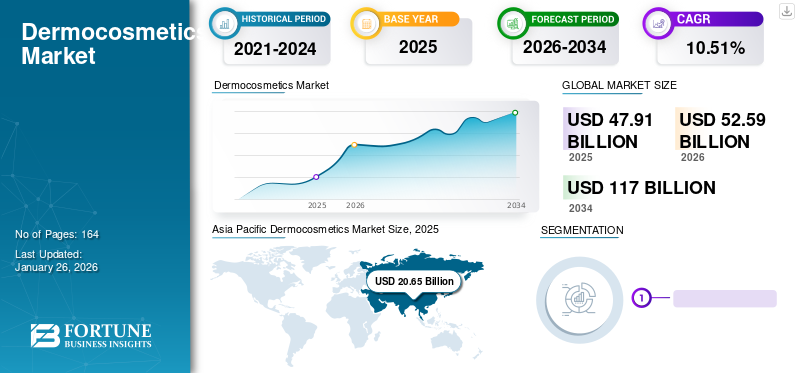
Download Free sample to learn more about this report.
Dermocosmetics Market KEY TAKEAWAYS
 Market Size & Forecast
- 2025 Market Size: USD 47.91 billion
- 2026 Market Size: USD 52.59 billion
- 2034 Forecast Market Size: USD 117.00 billion
- CAGR: 10.51% from 2026–2034
 Market Share
- Asia Pacific dominated the dermocosmetics market with a 43.11% share in 2025.
- The skin care segment is projected to account for 67.7% of the market in 2026.
- The pharmacies/drug stores segment is projected to lead the market with a 59.64% share in 2026.
 Key Regional Highlights
Asia Pacific
Valued at USD 20.65 billion in 2025, driven by rising adoption of skin and hair care products and growing presence of leading brands.
Europe
Valued at USD 9.97 billion in 2025, driven by increasing skincare awareness and the strong presence of leading dermocosmetic companies.
North America
Valued at USD 12.16 billion in 2025, supported by high product adoption, strong disposable income, and broad product availability.
U.S.
Projected to reach USD 12.17 billion by 2026, supported by growing demand for premium dermatological skincare products.
Japan
Projected to reach USD 6.86 billion by 2026, driven by strong consumer focus on skin and hair health and premium skincare products.
Read More

COVID-19 IMPACT
Consistent Adoption of Skin Care Products Led to Slight Positive Growth on the Market
The COVID-19 pandemic had a moderately positive effect on the global market in 2020. The market experienced slower growth in 2020 as a result of travel restrictions and supply chain disruptions. The number of dermatologist clinic visits also decreased due to these travel constraints and market closures. Teleconsultations for dermatological procedures had a significant impact on the market growth.
- According to a study published in the Cyprus Journal of Medicine in 2022, the study involved 153 patients, 14 males and 139 females, in the age group of 18 to 73 years, in Northern Cyprus during the pandemic. The study found that the demand for dermatocosmetic applications was still high, and patients who did not use dermocosmetics before the pandemic started using them during that time.
In terms of revenues of key companies, the market increased at a slower pace in 2020 compared to the previous year. As far as market players were concerned, some of the biggest players witnessed a slower growth in their sales volume of dermatocosmetics products during the pandemic.
- For instance, dermocosmetics is L'Oréal's largest segment, with net sales touching USD 3.2 billion in 2020. The segment sales increased by 30.7% in 2021 over 2020, driven by an increase in the global demand for skincare and haircare.
As a result of the revival of dermatologist visits, growth rates returned to pre-pandemic levels in 2022. The revenue of dermocosmeceutical companies is expected to grow steadily over the forecast period of 2025-2032.
Dermocosmetics Market Trends
Research Partnerships for Advanced Dermocosmetic Products is a Major Trend
One of the most prominent global dermocosmetics market trends in recent years is the active initiatives to research and develop advanced dermocosmetic products. New products and skin models are being developed to encourage a healthier skin microbiome. Similarly, prominent players' increased focus and initiatives on developing innovative products are expected to drive the growth of the market. For instance:
- In May 2020, L’Oréal Group partnered with the Melanoma Research Alliance to help advance this crucial research in skin cancer prevention and detection using sophisticated AI technology.
- In November 2020, CTIBiotech unveiled two bioprinted full-skin model technologies for skincare applications. The solutions were designed to provide researchers with the best tools to make the most human-compatible products. Currently, more companies are launching new and advanced products to expand skin and hair care across the globe.
Download Free sample to learn more about this report.
Dermocosmetics Market Growth Factors
Increasing Cases of Skin Problem Leading to Improved Product Adoption to Boost Market Growth
One of the most prominent drivers is the growing prevalence of skin diseases, including eczema, skin cancer, pigmentation, and others. Due to such a scenario, the demand for prevention and treatment of skin diseases by using bodycare products has increased. This factor will eventually contribute to market growth.
- According to an article published by Wiley Online Library in 2023, eczema (atopic dermatitis) is a major global public health issue with high prevalence and morbidity. The Global Asthma Network (GAN) Phase I data from 27 centers in 14 countries involving 74,361 adolescents aged 13–14 and 47,907 children aged 6–7 (response rate 90%, 79%) was analyzed. It was found that a median of 6% of children and adolescents had symptoms of current Eczema, with 1.1% and 0.6% in adolescents and children, respectively, reporting symptoms of severe eczema. Such a rise in the prevalence or incidence of diseases is expected to drive the demand for body care products such as skin cleansers, topical sebum-controllers, sunscreens, and others over the forecast timeframe.
- According to the data published in the National Library of Medicine in August 2023, acne vulgaris is the most common skin disease that occurs in adolescents and young adults, with a prevalence rate estimated in the range of 35.0% to 90.0% in the U.S.
Rising Awareness for Skin Disease Preventive Measures and Products to Drive Market Growth Prospects
The market is witnessing robust advancements in skin and hair care globally. Various research institutes and market players have been increasing initiatives to increase healthy skin health awareness. These products are formulated to preserve the health and beauty of the skin and hair. The growing awareness will eventually enhance product adoption, propelling market growth.
- In September 2023, ISDIN became the official sun protection brand of the 37th America's Cup, which will take place in Barcelona in 2024. The company will provide sun protection services to participants and the audience of the regatta as part of its global sun protection awareness campaign.
The increased awareness regarding skin preventive measures is anticipated to boost the growth of the global market for dermocosmetics.
RESTRAINING FACTORS
High Cost and Limited Geographical Availability of Products to Hinder Market Expansion
One of the substantial hindrances to market growth is the substantial cost associated with dermocosmetics. These products are typically priced higher than regular/traditional cosmetic products due to their active ingredients and specialized formulation. Such high cost is a barrier to product adoption among the developed and developing country population.
- According to an article published by the National Institutes of Health (NIH) in 2022, dermocosmetics fall within the so-called intangible costs, and a patient has to face overall high costs for improving their quality of life.
Furthermore, most branded products are unavailable in emerging countries due to constraints in continual innovation and weak distribution channels. Such factors may restrain the growth of the market across the globe.
Dermocosmetics Market Segmentation Analysis
By Type Analysis
Growing Awareness and Adoption of Skin Care Products Contributed to Skin Care Segment’s Dominance in 2022
In terms of type, the market is segmented into skin care and hair care.
The skin care segment held a significant global dermocosmetics market share in 2024. The growing awareness regarding skin disorders and their treatment is promoting product adoption across the globe. Similarly, the growing strategic initiatives by key players in order to launch innovative skin care products in the market are promoting segmental expansion. The skin care segment is expected to account for 67.7% of the market in 2026.
The skin care segment is further sub-segmented into anti-aging, skin whitening, sun protection, acne treatment, and others. The anti-aging sub-segment holds a significant proportion of the segment owing to the growing aging population and robust adoption of anti-aging creams in the market.
- According to statistics published by The World Bank Group in 2022, the percentage of the working-age population (15-64 yrs) in the U.S. is 54.1%, and France is 63.6%. This age group has strong concerns regarding skincare and beauty standards. Such a strong factor promotes product adoption and market growth across the globe.
The hair care segment holds a substantial share of the market. The hair care is further sub-segmented into anti-hairfall, anti-dandruff, and others. The segment share can be credited to the increasing cases of anti-hair fall and the strong demand for shampoos, conditioners, and hair serums across the globe.
In February 2022, K18, a revolutionary haircare brand in the U.S., announced the launch of its K18 Biomimetic Hairscience product in the Indian market. As claimed by the company, the product helps in reversing the hair damage in just 4 minutes.
To know how our report can help streamline your business, Speak to Analyst
By Distribution Channel Analysis
Pharmacies/Drug Stores Segment Dominated Due to Strong Initiatives by Key Players
In terms of distribution channel, the market is segmented into pharmacies/drug stores, online stores, and others.
The pharmacies/drug stores segment held a dominant share of the market. Pharmacies/drug stores are the most widely adapted distribution network for buying skin and hair care products, which has contributed to its segmental dominance. Similarly, the growing initiatives by key players to expand their penetration in skin laboratories across the globe have strongly influenced market growth. In 2026, the pharmacies/ drug stores segment is projected to lead the market with a 59.64% share.
- For instance, in February 2022, SkinCeuticals, a professional skincare brand in the U.S., inaugurated SkinCeuticals SkinLab by Barba Skin Clinic in Florida, U.S. This skin lab was opened in partnership with board-certified dermatologist Dr. Alicia Barba with a vision of providing a combination of dermatological services by using science backed clinical grade skincare products. Such initiatives are expected to drive market growth.
The online stores segment is expected to grow at a lucrative rate over the forecast period. The rising adoption of these products and skin disease awareness in emerging countries contribute to the segment growth over the forecast period. The convenience and certain discount benefits on major brands through online channels are another major segmental expansion factor.
The others segment is projected to account for the lowest share due to higher adoption and availability of these products at super and hypermarkets.
REGIONAL INSIGHTS
In terms of geography, the market is segmented into North America, Europe, Asia Pacific, Latin America, and the Middle East & Africa.
Asia Pacific
Asia Pacific Dermocosmetics Market Size, 2025 (USD Billion)
To get more information on the regional analysis of this market, Download Free sample
In 2025, Asia Pacific held 43.11% of the global market, reaching a valuation of USD 20.65 billion, and is projected to grow to USD 23.21 billion in 2026. The robust population adopting skin and hair care products and the growing penetration of major players in various countries are prominent contributors to the region's dominance. The strong beauty concerns and skin issues amongst the population of South Korea, China, Japan, India, and others, have robustly promoted regional growth. The Japan market is forecast to reach USD 6.86 billion by 2026, the China market is set to reach USD 9.04 billion by 2026, and the India market is poised to reach USD 4.11 billion by 2026.
- In September 2023, L’Oréal Group entered the Indian dermocosmetic market and introduced L’Oréal Dermatological Beauty (LDB) in India.
North America
North America accounted for USD 12.16 billion in 2025, representing 25.39% of the global market share, and is projected to reach USD 13.22 billion in 2026. North America held a substantial share in the global market. Robust product adoption, strong disposable income, and easier availability of products ultimately result in market growth. The U.S. market is expected to reach USD 12.17 billion by 2026.
Europe
The Europe market was valued at USD 9.97 billion in 2025, capturing 20.81% of global revenue, and is estimated to reach USD 10.77 billion in 2026. Europe is growing due to the increasing penetration of significant companies and robust awareness regarding skin and hair concerns. For instance, L’Oréal Group, headquartered in France, is one of the world’s cosmetic companies. Pierre Fabre Laboratories is the world's second largest dermo-cosmetics company. Such factors are propelling market growth. The UK market is anticipated to reach USD 1.88 billion by 2026, while the Germany market is estimated to reach USD 2.8 billion by 2026.
Rest of The World
Moreover, Latin America and the Middle East & Africa markets are growing due to their vast population, skin disease prevalence, and new product launches by various key and domestic players. Middle East & Africa contributed approximately USD 1.54 billion to the global market in 2025, accounting for 3.22% share, and is expected to reach USD 1.61 billion in 2026. The Latin America region captured 7.48% of the global market in 2025, generating USD 3.58 billion in revenue, and is projected to reach USD 3.78 billion in 2026.
- For instance, in December 2022, according to data published in the journal Dermatology and Therapy, around 25% of children and 1-3% of adults are prone to atopic dermatitis in Latin America.
List of Key Companies in Dermocosmetics Market
Strong Product Portfolio and Geographical Presence of L’Oréal Group, Pierre Fabre Group, and Unilever to Help Them Dominate the Market
The global market's competitive landscape reflects a semi-consolidated structure, with few dominant players holding substantial market shares. L’Oréal, Pierre Fabre Group, and Unilever are some of the major players that led to the global market growth for dermocosmetics in 2022.
L’Oréal held the maximum share due to its increasing sales, expansive product portfolio, and market presence. The company has multiple international skincare brands recommended by healthcare professionals. Further, companies such as Pierre Fabre Group and Unilever are adopting various strategic initiatives and awareness campaigns to disseminate awareness regarding body care in the market. Such factors have contributed to the significant shares of these players in the market.
- In April 2023, the Pierre Fabre group acquired the MÊME brand by Judith Levy Keller and Juliette Couturier. It is the first French dermo-cosmetic brand for patients experiencing the side effects of cancer treatments.
In addition, other players, such as Coty Inc., Puig, Beiersdorf AG, Colgate-Palmolive Company, and others, are focusing on product portfolio expansion and enhancing brand presence to strengthen their dominance in the dermocosmetics sector.
LIST OF KEY COMPANIES PROFILED:
- Pierre Fabre Group (France)
- L’Oréal (France)
- Coty Inc. (U.S.)
- Puig (Spain)
- Johnson & Johnson Services, Inc. (U.S.)
- Colgate-Palmolive Company (U.S.)
- Procter & Gamble (U.S.)
- Beiersdorf AG (Germany)
- Unilever (U.K.)
KEY INDUSTRY DEVELOPMENTS:
- October 2023: Nykaa partnered with Uriage Dermatological Laboratories to introduce its innovative skincare products to the Indian market.
- August 2023: Marc Jacobs International signed an expanded long-term license agreement with Coty Inc. that brought Marc Jacobs Beauty into its iconic portfolio. Its portfolio includes fragrances, color cosmetics, and skin and body care.
- January 2023: L’Oréal launched its brow care and skin supplements in the annual CES tradeshow organized by the Consumer Technology Association.
- August 2022: Puig acquired a majority stake in Loto del Sur, Colombia's leading natural cosmetics brand.
- June 2022: Kim Kardashian introduced SKKN BY KIM in partnership with Coty Inc. SKKN BY KIM is a clinically proven skincare solution to support the skin’s natural abilities and revitalize the complexion.
REPORT COVERAGE
The global dermocosmetics market research report provides a comprehensive market analysis. It provides an overview of the key segments, such as type, distribution channel, and geography. It includes key insights such as statistics on the key skin disease prevalence, regulatory scenarios, key industry developments, and new product launches in the market. Furthermore, it provides insights into market dynamics, company profiles of key players, and the COVID-19 impact on the market.
Request for Customization to gain extensive market insights.
Report Scope & Segmentation
|
ATTRIBUTE |
DETAILS |
|
Study Period |
2021-2034 |
|
Base Year |
2025 |
|
Estimated Year |
2026 |
|
Forecast Period |
2026-2034 |
|
Historical Period |
2021-2024 |
|
Growth Rate |
CAGR of 10.51% from 2026-2034 |
|
Unit |
Value (USD Billion) |
|
Segmentation |
By Type
|
|
By Distribution Channel
|
|
|
By Region
|
Frequently Asked Questions
According to Fortune Business Insights, the global dermocosmetics market size was valued at USD 52.59 billion in 2026 and is projected to grow to USD 117 billion by 2034.
The dermocosmetics market is expected to grow at a compound annual growth rate (CAGR) of 10.51% between 2026 and 2034, supported by strong demand for skin care and hair care solutions globally.
The Asia Pacific market size was USD 20.65 billion in 2025.
The dermocosmetics market is segmented into skin care and hair care, with skin care being the dominant segment. Subcategories include anti-aging, skin whitening, sun protection, and acne treatment, driven by rising awareness and an aging global population.
Major challenges in the dermocosmetics market include the high cost of advanced formulations, limited accessibility in emerging regions, and constrained distribution networks for premium products, which hinder widespread adoption in cost-sensitive markets.
The dermocosmetics market is driven by the rising prevalence of skin disorders such as eczema and acne, increased consumer awareness of skin health, growing demand for anti-aging and sun protection products, and continuous innovations in dermatological formulations.
LOreal Group, Pierre Fabre Group, and Unilever are the key players in the market.
The increasing body care awareness and a surge in strategic activities by key players to launch advanced products are key factors contributing to the adoption of products.



- 2021-2034
- 2025
- 2021-2024
- 164
Get 30-60 hrs Free Customization
Expand Regional and Country Coverage, Segments Analysis, Company Profiles, Competitive Benchmarking, and End-user Insights.













.webp)






Related Reports
-
US +1 833 909 2966 ( Toll Free )
-
Get In Touch With Us