Loitering Munition Systems Market Size, Share & Russia-Ukraine War Impact Analysis, By Platform Capability Type (Nano/Micro LM, Mini LM, and Tactical LM), By Launch Platform (Hand-Launched, Tube-Launched, Canister-Launched, and Air-Launched), By Guidance & Targeting Mode (GNSS/INS Navigation, EO/IR Targeting, and AI/ML Recognition), By Warhead Type (HE Fragmentation, Thermobaric/FAE, and Anti-Radiation), By Autonomy Level (Remote-Controlled, AI-Supervised, and Swarm-Coordinated), By End User (Army, Air Force, Naval Forces, and Special Operations Forces), and Regional Forecast, 2026-2034
 Download Free Sample
(Offer valid till 15th Aug 2026)
Loitering Munition Systems Market Size and Future Outlook
 Listen to Audio Version
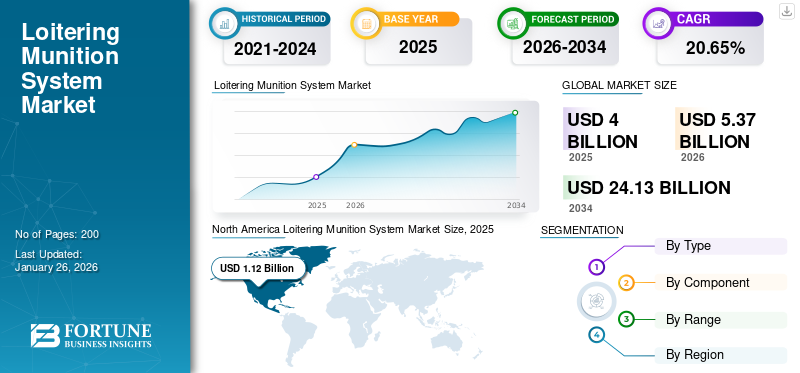
The global loitering munition systems market size was valued at USD 5.51 billion in 2025. The market is projected to grow from USD 6.42 billion in 2026 to USD 40.53 billion by 2034, exhibiting a CAGR of 25.89% during the forecast period. Europe dominated the loitering munition system market with a market share of 37.57% in 2025.
The market covers expendable unmanned strike systems that can search, identify, track, and engage targets after loitering over the battlefield. These systems sit between drones and precision missiles, giving forces a cheaper, faster, and more flexible way to attack armor, air-defense assets, command posts, vehicles, and time-sensitive targets.
The global market growth is mainly driven by lessons from Ukraine and other high-intensity conflicts, where small precision-strike drones have shown strong value at tactical levels. The product demand is rising as amid geopolitical tensions, armies want organic ISR-strike capability, anti-armor lethality, modern combat scenarios, lower-cost precision fires, minimal collateral damage, and systems that can work in GPS-denied or electronically contested environments.
Major players include AeroVironment, Inc., Israel Aerospace Industries Ltd., Elbit Systems Ltd., UVision Air Ltd., Rheinmetall AG, and WB Electronics S.A. / WB Group. Across the market, key players are focusing on modular warheads, man-portable and vehicle-launched variants, AI-assisted targeting, open-architecture control systems, local manufacturing partnerships, NATO/customer-specific production, and rapid scaling of production capacity to secure long-term defense procurement programs.
Download Free sample to learn more about this report.
Impact of Russia–Ukraine War
Shift from Niche Precision Weapons to Mass Battlefield Strike Systems to Drive Market Growth
The Russia–Ukraine war has made loitering munitions a frontline requirement given that both sides proved that small, expendable strike drones can locate, track, and destroy targets at much lower cost than conventional missile systems. Ukraine’s battlefield experience changed buyer thinking. Loitering munitions are no longer viewed only as special-forces tools, but as infantry, artillery, border-defense, and deep-strike assets. The war increased the demand for loitering systems that can attack armor, artillery, trenches, radar, air-defense units, logistics vehicles, ammunition depots, and command posts with faster kill-chain response.
Conventional missiles still remain critical for heavy strike missions but the war proved that loitering munitions fill the gap between artillery shells, ATGMs, tactical drones, and cruise missiles. This has created a new procurement logic. Armies want large quantities of lower-cost precision weapons for daily battlefield use, while reserving expensive missiles for strategic or heavily defended targets. Ukraine’s Ministry of Defence stated that its 2025 drone procurement plan includes over UAH 110 billion and targets procurement of 4.5 million FPV drones, showing how strike-drone demand is moving toward mass-scale consumption.
The demand forecast is, therefore, structurally positive. Future buyers will procure loitering munitions, covering man-portable, vehicle-launched, anti-armor, anti-radar, long-range, and swarm-capable variants.
Impact of the Middle East War
Increasing Low-Cost Precision Strike Needs to Make Loitering Munitions a Core Battlefield Capability
The Middle East conflict environment has accelerated loitering munition adoption as Israel, Iran-linked groups, Houthis, Hezbollah, and regional armed forces have demonstrated the value of one-way attack drones and loitering strike systems. These weapons offer a lower-cost option for attacking air-defense sites, radar systems, ships, logistics routes, military bases, and mobile ground targets compared with the repeated use of expensive conventional missiles.
Iran’s large-scale drone and missile attack on Israel in April 2024 and repeated Houthi attacks in the Red Sea showed that mass drone salvos can pressure even advanced air-defense architectures. This has increased the demand for loitering munitions as strike weapons, while also pushing investment in counter-UAS, jamming, short-range air defense, shipborne protection, and base-defense systems.
The war environment has proved that conventional missiles remain essential for hardened and strategic targets, but they are not always economical for daily tactical engagements. Loitering munitions are being positioned between artillery, ATGMs, ISR drones, and cruise missiles, giving armed forces a flexible strike layer for mobile vehicles, artillery positions, radar units, border threats, and dispersed enemy forces.
Loitering Munition Systems Market Trends
Shift toward AI-Assisted Targeting, Resilient Networks, and Multi-Platform Control
The leading technology trend is the movement from standalone loitering munitions to connected, software-led strike ecosystems. Armies want systems that can receive target data, share video, operate in jammed conditions, reduce operator workload, and integrate with broader battlefield networks. OEMs are, therefore, investing in automatic target recognition, RF sensing, MANET radios, edge autonomy, software-defined communications, and common control interfaces. Elbit’s E-LynX UxS launch reflects this direction as it is designed to connect manned and unmanned aerial and ground platforms within one secure network and carry telemetry, C2 data, video, and sensor feeds. In business terms, the market is moving from munition sale to networked strike solution.
For instance, in May 2026, AeroVironment expanded its AV_Halo platform with INSTINCT and DETECT, adding distributed autonomy, RF sensing, and faster edge decision-making for ISR, loitering, strike, and counter-UAS missions.
Market Dynamics
MARKET DRIVERS
Download Free sample to learn more about this report.
Battlefield Need for Organic, Fast, and Lower-Cost Precision Strike to Drive Market Expansion
The main driver for loitering munition systems market growth is the shift from centralized precision fires to unit-level strike capability. Modern armies want infantry, special forces, armored units, and artillery formations to detect and destroy targets without waiting for aircraft, large missile units, or long fire-support chains. Loitering munitions are attractive given that they combine surveillance, target confirmation, and strike in one expendable system.
This is especially important against armored vehicles, air-defense systems, command posts, artillery positions, and moving targets. Technology upgrades such as automatic target recognition, modular payloads, longer range, resilient communication links, and GNSS-denied navigation are making these systems more useful in contested battlefields.
For instance, in May 2026, AeroVironment announced that the U.S. Army selected Switchblade 400 for the Low-Altitude Stalking and Strike Ordnance (LASSO) program, supporting rapid development, delivery, and testing of a man-portable anti-armor loitering munition.
MARKET RESTRAINTS
Export Controls and Lack of Training for Operation May Slow the Wider Adoption of Loitering Munitions
A key restraint is that loitering munitions are not treated similar to ordinary drones. They are lethal weapon systems and often require strict export approval, storage controls, training, accountability, and post-delivery monitoring. This can slow procurement timelines, especially for countries that need urgent deliveries but do not yet have mature storage, operator training, or weapons-accountability systems. The restraint is stronger for systems with anti-armor payloads, autonomous target functions, long range, or sensitive guidance and communication technology.
MARKET OPPORTUNITIES
Allied Procurement, Local Manufacturing, and Sovereign Drone Programs to Create New Growth Channels
The biggest opportunity is the move by NATO, Europe, and Indo-Pacific partners to build domestic or allied loitering munition capacity instead of depending only on imported finished systems. Buyers increasingly want local assembly, technology integration, domestic training, and compatibility with their own command-and-control systems. This creates opportunities for OEMs that can offer partnership models, common controllers, modular payloads, and open-architecture software.
Elbit’s SkyStriker, Rheinmetall/UVision’s HERO family, WB Group’s WARMATE, IAI’s HAROP/HARPY, and AeroVironment’s Switchblade/AV_Halo ecosystem are well positioned as they combine strike hardware with software, launchers, communications, and integration support. Rheinmetall’s HERO order from a NATO customer also shows that European armed forces are converting battlefield lessons into structured procurement.
For instance, in, June 2026, AeroVironment signed an MoU with Taiwan’s Ubiqconn to develop a common controller ecosystem for Taiwan’s indigenous UAS program, including the integration of AV’s Kinesis mission-management software and support for multiple OEM drone types.
MARKET CHALLENGES
Need for Continuous Upgrades and Training to Create Significant Challenges
The biggest challenge that loitering munition market players are facing is a faster counter-cycle. As these systems become common, armies are investing heavily in jammers, RF detection, layered sensors, directed-energy systems, interceptor drones, and short-range air defense. This means OEMs must continuously upgrade datalinks, autonomy, seekers, navigation, and terminal guidance to remain effective. Training is another challenge as soldiers need more than basic flight skills. They must learn tactical employment, target selection, fires coordination, airspace management, and electronic-signature control.
SEGMENTATION ANALYSIS
By Platform Capability Type
Strategic LM / Long-Range Emerges as the Fastest-Growing Segment due to Rising Demand for High Precision Strikes
The global market, by platform capability type, is classified into Nano / Micro LM (Below 2 kg and Below 10 km), Mini LM (2–10 kg and 10–40 km), Tactical LM (10–100 kg and 40–200 km), Operational LM (100–500 kg and 200–750 km), and Strategic LM / Long-Range (Above 500 kg and Above 750 km)
The strategic LM / long-range (above 500 kg and above 750 km) segment is estimated to grow at the highest CAGR of 28.33% during the forecast period of 2026-2034. This growth is mainly supported by the need for long-range high precision strike systems that can hit high-value targets beyond the forward battlefield, including air-defense sites, command centers, logistics hubs, radar stations, and artillery positions. Armed forces are increasingly looking for loitering munitions that can stay airborne longer, cover wider areas, and reduce dependence on manned aircraft or expensive cruise missiles.
The tactical LM (10–100 kg and 40–200 km) segment accounted for the largest market share of 32.57% in 2025. In addition, the segment is projected to grow at a CAGR of 25.58% during the forecast period.
By Launch Platform
Naval / Coastal Surface-Launched Segment to Grow with Rising Demand for Maritime Surveillance and Coastal Defense Capabilities
The global market, by launch platform, is classified into hand-launched / throw-deployed, tube-launched (barrel-compatible cartridge), canister-launched (self-contained box module), rail / catapult-launched (pneumatic / bungee), vehicle-mounted direct-launch, artillery / mortar system / rocket-assisted launched, air-launched, naval / coastal surface-launched, and submarine-launched.
The naval / coastal surface-launched segment is estimated to expand at the highest CAGR of 27.95% during the forecast period of 2026-2034. This growth reflects the rising need for coastal defense, maritime surveillance-strike capability, and anti-access/area-denial operations. Countries with island territories, long coastlines, and contested maritime borders are increasingly interested in loitering munitions that can be launched from coastal batteries, patrol vessels, naval bases, or mobile shore-based launchers.
The canister-launched (self-contained box module) segment accounted for the largest market share of 22.44% in 2025. In addition, the segment is projected to grow at a CAGR of 27.78% during the forecast period.
By Airframe Configuration
Flying-Wing / Delta / Blended-Body Segment to Expand due to Better Aerodynamic Efficiency
By airframe configuration, the global market is classified into fixed-wing, folding / collapsible wing, VTOL / multi-rotor, flying-wing / delta / blended-body, and VTOL fixed-wing / hybrid VTOL.
The flying-wing / delta / blended-body segment is estimated to grow at the highest CAGR of 27.78% during the forecast period of 2026-2034. This design is gaining traction given that it offers better aerodynamic efficiency, more internal volume, improved endurance, and stronger payload flexibility compared with many conventional layouts. For loitering munitions, this matters as endurance, range, sensor carriage, and terminal attack stability directly influence mission value.
The fixed-wing segment accounted for the largest market share of 21.78% in 2025. In addition, the segment is projected to grow at a CAGR of 24.10% during the forecast period.
By Guidance & Targeting Mode
GPS-Denied / INS-Only Navigation Segment to Surge at the Highest CAGR due to Electronic Warfare Pressure
The global market, by guidance & targeting mode, is classified into GNSS / INS waypoint navigation, EO / IR operator-cued video targeting, passive RF / emitter-homing, laser-aided terminal guidance, AI / ML vision-based target recognition, and GPS-denied / INS-only navigation.
The GPS-denied / INS-only navigation segment is estimated to grow at the highest CAGR of 27.93% during the forecast period of 2026-2034. The segment is expanding as modern battlefields are increasingly affected by jamming, spoofing, and electronic modern warfare, making GPS-dependent systems vulnerable. Armed forces now want loitering munitions that can continue the mission even when satellite navigation is degraded or unavailable.
The EO / IR operator-cued video targeting segment accounted for the largest market share of 36.80% in 2025. In addition, the segment is projected to grow at a CAGR of 25.30% during the forecast period.
By Warhead / Payload Type
Modular / Field-Swappable Warhead Bay Segment to Expand due to Need for Multi-Mission Flexibility
The global market, by warhead / payload type, is classified into EFP / shaped-charge / HEAT, High-Explosive (HE) fragmentation, thermobaric / Fuel-Air Explosive (FAE), anti-radiation / passive RF homing, electronic warfare / non-kinetic payload, modular / field-swappable warhead bay, and general-purpose / anti-materiel blast.
The modular / field-swappable warhead bay segment is estimated to grow at the highest CAGR of 28.83% during the forecast period of 2026-2034. This segment is growing given that armed forces want one loitering munition platform to support multiple missions instead of buying separate systems for every target set. A modular payload bay allows operators to change warheads or mission payloads depending on whether the target is armor, personnel, radar, light vehicles, infrastructure, or soft-skinned assets.
The high-explosive (HE) fragmentation segment accounted for the largest share of 29.36% in 2025. In addition, the segment is projected to grow at a CAGR of 24.55% during the forecast period.
By Propulsion Unit
Turbojet / Microturbine Segment to Expand due to Soaring Demand for Longer Range and Heavier Munitions
By propulsion unit, the global market is classified into battery electric, gasoline / petrol engine, heavy-fuel / JP-8-compatible engine, turbojet / microturbine, hybrid-electric (battery + ICE), glide / engine-off terminal phase, rocket-assisted / boost-sustain, and glide / engine-off (fully unpowered attack).
The turbojet / microturbine segment is estimated to grow at the highest CAGR of 28.90% during the forecast period of 2026-2034. The segment growth is linked to the rising demand for faster, longer-range, and heavier loitering munitions that can reach time-sensitive targets before they relocate. Battery-electric systems remain important for small tactical use, but turbojet and microturbine propulsion become more attractive when the mission requires speed, range, payload weight, and penetration capability.
The battery electric segment accounted for the largest market share of 37.85% in 2025. In addition, the segment is projected to grow at a CAGR of 25.77% during the forecast period.
By Autonomy Level
EW-Resilient Autonomous Systems Segment to Expand with Need for Munition Operation under Heavy Jamming and Counter-Drone Pressure
The global market, by autonomy level, is classified into remote-controlled / human-in-the-loop, operator-on-the-loop, AI-supervised autonomous, fully autonomous / machine kill chain, swarm-coordinated autonomous, and EW-resilient autonomous.
The EW-resilient autonomous segment is estimated to grow at the highest CAGR of 28.67% during the forecast period. The segment growth is being driven by the need for operating loitering munitions under heavy jamming, spoofing, datalink disruption, and counter-drone pressure. Human-in-the-loop operation remains important but future systems need enough onboard autonomy to continue navigation, target tracking, and terminal engagement when communication links are degraded.
The remote-controlled / human-in-the-loop segment accounted for the largest loitering munition systems market share of 37.39% in 2025. In addition, the segment is projected to grow at a CAGR of 23.52% during the forecast period.
By End User
Army / Land Forces Segment to Grow with Rising Need for Supporting Infantry and Border-Defense Operations
The global market, by end user, is classified into army / land forces, air force, naval forces, special operations forces, border security, gendarmerie & homeland defense, and national guard / reserve & gendarmerie.
The army / land forces segment is estimated to grow at the highest CAGR of 26.81% during the forecast period of 2026-2034. In addition, this segment accounted for the largest market share of 51.74% in 2025. This growth is driven by the strong need for ground units on the battlefield to identify and strike threats quickly at tactical and operational depth. Land forces are using loitering munitions to support infantry, armored formations, artillery units, reconnaissance teams, and border-defense operations.
The air force segment accounted for the second-largest market share of 13.37% in 2025. In addition, the segment is projected to grow at a CAGR of 25.49% during the forecast period.
By Procurement Model
To know how our report can help streamline your business, Speak to Analyst
Licensed Production / Technology Transfer Segment to Expand due to Domestic Control Demand for Munition Production
The global market, by procurement model, is classified into direct domestic procurement, export sale / foreign military sales, foreign military assistance (grant-funded), licensed production / technology transfer, joint development / co-development program, and framework / multi-year contract.
The licensed production / technology transfer segment is estimated to grow at the highest CAGR of 27.42% during the forecast period of 2026-2034. This segment growth is driven by countries wanting domestic control over loitering munition production, especially after recent conflicts exposed supply-chain bottlenecks, ammunition shortages, and dependence on foreign suppliers. Governments increasingly prefer procurement models that support local assembly, domestic component sourcing, technology absorption, and wartime production scalability.
The direct domestic procurement segment accounted for the largest market share of 31.47% in the year 2025. In addition, the segment is projected to grow at a CAGR of 26.03% during the forecast period.
Loitering Munition Systems Market Regional Outlook
By region, the market is categorized into Europe, North America, Asia Pacific, the Middle East & Africa, and Latin America.
Europe
Europe Loitering Munition Systems Market Size, 2025 (USD Billion)
To get more information on the regional analysis of this market, Download Free sample
Europe accounted for the largest market share in 2025, valued at USD 2.07 billion, and is estimated to maintain the leading share in 2026, with a valuation of USD 26.86 billion. The regional market is growing as NATO countries now need low-cost strike systems that can defeat armor, artillery, radar, and frontline targets without relying only on missiles or manned aircraft.
U.K. Loitering Munition Systems Market
The U.K. market was valued at USD 0.18 billion in 2025 and is estimated to grow at a rate of 25.36% during the forecast period.
Eastern Europe Loitering Munition Systems Market
The Eastern Europe market was valued at USD 1.05 billion in 2025 and is estimated to grow at a rate of 27.35% during the forecast period.
Germany Loitering Munition Systems Market
In 2025, the Germany market was valued at USD 0.26 billion and is estimated to grow at a rate of 29.57% during the forecast period.
North America
North America held a significant share in 2025, valued at USD 1.43 billion, and is set to maintain the significant share in 2026, with USD 1.65 billion. The regional market is expanding as the U.S. Army is moving loitering munitions into regular infantry formations for organic anti-armor and non-line-of-sight strike capability.
U.S. Loitering Munition Systems Market
Based on North America's strong contribution and the U.S. dominance within the region, the U.S. market reached USD 1.37 billion in 2025 and is estimated to depict a CAGR of 24.36% during the forecast period.
Asia Pacific
The Asia Pacific market was valued at USD 1.29 billion in 2025 and secured the position of the third-largest region in the market. The regional market growth is driven by the need for distributed precision fires across land borders, islands, and maritime approaches. In addition, India’s emergency procurement contracts show that regional forces are buying loitering munitions for deterrence, counter-terrorism, and fast battlefield response.
China Loitering Munition Systems Market
The China market growth was valued at USD 0.36 billion in 2025 and is estimated to grow at a rate of 22.87% during the forecast period.
Japan Loitering Munition Systems Market
The Japan market was valued at USD 0.26 billion in 2025 and is estimated to grow at a rate of 28.40% during the forecast period.
India Loitering Munition Systems Market
The India market was valued at USD 0.18 billion in 2025 and is estimated to grow at a rate of 27.82% during the forecast period.
Middle East & Africa
The Middle East & Africa market is projected to grow at the highest CAGR of 27.62% during the forecast period. In 2025, the market value stood at USD 0.57 billion. The Middle East & Africa region is growing as Gulf and Israeli defense ecosystems are already fielding and exporting mature loitering munition families for ISR-strike, swarming, and stand-off attack roles.
Israel Loitering Munition Systems Market
The Israel market was valued at USD 0.15 billion in 2025 and is estimated to grow at a rate of 25.83% during the forecast period.
Turkey Loitering Munition Systems Market
The Turkey market was valued at USD 0.13 billion in 2025 and is estimated to grow at a rate of 28.86% during the forecast period.
Iran Loitering Munition Systems Market
In 2025, the Iran market was valued at USD 0.10 billion and is estimated to grow at a rate of 27.97% during the forecast period.
Latin America
The Latin America market was valued at USD 0.15 billion in 2025. The regional market is growing more gradually given that regional militaries are testing loitering munitions as a cost effective way to add high precision strike without large missile inventories.
Brazil Loitering Munition Systems Market
The Brazil market was valued at USD 0.05 billion in 2025 and is estimated to grow at a rate of 20.63% during the forecast period.
Mexico Loitering Munition Systems Market
The Mexico market was valued at USD 0.04 billion in 2025 and is estimated to grow at a rate of 22.30% during the forecast period.
COMPETITIVE LANDSCAPE
Key Industry Players
Leading Players Focus on System Upgradation with Automatic Target Recognition and GPS-denied Navigation to Enhance Market Share
The loitering munition systems market is becoming more competitive as defense buyers shift from small urgent purchases to structured programs, multi-year contracts, and sovereign production models. The competition is no longer based only on airframe performance. OEMs are competing based on production scale, local assembly, faster delivery, NATO interoperability, and the ability to support long-term military modernization programs.
Technology competition is also moving toward complete strike ecosystems rather than standalone munitions. Key players are upgrading systems with GPS-denied navigation, automatic target recognition, larger and modular warheads, resilient datalinks, swarming capability, common controllers, and integration with broader ISR and fire-control networks. As a result, the market growth is being driven by firms that can deliver not just a munition, but a scalable, upgradable, and locally supportable precision strike capabilities.
LIST OF KEY LOITERING MUNITION SYSTEMS COMPANIES PROFILED
- AeroVironment, Inc. (U.S.)
- Anduril Industries, Inc. (U.S.)
- Israel Aerospace Industries Ltd. (Israel)
- Elbit Systems Ltd. (Israel)
- Rafael Advanced Defense Systems Ltd. (Israel)
- UVision Air Ltd. (Israel)
- WB Electronics S.A. / WB Group (Poland)
- Rheinmetall AG (Germany)
- Roketsan Roket Sanayii ve Ticaret A.Ş. (Turkey)
- EDGE Group PJSC / ADASI (UAE)
- Paramount Aerospace Systems (UAE)
- Tata Advanced Systems Limited (India)
- National Chung-Shan Institute of Science and Technology (Taiwan)
- China Aerospace Science and Technology Corporation (China)
- Joint-Stock Company ZALA AERO (Russia)
KEY INDUSTRY DEVELOPMENTS
- February 2026: The German Bundeswehr/BAAINBw awarded Helsing an initial contract of around USD 263 million for HX-2 loitering munitions. These systems are aimed at strengthening Germany’s medium-range precision strike capabilities and supporting the Bundeswehr’s forward-deployed brigade requirements.
- October 2025: The U.S. Army awarded Mistral Inc. and UVision Inc. a USD 982 million multi-year IDIQ contract for the HERO 120 system, covering procurement, fielding, training, and sustainment under the Lethal Unmanned System program.
- June 2025: India’s Ministry of Defence/Indian Army awarded Solar Defence and Aerospace Ltd. a USD 15.8 million contract for around 450 Nagastra-1R loitering munitions, strengthening indigenous night-capable precision strike capabilities for artillery and infantry support.
- September 2024: The U.S. Army Contracting Command awarded AeroVironment a USD 54.86 million modification for Switchblade hardware production, including support connected to U.S. Army requirements and foreign military sales to Lithuania, Romania, and Sweden.
- June 2024: The U.S. Government awarded UVision Inc. and Mistral Inc. a USD 73.55 million contract to supply HERO-120SF loitering munitions to U.S. Special Operations Command, including munitions, spares, training, engineering changes, and system conversion support.
REPORT COVERAGE
The global loitering munition systems market analysis includes a comprehensive study of the market size & forecast by all the market segments included in the report. It contains details on the market dynamics and trends expected to drive the market over the forecast period. It provides information on key aspects, including an overview of technological advancements, pipeline candidates, the regulatory environment, and product launches. Additionally, it details partnerships, mergers & acquisitions, as well as key defense industry developments by major regions. The global market research report also provides a detailed competitive landscape with information on the market share and profiles of key operating players.
Request for Customization to gain extensive market insights.
Report Scope & Segmentation
| ATTRIBUTE | DETAILS |
| Study Period | 2021-2024 |
| Base Year | 2025 |
| Estimated Year | 2026 |
| Forecast Period | 2026-2034 |
| Historical Period | 2021-2024 |
| Growth Rate | CAGR of 25.89% from 2026-2034 |
| Unit | Value (USD Billion) |
|
Segmentation |
By Platform Capability Type
By Launch Platform
By Airframe Configuration
By Guidance & Targeting Mode
By Warhead / Payload Type
By Propulsion Unit
By Autonomy Level
By End User
By Procurement Model
By Geography
|
Frequently Asked Questions
Fortune Business Insights says that the global market value stood at USD 5.51 billion in 2025 and is projected to reach USD 40.53 billion by 2034.
In 2025, the Europe market value stood at USD 2.07 billion.
The market is expected to exhibit a CAGR of 25.89% during the forecast period.
The licensed production / technology transfer segment is expected to hold the highest CAGR over the forecast period.
The need for organic, fast, and lower-cost precision strikes in battlefield are key factors driving market expansion.
AeroVironment, Inc., Israel Aerospace Industries Ltd., Elbit Systems Ltd., UVision Air Ltd., Rheinmetall AG, and WB Electronics S.A. / WB Group are the top players in the market.
Europe dominated the market in 2025.



- 2021-2034
- 2025
- 2021-2024
- 200
-
(Offer valid till 15th Aug 2026)
Get 30-60 hrs Free Customization
Expand Regional and Country Coverage, Segments Analysis, Company Profiles, Competitive Benchmarking, and End-user Insights.




















Related Reports
-
US +1 833 909 2966 ( Toll Free )
-
Get In Touch With Us