Short-Range Air Defense System Market Size, Share & Industry Analysis, By System Type (Missile-Based, Gun-Based Air Defense Systems, Hybrid Gun-Missile), By Platform (Man-Portable, Vehicle-Mounted/Self-Propelled, Fixed/Relocatable, and Trailer-Mounted/Containerized), By Component (Interceptors and Missiles, Guns and Ammunition, Radar/EO-IR/Fire-Control Sensors, Command, Control), By Target Threat (UAS and Loitering Munitions, Cruise Missiles/Low-Flying PGMs, Rotary-Wing Aircraft, Fixed-Wing), By End User (Armed Forces, and Homeland/Critical Infrastructure), and Regional Forecast, 2026-2034
 Download Free Sample
Short-Range Air Defense System Market Size and Future Outlook
 Listen to Audio Version
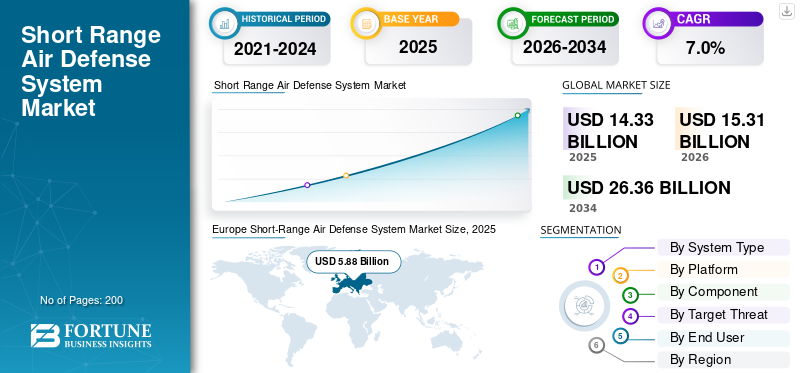
The short-range air defense system market size was valued at USD 14.33 billion in 2025. The market is projected to grow from USD 15.31 billion in 2026 to USD 26.36 billion by 2034, exhibiting a CAGR of 7.0% during the forecast period. Europe dominated the short range air defense system market with a market share of 41.03% in 2025.
The short-range air defense system market covers land-based systems and ground-based air and missile defense solutions designed to detect, track, and neutralize low-altitude threats such as drones, loitering munitions, helicopters, cruise missiles, rockets, artillery, and mortar threats. Demand is rising as militaries shift from standalone anti-aircraft weapons to integrated air defense architectures that combine interceptors, guns, sensors, electronic-kill effectors, and command and control.
Key players in the market include RTX Company, Northrop Grumman Corporation, Rheinmetall AG, MBDA, Saab AB, Lockheed Martin Corporation, Kongsberg Gruppen ASA, RAFAEL Advanced Defense Systems Ltd., Leonardo S.p.A., Thales Group, BAE Systems Inc., and Hanwha Aerospace Co., Ltd. These companies are driving the market through new missile defense system upgrades, mobile gun-missile platforms, counter-UAS solutions, sensor integration, and command and control systems.
Download Free sample to learn more about this report.
SHORT-RANGE AIR DEFENSE SYSTEM MARKET KEY TAKEAWAYS
 Global Market Size & Forecast
- 2025 Market Size: USD 14.33 billion
- 2026 Market Size: USD 15.31 billion
- 2034 Forecast Market Size: USD 26.36 billion
- CAGR: 7.0% from 2026–2034
 Market Share
- Europe dominated the market with a 41.03% share in 2025.
- The Missile-Based SHORAD Systems segment held the largest market share in 2025.
- The Vehicle-Mounted/Self-Propelled segment held the largest market share in 2025.
 Key Regional Highlights
Europe
Dominated the market in 2025 and is projected to grow at a 5.4% CAGR, driven by NATO modernization, counter-UAS programs, and increased air defense procurement.
North America
Expected to grow at a 5.8% CAGR, supported by M-SHORAD modernization, counter-drone systems, and integrated air defense investments.
Asia Pacific
Projected to grow at the fastest 8.6% CAGR, driven by border security, military modernization, and investments in integrated air defense networks.
U.S.
Reached USD 2.35 billion in 2025 and is projected to grow at a 5.6% CAGR during the forecast period.
Japan
Growth is supported by rising investments in integrated air defense systems, counter-drone capabilities, and military modernization initiatives.
Read More

Short-Range Air Defense System MARKET TRENDS
Shift Toward Layered and Networked Air Defense Architectures to Drive Market Growth
The short-range air defense system market is moving away from standalone anti-aircraft weapons toward layered, networked architectures that combine missiles, guns, sensors, programmable ammunition, and command and control systems within a unified operating framework. This trend is being shaped by the growing use of drones, loitering munitions, low-flying cruise missiles, and saturation attacks, where a single weapon system is no longer sufficient. Armed forces are increasingly looking for land-based systems that can operate independently but also connect into wider air and missile defense networks, making mobile ground-based platforms more valuable for battlefield protection, airbase defense, and critical infrastructure security.
MARKET DYNAMICS
MARKET DRIVERS
Download Free sample to learn more about this report.
Rapid Proliferation of Drones and Low-Altitude Threats to Drive Market Growth
The short-range air defense system market is being driven by the rapid proliferation of drones, loitering munitions, low-flying missiles, and battlefield surveillance UAVs. Modern forces can no longer rely solely on traditional anti-aircraft weapons, as the threat landscapes now include cheap, mobile, and high-volume aerial systems that can target troops, airbases, logistics nodes, and critical infrastructure. This is prompting militaries to invest in layered air and missile defense architectures that combine missiles, sensors, electronic defeat systems, and command and control platforms that can detect and defeat small threats before they reach operational assets.
- In February 2024, Canada’s Department of National Defence announced urgent procurement of approximately USD 169 million for the RBS 70 NG short-range Air Defence system and approximately USD 34 million for counter-drone equipment to support Canadian Armed Forces personnel deployed with NATO in Latvia.
MARKET RESTRAINTS
Cost Imbalance Between Expensive Missiles Interceptors and Low-Cost Aerial Threats to Restrain Market Growth
While the market is experiencing strong growth, expansion is constrained by interceptor availability, production lead times, and the cost imbalance between expensive missiles interceptors and low-cost aerial threats. Many militaries are trying to expand air and missile defense coverage at the same time, creating pressure on missile defense system inventories, supply chains, and production capacity. This restraint is mainly visible in missile-centric land-based systems, where demand for reloads can rise faster than production capabilities. As a result, buyers are increasingly investing in hybrid guns, electronic-kill systems, and command and control upgrades to reduce dependence on costly interceptors.
MARKET OPPORTUNITIES
Low-Cost Defeat Mechanisms and Counter-UAS solutions Create New Market Opportunity
A key opportunity in the market is the growing demand for lower-cost defeat mechanisms against drones, loitering munitions, and saturation attacks. While missile-based air and missile defense remains essential, using expensive interceptors against low-cost UAS is viewed as economically unsustainable during prolonged operations. This is opening room for directed-energy lasers, radio-frequency systems, electronic-kill effectors, and hybrid ground-based architectures that can reduce cost-per-engagement while protecting airbases, land forces, ports, oil and gas assets, and critical infrastructure.
MARKET CHALLENGES
Regulatory Hurdles to Limit Market Expansion
A major challenge in the short-range air defense system market is building the advanced weapon systems and securing permission to use them in real-world environments. Many land-based air defense systems rely on electronic defeat, jamming, directed-energy, sensors, and command and control links. However, deploying these capabilities around civilian airspace, domestic bases, airports, ports, and critical infrastructure requires extensive regulatory approvals. As a result, this creates a gap between procurement and operational use, slowing the effective fielding of new capabilities.
Impact of Russia-Ukraine and Middle East Conflicts
Growing Russia-Ukraine, Middle East, and Red Sea Conflicts Accelerate Product Demand
The Russia-Ukraine war, Middle East conflicts, Red Sea attacks, and wider drone-heavy combat environment have strengthened demand for short-range air defense systems. These conflicts have shown that land-based systems must counter rockets, artillery, and mortar (RAM) threats, drones, loitering munitions, cruise missiles, and low-altitude aircraft within the same battlespace. As a result, militaries are moving from isolated anti-aircraft assets toward layered air and missile defense networks that integrate missiles, guns, sensors, non-kinetic effectors, and command and control systems. The impact is especially evident in Europe and the Middle East, where battlefield losses, airbase vulnerabilities, and threats to critical infrastructure are turning urgent operational gaps into funded procurement programs.
Segmentation Analysis
By System Type
Missile-Based SHORAD Systems Segment Dominated the Market Due to Proven Effectiveness and Operational Readiness
In terms of system type, the market is categorized into missile-based SHORAD systems, gun-based air defense systems, hybrid gun-missile SHORAD systems, and directed-energy/ electronic-kill SHORAD.
The Missile-based SHORAD systems segment held the largest global short-range air defense system market share in 2025. The dominance is attributed to the widespread deployment and procurement of missile-based systems for countering low-altitude aircraft, helicopters, cruise missiles, UAS, and loitering munitions. Compared to newer directed-energy or electronic-kill solutions, missile-based systems benefit from existing mature production lines, combat-proven interceptors, established operator training, and clear integration paths with existing air and missile defense networks. Segment growth is supported by interceptor replenishment, MANPADS modernization programs, vehicle-mounted missile launchers, and battery-level upgrades across North America, Europe, Asia Pacific, and the Middle East.
The directed-energy/electronic-kill SHORAD segment is expected to grow at the highest CAGR of 14.8% over the forecast period.
To know how our report can help streamline your business, Speak to Analyst
By Platform
Vehicle-Mounted/Self-Propelled Platforms Segment Dominated the Market Due to the Need for Mobile Air Defense and Integrated Multi-mission Capabilities
On the basis of the platform, the market is classified into man-portable, vehicle-mounted/self-propelled, fixed/relocatable, and trailer-mounted/containerized.
The vehicle-mounted/self-propelled segment held the largest market share in 2025, as modern SHORAD is no longer limited to static point defense or man-portable weapons. Armed forces need mobile land-based systems that can move with armored formations, protect forward operating bases, and quickly respond to drones, helicopters, cruise missiles, and low-flying aircraft. These platforms are preferred as they integrate missiles, guns, radar, EO/IR sensors, fire-control systems, and command and control capabilities into a single deployable weapon system. Their dominance is mainly visible in Europe, North America, Asia Pacific, and the Middle East, where militaries are rebuilding mobile integrated air defense capabilities to support maneuver-force and airbase protection.
The fixed/relocatable segment is expected to show the fastest growth, registering a CAGR of 9.4% over the forecast period.
By Component
Interceptors and Missiles Segment Dominated the Market Due to Recurring Reload Demand and Hard-Kill Defense Capability
On the basis of component, the market is classified into interceptors and missiles, guns and ammunition, radar/EO-IR/fire-control sensors, command, control and battle management, and training, sustainment and services.
The interceptors and missiles segment held the largest global market share in 2025, as these systems remain the primary defeat mechanism against aircraft, helicopters, cruise missiles, UAS, and loitering munitions. Although guns, sensors, command and control, and electronic-kill systems gain importance, most operational SHORAD batteries still depend on missile interceptors for reliable hard-kill engagement at tactical range. This segment also benefits from recurring reload demand, stockpile replenishment, and wartime consumption, making it a larger revenue contributor than many hardware-only categories.
The command, control and battle management segment is expected to register the fastest growth, expanding at a CAGR of 10.3% over the forecast period.
By Target Threat
UAS and Loitering Munitions Segment Dominated the Market Due to Rising Drone Threat in Modern Warfare
On the basis of target threat, the market is classified into UAS and loitering munitions, cruise missiles/low-flying PGMs, rotary-wing aircraft, fixed-wing low-altitude aircraft, and rockets, artillery and mortars.
The UAS and loitering munitions segment held the largest global market share in 2025, as these platforms have become the most frequent and disruptive low-altitude threats in modern conflicts. Unlike traditional aircraft threats, drones can be deployed in large numbers, operated at low cost, and used for surveillance, targeting, or direct strike missions. This is forcing militaries to invest in air and missile defense systems that combine radar, EO/IR sensors, interceptors, guns, electronic-kill effectors, and command and control capabilities. The segment leads the market as every major SHORAD modernization program now has a counter-UAS requirement built into it.
The cruise missiles/low-flying PGMs segment is expected to register the fastest growth, expanding at a CAGR of 8.0% over the forecast period.
By End User
Army/Land Forces Segment Dominated the Market, Driven by Need to Protect Ground Forces from Diverse Threats
Based on end user, the market is segmented into army/land forces, air force/airbase defense, marine/littoral forces, and homeland/critical infrastructure.
The army/land forces segment led the market in 2025, as most SHORAD requirements are tied directly to protecting troops, armored formations, logistics routes, forward bases, and battlefield command positions from low-altitude threats. Modern land forces are facing drones, loitering munitions, helicopters, rockets, artillery, mortar threats, and low-flying missiles within the same operational environment, which makes mobile and layered land-based systems essential. As a result, armies are investing heavily in vehicle-mounted launchers, man-portable missiles, gun-missile systems, radar, EO/IR sensors, and command and control networks that can move with ground formations rather than only defend fixed installations.
The homeland/critical infrastructure segment is expected to register the fastest growth, expanding at a CAGR of 10.5% over the forecast period.
Short-Range Air Defense System Market Regional Outlook
By geography, the market is categorized into North America, Europe, Asia Pacific, and the Rest of the World.
North America
Europe Short-Range Air Defense System Market Size, 2025 (USD Billion)
To get more information on the regional analysis of this market, Download Free sample
North America holds the second-largest market share and is anticipated to grow at a CAGR of 5.8% during the forecast period. The market is led mainly by the U.S. and supported by Canada’s renewed ground-based air defense investments. Regional demand is shaped by mobile force protection, counter-UAS, cruise missile defense, airbase security, and the need to connect sensors and shooters through stronger command and control networks. The U.S. continues to drive short-range air defense system market growth through M-SHORAD, Coyote-type counter-drone systems, Stinger missile replenishment, directed-energy trials, and integrated air and missile defense modernization efforts.
U.S. Short-Range Air Defense System Market
Based on North America’s significant contribution to the market and the dominance of the U.S. within the region, the U.S. market stood at around USD 2.35 billion in 2025, growing at a CAGR of 5.6% during the forecast period.
Europe
In Europe, the market is anticipated to grow at the second-fastest pace, registering a CAGR of 5.4% during the forecast period. Europe dominates the market, as the region has moved fastest from capability-gap recognition to actual procurement. The Russia-Ukraine war highlighted the need for dense, layered, ground-based air defense against drones, loitering munitions, cruise missiles, helicopters, rockets, artillery, and mortar threats. As a result, NATO countries are rebuilding land-based systems for maneuver-force protection, airbase defense, and critical infrastructure security. At the same time, ongoing battlefield needs in Russia and Ukraine continue to generate strong replacement and battlefield demand. Europe’s leadership is further supported by large-scale programs such as Skyranger 30, PILICA+, RBS 70 NG, NOMADS, Mistral, IRIS-T SLS/SLM-adjacent lower-tier deployments, and counter-UAS upgrades.
France Short-Range Air Defense System Market
France market reached approximately USD 0.50 billion in 2025, anticipated to grow at a CAGR of 4.7% during the forecast period.
Germany Short-Range Air Defense System Market
Germany market reached approximately USD 0.84 billion in 2025 and is anticipated to grow at a CAGR of 6.5% during the forecast period.
Asia Pacific
Asia Pacific is anticipated to grow at a CAGR of 8.6% over the forecast period, as countries across the region are strengthening low-altitude defense around borders, islands, airbases, ports, and strategic military infrastructure. China, India, Japan, South Korea, Taiwan, and Australia are investing in land-based systems that can counter drones, cruise missiles, loitering munitions, helicopters, and low-flying aircraft. Demand is expanding beyond traditional anti-aircraft systems toward integrated air defense networks that combine radar, EO/IR sensors, interceptors, electronic-kill systems, and command and control networks.
China Short-Range Air Defense System Market
The Chinese market stood at around USD 0.94 billion in 2025 and is anticipated to grow at a CAGR of 6.7% during the forecast period.
Taiwan Short-Range Air Defense System Market
The Taiwan market in 2025 stood at around USD 0.24 billion, anticipated to grow at the highest CAGR of 12.5% during the forecast period.
Rest of the World
Rest of the World (Middle East & Africa and Latin America) holds a comparatively smaller market share but is expected to grow at the highest CAGR of 9.2% during the forecast period. Growth is being driven by airbase protection, counter-UAS, oil and gas infrastructure security, border defense, and critical-site protection. The Middle East represents the largest share of the regional market, as repeated drone, rocket, cruise missile, and loitering munition threats have made layered short-range air defense a direct operational requirement rather than a future modernization option. Latin America remains a smaller market; however, selective modernization is rising, particularly in fixed-site protection, counter-drone systems, and mobile land-force defense capabilities.
Israel’s deployment of the Iron Beam laser interception system highlights the region’s shift toward lower-cost defeat mechanisms for drones, rockets, and mortars, alongside conventional missile-based air defense.
Latin America Short-Range Air Defense System Market
The market in Latin America reached around USD 0.55 billion in 2025 and is anticipated to grow at a CAGR of 9.8% during the forecast period.
Middle East & Africa Short-Range Air Defense System Market
The Middle East & Africa market stood at around USD 2.39 billion in 2025 and is expected to reach USD 5.23 billion in 2034.
COMPETITIVE LANDSCAPE
Key Industry Players
Key Industry Players Focus on Providing Quick-Response Air Defense System Solutions to Gain Competitive Edge
The short-range air defense system market is led by players with strong capabilities in missiles, sensors, launchers, guns, command and control, and integrated air defense solutions. Key players include RTX, Northrop Grumman, Rheinmetall, MBDA, Saab, Lockheed Martin, Kongsberg, Rafael, Thales, Leonardo, BAE Systems, and Hanwha Aerospace. Competition is shifting away from standalone anti-aircraft weapons toward complete land-based systems that combine interceptors, radar, EO/IR sensors, mobile launchers, and networked command-and-control capabilities.
The trend toward hybrid gun-missile systems is evident in Rheinmetall’s Skyranger 30 platform, while RTX continues to strengthen its market position through Coyote and KuRFS counter-drone solutions. Northrop Grumman remains a key player through its Integrated Battle Command System (IBCS), as command-and-control capabilities increasingly emerge as the core of integrated air defense. Overall, companies that can provide fully networked and quick-response air defense system solutions are gaining a stronger competitive edge in the market.
LIST OF KEY SHORT-RANGE AIR DEFENSE SYSTEM COMPANIES PROFILED
- RTX Corporation/Raytheon (U.S.)
- Lockheed Martin Corporation (U.S.)
- Northrop Grumman Corporation (U.S.)
- Leonardo S.p.A. (Italy)
- Thales Group (France)
- MBDA (France)
- Saab AB (Sweden)
- Kongsberg Gruppen ASA (Norway)
- Rafael Advanced Defense Systems Ltd. (Israel)
- Rheinmetall AG (Germany)
- Hanwha Aerospace Co., Ltd. (South Korea)
- ASELSAN A.Ş. (Turkey)
- BAE Systems plc (U.K.)
- Bharat Dynamics Limited (India)
- Israel Aerospace Industries Ltd. (Israel)
KEY INDUSTRY DEVELOPMENTS
- March 2025: Saab signed a framework agreement and received an order from Latvia for RBS 70 NG short-range ground-based air defense systems, including firing units, missiles, and trainer units. The order was valued at around USD 195.00 million, with deliveries planned from 2026 to 2030.
- November 2024: Kongsberg signed a contract with the Netherlands for NASAMS and NOMADS air defense systems under the CITADEL program. The contract was valued at around USD 1.09 billion and included NOMADS as a mobile short-range air defense configuration for land-force protection.
- October 2024: Saab received an additional Lithuanian order for the MSHORAD mobile air defense system, adding another battery to Lithuania’s short-range air defense capability. The order was valued at around USD 114.00 million, with deliveries scheduled for 2026-2029.
- July 2024: Saab received an order from Lithuania for its Mobile Short-Range Air Defence solution, including mobile firing units, mobile radar units, command and control, training, and RBS 70 NG-related equipment. The order was valued at around USD 124.00 million, with deliveries planned for 2025-2027.
- February 2024: Rheinmetall received a German Bundeswehr order for Boxer-based Skyranger 30 mobile air defense systems. The contract was valued at around USD 643.00 million and covered one prototype plus 18 production vehicles, with an option for 30 more systems.
- February 2024: Canada announced urgent procurement of air defense and anti-drone capabilities for forces deployed with NATO in Latvia. The package included RBS 70 NG short-range air defense systems and counter-UAS equipment, with a combined value of around USD 202.00 million.
- April 2023: MBDA was contracted by Poland’s Armament Agency to supply CAMM missiles and iLaunchers for the PILICA+ air defense upgrade program. The contract was valued at around USD 2.37 billion and supports 22 PILICA+ short-range air defense batteries.
- May 2022: The U.S. Army awarded Raytheon Technologies a USD 624.00 million contract to produce around 1,300 Stinger anti-aircraft missiles to replenish U.S. stockpiles after major transfers to Ukraine. This directly supported missile-based SHORAD replenishment demand.
REPORT COVERAGE
The global short-range air defense system market analysis provides an in-depth study of market size, market segmentation, company profile & forecast by all the market segments included in the report. It includes details on the market dynamics and trends that are expected to drive the market during the forecast period. It offers information on the technological advancements, new product launches, key industry developments, and details on strategic partnerships, mergers & acquisitions. The market research report also encompasses a detailed competitive landscape with information on the market share and profiles of key market players.
Request for Customization to gain extensive market insights.
Report Scope & Segmentation
| ATTRIBUTE | DETAILS |
| Study Period | 2021-2034 |
| Base Year | 2025 |
| Estimated Year | 2026 |
| Forecast Period | 2026-2034 |
| Historical Period | 2021-2024 |
| Growth Rate | CAGR of 7.0% from 2026 to 2034 |
| Unit | Value (USD Billion) |
|
Segmentation
|
By System Type
|
|
By Platform
|
|
|
By Component
|
|
|
By Target Threat
|
|
|
By End User
|
|
|
By Region
|
Frequently Asked Questions
Fortune Business Insights says that the global market value stood at USD 14.33 billion in 2025 and is projected to reach USD 26.36 billion by 2034.
In 2025, the Europe market value stood at USD 5.88 billion.
The market is expected to exhibit a CAGR of 7.0% during the forecast period.
By system type, the missile-based SHORAD systems segment led the market in 2025.
Rising proliferation of drones and low-altitude threats is a key factor driving the market.
Key players in the market include RTX Corporation, Northrop Grumman Corporation, Lockheed Martin Corporation, Rheinmetall AG, MBDA, Saab AB, Kongsberg Gruppen ASA, Rafael Advanced Defense Systems Ltd., Thales S.A., Leonardo S.p.A., BAE Systems plc, and Hanwha Aerospace Co., Ltd.
Europe dominates the market in terms of share.



- 2021-2034
- 2025
- 2021-2024
- 200
Get 30-60 hrs Free Customization
Expand Regional and Country Coverage, Segments Analysis, Company Profiles, Competitive Benchmarking, and End-user Insights.




















Related Reports
-
US +1 833 909 2966 ( Toll Free )
-
Get In Touch With Us