Digital Clothing Market Size, Share & Industry Analysis, By Type (Upper Wear, Lower Wear, Full-Body Outfits, and Others), By Platform (Gaming Platforms, Social Media & Content Creation Platforms, Brand-Owned Digital Platforms, and Others), By End-User (Individual Consumers, Enterprises/Brands, and Creators & Designers), By Business Model (Direct Purchase, Subscription-Based Access, and Others), and Regional Forecast, 2026-2034
 Download Free Sample
(Offer valid till 15th Oct 2026)

Digital Clothing Market Size and Future Outlook
 Listen to Audio Version
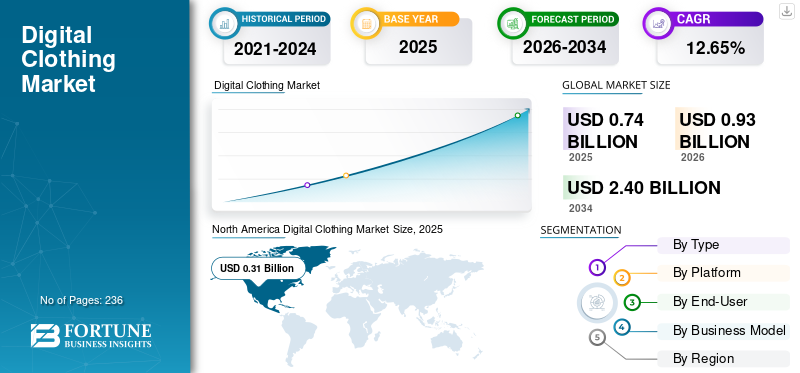
The global digital clothing market size was valued at USD 0.74 billion in 2025. The market is projected to grow from USD 0.93 billion in 2026 to USD 2.40 billion by 2034, exhibiting a CAGR of 12.65% during the forecast period. North America dominated the digital clothing market with a market share of 41.89% in 2025.
Consumers buy virtual outfits to express their identity on social media platforms and online games. The increasing adoption of avatar-based platforms, gaming environments, and digital content creation & 3D design tools that extensively use virtual clothes is driving global market growth. In addition, the growing number of fashion brands investing in the creation of 3D avatar personalities to promote their brand image and launch digital fashion collections. These consistent product launches is encouraging consumers purchase such products, favoring the product revenues globally.
Key companies in the global market include Roblox Corporation, Epic Games, Inc., Tencent Holdings Ltd., NetEase, Inc., and KRAFTON, Inc.
Download Free sample to learn more about this report.
DIGITAL CLOTHING MARKET KEY TAKEAWAYS
 Global Market Size & Forecast
- 2025 Market Size: USD 0.74 billion
- 2026 Market Size: USD 0.93 billion
- 2034 Forecast Market Size: USD 2.40 billion
- CAGR: 12.65% from 2026-2034
 Market Share
- North America accounted for 41.89% of the digital clothing market in 2025.
- The full-body outfits segment represented 39.71% of the global digital clothing market in 2025.
- The upper wear segment is expected to expand at the second-fastest CAGR of 12.73% during 2026–2034.
 Key Regional Highlights
North America
The North American market is expected to reach USD 0.38 billion in 2026, growing at a 12.00% CAGR during 2026–2034.
Europe
The European market size reached USD 0.13 billion in 2025, accounting for approximately 17.24% of the global product sales. The region’s market is projected to grow at 11.34% during 2026-2034.
Asia Pacific
Asia Pacific is forecast to grow at the highest CAGR of 13.93% from 2026–2034, while accounting for 33.43% of the global market and USD 0.25 billion in 2025.
U.S.
The U.S. market was valued at USD 0.25 billion in 2025, representing around 34.10% of global sales.
Japan
The Japanese market stood at around USD 0.044 billion in 2025, accounting for roughly 5.97% of global revenues.
Read More

DIGITAL CLOTHING MARKET TRENDS
Emergence of Micro-Transaction-Based In-Game Spending Behavior to Augment Market Growth
The increasing microtransaction-based spending on virtual apparel is significantly supporting the global digital clothing market growth, as consumers increasingly prefer making smaller purchases of low-priced digital garments rather than large one-time payment transactions on gaming and avatar-based platforms. In addition, consistent gamer developers’ efforts to launch new release contents, seasonal updates, or limited-time editions of body outfits are influencing consumers to buy such virtual goods, driving global market expansion.
MARKET DYNAMICS
MARKET DRIVERS
Download Free sample to learn more about this report.
Rising Number of Online Gamers and Smartphone Penetration to Drive Market Growth
The rising number of online gamers and their increasing spending on digital goods, including virtual clothing, skins, digital wardrobes, and other items, are driving the global digital clothing market growth. In addition, growing smartphone penetration and the increasing use of gaming and social media applications that offer in-game virtual goods are boosting product sales worldwide. According to the Entertainment Software Association (ESA), the number of mobile gamers in the U.S. increased from 33% of the total population in 2012 to 78% in 2024.
MARKET RESTRAINTS
Intellectual Property and Copyright Concerns to Restrain Market Growth
Unlike physical apparel, digital apparel is more vulnerable to unauthorized replication, modification, or redistribution across online platforms. Such copyright infringement issues are restraining global market expansion. In addition, the lack of a standardized legal framework and enforcement mechanisms for the protection of digital assets is hampering market expansion across many countries.
MARKET OPPORTUNITIES
Emergence of AI-driven Tools Creating Personalized Fashion Designs to Create New Growth Opportunities
AI-based tools analyze users’ past purchase data, avatar styling patterns, and social trends to generate personalized outfit recommendations automatically. The emergence of AI-driven tools that create personalized fashion designs and enable users to access unique, made-for-them digital garment designs is generating new market growth opportunities. In addition, the growing number of apparel brands releasing AI-generated digital apparel to keep customers engaged with their newer product offerings is creating new market growth avenues.
MARKET CHALLENGES
Difficulty in Accessing Complex Digital Assets Using Low-priced Smartphones to Hinder Industry Growth
Consumers require smart devices to access high-quality digital garment designs created through advanced 3D rendering, animation, and AR/VR integration. A significant portion of consumers using mid-range or low-priced smartphones that may not support complex digital assets is posing challenges to global industry growth. In addition, variations in operating systems, screen resolutions, and platform specifications are posing challenges for developers in ensuring uniform performance and visual quality across their digital design models, hampering global market expansion.
Segmentation Analysis
By Type
Greater Preference for Digital Apparel Encouraged Full-Body Outfits Segment Expansion
By type, the market is segmented into upper wear, lower wear, full-body outfits, and others.
The full-body outfits segment accounted for the leading global digital clothing market share of 39.71% in 2025. The segment is projected to grow at the fastest rate of 13.50% from 2026 to 2034. Greater consumer preference for digital apparel in the form of complete avatar skins or bundled outfits for a ready-to-use appearance, rather than buying individual components for wear, is generating considerable segmental revenue. In addition, consistent platform efforts to launch limited-edition body suits aligned with the latest game themes are favoring the segment’s growth.
To know how our report can help streamline your business, Speak to Analyst
The upper wear segment is projected to grow at the second-fastest rate of 12.73% from 2026 to 2034. Upper-wear items, including t-shirts, jackets, hoodies, and tops, are often the most visible part of an avatar in social and gaming environments. This visibility makes upper wear an essential avatar component, encouraging frequent product purchases and favoring the segment’s growth.
By Platform
Rising Number of Real-time Online Gamers Buying In-game Digital Apparel Boosted Gaming Platforms Segment Growth
Based on platform, the market is divided into gaming platforms, social media & content creation platforms, brand-owned digital platforms, and others.
The gaming platforms segment exhibited a leading global market share of 69.36% in 2025. The segment is projected to grow at the third-fastest growth rate of 12.40% over the forecast period. The rising number of real-time, multiplayer online gamers buying in-game body outfits, skins, and other digital items is driving the segment’s growth.
The brand-owned digital platforms segment is projected to grow at the fastest rate of 13.98% from 2026 to 2034. The growing number of fashion and lifestyle brands launching exclusive digital collections, limited-edition drops, and virtual showrooms to engage consumers is driving the segment’s growth.
By End-User
Growing Importance Of Digital Identity Led to Dominance of the Individual Consumer Segment
Based on end user, the market is segmented into individual consumers, enterprises/brands, and creators & designers.
The individual consumers segment exhibited a leading global market share of 72.41% in 2025. The segment is projected to grow at a rate of 12.33% during 2026-2034. A robust base of individual consumers purchasing virtual clothing for avatar customization in gaming, social media, and virtual environments is driving the growth of the segment. In addition, the growing importance of digital identity and self-expression is encouraging consumers to invest in virtual garments, favoring the segment’s growth.
The enterprises/brands segment is growing at a CAGR of 13.76% from 2026 to 2034. The growing number of enterprises collaborating with gaming platforms to develop proprietary digital apparel collections is driving the segment’s growth.
By Business Model
A diverse range of Digital Goods Sold Through Micro Transactions Boosted Direct Purchase Segment Growth
Based on business model, the market is segmented into direct purchase, subscription-based access, and others.
The direct purchase segment exhibited a leading global market share of 74.88% in 2025. The segment is growing at a rate of 12.34% from 2026 to 2034. Strong alignment of the direct purchase model with the majority of platforms, coupled with a diverse range of digital goods sold through microtransactions, is generating considerable revenue from the direct purchase segment. In addition, consistent digital platforms’ efforts to launch new content and ensure sustained engagement and repeat purchases are favoring the segment’s growth.
The others segment includes limited-edition or collectible drops, custom or made-to-order virtual clothing, and bundled or event-based access models. The segment is projected to grow at the fastest rate of 14.04% during the forecast period. The emerging business revenue models tied to exclusivity, scarcity, or special use cases within virtual environments are driving the segment’s growth.
Digital Clothing Market Regional Outlook
By region, the market is categorized into North America, Europe, Asia Pacific, South America, and the Middle East & Africa.
North America
North America Digital Clothing Market Size, 2025 (USD Billion)
To get more information on the regional analysis of this market, Download Free sample
The North America region held the largest global market share of 41.77% in 2025 and is expected to maintain its leading position during the forecast period. The North American market size is estimated to reach USD 0.38 billion by 2026. The market is projected to grow at a rate of 12.00% during 2026-2034. Significant spending on virtual goods and advanced digital infrastructure, serving as a core of digital clothing monetization, is driving the region’s market growth. In addition, the rising number of smartphone gamers investing in buying in-game digital outfits is driving product growth across Canada and Mexico.
U.S. Digital Clothing Market
The U.S. market size reached USD 0.25 Billion in 2025. The U.S. market accounted for around 34.10% of the global sales in 2025. The robust presence of leading market players, including Roblox Corporation, Epic Games, and Meta Platforms, supporting the publication and purchase of digital clothing is generating considerable product revenue nationwide.
Europe
The European region is expected to maintain its third-leading global market position during the forecast period (2026-2034). The European market size reached USD 0.13 billion in 2025, accounting for approximately 17.24% of the global product sales. The region’s market is projected to grow at 11.34% during 2026-2034. The integration of Augmented Reality (AR) is boosting product adoption by enabling immersive try-on experiences and interactive avatar customization across platforms. The emergence of AR-based applications and social media integration, where the product is used for virtual try-ons and content creation, is driving growth in the market. In addition, the increasing number of social media users investing in buying digital outfits for personalized avatar creation for their social media accounts is accelerating market growth across the Eastern European region.
U.K. Digital Clothing Market
The U.K.’s market reached around USD 0.028 billion in 2025, representing approximately 3.77% of global sales.
Germany Digital Clothing Market
Germany’s market reached approximately USD 0.023 Billion in 2025, equivalent to around 3.04% of global sales.
Asia Pacific
The Asia Pacific market is projected to grow at the fastest rate of 13.93% from 2026 to 2034. The region held a second-leading global market share of 33.43% and a market size of USD 0.25 billion in 2025. Rising smartphone penetration and the growing number of individual consumers actively engaged in online gaming, social platforms, and virtual environments are driving the region’s market growth. In addition, the growing number of content creators and gaming companies offering subscription-based digital services to their customers is driving market expansion across the region.
Japan Digital Clothing Market
The Japanese market stood at around USD 0.044 billion in 2025, accounting for roughly 5.97% of global revenues.
China Digital Clothing Market
China’s market is projected to be one of the largest worldwide, with revenues standing at around USD 0.078 billion in 2025, representing roughly 10.51% of global product sales. The growing product adoption in China is being driven by increasing consumer engagement in the virtual world, where avatar-based self-expression and personalization are becoming essential aspects of user interaction.
India Digital Clothing Market
The Indian market in 2025 stood at around USD 0.034 billion, accounting for roughly 4.57% of global market revenues. The growing number of developers creating virtual goods for personalization is driving market growth.
South America and Middle East & Africa
The markets in South America and the Middle East & Africa are expected to grow at a moderate pace from 2026 to 2034. The South American market in 2025 reached a valuation of USD 0.026 billion. Increasing gaming penetration and the rising adoption of AR/VR platforms are driving youth consumers’ demand for digital apparel, driving growth in the market. The consistent digital transformation, the growing popularity of virtual fashion shows, and the increasing number of consumers engaged in avatar-based environments where virtual apparel is used for personalization & social interaction are driving market growth in the Middle East & Africa region. In this region, the UAE reached a valuation of USD 0.0082 billion in 2025.
South Africa Digital Clothing Market
The South African market reached approximately USD 0.0065 billion in 2025, accounting for roughly 0.88% of global market revenues.
COMPETITIVE LANDSCAPE
Key Industry Players
Key Players Focus on Investing in AI-Driven Design Capabilities to Broaden Their Content Supply
The key players operating in the global market are Roblox Corporation, Epic Games, Inc., Tencent Holdings Ltd., NetEase, Inc., and KRAFTON, Inc. These players focus on enhancing their creator ecosystem to promote the creation of digital clothing and avatar items. In addition, these players invest in user-generated content (UGC) tools and AI-driven design capabilities to broaden their content supply.
LIST OF KEY DIGITAL CLOTHING COMPANIES PROFILED
- Roblox Corporation (U.S.)
- Epic Games, Inc. (U.S.)
- Tencent Holdings Ltd. (China)
- NetEase, Inc. (China)
- KRAFTON, Inc. (South Korea)
- NAVER Corporation (ZEPETO) (South Korea)
- Meta Platforms, Inc. (U.S.)
- Snap Inc. (U.S.)
- The Fabricant (The Netherlands)
- DRESSX (U.S.)
KEY INDUSTRY DEVELOPMENTS
- February 2026: ASOS, a global fashion retailer, partnered with AIUTA to enable customers to virtually visualize how garments would look on them from the comfort of their homes.
- January 2026: TLT, a global law firm, advises Future PLC, a media specialist, to acquire SheerLuxe Limited, a digital fashion and lifestyle publisher. The acquisition is aimed at expanding its portfolio of products in the women's digital fashion and lifestyle segment.
- December 2025: Google launched its virtual apparel try-on tool in India and the U.K. The tool allows shoppers to upload their selfies and choose virtual apparel based on their personalization requirements. Introduction of such tools is expected to increase virtual clothing sales across the U.K. and India.
- July 2025: Mango, a Spanish fashion retailer, introduced an AI-powered virtual fashion assistant, Mango Stylist, enhancing users' personalization in the shopping experience.
- July 2025: CLO Virtual Fashion, a 3D garment and visualization technology solutions provider, acquired swatchbook, a Californian digital materials solutions provider, to broaden its presence in the digital fabric solutions business.
- December 2024: Tribute Brand acquired Draup to launch a digital fashion platform.fun, offering a diverse range of digital apparel products.
- March 2022: Walmart acquired Zeekit, a virtual try-on clothing startup, to enable its customers to visualize their appearance and select virtual clothing based on their body dimensions, fit, size, and platform preferences.
REPORT COVERAGE
The global digital clothing market analysis provides an in-depth study of market insights, size, and forecast by business model and all other market segmentation bases included in the report. In addition, the report provides details on the market outlook, market dynamics, and trends expected to drive the market during the forecast period. The report on the market includes information on technological advancements, new product launches, key developments in the industry, and details on partnerships, mergers & acquisitions. The market research report also includes a detailed competitive landscape, with market share and profiles of key players.
Request for Customization to gain extensive market insights.
Report Scope & Segmentation
| ATTRIBUTE | DETAILS |
| Study Period | 2021-2034 |
| Base Year | 2025 |
| Estimated Year | 2026 |
| Forecast Period | 2026-2034 |
| Historical Period | 2021-2024 |
| Growth Rate | CAGR of 12.65% from 2026 to 2034 |
| Unit | Value (USD Billion) |
| Segmentation | By Type, Platform, End-User, Business Model, and Region |
| By Type |
|
| By Platform |
|
| By End-User |
|
| By Business Model |
|
| By Geography |
|
Frequently Asked Questions
Fortune Business Insights says that the global market value stood at USD 0.74 billion in 2025 and is projected to reach USD 2.40 billion by 2034.
In 2025, the market value stood at USD 0.31 billion.
At a CAGR of 12.65%, the global market is forecasted to grow from 2026 to 2034.
By type, the full-body outfits segment held the leading global market share.
The rising number of online gamers and smartphone penetration are the key factors driving the market worldwide.
Roblox Corporation, Epic Games, Inc., Tencent Holdings Ltd., NetEase, Inc., and KRAFTON, Inc. are the top players operating in the market.
North America dominated the market in 2025.
The emergence of AI-driven tools creating personalized fashion designs is expected to create new market growth opportunities.



- 2021-2034
- 2025
- 2021-2024
- 236
-
(Offer valid till 15th Oct 2026)
Get 30-60 hrs Free Customization
Expand Regional and Country Coverage, Segments Analysis, Company Profiles, Competitive Benchmarking, and End-user Insights.



















Related Reports
-
US +1 833 909 2966 ( Toll Free )
-
Get In Touch With Us