Dimmers Market Size, Share & Industry Analysis, By Product Type (Rotary Dimmers, Slide Dimmers, Touch/Push Button Dimmers, Smart Dimmers, Remote/Integrated Dimmers, and Others), By Installation (Retrofit/Replacement, New Installation, and Others), By Connectivity (Conventional and Wireless Smart), By End-User (Residential, Commercial, Industrial, and Others) and Regional Forecast, 2026-2034
 Download Free Sample
Dimmers Market Size and Future Outlook
 Listen to Audio Version
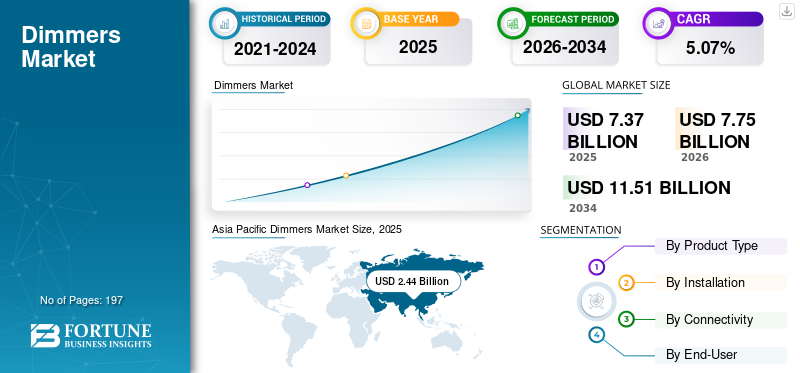
The global dimmers market size was valued at USD 7.37 billion in 2025. The market is projected to grow from USD 7.75 billion in 2026 to USD 11.51 billion by 2034, exhibiting a CAGR of 5.07% during the forecast period. Asia Pacific dominated the dimmers market with a market share of 33.11% in 2025.
A dimmer is an electronic control device that regulates the brightness of lighting by adjusting the voltage or current supplied to a light source. The dimmers market has become an important component of the modern lighting control ecosystem, driven by the rising demand for energy-efficient lighting solutions, enhanced user comfort, and smart home integration. Dimmers enable precise control over lighting intensity, helping reduce energy consumption, extend the lifespan of lighting systems, and improve ambiance across residential, commercial, and industrial environments.
The demand for dimmers is expanding steadily due to several structural trends in the global lighting industry. One of the key drivers is the widespread transition from conventional lighting technologies to LED lighting, which requires compatible dimming solutions for optimal performance. In addition, the increasing adoption of smart homes and building automation systems has accelerated the uptake of advanced dimmers, particularly those integrated with wireless connectivity technologies such as Wi-Fi, Zigbee, and Bluetooth. Rising awareness of energy conservation, along with supportive government regulations and building efficiency standards, is further contributing to market growth.
The global dimmers market is moderately fragmented, with a mix of established electrical equipment manufacturers and specialized lighting control providers. Key players such as Legrand, Lutron Electronics, Schneider Electric, Eaton Corporation, Siemens AG, Honeywell International Inc., and Signify hold significant market share, particularly in developed regions. These companies are actively focusing on product innovation, integrating smart technologies, and expanding into emerging markets to strengthen their competitive position. Strategic initiatives such as partnerships with smart home platform providers, investments in IoT-enabled solutions, and expansion of product portfolios are shaping the competitive landscape.
Download Free sample to learn more about this report.
Dimmers Market Key Takeaways
 Global Market Size & Forecast
- 2025 Market Size: USD 7.37 billion
- 2026 Market Size: USD 7.75 billion
- 2034 Forecast Market Size: USD 11.51 billion
- CAGR: 5.07% from 2026–2034
 Market Share
- Asia Pacific dominated the dimmers market with a 33.11% share in 2025.
- Smart dimmers held a 29.78% market share in 2025.
- The retrofit/replacement segment accounted for 59.63% of the market in 2025.
 Key Regional Highlights
Asia Pacific
Asia Pacific led the global market with revenue of USD 2.44 billion in 2025 and is expected to reach USD 2.58 billion in 2026.
North America
North America generated approximately USD 2.08 billion in revenue in 2025, driven by smart home adoption.
Europe
Europe accounted for USD 1.77 billion in 2025 and is projected to reach USD 1.85 billion in 2026.
U.S.
The market was valued at approximately USD 1.82 billion in 2025.
Japan
Growth is supported by increasing adoption of energy-efficient lighting and smart building technologies.
Read More

Dimmers Market Trends
Increasing Adoption of Smart Lighting Systems is Leading to Newer Market Trends
The growing adoption of smart lighting systems is driving significant growth in the dimmers market, as modern lighting infrastructure increasingly requires advanced control solutions for efficiency, convenience, and automation. Dimmers, particularly smart and connected variants, enable users to control lighting intensity remotely, integrate with home automation systems, and optimize energy consumption. With the rapid expansion of smart homes, commercial smart buildings, and IoT-enabled environments, the demand for intelligent dimming solutions has increased substantially. These systems enhance user comfort, improve energy efficiency, and support advanced functionalities such as scheduling, scene setting, and voice control integration.
Moreover, the growing penetration of wireless communication technologies such as Wi-Fi, Zigbee, and Bluetooth has further accelerated the adoption of smart dimmers across residential and commercial applications. Governments and regulatory bodies are also promoting energy-efficient building standards, encouraging the use of lighting control systems, including dimmers, to reduce electricity consumption. As a result, both retrofit projects and new installations are increasingly incorporating dimming solutions into broader smart lighting ecosystems.
For instance, in April 2026, Lutron Electronics introduced an advanced range of smart dimmers integrated with multiple smart home platforms, enabling seamless control through voice assistants and mobile applications. These solutions are designed to enhance user convenience while reducing energy consumption, reflecting the ongoing shift toward intelligent and connected lighting systems in the global dimmers market.
MARKET DYNAMICS
MARKET DRIVERS
Download Free sample to learn more about this report.
Increasing Adoption of Smart Homes and Building Automation is Driving Market Growth
The growing adoption of smart homes and building automation systems, along with the global transition toward energy-efficient lighting technologies, is significantly driving the dimmers market growth. Consumers and businesses are increasingly seeking advanced lighting control solutions that offer enhanced convenience, automation, and energy savings. Smart dimmers offer features such as remote control, scheduling, scene settings, and integration with voice assistants, making them a key component of modern connected environments. At the same time, the widespread shift toward LED lighting has increased the need for compatible dimming solutions that can optimize energy consumption, extend lighting lifespan, and improve overall efficiency.
The proliferation of IoT-enabled devices and rising consumer preference for intelligent and connected living spaces are further accelerating the adoption of smart dimmers across residential and commercial sectors. In addition, regulatory focus on sustainability and energy efficiency is encouraging the deployment of lighting control systems, including dimmers, in both retrofit and new installation projects.
For instance, in January 2026, Legrand expanded its connected lighting solutions portfolio by introducing a new range of smart dimmers compatible with major smart home ecosystems, including Apple HomeKit, Google Home, and Amazon Alexa. The developments highlight the growing integration of smart and energy-efficient lighting solutions, reinforcing the critical role of dimmers in the evolving lighting ecosystem.
MARKET RESTRAINTS
Compatibility Issues with LED and Smart Lighting Systems Are Restraining Market Growth
Compatibility challenges between dimmers and modern lighting technologies, particularly LED systems, are a key restraint for the dimmers market. Unlike traditional incandescent lighting, LED lights require specific dimming technologies and drivers to function effectively. The lack of universal standards often leads to issues such as flickering, limited dimming range, or malfunctioning, which can negatively impact user experience. This complexity can create confusion among consumers and installers, slowing down adoption, especially in retrofit applications where legacy wiring and mixed lighting systems are common.
Additionally, integrating dimmers with various smart home ecosystems and communication protocols can present interoperability challenges. Differences in standards across manufacturers and platforms may limit seamless integration, thereby restricting widespread deployment in certain regions.
For instance, in 2025, several lighting manufacturers highlighted ongoing challenges related to LED-dimmer compatibility, leading to the development of compatibility lists and testing programs to ensure proper performance. Despite these efforts, the lack of full standardization continues to pose a barrier to market growth.
MARKET OPPORTUNITIES
Expansion of Smart Cities and Connected Infrastructure is Creating Market Opportunities
The rapid development of smart cities and connected infrastructure presents significant opportunities for the dimmers market. Governments and urban planners are increasingly investing in intelligent lighting systems to enhance energy efficiency, reduce operational costs, and improve urban living conditions. Dimmers play a critical role in these systems by enabling adaptive lighting based on occupancy, daylight availability, and real-time usage patterns.
In addition, the integration of lighting controls with IoT platforms, sensors, and data analytics is creating new opportunities for advanced dimming solutions in public infrastructure, commercial buildings, and industrial facilities. These systems not only improve energy efficiency but also contribute to sustainability goals and carbon-reduction targets.
For instance, in 2026, several smart city projects across Europe and Asia incorporated intelligent lighting control systems with dimming capabilities to optimize street lighting and public infrastructure. This trend highlights the growing role of dimmers in next-generation urban development.
MARKET CHALLENGES
Rising Complex Installation and Integration Challenges the Market Expansion
The installation and integration of advanced dimmers, particularly smart and connected variants, can be complex and may require professional expertise. Many modern dimmers require neutral wiring, proper load compatibility, and integration with home automation systems, which can be difficult in older buildings with outdated electrical infrastructure. This increases installation time and cost, potentially discouraging adoption among end users.
Furthermore, the need to synchronize across multiple devices, platforms, and applications adds another layer of complexity. In commercial settings, integrating dimmers into building management systems (BMS) and ensuring seamless communication across devices can be technically challenging, requiring specialized knowledge and system configuration.
Segmentation Analysis
By Product Type
Smart Dimmers Segment is Leading the Market with Rapid Adoption of Connected Lighting Solutions
Based on product type, the market is segmented into rotary dimmers, slide dimmers, touch/push button dimmers, smart dimmers, remote/integrated dimmers, and others.
Smart dimmers dominated the market with a 29.78% share in 2025 and are the fastest-growing segment, driven by the increasing adoption of smart homes, IoT-enabled devices, and connected lighting ecosystems. These dimmers offer advanced features such as remote access, automation, and voice control integration, making them highly preferred in modern residential and commercial settings.
The remote and integrated dimmers are projected to grow at a CAGR of 5.33% during the forecast period. remote and integrated dimmers are being driven by the growing demand for smart buildings and advanced lighting infrastructure, where seamless integration with automation systems is essential. These solutions offer enhanced flexibility, scalability, and energy efficiency, making them suitable for modern lighting environments. Additionally, the increasing deployment of IoT-enabled systems and centralized control platforms is further supporting their adoption across various end-use sectors.
By Installation
Retrofit/Replacement Segment Dominates Due to Large Installed Base of Lighting Systems and Traditional Switches
Based on installation, the market is segmented into retrofit/replacement, new installation, and others.
The retrofit/replacement segment held 59.63% share in 2025, supported by the vast installed base of traditional switches and lighting systems that require upgrading. The transition to LED lighting and smart technologies is significantly driving retrofit demand, as consumers and businesses seek cost-effective ways to enhance energy efficiency and functionality.
The new installation segment is witnessing steady growth, driven by increasing construction activities and the development of smart buildings. However, its share remains comparatively lower due to limited adoption of dimmers as a standard feature in new construction, especially in price-sensitive markets. Over time, the segment is expected to grow as awareness and regulatory support for energy-efficient lighting increase.
By Connectivity
Conventional Segment Dominates the Market Owing to Its Widespread Usage and Cost-Effectiveness Factor
By connectivity, the market is bifurcated into conventional and wireless smart.
The conventional segment held the largest dimmers market share of 62.05% in 2025, owing to its widespread use and lower cost. However, its growth is gradually declining as the market shifts toward connected solutions.
The wireless smart segment is experiencing the fastest growth at a CAGR of 5.50% during the forecast period. The growth is driven by increasing demand for smart home automation and IoT-enabled lighting systems. Technologies such as Wi-Fi, Zigbee, Z-Wave, and Bluetooth are enabling seamless integration of dimmers with broader smart ecosystems.
By End-User
To know how our report can help streamline your business, Speak to Analyst
Residential Segment Dominates the Market Due to Rising Demand for Smart and Energy-Efficient Lighting
Based on end-user, the market is segmented into residential, commercial, industrial, and others.
The residential segment dominated the market, accounting for approximately 64.20% in 2025, driven by the increasing adoption of smart homes, rising consumer awareness of energy efficiency, and the growing need for enhanced lighting comfort and ambiance. Moreover, the rising penetration of LED lighting in households is further supporting the demand for compatible dimming solutions that can optimize performance and extend product lifespan. The growing preference for customizable lighting environments, supported by features such as scene setting and voice control, is also encouraging the adoption of dimmers in residential applications. Moreover, increasing retrofit and renovation activities in developed regions are contributing to sustained demand for advanced dimming solutions in existing homes.
The commercial segment also holds a significant share, supported by demand from offices, retail spaces, hospitality, and healthcare facilities where dimmers are used to optimize lighting conditions and reduce energy consumption.
The industrial segment accounts for a smaller share due to limited application scope, while the other segments contribute minimally to the overall market.
Dimmers Market Regional Outlook
By region, the market is categorized into Europe, North America, Asia Pacific, Latin America, and the Middle East & Africa.
Asia Pacific
Asia Pacific Dimmers Market Size, 2025 (USD Billion)
To get more information on the regional analysis of this market, Download Free sample
The Asia Pacific region dominated the global market, accounting for USD 2.44 billion in 2025 and expected to reach USD 2.58 billion in 2026. The Asia Pacific market is growing due to rapid urbanization, increased construction activity, rising adoption of smart home technologies, and growing demand for energy-efficient lighting solutions across countries such as China, India, Japan, and Southeast Asia. Government initiatives promoting energy conservation and smart infrastructure development are further supporting market growth.
China Dimmers Market
In 2025, the Chinese market was valued at USD 0.81 billion. This regional market is growing due to strong residential and commercial construction activities, increasing adoption of smart home systems, and the widespread transition to LED lighting. The presence of large-scale manufacturing capabilities and growing investments in smart infrastructure are further driving market expansion.
India Dimmers Market
The Indian market in 2025 accounted for USD 0.42 billion, accounting for a significant share of the Asia Pacific market. The market is growing due to rapid urban development, increasing adoption of smart home devices, rising awareness of energy efficiency, and government initiatives promoting sustainable infrastructure and electrification.
North America
North America was valued at approximately USD 2.08 billion in 2025 and expected to hit USD 2.19 billion by 2026. The market in North America is growing due to high adoption of smart home technologies, strong regulatory focus on energy efficiency, and advanced lighting infrastructure. The region is witnessing increasing demand for wireless smart dimmers and retrofit solutions.
U.S. Dimmers Market
The U.S. market was analytically approximated at around USD 1.82 billion in 2025. The U.S. market is growing due to widespread adoption of home automation systems, strong demand for energy-efficient lighting solutions, and increasing retrofit activities across residential and commercial sectors.
Europe
The Europe region accounted for USD 1.77 billion in 2025 and is projected to hit USD 1.85 billion in 2026. The European market is growing due to strong regulatory frameworks supporting energy efficiency, the increasing adoption of smart lighting systems, and rising investments in sustainable building infrastructure. The European Union’s focus on reducing energy consumption and carbon emissions is encouraging the use of lighting control solutions, including dimmers.
U.K. Dimmers Market
The U.K. market accounted for USD 0.32 billion in 2025. The market is growing due to increasing smart home adoption, rising retrofit activities, and strong demand for energy-efficient lighting solutions.
Germany Dimmers Market
The German market accounted for USD 0.39 billion in 2025. The market is driven by strong industrial and commercial infrastructure, high adoption of smart building technologies, and stringent energy-efficiency regulations.
Latin America & Middle East Africa
Latin America and the Middle East & Africa region was accounted for approximately USD 0.61 billion and USD 0.47 billion in 2025, respectively.
The Latin America market is growing due to increasing urbanization, rising construction activities, and growing awareness of energy-efficient lighting solutions. Countries such as Brazil and Mexico are witnessing increased adoption of modern lighting systems and smart home technologies.
The Middle East & Africa market is growing due to expanding infrastructure development, rising investments in smart cities, and increasing adoption of energy-efficient lighting solutions across commercial and residential sectors.
GCC Dimmers Market
The GCC market in 2025 was valued at USD 0.18 billion. The market is growing due to increasing investments in smart city projects, rising construction of commercial infrastructure, and growing adoption of advanced lighting control systems across countries such as the UAE, Saudi Arabia, and Qatar.
COMPETITIVE LANDSCAPE
KEY INDUSTRY PLAYERS
Rising Focus on Smart Dimming Technologies and Expanding Connected Lighting Solutions Leads to Better Market Positioning
Vendors are undertaking various developments to support market growth by focusing on product innovation, smart technology integration, and expansion of connected lighting portfolios. Major players such as Lutron Electronics, Legrand, Schneider Electric, Signify, Eaton Corporation, and Siemens are investing in advanced dimming technologies, including wireless smart dimmers, IoT-enabled lighting controls, and integrated building automation solutions. These companies are continuously enhancing product capabilities by incorporating features such as voice control compatibility, mobile application integration, energy monitoring, and interoperability with smart home ecosystems to improve user experience and energy efficiency.
In February 2026, Schneider Electric announced the expansion of its smart home and building automation portfolio by introducing advanced dimming solutions integrated with IoT-enabled energy management systems. These solutions are designed to enhance lighting control, reduce energy consumption, and support sustainable infrastructure development, highlighting the increasing focus on intelligent lighting technologies in the industry.
LIST OF KEY DIMMERS COMPANIES PROFILED
- Lutron Electronics Co., Inc. (U.S.)
- Legrand S.A. (France)
- Schneider Electric SE (France)
- Signify N.V. (Netherlands)
- Eaton Corporation plc (Ireland)
- Siemens AG (Germany)
- Honeywell International Inc. (U.S.)
- Hubbell Incorporated (U.S.)
- ABB Ltd. (Switzerland)
- Leviton Manufacturing Co., Inc. (U.S.)
KEY INDUSTRY DEVELOPMENTS
- March 2026: Signify (Philips Lighting) launched an upgraded version of its Interact connected lighting platform, incorporating advanced dimming capabilities with IoT-enabled sensors to optimize lighting usage and improve energy efficiency in commercial buildings.
- January 2026: Legrand introduced a new range of smart dimmers compatible with major smart home ecosystems, including Apple HomeKit, Google Home, and Amazon Alexa, enabling enhanced automation and remote lighting control.
- December 2025: Lutron Electronics expanded its Caséta smart lighting portfolio by introducing next-generation dimmers with improved wireless connectivity and enhanced integration with voice assistants and home automation systems.
- October 2025: Eaton Corporation launched advanced connected lighting control solutions, including intelligent dimmers for commercial and industrial applications, with a focus on energy efficiency and building automation integration.
- August 2025: Leviton Manufacturing introduced new Decora smart dimmers with enhanced Wi-Fi capabilities and simplified installation features, targeting residential retrofit applications and supporting the growing demand for smart home solutions.
REPORT COVERAGE
The global dimmers market analysis provides an in-depth study of the market size & forecast by all the market segments included in the report. It contains details on the market dynamics and market trends expected to drive the market in the forecast period. It offers information on technological advancements, new product launches, key industry developments, and partnerships, mergers & acquisitions. The market research report also includes a detailed competitive landscape, providing market share and profiles of key players.
Request for Customization to gain extensive market insights.
Report Scope & Segmentation
| ATTRIBUTE | DETAILS |
| Study Period | 2021-2034 |
| Base Year | 2025 |
| Estimated Year | 2026 |
| Forecast Period | 2026-2034 |
| Historical Period | 2021-2024 |
| Growth Rate | CAGR of 5.07% from 2026-2034 |
| Unit | Value (USD Billion) |
| Segmentation | By Product Type, By Installation, By Connectivity, By End-User, and Region |
| By Product Type |
|
| By Installation |
|
| By Connectivity |
|
| By End-User |
|
| By Region |
|
Frequently Asked Questions
Fortune Business Insights says that the global market value stood at USD 7.37 billion in 2025 and is projected to reach USD 11.51 billion by 2034.
The market is expected to exhibit a CAGR of 5.07% during the forecast period.
The residential segment led the market in terms of end-user.
Increasing adoption of smart homes and building automation is driving market growth.
Lutron Electronics, Legrand S.A., ABB, and Schneider Electric are among the prominent players in the market.
Asia Pacific dominated the market, with the highest share in 2025.



- 2021-2034
- 2025
- 2021-2024
- 197
Get 30-60 hrs Free Customization
Expand Regional and Country Coverage, Segments Analysis, Company Profiles, Competitive Benchmarking, and End-user Insights.



















Related Reports
-
US +1 833 909 2966 ( Toll Free )
-
Get In Touch With Us